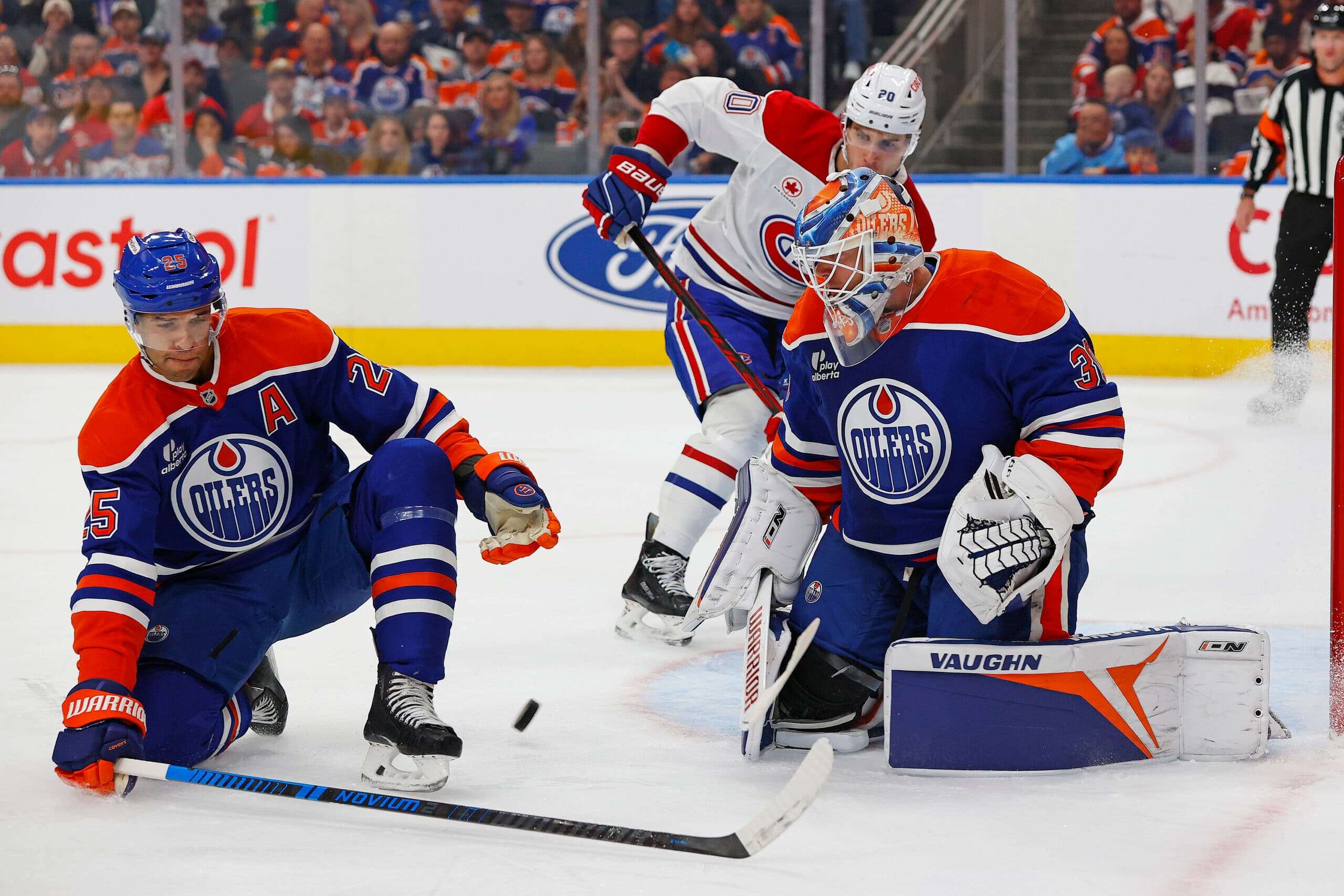
To sit here and say the penalty kill has been a major issue for the
Edmonton Oilers would be a bit disingenuous.
They’ve operated at an 81.5 percent clip following
Monday’s loss to the Buffalo Sabres, the 13th-ranked penalty kill. At home, they’ve one of the best on the kill, at a 90.5 percent clip that’s fourth overall, but on the road, it’s one of the worst at 75.8 percent, ranking 25th.
One change this season has been in the defenders. Mattias Ekholm leads the way in PK time on ice at nearly 36 minutes, while
Evan Bouchard is up to 35 minutes on the penalty kill, which, on a per-game rate, is the highest of his career next to the 2021-22 season. Brett Kulak and Darnell Nurse, meanwhile, have played 29 minutes and 27 minutes, respectively.
The results may not be what you would assume, as the Oilers’ penalty kill has been very effective with Bouchard on the ice, allowing just 6.9 goals against per hour, below the league average rate this season of 7.6. All but five of his minutes have been paired with Ekholm, and that pair is allowing 7.8 goals against per hour — not a poor number by any stretch — while allowing below-average numbers in terms of quality allowed.
What we see from other defencemen on the penalty kill is concerning trends. While the Oilers have faired well in terms of goals against when other defencemen are on the ice, one stands out above the rest:
Darnell Nurse.
While above the ledger in terms of goals against per hour, the Oilers are getting absolutely caved when he’s on the ice killing penalties, allowing expected goals against and scoring chances against at nearly two times the league average rate. Bailed out by great goaltending, he and his partner, Jake Walman, have clearly struggled this season, and Noah Ostlund’s game-opening power play goal was a great highlight of it.
Ostlund sneaks in behind Nurse, receives a pass from Isak Rosen, and has all the time in the world to beat Stuart Skinner in tight. Nurse was wholly unaware of Ostlund’s positioning, as Walman A) didn’t communicate about a man getting behind Nurse and B) actually ended up giving Ostlund more room in front of the net.
These issues for Nurse on the penalty kill aren’t recent by any means. As Jonathan Willis pointed out in his above tweet that sparked this deeper dive into the penalty kill, the results with Nurse on the ice have been among the worst for any defenceman in the last four years.
In fact, since the Oilers hired Knoblauch, the team is giving up twice as many goals against with Nurse on the ice as with him off. Yet, for some inexplicable reason, no Oilers defenceman has spent more time killing penalties than Nurse over that time.
That’s starting to change this season, though. Bouchard has emerged as a viable penalty killer, while Nurse’s time-on-ice short a man has dipped roughly 40 seconds per game as a whole. He began the season as a primary penalty killer, as through Edmonton’s first six games of the year, he averaged 1:34 in ice-time. From Game 7 (at Ottawa) through Game 15 (at Dallas), Nurse averaged 57 seconds per game on the penalty kill.
Edmonton’s brutal 9-1 loss to the Colorado Avalanche saw Nurse play just under four minutes on the kill, but in the games since, he’s averaging 1:45 per game.
All of this to say one thing: if the Oilers want to see their penalty kill improve, taking Nurse off the unit entirely is the route to go. And for Nurse himself, it might help him simplify his game.
Zach Laing is Oilersnation’s associate editor, senior columnist, and The Nation Network’s news director. He also makes up one-half of the Daily Faceoff DFS Hockey Report. He can be followed on X at @zjlaing, or reached by email at zach.laing@bettercollective.com.
ARTICLE PRESENTED BY bet365