
OilersNation has no direct affiliation to the Edmonton Oilers, Oilers Entertainment Group, NHL, or NHLPA
The day the Oilers owner was shot: Inside the forgotten 1982 hostage crisis of Peter Pocklington

Jul 29, 2026, 09:00 EDTUpdated: Aug 12, 2026, 14:55 EDT


Love him or hate him, and almost everyone has hated him for the last 30-plus years, there are few Edmonton Oilers who lived a more interesting life than the man who owned them: Peter Pocklington.
He was a flamboyant and frustrating personality, whose ego helped create his celebrity in the Edmonton scene from the late 1970s to the late 1990s.
Through the arrival of Wayne Gretzky, the Oilers’ introduction into the National Hockey League, and owning baseball’s Trappers and soccer’s Drillers, he helped make Edmonton a sporting destination.
His various business ventures would later ensnare him as one of the biggest villains in Edmonton by the late 1980s with the Gainers strike, the eventual sale of Gretzky, and the will-they, won’t-they threats of moving the Oilers to Hamilton, Minnesota, or Houston.
But his charisma was undeniable. He tried – and failed – to run for the leadership of the Progressive Conservative Party in 1983, raced jet boats on the world stage, and was confronted by Mexican bandits.
He also experienced one other bizarre, scary, out-of-a-movie ordeal that over the years has become largely forgotten, despite having little parallel in sports.
Before committing the “Hockey Crime of the Century,” Pocklington was held hostage in his Edmonton home for $2 million by a desperate gunman. He was lucky to survive.
And no, the perpetrator wasn’t a disgruntled Oilers fan.
“I really thought I was God’s gift to mankind,” said Pocklington in his book I’d Trade Him Again: On Gretzky, Politics, and the Pursuit of the Perfect Deal. “Until the day I met Mirko Petrovic, the Yugoslav immigrant who was about to prove I wasn’t so invincible after all….
“I thought I was bulletproof — until I was shot.”
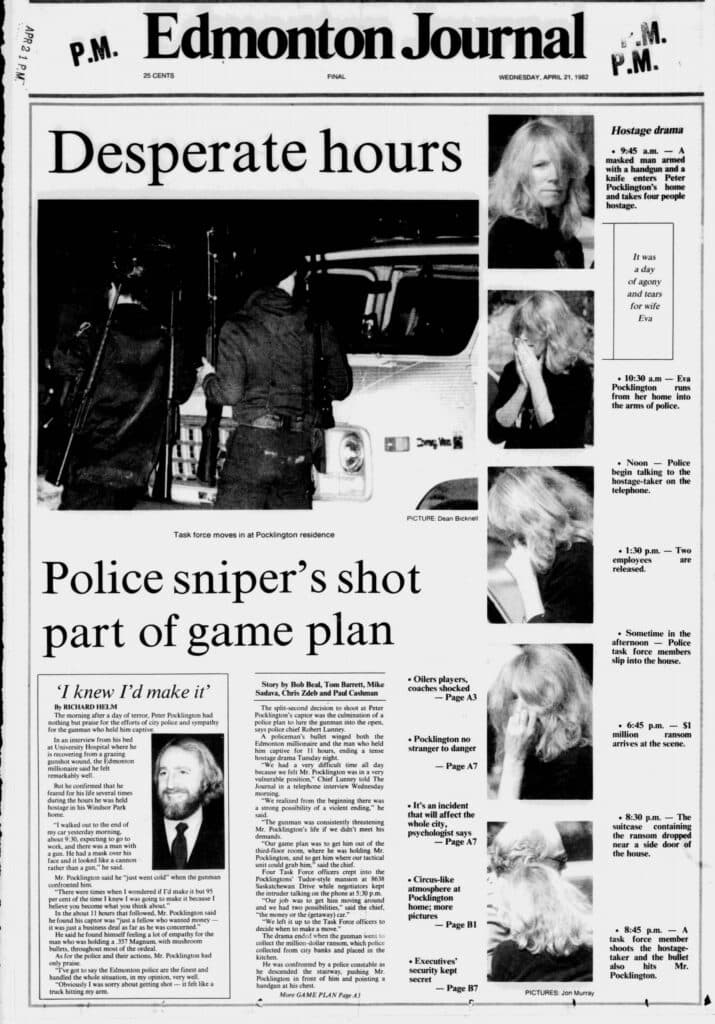
The front page of the Edmonton Journal on April 21, 1982.
Why was Peter Pocklington held hostage in 1982?
The year was 1982.
On the ice, the Oilers were victims of one of the biggest upsets in NHL history at the hands of the Los Angeles Kings, who were 48 points worse in the regular season, and even came back from a five-goal deficit in Game 3.
The Miracle on Manchester, as it’s known, prompted Edmonton Journal columnist Terry Jones to go on a front-page tirade, infamously calling them “weak-kneed wimps” and “choke artists.”
Long story short, the season was over. Gretzky, along with Kevin Lowe, were unexpected additions to Team Canada’s squad at the World Championships in Finland, and a long offseason was just underway.
And on the mild spring morning of April 20, Peter Pocklington awoke at his home on 8638 Saskatchewan Drive like it was any other day. His five-year-old son had been taken to school, and he was about to head to his office. He finished his breakfast, said goodbye to his wife Eva, and walked out to the attached garage.
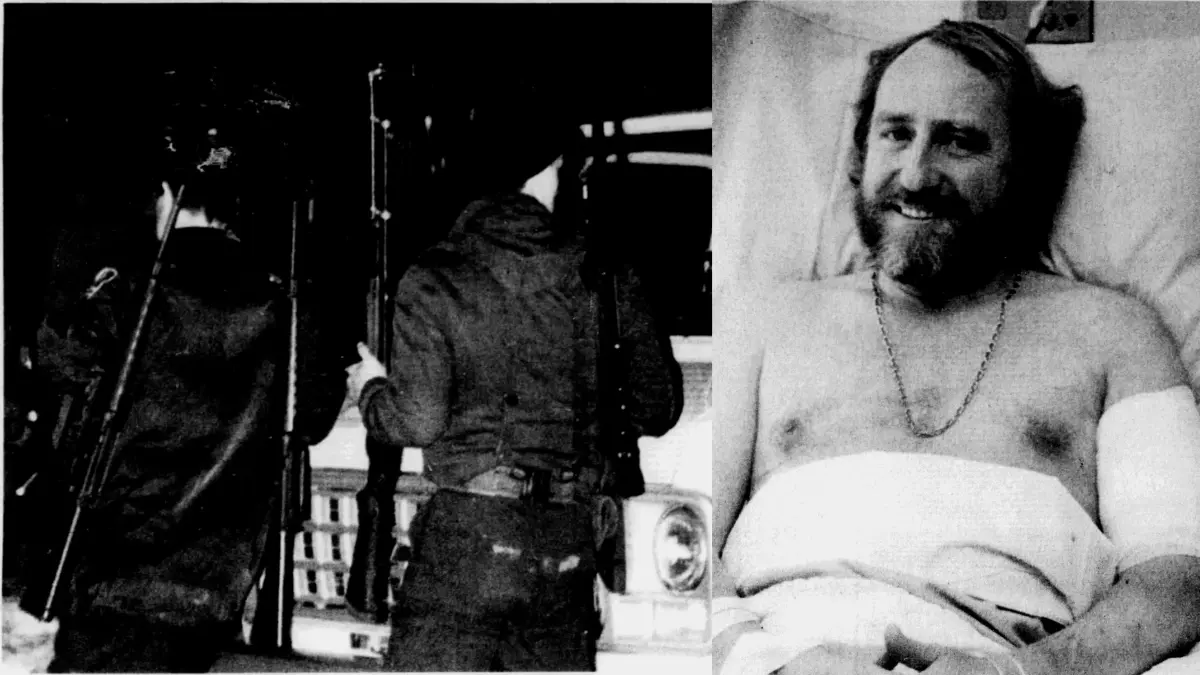
That’s where a man in a black balaclava waited in the shadows and brandished a chrome-plated .357 Magnum at Pocklington.
Mirko Petrovic was a Yugoslavian immigrant originally in the cement business in Fort McMurray, but had fallen on hard times. He was the man behind the mask, desperate, and looking for $5 million.
They walked inside the house together, and Eva screamed when she saw her husband held at gunpoint by a masked man. Peter told him to uncock the gun if they wanted to talk money. Petrovic evaluated his options and complied.
The other people in the house were a houseguest, Joe, who became their son’s babysitter, and their housekeeper, Carmen. They both were brought into the room and watched.
Ever smooth under pressure, Pocklington attested that he didn’t have $5 million to give him, which triggered a tense negotiation, the biggest one in his life of wheeling-and-dealing. They bartered as the businessman countered with $1 million. Eventually, they’d settle on $2 million so no one would get hurt.
The gunman planned to kidnap Eva until Peter scrounged up the money. Petrovic told them how it was going to work, while all three of them were tied up.
First, he asked Eva to move the getaway vehicle, not Pocklington’s Rolls-Royce or Porsche, but the more clandestine Ford Bronco (a dozen years before OJ’s famous chase). She was going to be stuffed in the back under Persian rugs.
As she was followed to the garage by the gunman, Eva saw police. She made a break for it and ran, leading to her escape. The gunman lost his hostage and was pissed off.
“Well,” he told Peter as he returned inside, “I guess I’m going to have to kill you and everybody else here.”
—
The police being there was not a coincidence.
Eva was on the phone with her friend Martha when she screamed upon seeing the gunman. The abrupt end to the phone call prompted Martha to call Pocklington’s secretary Irene Gunter, saying something was wrong.
So before Eva made her way to the garage, Gunter called the house to check in. Eva answered and blurted, “Claire, I just can’t make lunch. Sorry, goodbye.”
Gunter listened to her hunch and called the police, who were in the driveway when Eva began moving the vehicles around.
With her now safely in the hands of police, the gunman’s plan was toast and Pocklington had to think fast to save his life. He concocted a new getaway scheme, selling the gunman on an escape with his private jet to an abandoned hangar in the United States.
“We’ll make sure the police deliver the $2 million, then you and I go to the plane and we’ll fly into the U.S.,” he said in his book. “The Americans have military airports all over the place; a lot of them are abandoned. We’ll fly low and get into one, drop you off and you’re gone.”
The plan, however Jerry Bruckheimer inspired at this point, satisfied Petrovic.
By now it was roughly 11 a.m., and the gunman decided to take Pocklington upstairs to the third floor with him, while the other two remained downstairs (they would be released a couple hours later).
But the police were aware of the extent of the situation thanks to Eva’s escape, and began calling the house to negotiate the terms. According to the Edmonton Journal, 15 phone calls were made by police to the house over those several hours. Some were quick, others long and detailed as they worked on logistics.
Getting $2 million in cash in that amount of time in Edmonton couldn’t be done at the snap of a finger. Then arranging the pilots and flight was a whole other matter.
Police insisted Pocklington should bond with his captor to help save his skin, as the 1 p.m. deadline approached.
But this would be the first of many deadlines missed. Frustrations grew, not just for the soon-to-be rich criminal, but the man whose life hung in the balance.
“I don’t mind admitting I was getting a little worried,” Pocklington said. “I was sure this guy was manic depressive, and my only hope was to keep him calm enough and stable enough not to panic and start shooting.”
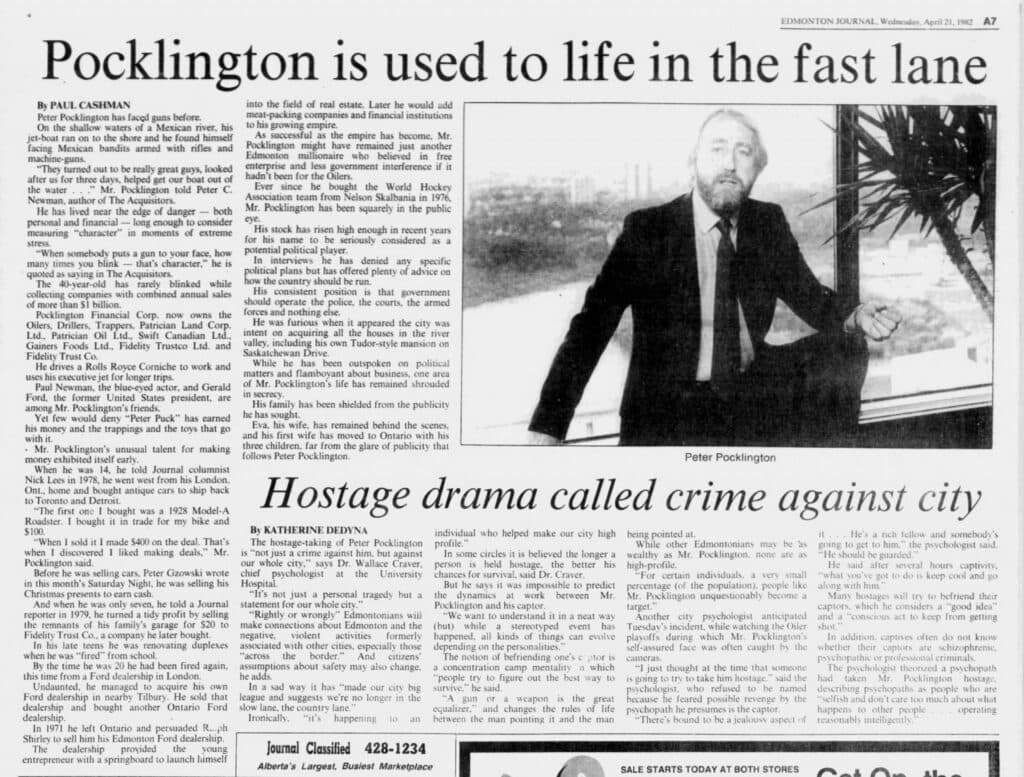
April 22, 1982 edition of The Edmonton Journal.
Meanwhile, outside the house it was a circus.
Edmonton was experiencing the type of crime that would be the lead story of ABC’s Nightline with Ted Koppel that evening. Such a prominent person being held hostage was movie stuff, and in the world of sports, a rarity to say the least.
Police contained the surrounding area, closing the Groat Road Bridge, and denying any footfall access to Hawrelak Park.
But that didn’t stop a reported crowd of more than 1,500 people gathering outside, including one shrewd businessman.
Joe Ewing ran a catering business and decided not to let a good tragedy go to waste, preparing sandwiches and beverages for the crowd. It wasn’t Oilers gate revenue or anything, but it was a quick buck.
“I’m doing better in half a day than I usually do in two days,” he told The Journal. Reportedly, he made about $700 in a few hours.
As the situation went along, it was broadcast live into people’s homes across Canada.
The police sneak into Pocklington’s house
The longer they waited, Pocklington admits to getting Stockholm syndrome, a coping condition where captives develop empathy or even loyalty to their captors, so named after an attempted bank robbery in Stockholm in 1973.
“I grew concerned for his safety,” recalled Pocklington. “‘For God’s sake, get down, or they’ll shoot you.’
“As the hours passed, I asked if Joe’s mother (Pocklington’s nickname for his kidnapper) would approve of what he was doing, and I gave it to him for resorting to extortion to get his money. ‘You could have come to me and we could have done a business deal and we probably would have made more.’”
As new deadlines passed, the afternoon became evening. Bathroom logistics were made more embarrassing by Petrovic’s “hands-on assistance” in helping Pocklington pee into a bottle. The money was still not there, nor the private jet arrangements.
That was until 8:30 p.m. when the call arrived. The money was downstairs; the ride to the airport was outside.
What ensued next nearly killed the Oilers owner.
Pocklington was untied from the chair, but his hands were still bound by wire. The two of them made their way, slowly, down the stairs with the Magnum nuzzled in Pocklington’s back.
Meanwhile, the suitcase sat in the kitchen with $2 million in $20 bills.
But unbeknownst to them, and to the police units negotiating with the gunman over the phone all day, a four-member team of Edmonton’s elite police task force had already broken into the house and were anticipating the two of them.
This communication breakdown later became a major snafu within policing ranks.
A tactical unit member burst through the door and yelled, “Halt, police!” firing a .22-calibre bullet from an M16. The bullet went through Pocklington and then hit the gunman, he said in his book, correcting claims made in the press that it was the other way around.
“It went through my arm, missing my bone by a hair,” he explained afterwards. “If it had hit the bone, my arm would have been gone because the bullet would have smashed it.
“Instead, the bullet started to spin, and I still have a scar in my back from where it came out.”
The bullet then hit Petrovic in the arm, the heavy impact knocking them both over. Pocklington claims that Joe’s gun then also went off, but since the impact was so jarring, it didn’t get to its intended destination.
If Pocklington hadn’t been shot, then he surely would’ve been dead. Knocked unconscious, police had their man, and the gunman suffered worse injuries than Pocklington, even requiring a skin graft on his injured arm.
The University of Alberta Hospital was just a short drive away from the Pocklington residence, and he was taken by ambulance. But he was fuming. The police bungled the situation in his eyes, and he became unglued on whoever would listen.
He would spend three days in hospital recuperating.
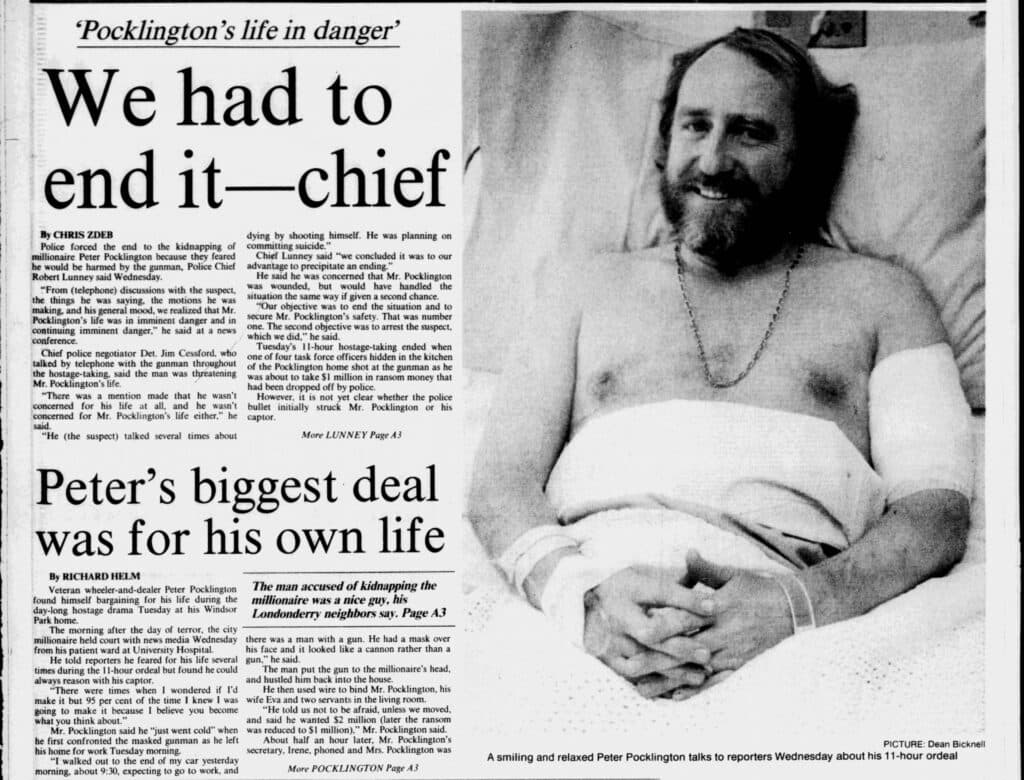
Front page April 22, 1982.
Psychologist: ‘Not just a crime against him, but the entire city’
The situation was a shock to many, and Edmontonians wanted Pocklington to know they were glad he was OK.
As the chief psychologist at the University Hospital put it afterwards in The Journal, “This is not just a crime against him, but the entire city.”
“The night I was released from hospital, with my arm still in a sling, Eva and I went to Renfrew Park to watch the Edmonton Trappers, the minor league baseball team I owned,” said Pocklington. “There were 5,000 or so people at the game and, God, they gave me a standing ovation. I couldn’t believe it.”
Gretzky heard about the situation overseas and couldn’t believe it.
“Oh, it was shocking to us,” Gretzky recalled. “But to hear the stories of how it unfolded, only Peter Pocklington could have done that.”
Even the man who had carved the Oilers something fierce just a week prior in Terry Jones sounded shaken in his column the next day.
“I believe Edmonton sports fans would want Peter Pocklington to understand, today, after the trauma he lived through — and the anxiety which will undoubtedly haunt him and his family for the rest of their lives — that to this city he’s viewed as being more than just another sports franchise owner playing with his ‘toys,’” wrote Jones in the Journal on April 21.
“Peter Pocklington, we don’t tell him often enough, has meant more to this city, because of the professional sports franchises he has brought us which are major factors in helping this city through the grand transition, as I’ve so often put it, from being a pimple on the prairie to major league.”
Oh, how that sentiment would become more complicated over the years.
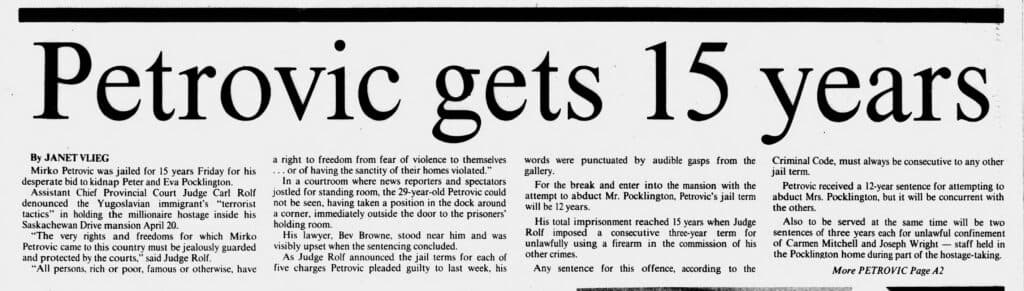
July 28, 1982 of The Edmonton Journal.
In the days that followed, people wanted to know who this brazen criminal was.
“He was an exceptionally nice person,” described his landlord to the press. “He was an exceptionally good tenant.” Others who knew Petrovic said similar things. They would’ve never expected it.
The case moved quickly as Petrovic pleaded guilty to charges. By July, he was slapped with a 15-year prison sentence for using “terrorist tactics,” as Judge Carl Rolf described it to the courtroom. Attempts to appeal were rejected.
But that’s not where the story ended, according to Pocklington.
The prison warden in Ponoka called him years later and said Petrovic was a model prisoner and they wanted to release him to go back to Yugoslavia.
As long as he was going back home, Pocklington didn’t mind. However, a few days before he was set to leave, he allegedly called Pocklington.
“Mr. Peter (Petrovic’s nickname for Pocklington), I need $10,000 so I can buy a gravel truck and I can become gainfully employed again,” Pocklington wrote in his book. He says he wired him the money.
A year and a half later, he heard from his former gunman for the last time.
Business was going well, he said. He had two trucks now.
Michael Menzies is an Oilersnation columnist and co-host of PreGaming and Oilersnation After Dark. He’s also been the play-by-play voice of the Bonnyville Pontiacs in the AJHL since 2019. With seven years of news experience as the Editor-at-Large of Lakeland Connect in Bonnyville, Menzies collects vinyl, books, and stomach issues. Follow him on X at Menzies_4.
PRESENTED BY CAPITAL GMC BUICK

Hockey fans recognize elite performance instantly, and that’s exactly how Capital GMC Buick operates. With one of the city’s deepest selections of top-quality GMC and Buick vehicles and a customer experience built to win year after year, this dealership consistently leads the pack. Five current NHL players proudly drive vehicles from Capital GMC Buick, and for good reason. The store has been rated the #1 GM dealership in Canada by DealerRater for three consecutive years, is the only GM dealer in Edmonton endorsed by J.D. Power as a Dealer of Excellence, and has raised over $30,000 for the Stollery Children’s Hospital.


Breaking News
- Oilersnation Radio: The Oilers are back in town and the Elks can clinch a playoff berth
- Former Oilers goaltender Connor Ingram announces retirement
- ‘Ready for this camp’: Isaac Howard targets big step forward with Oilers
- Oilers 2026 Prospect Countdown No. 6: Paul Fischer
- Former Oilers defenceman John Klingberg retires at 34

Edmonton OilersTeam Cap Summary

Cap Summary
2027-28
2028-29
Projected Cap Hit
$88,322,500
$61,025,000
Projected Cap Space
$25,177,500
$61,975,000
Current Cap Space
$25,177,500
$61,975,000
Active Players
16/23
10/23
Draft Picks
Round
'27
'28
1
0
1
2
1
0
3
0
1