OilersNation has no direct affiliation to the Edmonton Oilers, Oilers Entertainment Group, NHL, or NHLPA
Ask Dubey: Knoblauch on the hot seat? Skinner’s biggest weakness?

Photo credit: © Jerome Miron-Imagn Images

By Devan Dubnyk
Dec 3, 2025, 08:00 ESTUpdated: Dec 3, 2025, 11:49 EST
We’ve seen some rough showings at home from the Edmonton Oilers early this season.
In the span of a couple of weeks, they’ve taken a 9-1 loss to Colorado and an 8-3 drubbing from Dallas. Those games are hard to watch, and they are even harder to be a part of if you are in that dressing room. Losing like that at home stings more than getting it from a hostile crowd on the road.
Right now, you can see the same issues piling up: turnovers, disjointed play, guys not on the same page. Pucks are getting turned over at bad times, like when you are already down 2-0, and simple plays are turning into chances the other way. The Oilers need to get back to playing shift by shift as a group of five. That is as simple and as complicated as it gets.
Everybody cares. Everybody wants to be the one who goes out there and makes a difference. But if five guys are not connected, if the communication is off and players are separated all over the ice, you get exactly what we have been seeing: odd-man rushes, loose rebounds, penalties, and overworked penalty kills. It all starts to fall apart at once.
The Oilers have the personnel to fix this. They need to stop shooting themselves in the foot, give their goalies a chance to make some saves, and then, when the goalies do, the goalies need to answer with a few big ones of their own.
With that, let’s get into your questions.
 Walter Tychnowicz-Imagn Images
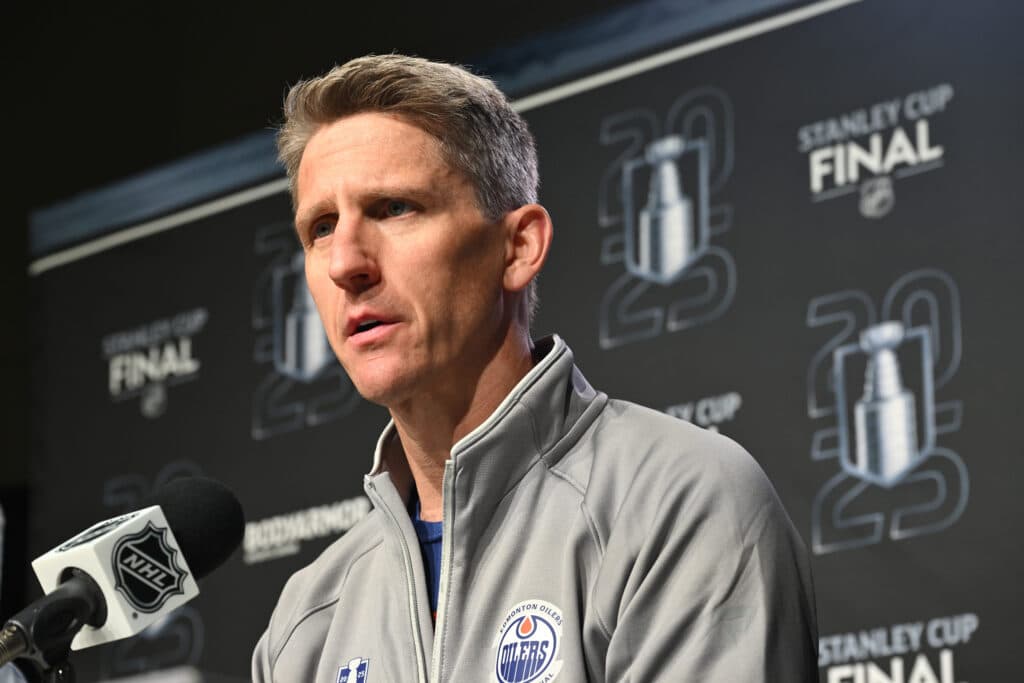
Jun 3, 2025; Edmonton, Alberta, CAN; Edmonton Oilers head coach Kris Knoblauch is seen during media day in advance of the 2025 Stanley Cup Final at Rogers Place. Mandatory Credit: Walter Tychnowicz-Imagn Images
Is Knoblauch on the hot seat?
Question from Danny Harper:
If the Oilers do not turn things around, who would be the top contender to succeed Knoblauch as coach?
If the Oilers do not turn things around, who would be the top contender to succeed Knoblauch as coach?
Kris Knoblauch has been to back-to-back Stanley Cup Finals. He has done an incredible job with this group and has earned a much longer leash than this rough stretch to start the season. Even with how bad these losses feel, the Oilers are still in a spot where a small winning streak gets them right back into a playoff position.
I cannot imagine I am the only one who thinks there is no chance Knoblauch is on the hot seat. People are anxious and frustrated, and that is fair, but he has more than earned the chance to get this turned around.
Why are the gaps and crease coverage such a mess?
Question from @MyNameIsYef:
Are the Oilers’ defencemen backing into the crease on rush plays because of the system, or is closing gaps an issue? The D also are not clearing the area near the crease and are creating screens. Is this drop-off related to a new D coach, overuse of players, or teams figuring the Oilers out?
Are the Oilers’ defencemen backing into the crease on rush plays because of the system, or is closing gaps an issue? The D also are not clearing the area near the crease and are creating screens. Is this drop-off related to a new D coach, overuse of players, or teams figuring the Oilers out?
There is a lot to unpack here, but it all comes back to the same thing: the group of five is not playing together right now.
When a team is not connected, it shows up everywhere. One of the first places is gap control. For a defenceman to hold a good gap, he needs help from the forwards and structure from the whole group.
If the forwards are turning pucks over at the blue line or not getting pucks deep, the D do not have time to follow the play up the ice. When that happens, they are forced to slam on the brakes and back up. They simply do not have the speed they need to match the attack, so the gap disappears.
On the flip side, if the D are not on their toes and are not skating up ice behind the play, the same thing happens. A turnover comes, and suddenly they are flat-footed and backing in.
Back pressure matters too. If the forwards are not tracking back, the defencemen do not feel comfortable holding that tight gap. Playing an aggressive gap means you accept the risk that a guy might go around you. You only feel good doing that if you know you have layers behind you. When you feel like you are the last man back, you naturally back off.
Clearing the crease is related. You cannot really move a guy once he is established in front of you anymore. The league does not let you live by “jungle rules” like it used to. So it becomes about getting to the spot early and denying that ice instead of trying to blow somebody up once they are already there.
When there are turnovers and sloppy play, there is no time to read and anticipate. You are behind the play, late to the front of the net, and then it just looks like the D cannot box anybody out or let the goalie see the puck.
And remember, with the new rules, if you are too aggressive in front, you are probably taking a penalty. So if you cannot move the guy, you have to at least choose: either get the goalie a sightline, or commit to blocking the shot yourself. None of that is easy, and when the team is disconnected, it all breaks down at the same time.
This is not a systems issue where a coach is telling them to back in. Every team wants tight gaps and a clean net-front. It is a symptom of the whole group not playing together.
 © Timothy T. Ludwig-Imagn Images
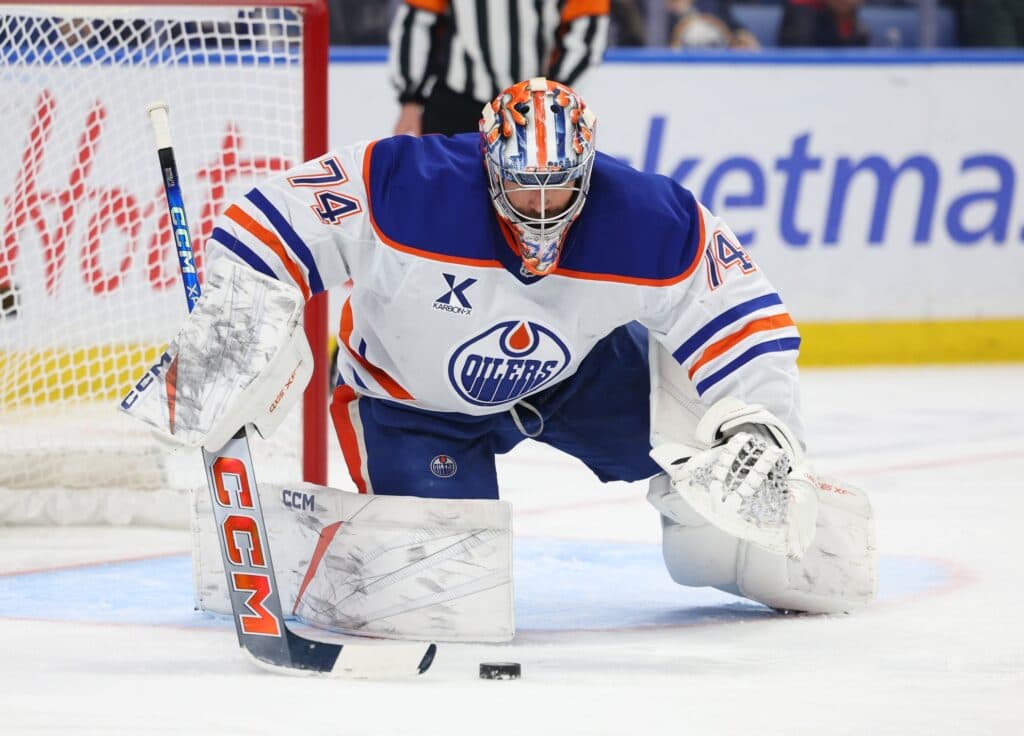
Nov 17, 2025; Buffalo, New York, USA; Edmonton Oilers goaltender Stuart Skinner (74) looks to cover ups the puck during the second period against the Buffalo Sabres at KeyBank Center. Mandatory Credit: Timothy T. Ludwig-Imagn Images
Is reading the play Skinner’s biggest weakness?
Question from @Redbeard506:
Do you think the biggest weakness in Stuart Skinner’s game is his ability to read and anticipate the play? For example, the first goal in the Buffalo game looked like an easy poke-check read. He seems like he is always behind the eight ball, trying to react.
Do you think the biggest weakness in Stuart Skinner’s game is his ability to read and anticipate the play? For example, the first goal in the Buffalo game looked like an easy poke-check read. He seems like he is always behind the eight ball, trying to react.
I think that is going too far. I do not believe Skinner has a fundamental problem reading plays. I do agree with you on that Buffalo goal, though. When a player is that tight, and you are in RVH, your stick has to be active. You can use it on your backhand to poke, or you can keep it in front and jam up the lane as the guy tries to walk in tight. Either way, you cannot let him just tuck it around you.
Right now, it looks like Skinner is behind the play at times, and that is where the frustration comes from. But a lot of that is what is happening in front of him.
When the team in front is chaotic, it feels like every option is available to the puck carrier. As a goalie, when you trust your structure, you might narrow it down to two options: this guy is either shooting or passing here. That lets you sit on those reads and be ahead of the play.
When things are off the rails, it feels like there are five options. Shot, backdoor, seam pass, high one-timer, maybe another guy popping open. Now you are not really reading and anticipating, you are just reacting and hoping you get there in time. Your feet move more, your stance changes, your angles get off, and even the saves you do make look frantic.
You can actually see that with Skinner right now. He is making some great saves, but he is doing it while playing catch-up. Think of that rebound sequence against Dallas. He makes a big stop, but he is diving around and out of control because he is pure reaction at that point, not ahead of the play.
It is on him to calm his game down, but it is also on the skaters to give him some consistency and predictable reads. When the group tightens up, you will see his anticipation look better, too.
How should goalies battle through screens?
Question from Lance (@LanceDoesStuff):
When fighting through a screen, I see some goalies go low, and some stay tall. What is the proper way to battle through a screen, and what can goalies do in practice to work on it?
When fighting through a screen, I see some goalies go low, and some stay tall. What is the proper way to battle through a screen, and what can goalies do in practice to work on it?
Great question.
In general, you want to stay on your feet as long as possible on point shots. It is much easier to go down into a save than it is to start low and try to come up to a puck that suddenly appears through traffic.
If you sink your hips and drop your chest back, you might feel like you are digging in and ready, but you make it really hard to move up on the puck when it comes through. If you are upright, you can drop into your save and then explode on the rebound.
I’m 6-foot-6, so I could usually look over top of most screens. I liked to stand tall and work around bodies, picking a lane high or low without leaning all my weight onto one leg. If you lean too much, you are stuck. You cannot push, you cannot recover, and you are done if the puck goes the other way.
The most important piece, though, is getting to your spot early. When the puck goes from the corner up to the point, you have to explode to the top of your crease and get set. If it goes D-to-D, you cannot drift over and arrive as the shot is coming. If you are still moving and guys are moving in front of you, you will get screened more often than not.
So the sequence is: beat the pass to your spot, get your feet set, then work to find the puck. Sometimes that is over top, sometimes it is around a hip, sometimes you have to dip a little. But if your feet are set, you at least have a chance to react, even if you only pick it up late.
In practice, it is hard to fully replicate game traffic because D-men are not going to hammer pucks through three guys in front during a drill. You still want to use those reps to work on skating cleanly into position and getting set early, even if the chaos in front is not the same. The real comfort battling through moving screens comes from games, and from consciously treating it as something you are trying to improve every time those situations show up.
That wraps up this edition of Ask Dubey. Keep the questions coming with the hashtag #AskDubey or drop them in the comments, and we will keep digging into what is going on with the Oilers, in the crease and everywhere else.
Watch the full episode of Ask Dubey on YouTube…


Breaking News
- Evan Bouchard’s contract is aging well amid the NHL’s salary cap boom
- Bowman: Hockey Canada reinstating Formenton played ‘big role’ in Oilers signing
- Oilers bold prediction: Colton Dach becomes an everyday player
- Oilers scrape bottom of hockey barrel in signing Alex Formenton
- Edmonton Oilers sign Alex Formenton to one-year contract
Edmonton OilersTeam Cap Summary
Cap Summary
2026-27
2027-28
Projected Cap Hit
$102,071,666
$88,322,500
Projected Cap Space
$1,928,334
$25,177,500
Current Cap Space
$1,928,334
$25,177,500
Active Players
22/23
16/23
Draft Picks
Round
'26
'27
1
0
0
2
1
1
3
1
0