
OilersNation has no direct affiliation to the Edmonton Oilers, Oilers Entertainment Group, NHL, or NHLPA
What David Tomasek’s SHL statistics suggest about his NHL potential


Heading into the 2025-26 NHL season, an intriguing wildcard option for the Edmonton Oilers’ forward lineup is David Tomasek. Signed to a one-year, $1.2 million contract back in April, the 29-year-old Czech-born forward has played in various European leagues throughout the past decade, most recently appearing with the Färjestad BK of the Swedish Hockey League in 2024-25. He now has a chance to play on a contending team in the world’s top league.
With the departure of multiple top-nine forwards this summer, the Oilers’ forward lines are projected to be wide open, brimming with opportunity for new faces to make an impact. Can Tomasek take advantage and prove to be a useful player for Edmonton? Let’s take a closer look and examine what we could expect from him this upcoming season.
Firstly, here is a brief summary of Tomasek’s numbers in the SHL last season:
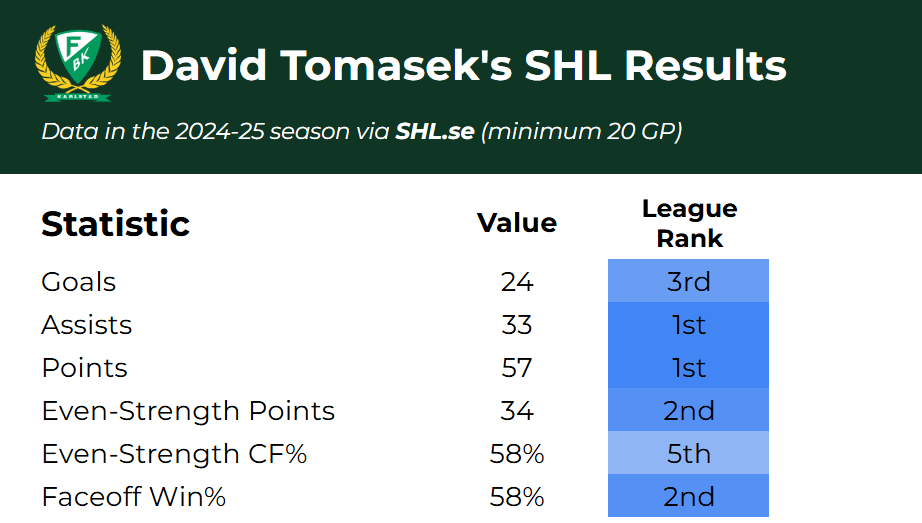
With 24 goals, 33 assists, and a total of 57 points in 47 games, Tomasek was the SHL’s leading scorer in 2024-25, ranking ahead of multiple former NHL players such as Jacob Silfverberg and Oscar Lindberg. Even at even-strength specifically, his production totals were excellent, ranking 2nd in the SHL with 34 even-strength points. This wasn’t just some anomaly or one-off campaign, either. In the 2023-24 season, Tomasek remained at 3rd place in SHL scoring with 45 points in 52 games.
“[The SHL is] not an easy league to produce in,” said Daily Faceoff analyst Steven Ellis on OilersNation Everyday regarding Tomasek’s production rate. “Point-per-game, in most European leagues, that’s tough to do. Scoring just isn’t as high there.”
In addition, Tomasek’s underlying on-ice numbers were also exceptional, as Färjestad controlled 54 percent of the goals and 58 percent of the shot attempts with Tomasek on the ice at even-strength. To put those numbers into perspective, former NHL centre Johan Larsson also played in the SHL last year and put up a 59 percent CF%. Although Larsson struggled to maintain a regular spot in the NHL, largely due to lacklustre production, his relative possession and defensive metrics were consistently strong.
From this comparison, it’s not totally unreasonable to deduce that Tomasek was quite solid defensively in the SHL and that it could partially translate to the NHL. Prospect writers Scott Wheeler and Corey Pronman have both praised his play without the puck.
Overall, Tomasek was a very versatile player for Färjestad. He ranked first among their forwards in even-strength, power-play, and total TOI per game. Tomasek primarily played centre last season and excelled in the faceoff circle, ranking third among all forwards in total faceoff win percentage and first in defensive zone faceoff win percentage specifically. He also spent a decent amount of time on the wing.
With all of that in mind, there’s quite a lot to be pleased with in regards to Tomasek’s performance in the SHL, from the simple box score totals to the advanced metrics. But of course, the main question is – can Tomasek’s game translate effectively to the NHL?
Here is a list of some potential historical comparables to Tomasek that I compiled:
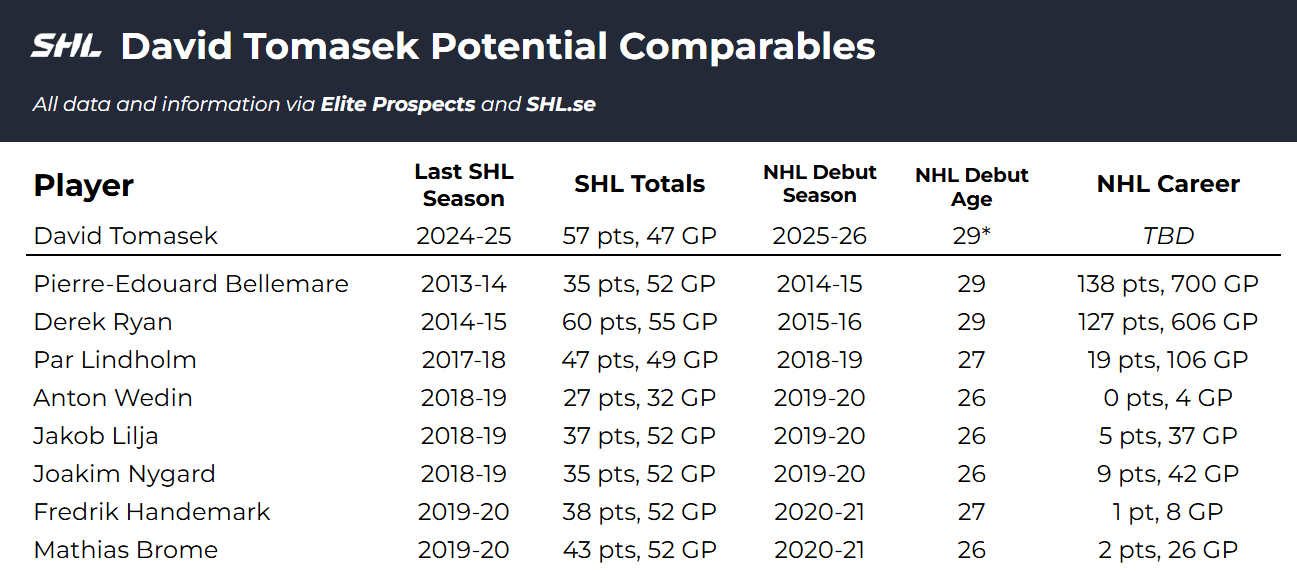
Each of the players on this list were fairly similar to Tomasek’s current situation; they were undrafted forwards aged ~26-29 with no prior NHL experience, had at least one strong season in the SHL, and then signed a contract with an NHL team in the subsequent year. However, I could only find two that developed into regular, successful NHL players; Derek Ryan and Pierre-Edouard Bellemare.
Ryan and Bellemare had unique and unconventional careers. Per Jason Gregor, they are the only players in NHL history to make their NHL debut at age 29 and go on to play over 600 games. They wound up being highly useful NHL bottom-six players for roughly a full decade, with Ryan hitting the 38-point mark twice in his career while both of them generally had superb defensive metrics.
Though scoring rates were slightly higher this season compared to 2013-14 and 2014-15, it should be noted that Tomasek had superior production rates to both of them, especially Bellemare by a pretty strong margin. That is very encouraging.
However, there’s a compelling case to be made that Ryan and Bellemare are outliers rather than the norm. Most of the other players on this list were either temporary NHL depth players who eventually returned to Europe, or they hardly played in the NHL at all in the first place.
For instance, in 2017-18, 27-year-old Par Lindholm ranked fourth in the SHL with 47 points in 49 games alongside a very strong playoff performance to boot. This earned him a contract with the Toronto Maple Leafs. However, Lindholm had just 1 goal and 13 points in his first NHL season. He signed a two-year contract with the Boston Bruins in 2019, but had just 6 points in 40 games in 2019-20 and played a mere one game in 2020-21, ultimately leading to the Bruins placing Lindholm on waivers for the purposes of contract termination. He wound up going back to the SHL.
Anton Wedin had a somewhat similar story, producing at a near PPG-pace in the SHL in 2018-19 and earning a contract with the Chicago Blackhawks, but he played just four NHL games in total. Many Oilers fans should also recall Joakim Nygard, who was signed by Edmonton after a fairly strong SHL season in 2018-19, but though he showed some flashes of speed and skill in the NHL, he struggled to be a regular on a team with already mediocre depth at the time.
Of course, Tomasek’s raw PPG rate is the best on the list. That, combined with his possession metrics and positional versatility, indicates that his statistical chances of success are likely better than it was for many of these players. Interestingly, Nygard also played on Färjestad this past season, and Tomasek more than doubled his production. Again, another very encouraging comparable.
Still, the point being made here is that a career akin to Ryan’s or Bellemare’s is far from a guarantee. Tomasek’s transition speed and skating have also been pointed out as potential weaknesses, which could certainly impact how he adjusts to NHL ice, where he will have less space to make plays. Thus, expectations should be somewhat tempered.
Though Edmonton’s departures up front open up opportunities, Tomasek will face a solid amount of competition this upcoming season. On the bright side, his ability to play both centre and wing (specifically right-wing) greatly increases his chances of being an NHL regular.
But at centre, he will compete with the likes of Adam Henrique, Noah Philp, and perhaps even Ryan Nugent-Hopkins if Kris Knoblauch decides to play him at 3C, while on the right-wing, he will compete with Matthew Savoie, Kasperi Kapanen, Curtis Lazar, and perhaps Trent Frederic and Vasily Podkolzin too (the latter two primarily play at LW, but can also play at RW).
Realistically, the best-case scenario is likely that Tomasek becomes a highly effective third-liner, producing ~30+ points. I could see a third line centered by RNH with Tomasek and perhaps one of Trent Frederic or Isaac Howard seeing great success. While he could obtain an opportunity next to Leon Draisaitl at some point in the season, depending on how lines and injuries shake out, historical comparables suggest that his chances of success in the top-six are highly unlikely.
I would be interested to see how Tomasek could fare as a 4C. I think there is a very solid chance that he could succeed against fourth-line competition, and both his faceoff skills and right-handedness make this option even more appealing. ~20ish points and solid underlying numbers on the fourth-line could be a more fair and reasonable expectation for him, which would still be worth the contract in my opinion.
All things considered, I do like this signing by the Oilers. It is low-risk with potential for a fairly good reward. Time will tell how his game translates to the NHL.
Find me on Twitter (@NHL_Sid)


Breaking News
- Trying to make sense of why the Oilers signed Alex Formenton
- Evan Bouchard’s contract is aging well amid the NHL’s salary cap boom
- Bowman: Hockey Canada reinstating Formenton played ‘big role’ in Oilers signing
- Oilers bold prediction: Colton Dach becomes an everyday player
- Oilers scrape bottom of hockey barrel in signing Alex Formenton

Edmonton OilersTeam Cap Summary

Cap Summary
2026-27
2027-28
Projected Cap Hit
$102,071,666
$88,322,500
Projected Cap Space
$1,928,334
$25,177,500
Current Cap Space
$1,928,334
$25,177,500
Active Players
22/23
16/23
Draft Picks
Round
'26
'27
1
0
0
2
1
1
3
1
0