
OilersNation has no direct affiliation to the Edmonton Oilers, Oilers Entertainment Group, NHL, or NHLPA
A Look at the NHL Schedule, Travel, Reduced Goal Scoring, Fewer Penalties, and More

Photo credit: Walter Tychnowicz-Imagn Images

By Jason Gregor
Jul 21, 2025, 16:00 EDTUpdated: Jul 21, 2025, 17:11 EDT
The off-season is a great time to look at trends around the NHL.
Today, we will look at the NHL schedule, how most teams struggle on back-to-back games, a reduction in high-end point totals for players, and one obvious trend that led to a significant reduction in goals scored in the NHL last year. It is a trend the NHL has to be aware of before it becomes the norm again.
Let’s start with the schedule. Here’s a look at how teams fared in the second half of back-to-back games last year, with Western Conference teams on the left and Eastern teams on the right.
TEAM | GP | 2ND BTB | TEAM | GP | 2ND BTB | |
LAK | 14 | 9-4-1 | TOR | 16 | 10-4–2 | |
VGK | 13 | 9-4 | NYR | 14 | 8-5-1 | |
DAL | 11 | 8-2-1 | CAR | 15 | 8-7 | |
COL | 12 | 8-3-1 | OTT | 12 | 8-4 | |
EDM | 14 | 7-7 | FLA | 14 | 7-7 | |
CHI | 12 | 5-5-2 | WSH | 13 | 7-6 | |
MIN | 12 | 5-6-1 | MTL | 15 | 7-5-3 | |
UTA | 12 | 4-6-2 | PIT | 14 | 6-7-1 | |
STL | 10 | 4-4-2 | BOS | 10 | 5-4-1 | |
CGY | 10 | 3-6-1 | TBL | 11 | 5-6 | |
ANA | 11 | 3-8 | NYI | 12 | 5-7 | |
SJS | 12 | 3-5-4 | BUF | 13 | 5-8 | |
NSH | 14 | 3-9-2 | NJD | 12 | 3-8-1 | |
VAN | 10 | 2-8 | DET | 11 | 3-6-2 | |
WPG | 8 | 2-6 | CBJ | 12 | 2-10 | |
SEA | 12 | 0-12 | PHI | 13 | 1-10-2 | |
.401W% | 187 | 75-95-17 | .434W% | 207 | 90-104-13 |
Only 11 teams had a winning percentage of .500 or better. West teams combined for a .401W%, while the East had .434W%. Seattle was 0-12, which is rather amazing when you think about it. It is important to note that most teams played the second half of a BTB game on the road.
The West played 49 games at home (26-21-2) and 138 on the road (49-74-15), while the East had 72 games at home (39-27-6) and 135 on the road (51-77-7).
Only six teams in the league won more than half of the latter games on a back-to-back on the road: Toronto (7-2-1), Dallas (6-2-1), Vegas (6-3), Colorado (6-3-1), Edmonton (6-4), and the New York Rangers (5-2-1).
Here’s a look at the number of BTB games teams will play this season (home and away in parentheses).
- 16: LAK (5-11), MTL 6-10), NYI (6-10), PIT (10-6), and SJS (8-8).
- 15: CAR (6-9), CBJ (6-9), NJD (8-7), TBL (4-11), and TOR (4-11).
- 14: MIN (6-8), OTT (6-8), PHI (3-11), and WSH (2-12).
- 13: BOS (6-7), BUF (4-9), DET (5-8), EDM (2-11), FLA (4-9), NSH (4-9), NYR (10-3), SEA (3-10), STL (9-4) and VAN (5-8).
- 12: CHI (7-5), COL (3-9), DAL (3-9), and VGK (3-9).
- 11: ANA (6-5) and UTA (1-11).
- 9: CGY (1-8) and WPG (4-5).
The Rangers and Penguins have 10 games at home in the second half of BTB games. Meanwhile, the teams with the worst home-to-road differential are Utah (1-11), Calgary (1-8), Washington (2-12), Edmonton (2-11), and Philadelphia (3-11).
On average, teams play 13 games that are the second half of a BTB, which makes up 15.8% of the season. For a team like Utah, which is hopeful to push into a playoff spot, then will likely need a point percentage of .500 in those games.
Of the 16 playoff teams last year, only Tampa Bay (454P%) and New Jersey (.291P%), and Winnipeg (.25o%) had a P% lower than .500 in the second half of BTB games. Winnipeg only had eight BTB games, which was 9.7% of their season.
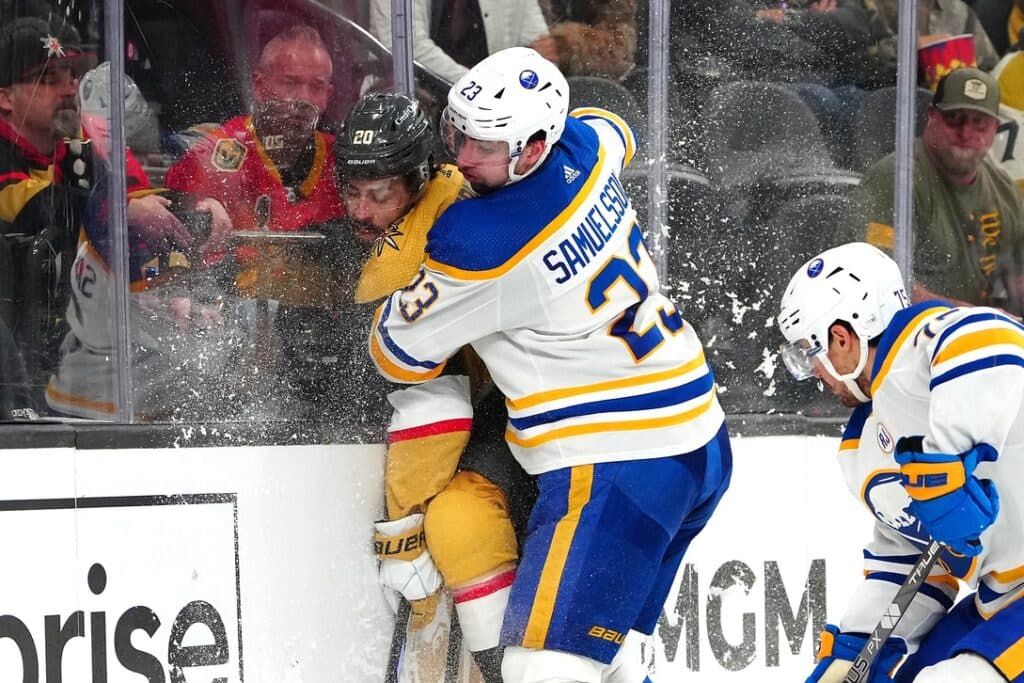 © Stephen R. Sylvanie-Imagn Images
Dec 15, 2023; Las Vegas, Nevada, USA; Buffalo Sabres defenseman Mattias Samuelsson (23) checks Vegas Golden Knights center Chandler Stephenson (20) during the second period at T-Mobile Arena. Mandatory Credit: Stephen R. Sylvanie-USA TODAY Sports
GOAL SCORING DECREASE…
Goal scoring has been on a slow decrease over the past three seasons. Hopefully, this trend stops, and we don’t dip under six goals/game again.
It is easy to pinpoint why goals went down last year. The NHL is simply calling fewer penalties. The league had 816 fewer power plays than in 2024 and 957 fewer than were called in 2023. Please don’t tell me the players are suddenly that much more disciplined.
Season | Goals | G/GP | 5×5 G | PPG | PPO | PP% | SHG | PSG | ENG |
2025 | 7978 | 6.08 | 5226 | 1537 | 7101 | 21.6 | 208 | 7 | 524 |
2024 | 8168 | 6.23 | 5324 | 1660 | 7917 | 21 | 234 | 16 | 447 |
2023 | 8343 | 6.36 | 5447 | 1717 | 8058 | 21.3 | 250 | 15 | 438 |
The numbers in red show the lowest total of any season.
There was a slight reduction in 5×5 goals (98), despite more 5×5 time, and there were 123 fewer PP goals. The league did see an increase of 77 empty net goals, mainly due to teams pulling their goalie earlier than ever before. The power play efficiency across the league was up slightly. However, my main issue is the reduction of power plays.
It is a massive drop from 2023 and 2024, and the league needs to realize that offence sells tickets in the regular season, and fans loathe seeing the best offensive players hooked, slashed, and held more. The better players have the puck more, and most infractions occur on the puck carrier. It isn’t difficult to see that last season, the NHL allowed the better players to be impeded more. For the love of puck, please call the rulebook.
And another trend that isn’t ideal is the reduction of high-point producers.
Year | 100+ pts | 90+pts | 80+pts | 70+pts | 60+pts | 50+pts |
2023 | 11 | 19 | 31 | 60 | 95 | 136 |
2024 | 9 | 17 | 29 | 52 | 93 | 139 |
2025 | 6 | 12 | 28 | 49 | 85 | 133 |
Most of the point reduction comes from the top-end players. In 2023, there were 19 players with 90+ points, and last year, only 12, while the number of 100+ point players went from 11 to six. Having fewer high-end players isn’t ideal for marketing the league, and it is pretty clear that the significant reduction in power plays is leading to this.
CALL THE DAMN RULEBOOK.
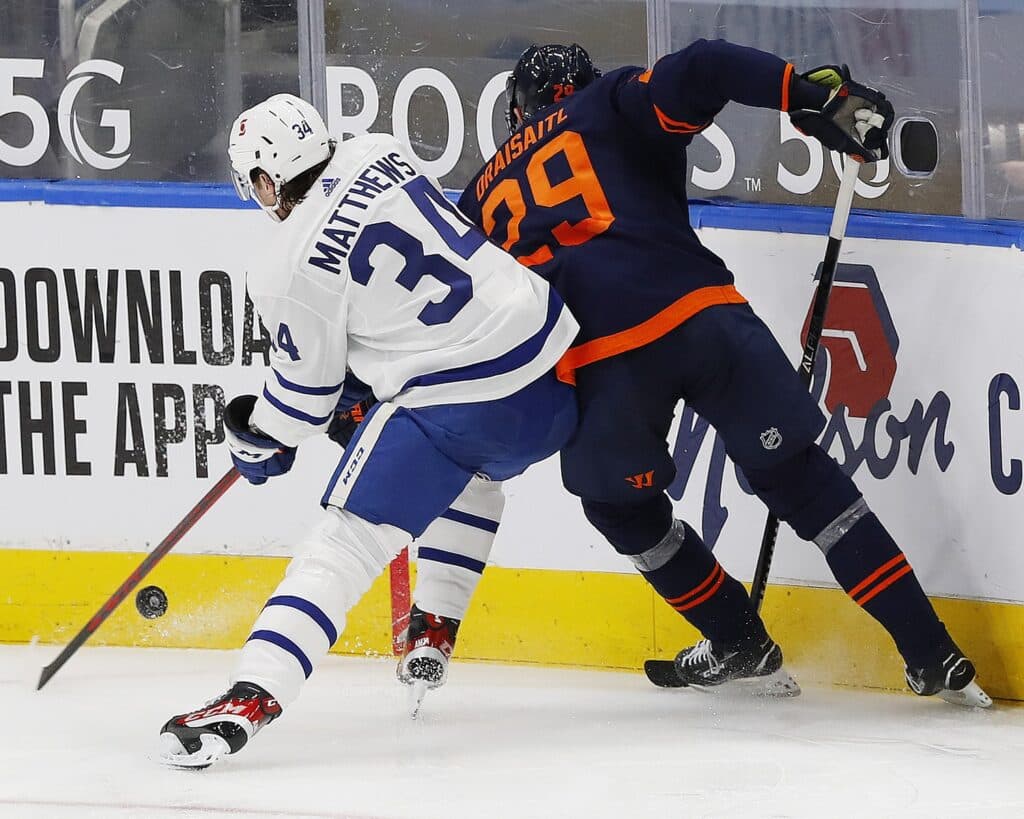 © Perry Nelson-USA TODAY Sports
Jan 28, 2021; Edmonton, Alberta, CAN; Toronto Maple Leafs forward Auston Matthews (34) and Edmonton Oilers forward Leon Draisaitl (29) battle along the boards for a loose puck during the second period at Rogers Place. Mandatory Credit: Perry Nelson-USA TODAY Sports
OILERS SCHEDULING QUIRK…
The Oilers’ road trip schedule out East is different than any other in franchise history. The Oilers play 16 games in the Eastern Time Zone (ET), but all 16 will be completed by December 18th, and all will happen in only three separate road trips.
They’ve never not had a game in the Eastern time zone in the final four months of the regular season until this season. Here’s a look at how many games they played in ET in January, February, March, and April in previous seasons and the total number of trips needed out east to play all the games.
YEAR | JAN | FEB | MAR | APR | TOTAL | TRIPS to ET |
2015 | 3 | 5 | 4 | 0 | 12 | 4 |
2016 | 2 | 4 | 3 | 0 | 9 | 5 |
2017 | 4 | 5 | 0 | 0 | 9 | 5 |
2018 | 0 | 0 | 4 | 0 | 4 | 5 |
2019 | 0 | 7 | 2 | 0 | 9 | 5 |
2020 | 4 | 3 | *3 | 0 | 10 | 5 |
2021 | 2 | 3 | 3 | 3** | 13 | 5 |
2022 | 5 | 4 | 1 | 2 | 12 | 5 |
2023 | 0 | 6 | 3 | 0 | 9 | 5 |
2024 | 2 | 0 | 6 | 0 | 8 | 6 |
2025 | 2 | 4 | 5 | 0 | 11 | 5 |
2026 | 0 | 0 | 0 | 0 | 0 | 3 |
* Three didn’t happen as scheduled, ended prematurely due to COVID.
** They also had two in May due to the late start of the season. Also had three ET teams in the division, which led to more games v. ET teams.
** They also had two in May due to the late start of the season. Also had three ET teams in the division, which led to more games v. ET teams.
They will have a lot of travel early in the season with a five-game trip from October 14th to 21st with stops vs. NYR, NYI, NJ, DET, and OTT. Then they have a seven-game journey from November 12th to 22nd vs. PHI, CBJ, CAR, BUF, WSH, TB, and FLA. And they have a five-gamer from December 13th to 20th in TOR, MTL, PIT, BOS, and MIN (Central Time Zone).
They play 21 of their first 35 games on the road, and 16 of them are ET. It is a tough start, travel-wise, but less travel in the second half of the season should, in theory, help them be a bit more rested for the playoffs.
The one major advantage to fewer trips out east is that the Oilers have reduced their travel by almost 10,000 kilometers. Here is the distance the Oilers travelled the past four seasons via the NHL.
- 2022-23: 83,660 km
- 2023-24: 81,837 km
- 2024-25: 80,363 km
- 2025-26: 70,477 km
And these travel numbers from the NHL contain a few minor caveats. It is based on teams not returning home in the middle of a road trip and ignores the Olympic break.
So, for example, the Oilers play February 4th at Calgary before the Olympic break, and after the break, they play February 25th in Anaheim. The numbers below reflect Edmonton traveling from Calgary to Anaheim and do not include them coming back to Edmonton for the Olympic break. If a team finished on the road before the Olympics break, but started at home after it would calculate the trip back home. In the case of EDM, it doesn’t account for the 246 KM (153 miles) flight distance from Edmonton to Calgary. Similar to the 4 Nations break last year.
TEAM | MILES | KM | TEAM | MILES | KM | |
DAL | 49,549 | 79,747 | FLA | 39,837 | 64,117 | |
SJS | 48,847 | 78,611 | STL | 39,506 | 63,575 | |
COL | 47,426 | 76,325 | NYR | 38,929 | 62,655 | |
NSH | 46,163 | 74,291 | CHI | 38,237 | 61,531 | |
VAN | 46,101 | 74,189 | MIN | 37,139 | 59,767 | |
ANA | 45,734 | 73,605 | CBJ | 36,835 | 59,283 | |
VGK | 45,040 | 72,488 | WSH | 36,592 | 58,892 | |
CGY | 43,993 | 70,804 | PHI | 35,882 | 57,749 | |
EDM | 43,791 | 70,477 | CAR | 35,463 | 57,072 | |
WPG | 43,455 | 69,932 | MTL | 34,920 | 56,201 | |
PIT | 43,419 | 69,883 | OTT | 34,710 | 55,854 | |
BOS | 43,083 | 69,334 | NJD | 33,873 | 54,511 | |
SEA | 42,918 | 69,067 | BUF | 32,518 | 52,327 | |
LAK | 42,577 | 68,523 | DET | 32,315 | 52,006 | |
UTA | 42,012 | 67,614 | TOR | 32,056 | 51,593 | |
TBL | 40,221 | 64,725 | NYI | 28,953 | 46,602 |
Making three trips out East has lowered the distance travelled for the Oilers significantly. They will travel only 594 km more than Pittsburgh. Western Conference teams always travel the most, due to geography, but reducing almost 10,000 KM from last year should be a benefit for Edmonton.
It is crazy how the Islanders will travel 20,000 fewer miles and 33,000 fewer kilometers than the Dallas Stars this coming season. I wonder if those who complain about state tax laws will be clamouring for more “fair” travel, too. There will always be perceived advantages, but the biggest advantage Stanley Cup winners have had recently is that three of the last five winners were able to activate a player with a $9.5 million AAV for the playoffs. Thankfully, that won’t be the case starting in 2026-27, and I suspect in a few years the “no state tax” complaint won’t be nearly as loud.
 © Jayne Kamin-Oncea-Imagn Images
Apr 23, 2025; Los Angeles, California, USA; Edmonton Oilers goaltender Stuart Skinner (74) looks on as Los Angeles Kings celebrate a goal by right wing Quinton Byfield (55) in the second period of game 2 of the 2025 Stanley Cup Playoffs at Crypto.com Arena. Mandatory Credit: Jayne Kamin-Oncea-Imagn Images
PARTING SHOT…
Earlier, we looked at how many sets of BTB games each team has. I thought it would be good to include how many times each NHL team faces an opponent who is in the second half of a BTB.
- 19: DET, MTL, and PIT.
- 17: BOS, LAK, and NYI.
- 16: ANA, CBJ, EDM, and NYR.
- 15: MIN, UTA, and VGK
- 14: CGY and OTT.
- 13: STL, TOR, and WSH.
- 12: BUF, CHI, PHI, and TBL.
- 11: NSH, NJD, and VAN.
- 10: CAR, FLA, and SJS.
- 9: DAL and SEA.
- 8: COL and WPG.
These are games where a team has an advantage, although there are a few cases where both teams are playing the second half of a BTB.
One final point: I believe it would be better for player rest and increased animosity if the NHL had teams play the same opponent in consecutive games, like we saw during the 2021 season. I realize you can’t do this for every game, but each team should be able to do it at least three to four times a year to start.
For instance, Edmonton goes on a four-game road trip and plays LA twice and then Anaheim twice, rather than once vs. the Kings, Ducks, Sharks, and Golden Knights. Less travel and heightened intensity.
Imagine your favourite team playing their biggest rival in consecutive games. The games don’t always have to be on back-to-back nights. It could be a Monday, Wednesday or Thursday, or Saturday. Build up the hype.
Read More…
- Savoie, Howard, and Jonsson lead Oilers’ Prospect Pool Breakdown at Daily Faceoff
- Will Trent Frederic be an impact player for the Oilers during his eight-year contract?
- Oilers Questions: What’s happening with the goaltending, how excited should we be about rookie forwards, and more
- Looking back at Stan Bowman’s additions to the Oilers
- Lukas Dostal’s new contract gives us an idea of what Stuart Skinner’s next deal could look like
- Ask Dubey: Changing goalie coaches, an extension for Stuart Skinner, living in Edmonton, and more
Presented by Litco Law

Litco Law has been serving Edmontonians and all of Alberta for over 50 years. A family-owned and operated company, their purpose is to balance the power for people who find themselves having to navigate the complex legal system. They can help with personal injury claims (like car accidents), employment matters (such as wrongful dismissal or severance package reviews), or if you’ve been denied long-term disability benefits. Litco Law is known for being experienced, responsive, and genuinely caring. You might not believe Lawyers You’ll Love™ exist—but they do. To learn more or book a free consultation, visit LitcoLaw.com.


Breaking News
- What if the Oilers traded for Mikko Rantanen in 2025?
- Leon Draisaitl welcomes Mike Babcock’s accountability, but will it apply to every Oiler?
- Oilers’ Josh Samanski goes incognito at German festival to find romance
- Draisaitl proud to play NHL games in native Germany: ‘This is very special’
- Oilersnation Radio: We want to go watch the Oilers play in Germany

Edmonton OilersTeam Cap Summary

Cap Summary
2026-27
2027-28
Projected Cap Hit
$99,274,166
$87,350,000
Projected Cap Space
$4,725,834
$26,150,000
Current Cap Space
$4,725,834
$26,150,000
Active Players
23/23
15/23
Draft Picks
Round
'26
'27
1
0
0
2
1
1
3
1
0