
OilersNation has no direct affiliation to the Edmonton Oilers, Oilers Entertainment Group, NHL, or NHLPA
Will the Oilers still have an elite power play in 2025-26?

Photo credit: © Walter Tychnowicz-Imagn Images

The Edmonton Oilers’ power play has been dominant for many years. At times, it has seemed that they could score at sheer will.
The power-play reached its peak in the 2022-23 season, averaging a remarkable 13 goals per hour; for context, no other team in the 21st century has exceeded 11.5 in a single season. And somehow, they managed to improve upon that rate in the postseason, scoring at a rate of 19 goals per hour (!!!) alongside a near 50 percent conversion rate in the 2023 playoffs. Simply put, they were unstoppable on the man advantage that year.
However, the team’s power play has, relatively, taken a step back in the past two seasons. In the following season in 2023-24, they scored at a rate of 10.6 PP goals per hour. Of course, this is still an excellent rate, but it was not enough for first in the league, and it marked a decline of 20 percent compared to the season prior. Then, it fell further to 8.9 goals per hour in 2024-25, ranking 10th in the NHL. Again, not a bad rate by any means, but it falls below the expectations for a team with Connor McDavid and Leon Draisaitl on it.
It must also be mentioned that in the 2024 and 2025 Stanley Cup Finals combined, the Oilers scored just 6.9 goals per hour against the Florida Panthers on the PP, with a dismal conversion rate of 15 percent. The underperforming PP was one of many factors leading to their back-to-back losses.
As questions persist around the Oilers’ current 5-on-5 depth scoring and goaltending, the team’s power-play will need to be at the top of its game all season long if 2026 is to be the year they finally win the Stanley Cup. So how exactly will it fare in 2025-26?
First, let’s try to figure out why exactly the power play has slowed down in the past two seasons. One simple and obvious reason is that they aren’t generating the same volume and quality of looks as they did before.
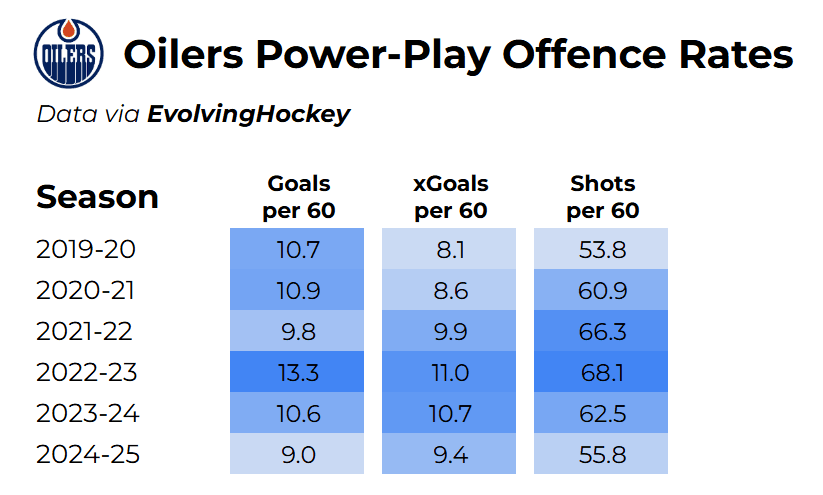
It is no coincidence that the year the Oilers scored a record-high number of PP goals was also the year in which they averaged the most shots and expected goals in the McDavid and Draisaitl era. They averaged 68 shots per hour of PP time that season, the 5th highest by any team in a single season since 2007. Comparatively, they averaged less than 56 shots per hour in 2024-25.
I believe there are a couple of reasons for this. For one, Connor McDavid has seen a dramatic decrease in his shot volume. He averaged 20 shots per hour on the PP in 2022-23, but it declined to 15 in 2023-24, and then 11 in 2024-25, nearly a full 50 percent reduction.
The thing is, McDavid’s shooting percentage has not decreased. If anything, it has actually increased. In 2022-23, his shooting percentage was 19%, but it was at 20% in 2024-25. The big difference is that McDavid simply shot the puck much less, thus leading to considerably fewer goals. In my eyes, he is overpassing far too much, and it must stop this season. He has an excellent and lethal shot, and he needs to use it more.
A similar story is there with Ryan Nugent-Hopkins, who was averaging over 11.5 shots per hour in 2022-23, but it has declined to less than 9 in the past two seasons. Leon Draisaitl has consistently remained great, ranking 2nd in the NHL in PP goals per 60 over the past two seasons, but the Oilers’ PP is at its best when each of McDavid, Draisaitl, and RNH are legitimate shooting threats. But in the past two seasons, the PP has been much more stationary, and both McDavid and RNH are not as active and dangerous scoring threats as they were two seasons ago. That must change.
Furthermore, one thing that will have a significant impact on the Oilers’ PP in 2025-26 is the net-front presence. That spot has mainly been occupied by Zach Hyman, who was excellent in that spot in 2022-23 and continued that success the following season, but he has shown major signs of decline this past season.
In 2023-24, Hyman averaged 3.5 goals per hour on the man advantage. It then declined to 1.6 in 2024-25, more than a 50 percent regression. Then, in the 15 playoff games he played, Hyman did not score a single goal on the PP, and the Oilers often put Corey Perry in his spot. Unlike McDavid or RNH, Hyman’s goal decrease does not seem to be entirely driven by fewer shots taken, as he averaged 3.6 expected goals per hour in 2022-23, compared to 3.3 in 2024-25; not a substantial difference. Simply put, his finishing ability saw a big decline.
With Hyman suffering a wrist injury in the 2025 playoffs, one that is expected to keep him out for the beginning of this regular season as well, there is a real chance that Hyman’s goal-scoring will see an even greater dip this season. That will be a big question mark for this upcoming season.
Andrew Mangiapane or Trent Frederic could spend some time on the top PP unit in place of Hyman to begin the year. Mangiapane had some PP success with the Flames in the 2021-22 season, and although Trent Frederic has relatively little experience, his size and playing style could allow him to be a strong presence at the front of the net. Though interestingly, David Tomasek was on in Hyman’s spot on the top PP unit recently in practice; we’ll see if that sticks moving forward.
The deployment of the second PP unit will also be an interesting storyline. Typically, the Oilers have hardly given any substantial time to their second unit, as their success has almost entirely been driven by the top unit, but that could change this upcoming season if 21-year-olds Matthew Savoie and Isaac Howard have breakout years. They could have the opportunity to drive a genuinely impactful second unit this season. I could definitely see a second PP unit of Savoie, Howard, Andrew Mangiapane, Adam Henrique, and Jake Walman having some success (though the Oilers do often like to run two defencemen on the second PP unit).
Another thing that will have a big impact, which I believe is not mentioned enough, is the coaching.
Back in the 2017-18 NHL season, the team’s PP was nothing short of a disaster, ranking dead last in the NHL at a lowly 14.8 percent conversion rate on the man advantage. It eventually caused the management to make a coaching change in the area, and Glen Gulutzan – who had recently been fired as Calgary’s head coach – was hired by the Oilers as their PP coach in 2018.
Immediately, the Oilers saw a significant improvement, ranking 9th in PP conversion rate in 2018-19. And ever since 2019-20, Edmonton has held the best power-play in the entire league by every major metric. Of course, the PP has slowed down in the two most recent seasons, and it should be obvious that McDavid and Draisaitl’s elite play has been the driving force behind the team’s success on the man advantage, but it’s fair to say Gulutzan deserves some credit here for overseeing this overall dramatic improvement.
However, Gulutzan left the organization this summer as the Dallas Stars hired him as their head coach. In his place, the Oilers have hired Paul McFarland.
McFarland was most recently the head coach of the WHL Calgary Hitmen, but he has several years of experience as an NHL assistant coach, spending 2 years with the Florida Panthers, 1 with the Toronto Maple Leafs, and 3 with the Seattle Kraken. However, when he manned the PP with Seattle, it was far from successful, as it ranked 29th, 20th, and 21st in 2021-22, 2022-23, and 2023-24, respectively, in goals per hour. Of course, Seattle didn’t nearly have the star power that Edmonton does, but it is something worth noting.
We’ll see quite soon how McFarland will run Edmonton’s power play.
*All stats via Natural Stat Trick and EvolvingHockey
Find me on Twitter (@NHL_Sid)


Breaking News
- Connor McDavid shows elite skating ability in viral training clip
- Better Lait Than Never: Give me some Oilers news please
- Oilers from the past: One-quarter of HOPE, Magnus Pääjärvi, joins old friend in Sweden
- Former Oilers prospect Matvei Petrov signs two-year KHL deal
- Draisaitl 4th-best in EA Sports rankings, Bouchard sixth among defencemen

Edmonton OilersTeam Cap Summary

Cap Summary
2026-27
2027-28
Projected Cap Hit
$99,274,166
$87,350,000
Projected Cap Space
$4,725,834
$26,150,000
Current Cap Space
$4,725,834
$26,150,000
Active Players
23/23
15/23
Draft Picks
Round
'26
'27
1
0
0
2
1
1
3
1
0