
OilersNation has no direct affiliation to the Edmonton Oilers, Oilers Entertainment Group, NHL, or NHLPA
Analyzing five stats that defined the Oilers first-round loss to the Ducks
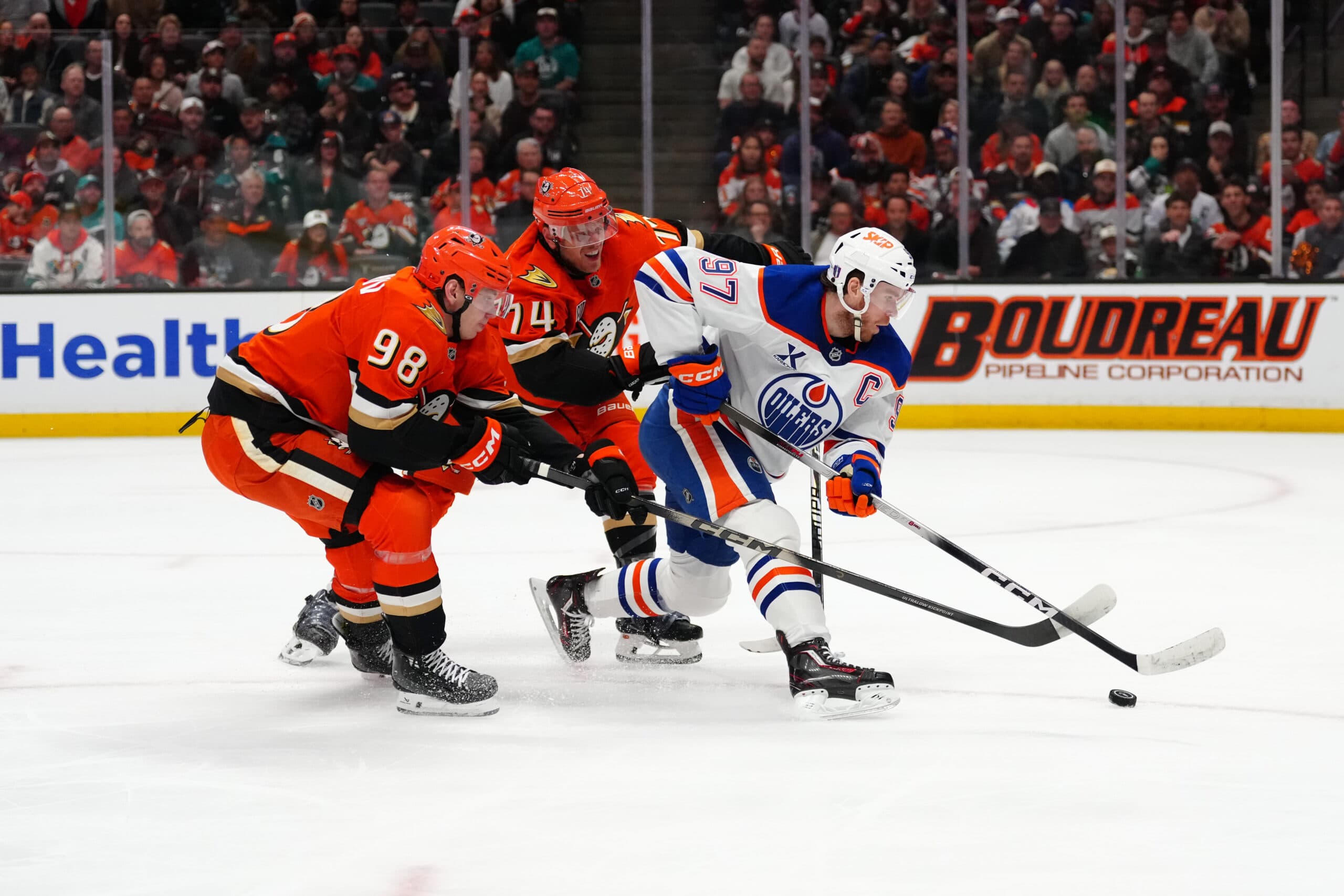
Photo credit: Kirby Lee-Imagn Images

By Lane Golden
May 12, 2026, 09:00 EDTUpdated: May 12, 2026, 15:05 EDT


The first step in any successful offseason is to properly identify where things went wrong.
For the Edmonton Oilers, there’s a lot you can point to. Whether you’re discussing goaltending, defence, or special teams, none of it was up to snuff in their first-round series against the Anaheim Ducks.
Now that the dust has settled, I’d like to do one last retrospective on a disappointing series for Edmonton, focusing on some key data points. To do it, I’ll be using numbers from Corey Sznajder, creator of All Three Zones.
Corey does an excellent job tracking microstats throughout the NHL season, which uncover fascinating details under the hood. Traditional stats like goals and shots can tell us what happened, but microstats tell us how it happened. They’re the little things like zone exits and puck retrieval success rate, which highlight strengths and weaknesses within the process.
For this article, I’m picking the most interesting microstats from the Oilers first-round series against Anaheim, and what the implications are for the team this offseason.
Point Shot Assists – EDM: 26 ANA: 13
One of the telltale signs that things aren’t going well for the Oilers is when they start to rely too heavily on point shots. Shots from the blue-line have gone out of vogue in the NHL over the past decade or so, as teams have taken a more thoughtful approach to offence.
According to Sportlogiq, inner slot shots have an incredible success rate of 22 per cent. Point shots, on the other hand, are terribly inefficient, only going in about one per cent of the time (three per cent if there’s traffic). Statistical analysis has caused a shift away from the old-school strategy of firing slap shots from the point and crashing the crease for rebounds.
Now, there’s nothing wrong with mixing in some point shots, especially if there’s deliberate traffic and lateral passing to get the goalie moving. Edmonton was deferring to their blue liners for shots far too often, though. They made 26 passes leading to point shots, which is double the 13 that the Ducks set up. Again, this would be fine if the Oilers were also outshooting and out-chancing the Ducks from other areas of the ice. They did not. All Three Zones had the chances as 98-76 in favour of the Ducks in the series.
We saw this a lot towards the end of the Dave Tippett era in Edmonton. When the point shots start creeping into their game, and the inner slot shots disappear, you know they’re out of answers tactically. Bombing away from the point over and over surely isn’t the game plan, but it’s a signal that the game plan isn’t working, and the players aren’t problem-solving to get the puck to a better spot.
Oilersnation wants to hear from you, the reader, in our new weekly “Letters to the Editor” segment. Letters can be emailed to Oilersnation’s managing editor Zach Laing (zach.laing@bettercollective.com), titled “Letters to the Editor.” Please include a letter up to 300 words, including your name, place of residence (city, town, province, or state). Your letters may be edited for length and/or clarity. Letters must be submitted by 6 PM MT Saturday night to be considered for feature on Sunday mornings.
Shots off Faceoffs – EDM: 12 ANA: 23
Putting together an effective collection of set plays off offensive-zone faceoffs is an underrated way of generating offence. Getting shots within a few seconds of a faceoff win can catch defences and goalies off guard, before they can get set up. In this series, the Ducks won that battle decisively.
They outshot Edmonton 23-12 off faceoffs and outscored them 2-0. That might not seem like a huge swing, but Anaheim’s crucial go-ahead goal late in Game 2 came on a shot through traffic off a faceoff.
It’s not the main reason the Oilers lost the series, per se, but it shows a lack of preparedness and attention to detail on their part. That wasn’t an issue for a well-coached Ducks team.
Rebounds – EDM: 8 ANA: 14
This series was Connor Ingram’s first playoff action since 2022, when the Colorado Avalanche swept his Nashville Predators in the first-round. While he got his first playoff win at long last, this series didn’t go well for Ingram.
According to All Three Zones, the Ducks generated 14 shots off rebounds in the series to Edmonton’s 8, and honestly, even that feels low. Ingram struggled to absorb shots, and pucks pinballed off him all series, leading to numerous goals and scoring chances.
His .876 save percentage and -6.74 goals saved above expected were disappointing results, given his strong finish to the regular season. The Oilers defence didn’t do a great job helping him out, especially on the penalty kill, but he also didn’t help himself with the rebound control.
Five-on-Four Chances – EDM: 19 ANA: 29
As the best power play unit in the NHL this season, the Oilers were expected to have the clear advantage in special teams. Their penalty kill was highly inconsistent, but the Ducks ranked only 23rd in power play and 27th in penalty kill in the regular season. On paper, it wasn’t close.
That’s not how it turned out in reality, however, and Anaheim picked the Oilers penalty kill apart. They scored on a ridiculous 50 per cent of their man advantages, and added a short-handed goal for good measure.
Edmonton’s penalty kill has been a growing concern since its brilliant run in the 2024 postseason, due to declines in both systems and personnel. Warren Foegele, Connor Brown, and Ryan McLeod brought a great deal of pace and defensive IQ, while Vincent Desharnais’ length and shot blocking helped protect the net front. All of them left in the 2024 offseason, leaving the team with a diminished penalty-killing group.
The Oilers ran a wedge +1 system, in which penalty killers form a triangle (wedge) shape, and the +1 forward applies pressure to the puck carrier. They continued using it in 2024-25 and managed to stay around league average for most of the season despite personnel losses the previous summer.
After their poor performance in the 2025 Stanley Cup Final, however, Mark Stuart changed the penalty kill system to a 2-2 box. Edmonton fell to 20th in PK percentage under the more passive system, and the heat maps from HockeyViz paint an ugly picture. In these visualizations, dark orange indicates areas where the Oilers penalty kill gave up more shot attempts, and purple indicates areas where they gave up fewer:
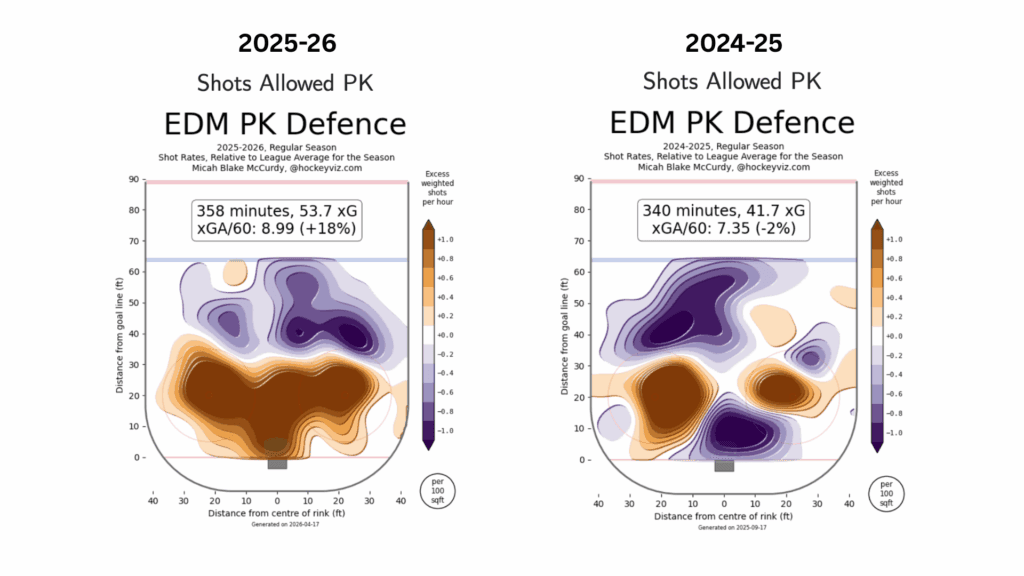
As you can see, the penalty kill gave up a ridiculous amount of chances this season, even in the inner slot, which they used to protect pretty consistently. The penalty kill has been a disaster all season, but against the Ducks, it reached a boiling point. Not even their power play could overcome the disaster happening on the other side of the special teams.
There’s a good chance we see some changes with the coaching staff this offseason, and it would surprise me if Stuart wasn’t one of the first on the chopping block. The Oilers would be wise to target good penalty killers this offseason to restore some of what was lost in 2024, especially with Henrique’s contract expiring, but a new voice could also be critical to breathing new life into this PK unit that’s in desperate need of it.
Carries With Chances – EDM: 41 ANA: 58
The Ducks have a lot of young, fast legs, so I expected them to be a challenge for the Oilers off the rush. Still, I didn’t expect them to out chance Edmonton by such a wide gap following carries across the offensive blue line.
Anaheim did a great job applying pressure on the Oilers when they cycled the puck high in the offensive zone, creating numerous odd-man rushes off turnovers. Edmonton’s 1-2-2 neutral zone structure was also quite porous, so even when the forecheck was supposed to be set, they couldn’t stop the Ducks from winding up ice with speed.
In what became a run-and-gun series, the Oilers were too careless with the puck, and they lacked attention to detail in their structure. That’s a connecting theme with most of these stats. The point shots are a symptom of dysfunction in the offensive game plan, the rush chances against come from a loose, disconnected neutral-zone forecheck, and an ineffective penalty killing system caused them to bleed chances.
Injuries certainly played a role in the Oilers first-round exit. Their top guys were too banged up to punch the Ducks back with the same force when they needed a push. That excuse isn’t the whole story, though. The truth is, they were simply not a cohesive unit in 2025-26, and that was evident from the way they played throughout the regular season and in this series.
PRESENTED BY DERRICK DODGE

There’s a new chapter beginning at Derrick Dodge, and the momentum is real. Under new ownership, the dealership is bringing fresh energy, a renewed focus on customer experience, and a bold, forward-thinking approach to vehicle buying. This change marks the start of an exciting new era, built around transparency, trust, and putting customers first. To celebrate this transition, every vehicle purchase comes with a trip for two to Las Vegas. Whether you’re shopping for your next vehicle or simply curious about what’s changed, Derrick Dodge is moving forward with confidence, purpose, and a clear vision for the future.


Breaking News

Edmonton OilersTeam Cap Summary

Cap Summary
2026-27
2027-28
Projected Cap Hit
$103,771,666
$88,322,500
Projected Cap Space
$228,334
$25,177,500
Current Cap Space
$228,334
$25,177,500
Active Players
23/23
16/23
Draft Picks
Round
'27
'28
1
0
1
2
1
0
3
0
1