
OilersNation has no direct affiliation to the Edmonton Oilers, Oilers Entertainment Group, NHL, or NHLPA
D.J. Smith has a plan to fix the Oilers’ penalty kill
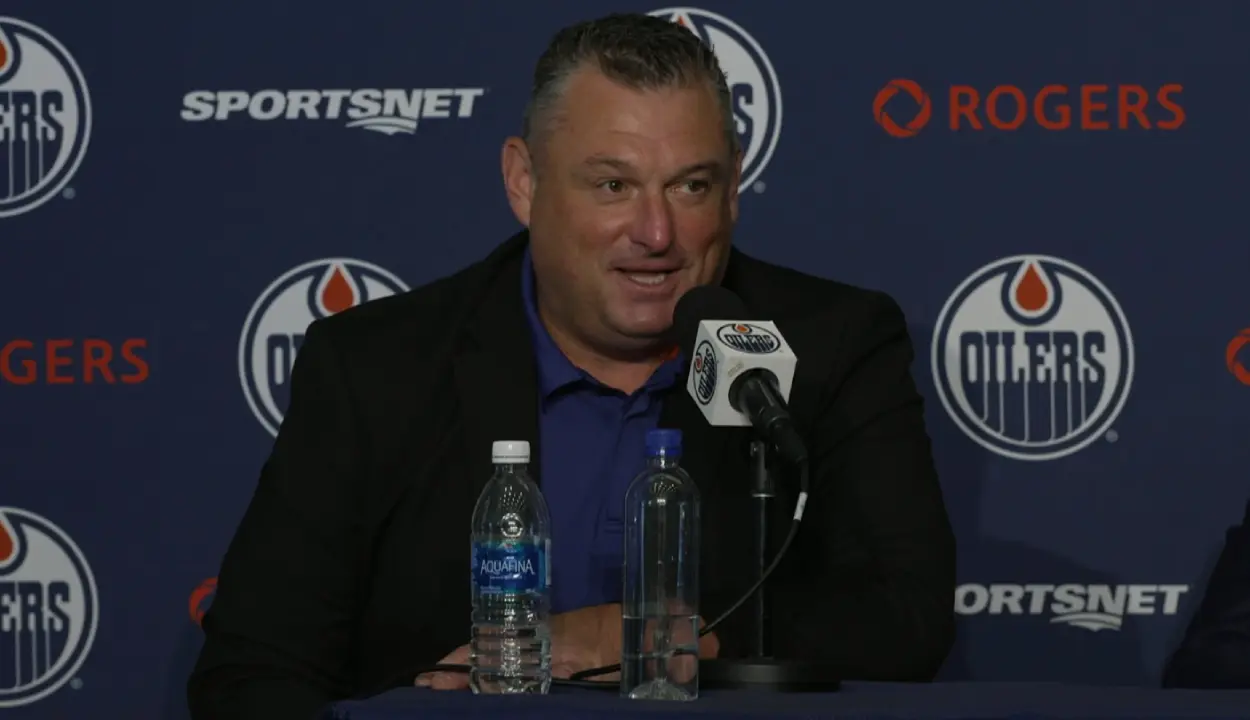
Photo credit: Oilers+

By Jason Gregor
Jun 24, 2026, 11:00 EDTUpdated: Jun 25, 2026, 13:01 EDT


Over the past five years, the Edmonton Oilers have had a below-average penalty kill.
They’ve allowed the ninth most power play goals since 2022, been shorthanded the 11th most times and are tied for 17th with a 78.4 per cent penalty kill. They have ranked 17th, 20th, 15th, 16th and 20th each of the past five seasons. They did have one great stretch right after Kris Knoblauch was hired as head coach. Their penalty kill was 81.7 per cent (seventh-best) in the 69 regular-season games with Knoblauch and Mark Stuart running it, and then it was outstanding in the 2024 playoffs at 94.3 per cent.
But that run has been the outlier. The penalty kill has been dreadful the past two playoffs, clicking at an ugly 67.1 per cent in 2025, allowing 23 goals on 70 kills, and this year they had the worst penalty kill in the playoffs at a pathetic 50 per cent allowing eight goals on 16 kills in their series loss to Anaheim.
What can the new coaching staff do to improve the penalty kill?
First off, I asked Jason Dickinson and Connor Murphy, who made up 50 per cent of the league’s top penalty killing unit last year in Chicago, before getting traded to Edmonton, to give a player’s perspective. Dickinson shared his thoughts first.
“If you look at different teams and different systems and what works. Carolina plays an all-out press. All four guys are constantly going the whole time. They are the gold standard right now, because they just won the Stanley Cup. So, would that system necessarily work for us? Would it work for another team? Maybe not. It’s really important that as a group of PKers and whoever might be out there on the kill, there’s going to be guys that rotate in and out that aren’t consistent, but as the core group of PKers, it’s important that with the coaching staff, we put together a plan that works best for the players. You can implement a system that doesn’t make sense for the guys that you have on the ice and it’s not going to work.“It’s important that everybody has feedback on what feels right. What they feel like they’re opening up and what’s going to be exposed. The biggest thing is to communicate with the coaches and the players that, ‘Hey, this doesn’t feel right, or this is what’s been working and what I like to do, and these are my tendencies and how it fits in with this system.’“I’ve played all kinds of systems on the penalty kill. I started with the top-down press. I went to a diamond in Chicago and then we went to more of a hybrid press down with a diamond in Chicago last year. It’s not that one system works, it that the system needs to fit the players.”
Dickinson is big on communication. The coaches and players have to be on the same page. Mike Babcock and his staff will need to decide who is on the penalty kill and then ask them what they feel is the best system for their group. Ultimately, the players need to trust it, have the skill to implement it, and they will need quality saves from the goalies.
Murphy shared his thoughts on how they can improve the penalty kill.
“I think having guys like a group of consistent players, like we did in Chicago, where we had four of us that we’re killing together almost every kill, really helps. Just to have some chemistry and being able to build momentum. It takes a little bit to start a season with a group of guys, but finding consistency and continuity is key. That’s why it was tough when we got there (Edmonton) with mixing up our kills (new system) and adding players. You want to build momentum through the details that coaches are bringing.“And then you ride that, and you just gain that confidence between the goalie and the players on positioning and angles, and you end up getting saves where you should have gotten scored on because goalies know where you’re standing, and you end up getting confidence. Confidence on the penalty kill is similar to the power play. When you have it and trust what you are doing success follows.Talking with some guys, like Ekky (Ekholm) and Bouch (Bouchard) and even coach Stu (Mark Stuart) about the playoffs, I don’t know if it was last year or the year before they said they went on a crazy run and they didn’t get scored on, and the momentum just built. So just to have that momentum, I think it is important, as you gain confidence in each other. I think that will be a big thing to start the season with whatever system we’re trying to build with.”
Dickinson spoke more about the technical side, while Murphy added the importance of the mental side. If the players trust the system, it is easier to gain confidence. You get a few good kills, and you start to believe you will kill off the next one. I know in the 2024 playoffs the Oilers had so much confidence in their penalty kill that during intermission players would say, “Don’t be afraid to take an aggressive penalty — we will kill it off and gain momentum.” And usually, they did. They only allowed one power play goal in three of their 25 playoff games that year.
They killed all 12 penalties against the Los Angeles Kings in round one.
Vancouver went 1-for-3 in Game 2 and 2-for-3 in Game 3, but then went 0-for-14 in Game 4-7.
Edmonton killed off all 14 Dallas penalties in round three.
They killed off 20 of 21 against Florida in the final.
Their confidence was so high that year that they welcomed an opposing power play. In their final 17 games, they only allowed one goal on 49 kills and allowed only 61 shots in 90:59 of penalty kill time. They were absolutely dominant. And they were only 45.3 per cent on shorthanded faceoffs. The penalty kill excelled due to how aggressive and in sync they were.
Cody Ceci (205 minutes) and Darnell Nurse (202) killed the most followed by Mattias Ekholm (160) and Vincent Desharnais (159). The forwards were Ryan Nugent-Hopkins (158), Mattias Janmark (128), Connor Brown (124), Derek Ryan (112), Ryan McLeod (100), Warren Foegele (72) and Leon Draisaitl (43). Draisaitl came out for faceoffs mainly, as he took the second most and went 53-43. When he won the faceoff, he’d quickly go off.
PK UNITS FOR THIS SEASON…
Murphy and Dickinson should be on the first penalty kill unit. With Darnell Nurse asking for a trade, Murphy’s penalty kill partner is still undecided. It will likely be Jake Walman or Ekholm. I’d have Ty Emberson on my second unit’s penalty kill. I’d rather play Evan Bouchard on the power play and five-on-five. He can play some penalty kill time, and he’s smart enough to kill, but I wouldn’t have him as my penalty kill minute leader this season like he was last year.
Up front, you want a clear top forward pairing. Kasperi Kapanen and Dickinson were good together in the playoffs, but Kapanen is testing free agency. Matt Savoie played the most penalty kill minutes last year, and he’s quick and reads the play well. He’s an option, but it will depend on how Mike Babcock wants to distribute minutes. He was adamant in his press conference yesterday, that his depth players will have more of a role. I think Nugent-Hopkins should have his overall minutes reduced slightly, and it might come on the penalty kill. RNH is more effective on the power play than he is on the penalty kill. He could be in the third group of killers. I’d give Vasily Podkolzin a look. His work ethic is second to none. He is willing to block shots, skates well, and the only question is whether he can read and react how they want. Josh Samanski, or if they sign a unrestricted free agent fourth-line centre, should anchor the second penalty kill group. Before being fired, Kris Knoblauch mentioned at his end-of-season presser that they would try Trent Frederic on the penalty kill. I know Colton Dach would like an opportunity as well. If Mattias Janmark is healthy and can contribute he’s a solid penalty killer.
Edmonton has options, but they need to find the right partners and match them up with a system that works.
D.J. Smith will oversee the penalty kill. Jim Matheson and I had a conversation with him after the press conference, and it seemed clear he will want a more aggressive penalty kill.
“I’ve been a pressure guy my whole life. I hate sitting back, but if that’s what is going to get the job done, that’s what we’re going to do. Mike and I will sit down, and we’ll look at the best kills. But I know that the two best in the league every year is Carolina and Florida, and two years ago it was L.A. and we pressured everything that moved. When we look at the forward group and the D group and ask can we do that and then we’ll make the best plan.“But I can tell you this, the best players in the world want time. So, we got to take time and space away. I think the number one thing we’re going to improve here is our stand at the line on zone entries. Edmonton was 27th in the league last year at denying entry on the penalty kill. I’ve always been a 1-3 guy, that’s going to hold hard at the line. We are going to try and keep get that number down, and if you can get that into the top 10, then you’re creating turnovers and you’re not spending as much time in your zone.”
The penalty kill has been consistently below average for years, and outside of a stellar run in 2024, it has been a weak spot. Smith wants that change in 2026-27.
HERE AND THERE….
— Smith coached Evan Bouchard and Darnell Nurse at the World Championship and added this about tidbit about Nurse on the penalty kill.
“I hope that I can coach Nursey because he’s a big man with reach and length and our penalty kill over there was 93 per cent, and net 100 per cent, and he was the number one guy out the door. It was a different system where we pressure, pressure, pressure. He hasn’t had the opportunity to do that in Edmonton, as it’s been more of a sit at the net and make reads kind of style. I think with his length and his athleticism he can be an elite penalty killer in the National Hockey League. Now, that’s not my business (trade request), that’s his and his family’s and Stan’s, but I would certainly welcome him back.”
— Smith is excited to coach Bouchard full-time after getting to know him for a month at the World Championships. Bouchard was outstanding, before being concussed and missing the playoffs.
“I loved his demeanour. I liked his attitude off the ice. We connected right away. I love players. They are all different and unique, but I feel like me and Bouch are going to have a really good relationship. I’m will push him to be, in my opinion, a superstar. I think he’s even better than he’s been. I think there’s been a knock on his defensive play, and we have to look at it, and I have to push him to be better. We’d like to remove that (reputation) from him and give him an opportunity to be a guy who can be an Olympian.
Matheson asked him, “How do you get away from how he looks nonchalant at times?
“His nonchalantness is what hurts him, but it also makes him great. I mean, he’s willing to sit in the pocket longer than most quarterbacks to make that play where other guys panic. When I talk about Drew Doughty, the best part about Drew is he still thinks he’s the greatest player in the league and that helps great players because they never look down on themselves. They’re always thinking that they got the mental edge on someone and I feel with Bouch, he feels he can make a play at all costs. I talked to him last week when I talked about coming here. I’m like sometimes in football, even Dan Campbell (Detroit Lions head coach) punts. You know what I mean? Sometimes it (a pass or play) isn’t there and you can’t force it, so we have to do that (dump it out or make safe play), because if we do that, your game’s going to skyrocket like, but we have to learn that, and the I had a month to build a relationship with him. So, he knows it’s coming from a place of I’m trying to help this kid. I’m not a dictator. I’m not going to stand up there and say I got all the answers, I’m just to try and help him be the best player he can be.”
— Smith has coached against Connor McDavid and Leon Draisaitl. I asked him whether he preferred seeing them on a line together or centring their own line when he coached against them?
“It’s better when they’re on one line on the road in my building. When we played in L.A., for instance, I want them on one line. I know I can essentially put all my eggs in one basket to shut them down with Kopitar, Doughty, Anderson or whoever, and we’re going to stay above you the entire night. The other players are just racing on and off because it’s all about getting them the puck and giving them the minutes, so if you can keep them off the board and not take too many penalties you can win.“I don’t like when they got the two of them together in Edmonton because I can’t get the matchup. It’s a tough one and Mike’s going to make that decision, but clearly, they will play together at times. In this building it is a real hard one when you get them together, especially when they get you on an icing or they get you on a bad change and one of your weaker defensive lines is on the ice, and here they come with Bouch, or whoever it is and you’re pinned in for a deuce. It’s like killing a penalty. It can be a big advantage the home/road situation for me.”
Listening to Smith tells me we will see them together at times, likely more at home than on the road. They only played 317 minutes together at five-on-five last season, and I’ve heard the argument that if you play them together there is more icetime for other players, but I’m not sold on that. If depth players have roles on the penalty kill, and Babcock is adamant they will play around 20 minutes/game, then there are still benefits to having them on their own line.
— The one idea I don’t agree with it from those suggesting the first unit power play should play less. It is the biggest weapon the Oilers have. If you eliminate McDavid and Draisaitl’s penalty kill, and one or two shifts at five-on-five, that makes more sense to me. The power play has been the best in the NHL over the past five seasons, by more than three per cent over every team in the NHL and five per cent better than every team except Tampa Bay, Toronto, Dallas and the New York Rangers. That is a massive advantage and lowering that just to give the second unit an extra 30 seconds could lower your chances of scoring.
I could see them splitting time on the first unit. They used to have Zach Hyman and Evander Kane split time, so maybe they do that with another player, and maybe even split RNH’s time with Savoie. But I see little benefit from removing McDavid and Draisaitl earlier. Edmonton was 27-13-7 in games they scored a power play goal and 14-17-4 when they didn’t. It is a clear advantage and increases their chances of winning.
PRESENTED BY PRAIRIE TOYOTA DEALERS

It’s time for a truck that can play in every zone. Which means, it’s time to Toyota! Its standard i-FORCE engine delivers more power than ever and a towing capacity of up to 6,400 lbs. It helps you take on challenging landscapes with confidence with its available Panoramic Multi-Terrain View Monitor that provides a live, underfloor view of the terrain your tackling. It even makes loading and unloading gear effortless with its available Power Liftgate. Whether it’s for early morning practice or weekend away games, the Tacoma is a teammate you can rely on. Visit your local Prairie Toyota dealer today.


Breaking News
- Ryan Shea’s strong Oilers debut, in sync with the top unit, comes as no surprise
- Mike Babcock praises Colton Dach as Oilers test him at centre
- ‘He taught us how to work’: Sean Avery endorses Oilers hiring Mike Babcock
- Monday Musings: New pre-season rules, schedule quirks, Evan Bouchard and more…
- Oilers 2026 Prospect Countdown No. 1: Isaac Howard

Edmonton OilersTeam Cap Summary

Cap Summary
2027-28
2028-29
Projected Cap Hit
$88,322,500
$61,025,000
Projected Cap Space
$25,177,500
$61,975,000
Current Cap Space
$25,177,500
$61,975,000
Active Players
16/23
10/23
Draft Picks
Round
'27
'28
1
0
1
2
1
0
3
0
1