
OilersNation has no direct affiliation to the Edmonton Oilers, Oilers Entertainment Group, NHL, or NHLPA
Do the numbers support the Oilers loading up McDavid and Draisaitl?
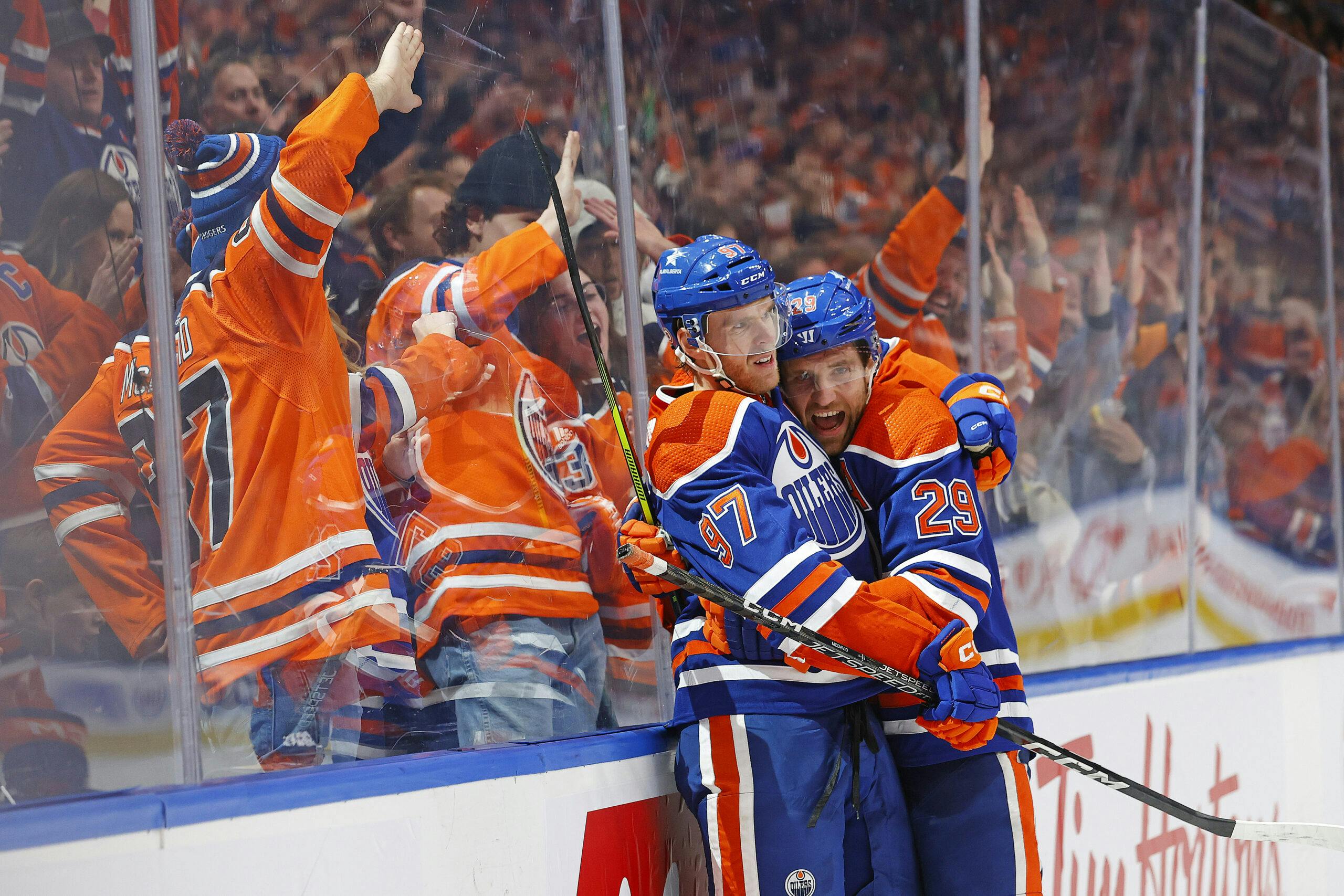
Photo credit: Perry Nelson-USA TODAY Sports

Sep 26, 2026, 09:00 EDTUpdated: Sep 25, 2026, 16:12 EDT


The Edmonton Oilers have spent years debating whether they are better with Connor McDavid and Leon Draisaitl together or apart. But over the past three seasons, the answer has depended heavily on who plays beside them.
With Zach Hyman on their wing, McDavid and Draisaitl have outscored opponents 60-26 at five-on-five since 2023-24. Without him, Edmonton has actually been outscored 29-27.
As Mike Babcock begins his tenure in Edmonton, he appears ready to start with McDavid and Draisaitl together. “I’m going to try and start with the two of them together, for sure,” Babcock said, as the two have been on a line with Vasily Podkolzin since captains’ skates. He has also said he likes both McDavid’s and Draisaitl’s ability to drive a line on their own and believes Ryan Nugent-Hopkins can do the same.
That makes his approach especially interesting because Babcock has historically leaned toward balance. From 2007-08 through 2014-15 in Detroit, Pavel Datsyuk and Henrik Zetterberg spent only about 35 per cent of their five-on-five minutes together, with Babcock more often leaning toward each star driving his own line.
Splitting McDavid and Draisaitl has already given Edmonton two effective lines. The question is whether Podkolzin can help the top line be dominant enough to make breaking that up worth it.
How much does the third linemate matter?
If the Oilers opt to load up 97 and 29, the third member of the line matters a lot more than you would think.
Over the past three seasons, McDavid and Draisaitl have produced some dominant results together at five-on-five, but much of that dominance has come with Zach Hyman alongside them. Take Hyman away, and the numbers change considerably.
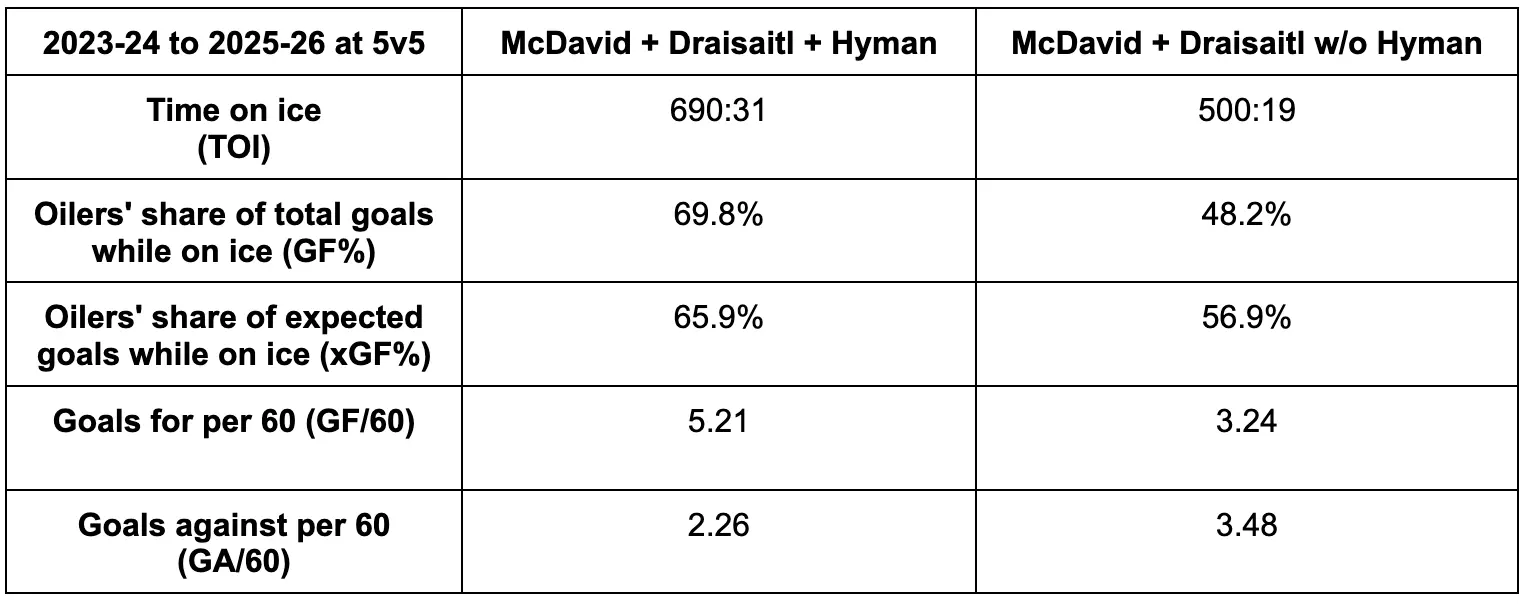
Considering they are two of the NHL’s best players, you’d expect them to dominate regardless of who plays alongside them, but the numbers suggest that hasn’t been the case.
With Hyman, the trio has scored 5.21 goals per 60 minutes while allowing just 2.26. Without him, the scoring rate falls to 3.24, while the goals-against rate jumps to 3.48. Their underlying results remain strong as they carry a 56.9 per cent expected-goal share, but that’s still a sizeable drop from the 65.9 per cent mark they’ve posted with Hyman.
Simply putting McDavid and Draisaitl together hasn’t automatically created an unstoppable line. The third member has mattered, and their results without Hyman haven’t come close to matching what the trio produced together.
That’s what makes Podkolzin such an interesting choice to open the season alongside them. His game shares some of the qualities that have made Hyman successful, such as his forechecking and puck retrieval, without needing to be the primary puck carrier. The trio looked promising in its preseason opener this week, but with fewer than 56 five-on-five minutes together, the sample is still far too small to know if it will translate.
If Podkolzin can bring some of what Hyman did, stacking the two superstars becomes much more intriguing, but Babcock would still have to weigh that upside against what they give up by separating two combinations that have already worked.
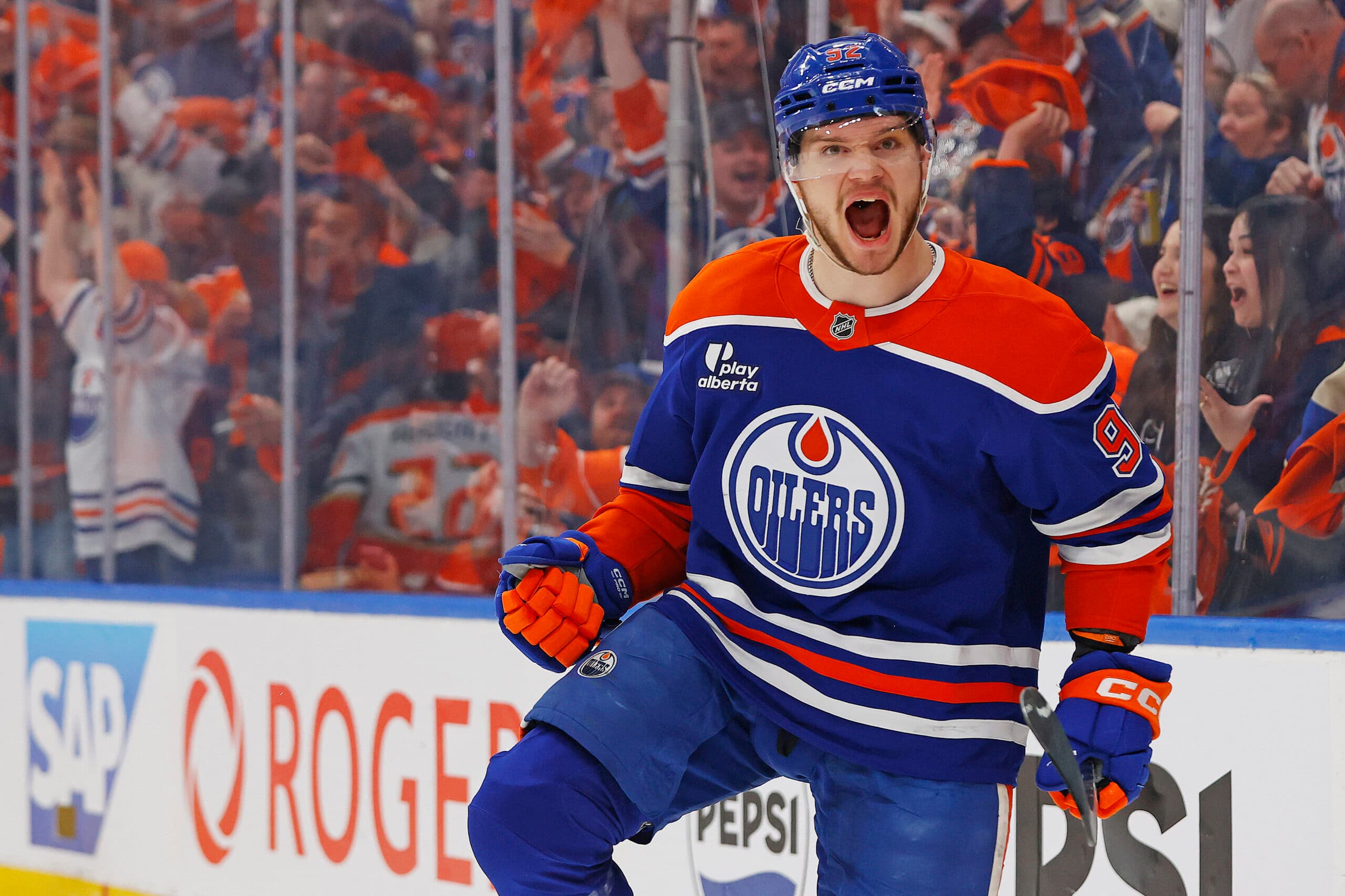
Apr 28, 2026; Edmonton, Alberta, CAN; Edmonton Oilers forward Vasily Podkolzin (92) celebrates after scoring a goal during the first period against the Anaheim Ducks in game five of the first round of the 2026 Stanley Cup Playoffs at Rogers Place. Mandatory Credit: Perry Nelson-Imagn Images
What do the Oilers give up by going nuclear?
The other side of the McDavid/Draisaitl debate is what the Oilers give up by putting them together. Over the past three seasons, the Oilers have already gotten strong results from splitting their stars, with McDavid playing alongside Nugent-Hopkins and Hyman, while Draisaitl drives his own line away from those three.
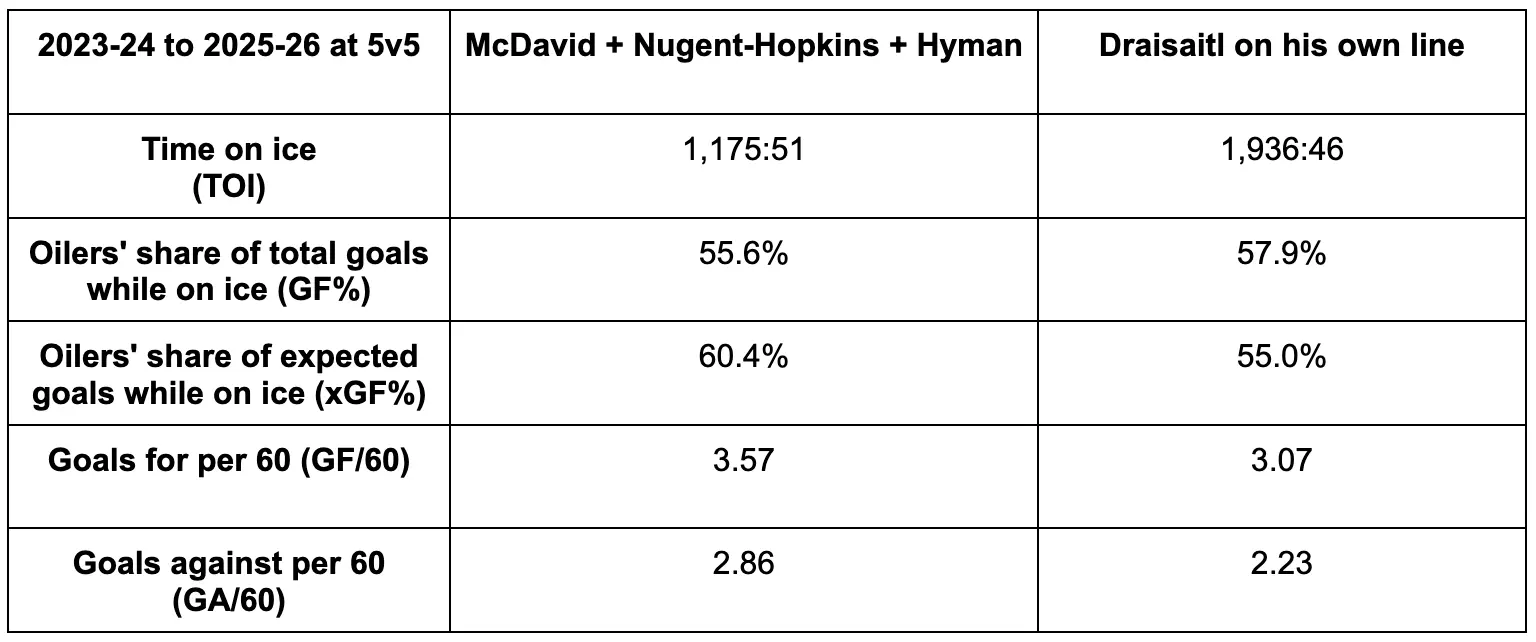
The line of McDavid, Nugent-Hopkins and Hyman has controlled 60.4 per cent of the expected goals in nearly 1,200 five-on-five minutes together. Draisaitl, centring a line without those three, has controlled 55.0 per cent of the expected goals and 57.9 per cent of the goal share over almost 2,000 minutes.
Neither line matches what McDavid, Draisaitl and Hyman did together, but the Oilers get two effective lines instead of one dominant one. Averaging the numbers across the two lines, splitting the two superstars has produced about a 57.7 per cent share of the expected goals.
That is the bar a loaded-up top line has to clear. If the nuclear option only reproduces what they did without Hyman (56.9 per cent expected-goal share), it would sit below McDavid’s line and barely above Draisaitl’s, while also taking him away from a second line he has already shown he can drive.
Who would hold down the second line?
If Podkolzin can give McDavid and Draisaitl something close to what Hyman has, and the line continues controlling roughly two-thirds of the expected goals, the next question is whether Nugent-Hopkins and Hyman can give Edmonton enough on the second line without either superstar.
Babcock has said he believes Nugent-Hopkins can drive a line on his own, but the history of that isn’t very encouraging. As I wrote earlier this month, the Oilers have controlled just 47.7 per cent of the expected goals over the last 10 seasons with Nugent-Hopkins on the ice without McDavid or Draisaitl. That said, playing with Hyman has helped, as since 2023-24, the Oilers have broken even 17-17 in goals and controlled 51.0 per cent of the expected goals in nearly 360 five-on-five minutes with neither superstar on the ice.
Those are respectable results, but they are closer to average, and don’t prove the pair can anchor a second line.
So, do the numbers suggest going nuclear?
The numbers don’t make a clear case for it — though it’s worth remembering that these are historical rates, not guarantees of what will happen in 2026-27.
Assuming roughly equal usage between the top two lines, splitting Edmonton’s two superstars on separate lines has produced an average of 57.7 per cent of the expected goals and a 56.8 per cent goal share over the past three seasons.
Even in a best-case scenario, where Podkolzin helps McDavid and Draisaitl replicate the 65.9 per cent expected-goal share they posted with Hyman, the overall gain is small. Paired with a Nugent-Hopkins/Hyman-led second line at 51.0 per cent, the two lines combine for an average of about 58.5 per cent of the expected-goal share, barely better than splitting them. The actual-goal numbers look more favourable to loading up, but the trio’s 69.8 per cent mark was inflated by finishing well above its underlying numbers.
That said, if Podkolzin can’t help McDavid and Draisaitl reach the level they did with Hyman, and the duo instead looks more like it has without him in the past, the picture changes quickly. Combined with a Nugent-Hopkins/Hyman second line, the two units average roughly 54 per cent of the expected goals and a 49 per cent goal share, both worse than what Edmonton has gotten by keeping its stars apart.
Based on past numbers, even at its ceiling, going nuclear offers only a modest advantage. Fall short of that ceiling, and the numbers make a much stronger case for the balance the Oilers already know works.
🪦 RIPNATION: GET YOUR TICKETS NOW

After nearly two decades, it’s time to say goodbye to Oilersnation — the brand name, that is. Everyone is fine. In fact, we’re throwing a funeral to pay our respects to the logo that was…. Join us Saturday, September 26th at The Pint Downtown for RIPNATION: In Loving Memory of a Logo, a one-night-only celebration of the end of an era and the beginning of something new. Expect the unexpected….
Tickets exclusively available at nationexperiences.ca


Breaking News

Edmonton OilersTeam Cap Summary

Cap Summary
2026-27
2027-28
Projected Cap Hit
$103,771,666
$88,322,500
Projected Cap Space
$228,334
$25,177,500
Current Cap Space
$228,334
$25,177,500
Active Players
23/23
16/23
Draft Picks
Round
'27
'28
1
0
1
2
1
0
3
0
1