
OilersNation has no direct affiliation to the Edmonton Oilers, Oilers Entertainment Group, NHL, or NHLPA
Oilers History: Forty years ago today Sports Illustrated alleged five players on team have ‘substantial cocaine problems’

May 12, 2026, 12:00 EDTUpdated: May 12, 2026, 15:05 EDT


Imagine just days after one of the most gut-wrenching losses in your career, you and your teammates were embroiled in a public scandal after a scathing article accused you of being a team of drug addicts. That’s what happened to the Edmonton Oilers in 1985-86.
Steve Smith infamously banked the puck off of Grant Fuhr’s leg into the Oilers net with 13 minutes left in Game 7 of the Smythe Division Final against the Calgary Flames on April 30, 1986. Edmonton couldn’t find a tying goal.
That hard-fought Battle of Alberta classic series in 1985-86 gave the Flames legitimacy that they could compete with the Oilers and stopped Edmonton’s bid for three straight Stanley Cups.
Questions surrounded the team after losing on April 30, and “growing up,” they’d have to do.
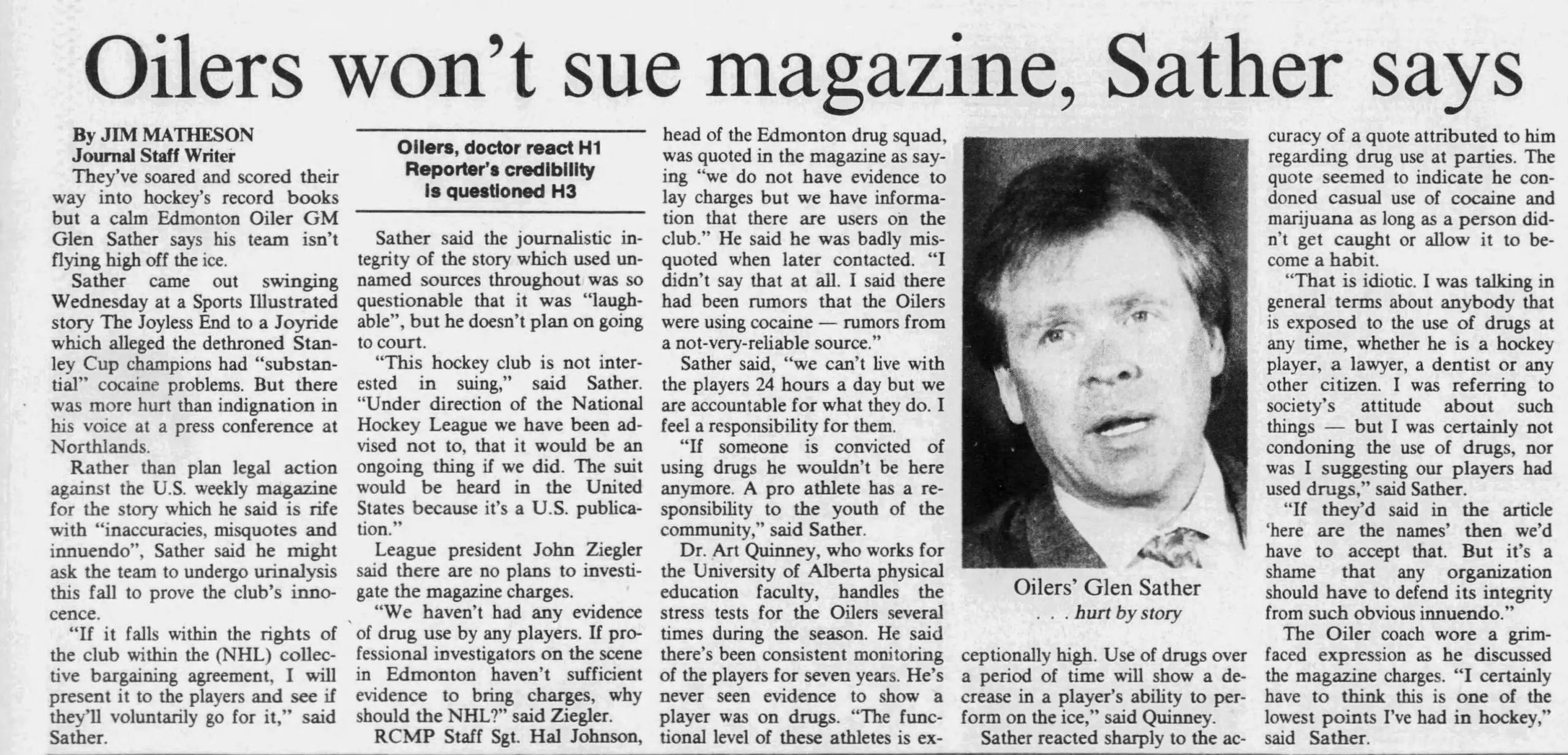
But that quote took on a new context less than two weeks later, when a Sports Illustrated story linked the franchise with rumour, innuendo, and criminality.
Forty years ago today, SI published an article that claimed five unnamed Edmonton Oilers had “substantial cocaine” problems, according to the writer’s unnamed sources.
The piece in the May 12, 1986, issue was called “The Joyless End to a Joyless Ride” and put the organization under a level of public scrutiny it hadn’t seen before. The Oilers denied these claims, even getting ahead of the magazine’s release to refute the rumours vociferously.
“One former Oiler insider told SI that at least five team members have had ‘substantial’ cocaine problems,” the article, written by Armen Keteyian and Donald Ramsay, claimed in 1986.
“Three sources told SI they have seen Oiler players use cocaine or marijuana at parties in Edmonton and other NHL cities. One agent quoted an Edmonton player he represents as having told him, ‘Every time we go into New York City, it’s a real blizzard, and I’m not talking about the weather.’”
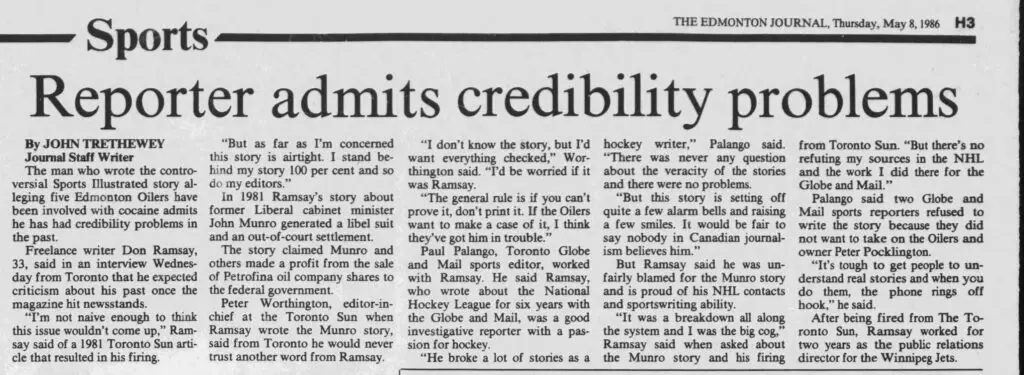
Edmonton Journal article on May 8, 1986, after an advanced article about the Edmonton Oilers and alleged drug use was released.
The article went on to allege a series of “jams” with the police, personal finances, and “all sorts of escapades” in the early years of the franchise.
The writers talked to Max Offenberger, a Boston-based educational psychologist, who was hired by Glen Sather in 1981 to work as a consultant and to help provide information related to alcohol and drug abuse for the Oilers.
Offenberger is quoted in the article as saying that the club came “too far, too young, too fast” and had “too much money and too much freedom.”
Amongs other alleged situations were Mark Messier driving his Porsche into three parked cars and leaving the scene, DUI charges for Dave Semenko and Dave Hunter, and a Christmas party in 1984 where the Oilers were allegedly privy to where city police had set up checkstops, something only 20 officers knew of.
Grant Fuhr’s financial problems were discussed, as Sather became his unofficial “financial manager,” the article alleged, helping him buy a house, but also putting a lien against it.
Overall, the tone was ugly and painted the Oilers in an unflattering light, to say the least.
“I’m not so naive to think that no one on this hockey club has been exposed to something they shouldn’t have,” said Sather in the article. “Any kind of drugs you want to find, I’m sure has been exposed to this team at one time or another.
“If a guy goes to a party, gets drunk, or sniffs a line of cocaine, or smokes a joint, that doesn’t make him a compulsive user or dealer or anything. That makes him a guy who went to a party and had a good time. If it becomes a habit, if he gets caught, then you’ve got a problem. But until it’s a problem, I can’t do anything with it.”
The response
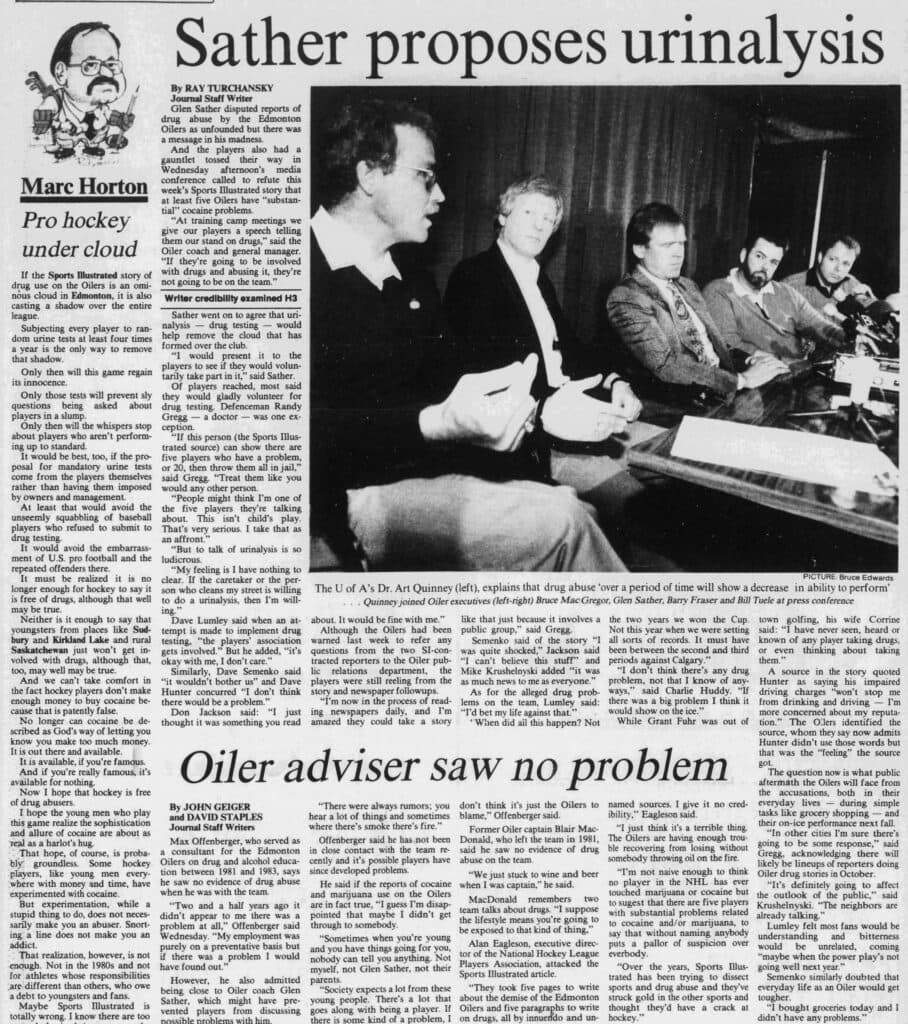
This bombshell article received major backlash from the Oilers and the hockey world. Days before, on May 8, Oilers executives held a press conference to address these rumours.
Sather refuted these charges and called the article “yellow journalism.” Editorials in the ensuing days would question Sports Illustrated’s use of unnamed sources to fuel the story. However, the Oilers were advised not to sue SI.
He also took umbrage at the quote attributed to him above about party behaviour and resented the fact that it came across as condoning this conduct.
During the press conference, Sather seemed open to the idea of players voluntarily doing urinalysis if they saw fit to leave no doubt about their status, but that it wouldn’t be a requirement. Many Oilers were quoted in that edition of the Edmonton Journal as saying they were open to it, but notably, defenceman Dr. Randy Gregg said it was ludicrous.
Another Journal story that day quoted Max Offenberger as saying he didn’t see any drug abuse on the team when he worked there from 1981 to 1983.
“Two and a half years ago, it didn’t appear to me there was a problem at all,” said Offenberger in the May 8, 1986, edition. “My employment was purely on a preventative basis, but if there was a problem, I would have found out.”
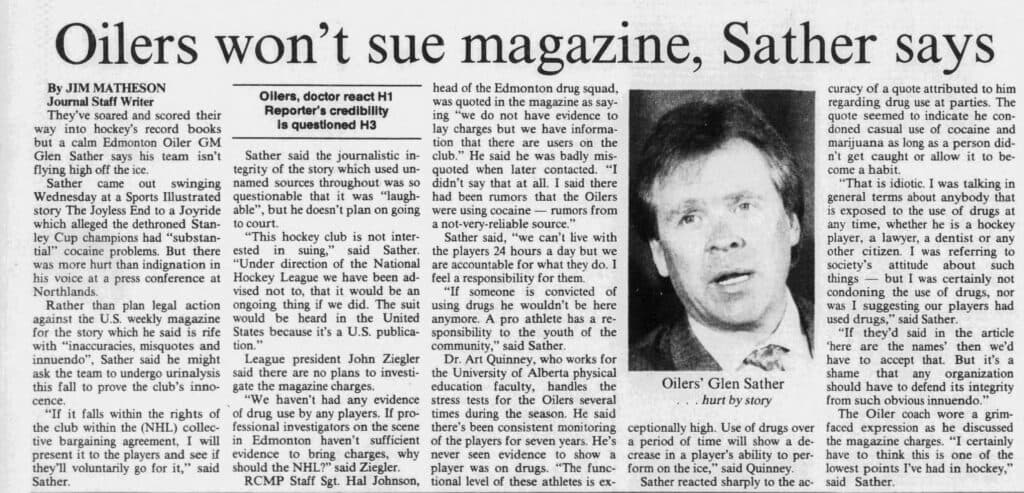
RCMP Staff Sgt. Hal Johnson, head of Edmonton’s drug squad, was quoted in the SI story as saying they had information, but “not enough evidence” to lay charges against certain Oilers. In the Edmonton Journal, Johnson said he was badly misquoted and only that they’d received rumours from a “not-very-reliable” source.
NHL president John Ziegler said the league would not investigate these claims, saying there was no evidence.
Later that week, Wayne Gretzky said he would welcome drug testing in the NHL, but wouldn’t comment specifically about the SI story.
There was another wrinkle.
Donald Ramsay’s credibility was questioned due to his past. A 1981 Toronto Sun article claimed politician John Munro profited from the sale of shares in the oil company Petrofina to the federal government. It became a libel suit and ended in an out-of-court settlement.
“I’m not naive to think this issue wouldn’t come up,” Ramsey said about the article. “But as far as I’m concerned, this story is airtight…”
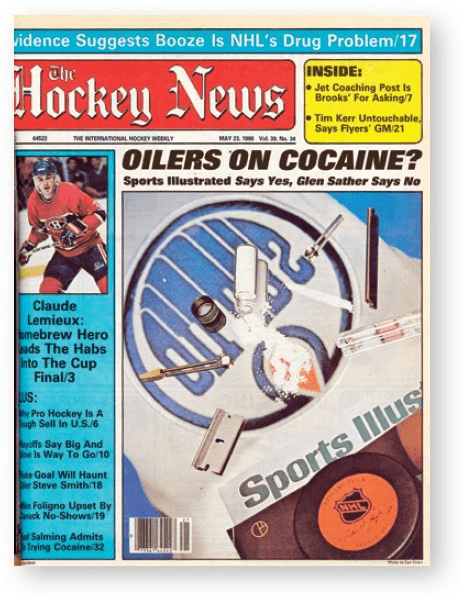
The Hockey News. May 23, 1986.
Fuhr
In 1990, Grant Fuhr was suspended by the NHL for one year due to “dishonourable conduct” to the league. He had admitted to a cocaine problem in August 1990 that had lasted seven years and the year prior, spent two weeks in a treatment facility.
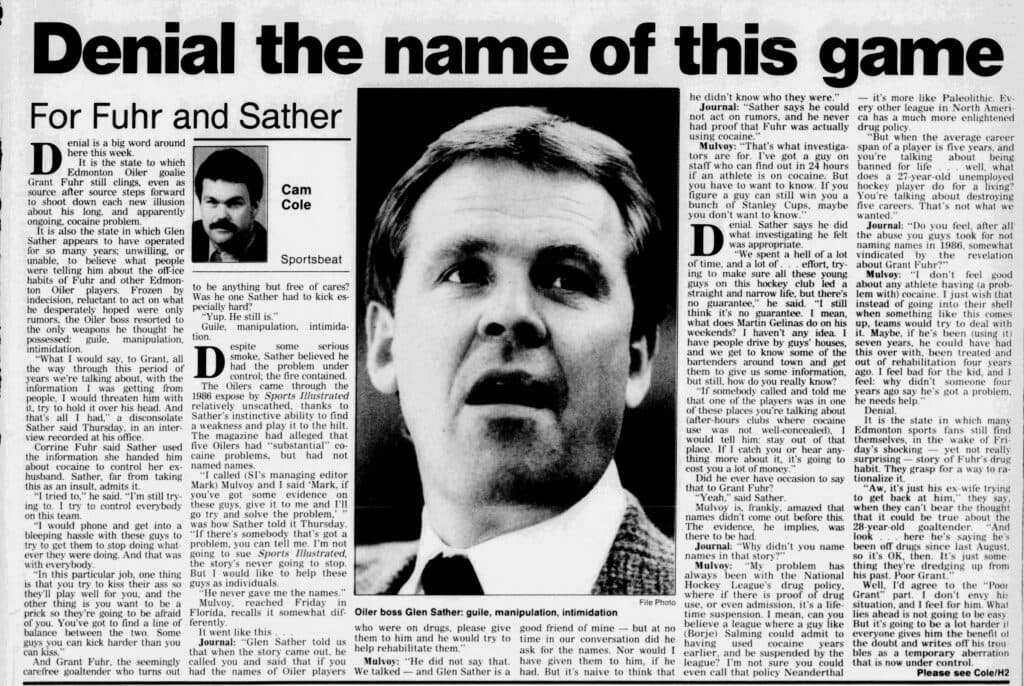
While it may have put some credence to the rumours of old, Edmonton Journal columnist Cam Cole, talked to Sports Illustrated’s managing editor Mark Mulvoy. He had this to say.
“My problem has always been with the NHL’s drug policy, where if there’s of drug use, or even admission, it’s a lifetime suspension,” said Mulvoy in the Sept. 1, 1990 edition of the Journal.
The NHL did have a draconian drug policy at the time. Around the time of the original SI story in 1986, Borje Salming admitted he had experimented with the drug “five or six years ago” but not since.
Ziegler initially suspended Salming for an entire season due to his admission, but it was eventually reduced to eight games.
Fuhr has been open about his struggles, as mentioned in Making Coco: The Grant Fuhr Story.
The Edmonton Oilers’ public reputation had taken a hit, but their production on the ice did not.
The 1987 Oilers arguably was the best team in franchise history, as they learned from mistakes made the season before, and won their third Stanley Cup.
But May 1986 was a lightning rod moment for the organization, one many have forgotten, and others have learned from.
Michael Menzies is an Oilersnation columnist and co-host of PreGaming and Oilersnation After Dark. He’s also been the play-by-play voice of the Bonnyville Pontiacs in the AJHL since 2019. With seven years of news experience as the Editor-at-Large of Lakeland Connect in Bonnyville, Menzies collects vinyl, books, and stomach issues. Follow him on X at Menzies_4.


Breaking News
- Real Life Podcast: Oilers pre-season updates, Mark Messier’s Babcock comments, and Caleb Williams
- Oilers’ goaltending tandem ranks 25th in Daily Faceoff pre-season rankings
- Oilers respond to Messier’s comments: ‘He’s more than welcome to come here’
- GDB -3.0: Oilers youth travels to Vancouver (8 PM MT, SN)
- Three players to watch in tonight’s Oilers vs. Canucks pre-season game

Edmonton OilersTeam Cap Summary

Cap Summary
2026-27
2027-28
Projected Cap Hit
$102,921,666
$88,322,500
Projected Cap Space
$1,078,334
$25,177,500
Current Cap Space
$1,078,334
$25,177,500
Active Players
23/23
16/23
Draft Picks
Round
'27
'28
1
0
1
2
1
0
3
0
1