


"Pure wizardry"- @BizNasty2point0 This defensive play by Jackson Lacombe on McDavid was FILTHY

OilersNation has no direct affiliation to the Edmonton Oilers, Oilers Entertainment Group, NHL, or NHLPA
Oilers Thoughts: Connor McDavid’s tough series against the Ducks, fatigue and potential injury as factors, and more
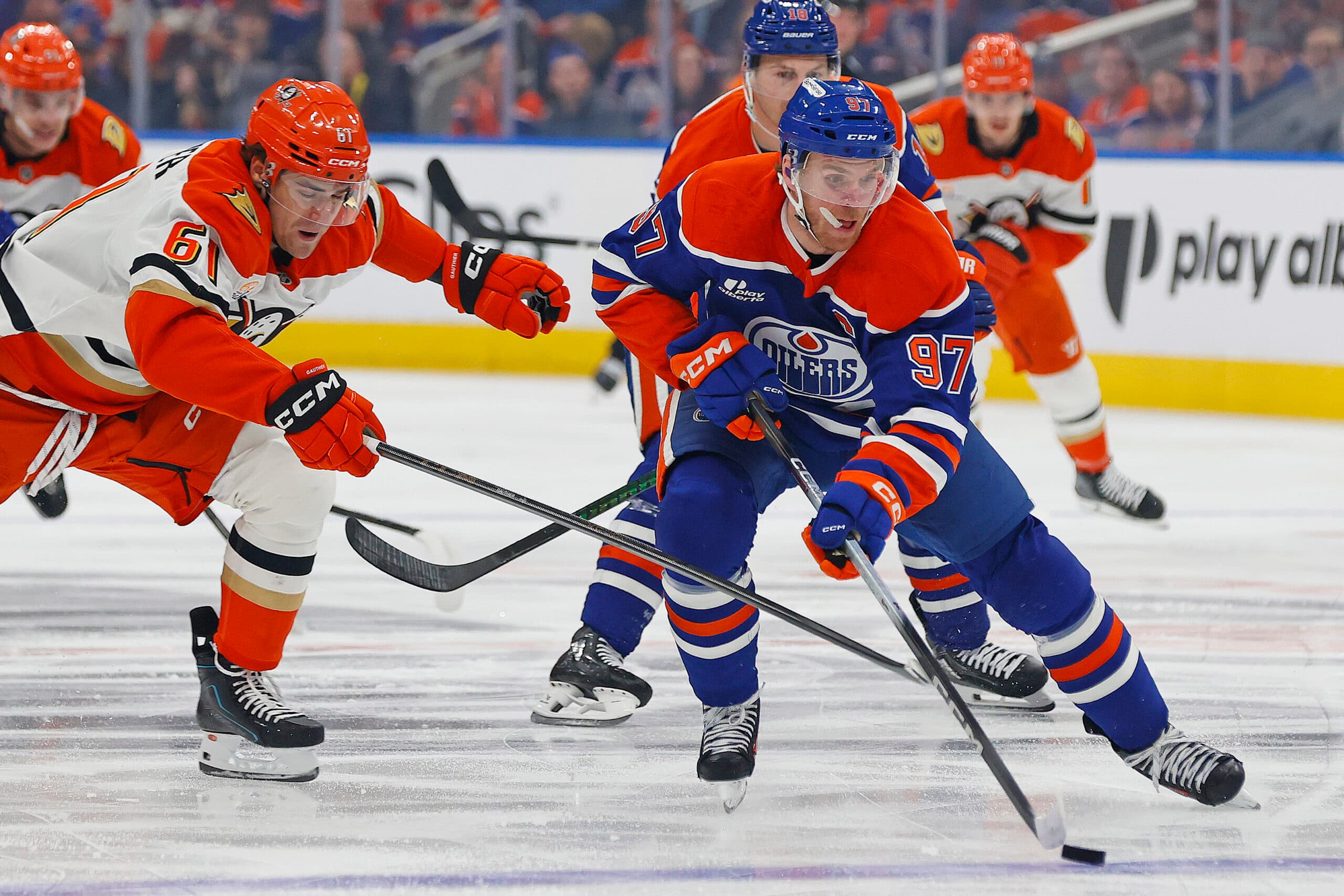
Photo credit: Perry Nelson-Imagn Images

May 2, 2026, 10:30 EDTUpdated: May 2, 2026, 15:41 EDT
It’s not too often we can say that Connor McDavid just “didn’t have it.”
We’ll hear soon about the injuries he was fighting through against the Anaheim Ducks in full detail, but with a team-worst -8 in the series, and with the Edmonton Oilers falling to the Ducks in six games for their first first-round exit since 2021, it’s fair to say the Oilers’ captain simply didn’t have it.
According to Natural Stat Trick, McDavid was on the wrong side of the five-on-five numbers against Anaheim, posting a 46.67 CF%, a 47.38 xGF%, a 3–7 goal share in favour of the Ducks, and being outshot 40–55 and outchanced 35–46.
Moreover, throughout the series, there was talk about how much Ducks blueliner Jackson Lacombe shut down McDavid.
There were moments where you thought the regular-season points leader was going to break through the Ducks’ D-corps off the rush, but it always seemed like there was a last line of defence in Lacombe, with the Ducks defenceman keeping pace with McDavid, and then either erasing him into the boards or swatting the puck away, most of the time.
The metrics also align with the eye test, as with Lacombe on the ice against McDavid at five-on-five, the shot share was 42–19 in favour of the Ducks, with the Oilers being outscored 6–2 as well. Still, McDavid did register six points in six games, which is nothing to take lightly, but for him, those are rather human-like numbers.
Fatigue and potential injury likely played the biggest role in McDavid’s struggles vs. Ducks
As many Oilers fans have watched McDavid produce out-of-this-world, highlight-reel moments his entire career, it’s tough to see the Oilers’ captain look “human.” On one hand, you could point to father time, even at age 29, starting to creep in, but in my opinion, his struggles in the series against the Ducks likely come down more to what’s been reported, which are injuries and fatigue.
I know we shouldn’t make excuses for these freak-of-nature athletes who are paid millions of dollars to play a sport, but McDavid has played an absurd amount of hockey over the last three seasons — 278 NHL games, including regular season and playoffs, plus another ten games with Team Canada at the Four Nations Face-off and the Olympics. That many games, played at such a high level, can take a toll on even the best athletes.
As well, looking back to the last Olympics, much like his NHL team, the Oilers do, Team Canada leaned on McDavid very heavily. Also, as a fan, I think about how crushing it was for Team Canada to lose the gold medal game to Team USA in overtime, and I can only imagine what McDavid would’ve experienced emotionally in that loss. Tenfold and more than what fans could imagine.
And to add to all those games he’s played and the physical and emotional toll it can take, and combine that with the last 14 games of this past regular season — where his ride-or-die in Leon Draisaitl was sidelined with an injury — McDavid, with his team’s playoff lives still uncertain, had to raise his game once again, which he did, registering 24 points over that span.
When you tally all of that up, combined with injuries we’ll soon hear about, I’m sure, there was not much left in the tank for McDavid in the playoffs when it was all said and done.
Thoughts on McDavid saying the Oilers were too “average”
After the 5–2 Game 6 loss to the Ducks, McDavid mentioned in his postgame interview that the Oilers were dealing with injuries, saying, “Too hurt too soon. The first round is always tough, it’s always chaotic, and it’s tough to play through things so early on, as many guys did in here.”
Yet, the most talked-about quote came when he said:
“We were an average team all year. An average team with high expectations, you’re going to be disappointed. We just never found it.”
I appreciate McDavid, who, earlier in his career, used to beat around the bush in interviews, that he was very candid and open about his team’s “average” season. After all, the Oilers had a tough time throughout the season putting together winning streaks, which was quite the contrast from previous seasons, more specifically when they went on a 16-game winning heater in the 2023–24 season.

"We were an average team all year. When you're an average team with high expectations, you're going to be disappointed." Connor McDavid speaks with the media following the end of the Oilers season
The Oilers finished with 93 points, their lowest point total since the 2018–19 season, and their penalty kill was rather “mid,” as the younger generation would say, finishing 20th at 77.8 percent before dropping to just 50 percent in the playoffs. In comparison, just two postseasons ago, the PK was spectacular and one of the team’s strengths at 94.3 percent.
The Oilers’ blue line, which went into the 2025–26 season with some saying it may be the best in the league, had consistency issues throughout the season, and that trickled into the playoffs, with the top pairing of Evan Bouchard and Mattias Ekholm having up-and-down moments throughout the series versus the Ducks. And if we were to get into the Oilers’ goaltending saga throughout the season, that would be a whole novel on its own.
Above all, and I know this reasoning has been played out like a broken record, but losing players like Connor Brown, Evander Kane, and Corey Perry — solid NHL veterans, I feel, reduced the team to that “average” standard that McDavid alluded to. And I think about the rotation of, rather inexperienced, players they had to use to fill holes due to necessity and injuries this season, like Connor Clattenburg, Isaac Howard, Quinn Hutson, Roby Järventie, Noah Philp, Alec Regula, and David Tomášek, come to mind.
It seemed like the Oilers, at times were just trying to plug holes with random pieces, while crossing their fingers that something would hit.
Of course, there are positives like Vasily Podkolzin and Matt Savoie taking a step, but I feel McDavid’s candidness in calling his team “average” is a direct message to management. There are several factors behind the team’s “average” season, but most importantly I think it came down to personnel — the make up of the team this season — that just didn’t cut it.
This upcoming offseason will be the most important one of McDavid’s career
Last October, McDavid gave his team a huge break, signing a team-friendly two-year extension at a $12.5 million cap hit, his current cap hit, when he could’ve got more money, potentially more than the $17 million per season that Kirill Kaprizov of the Minnesota Wild is expected to make next season.
That said, as Zach Laing noted, the Oilers will have no lack of cap space heading into the summer, with $16.49 million to work with, and will have to make some big decisions on pending unrestricted free agents like Adam Henrique, Jason Dickinson, Jack Roslovic, Kasperi Kapanen, Max Jones, Curtis Lazar, Connor Murphy, and Connor Ingram, with restricted free agents Colton Dach and Spencer Stastney to sign as well.
So, as the Oilers’ 2025–26 season ends in an underwhelming fashion with a first-round exit, and with McDavid leaving money on the table to help his team win a Stanley Cup while coming off a disappointing campaign, there are so many questions left to be answered, including players re-signing, question marks in net, and even behind the bench.
With the Oilers’ captain only locked in for two more seasons beyond this one, the pressure is on management to turn this team from “average” back into a contender in hopes of keeping him in Oil Country beyond that window. Because of that, this offseason will, without a doubt, be the most important one of the McDavid era in Edmonton.
ARTICLE PRESENTED BY bet365


Breaking News
- Oilers rookies face Flames rookies in Calgary: Game Information, Where to Watch, and More
- Extensions for Ostlund and Minten give Oilers outline to lock up Matt Savoie
- Oilers 2026 Prospect Countdown No. 4: Rudolfs Berzkalns
- Mailbag Monday: What do the Oilers need out of Jake Walman this season?
- Sunday Scramble: Will the Oilers respond to growing anger surrounding Alex Formenton?

Edmonton OilersTeam Cap Summary
Cap Summary
2027-28
2028-29
Projected Cap Hit
$88,322,500
$61,025,000
Projected Cap Space
$25,177,500
$61,975,000
Current Cap Space
$25,177,500
$61,975,000
Active Players
16/23
10/23
Draft Picks
Round
'27
'28
1
0
1
2
1
0
3
0
1