


The Raiders have drafted Leon Draisaitle of Germany, a 6'2 198 pound forward who scored 56 pts in 35 games last year in Germany

OilersNation has no direct affiliation to the Edmonton Oilers, Oilers Entertainment Group, NHL, or NHLPA
Long Read: How Leon Draisaitl, a kid from Cologne, Germany, became a 1,000-point scoring superstar

Photo credit: Perry Nelson-Imagn Images

By Jason Gregor
Dec 17, 2025, 14:00 ESTUpdated: Dec 17, 2025, 13:21 EST
Last night in Pittsburgh, Leon Draisaitl became the 21st-fastest player to score 1,000 points in NHL history. Draisaitl needed 824 games to reach the 1,000 mark — two more games than Mark Messier, and six fewer than Adam Oates to slot in between the Hall of Fame players.
The list of players to reach 1,000 points in 824 games or fewer is extremely impressive, and Draisaitl deserves to be among them.
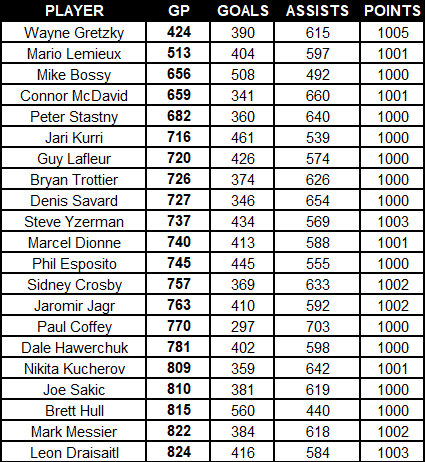
It is an amazing accomplishment, but how did a young boy from Cologne, Germany, become one of the most prolific scorers in NHL history? Draisaitl’s path to NHL superstardom is different than his peers, and I wanted to find out how he went from shooting balls against the wall in parking lots in Germany to staring in the NHL.
To understand a player’s journey, we have to go back to where it began, in Cologne, Germany. Leon Draisaitl was the second child for Peter and Sandra Draisaitl. His sister, Kim, is two years older and not only one of his biggest supporters, but one of his closest allies.
I spoke to them, as well as Leon, and they graciously shared their insight into Leon’s journey to the NHL, reaching 1,000 points and solidifying his spot as the greatest German hockey player ever, and one of the best the NHL has ever seen. I also spoke to past and present Edmonton Oilers coaches and teammates to learn more about Draisaitl the person and the player.
EARLY YEARS
 Peter and Sandra Draisaitl
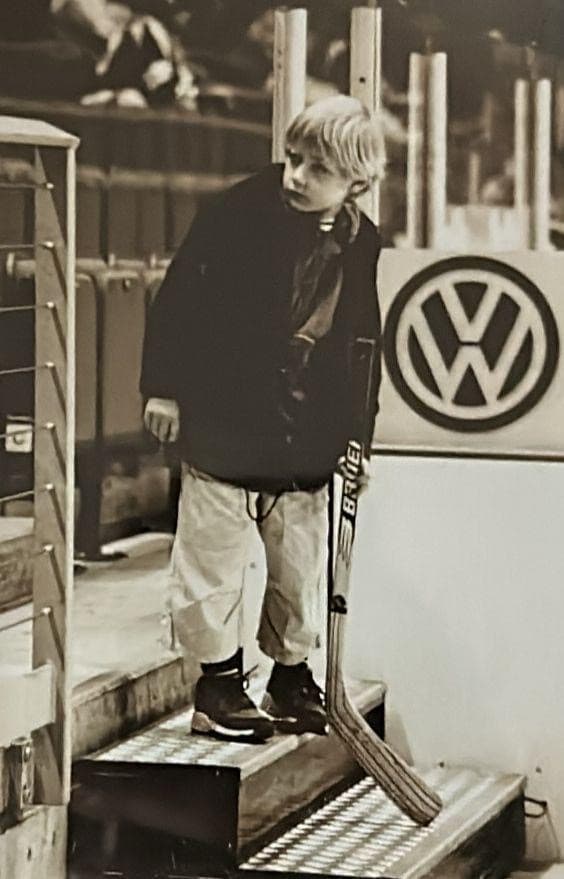
A young Leon Draisaitl—he had his big blade from a young age
Sandra: He didn’t like ice skating very much at first, but we didn’t push it. Of course, Leon was in the locker room and sometimes in his dad’s arms after a game. Leon also watched the games on my lap with total focus, which was unusual because all the other kids were playing together, but he sat and watched.In 1998, Leon was two and a half and Peter was at the Olympics in Nagano. Leon sat in front of the TV in full ice hockey gear with skates and a stick and watched his dad. It was a bit crazy, and I smile now because Leon’s nephew Carlo (Kim’s son) is the same age and just as crazy about hockey and watching.Peter: He was around five when he started. And did he love it right away? I wouldn’t say so. It was a bit of a struggle. I remember not only one situation, but a few of them where you get up at five in the morning and drive him to practice or to a game, then you put the gear on, you have him dressed and you sweat and it’s hot and he kind of hated it. And after you’re done, he looks at you as said, “I don’t go.” It happened a few times. It’s so funny when you think about it. So, it was definitely a process.
What else was he interested in?
Sandra: As a mother, it was sometimes exhausting because I tried to show Leon other things, with little success. It was just hockey, hockey, and hockey. Leon needed a maximum of one meter of space, no matter where… then he unscrewed the caps off bottles and played hockey against himself, shooting the caps at himself with his hands for hours until the moves worked. But at that point, he had never been on the ice.When he was five Leon started at the KEC skating school in Cologne, but he stopped again because he didn’t feel like putting on and taking off his gear. At home, he thought the equipment was great, he even fell asleep with his stick and helmet (his first helmet came from Jörg Mayr), but he didn’t really want to play, because he was shy with all the boys he didn’t know.So, then we went to soccer for a year, Fortuna Cologne, where he had a coach, a girl, who wouldn’t let him shoot, and then he came to me, angry at the coach, and said he wanted to play hockey again. After that it was just hockey.Peter: He had a real talent for ball sport. He could throw the ball immediately, and he was really good at soccer, European football, which I thought was unbelievable. But that only lasted a short time. He still has good ball handling skills though.
 Peter and Sandra Draisaitl
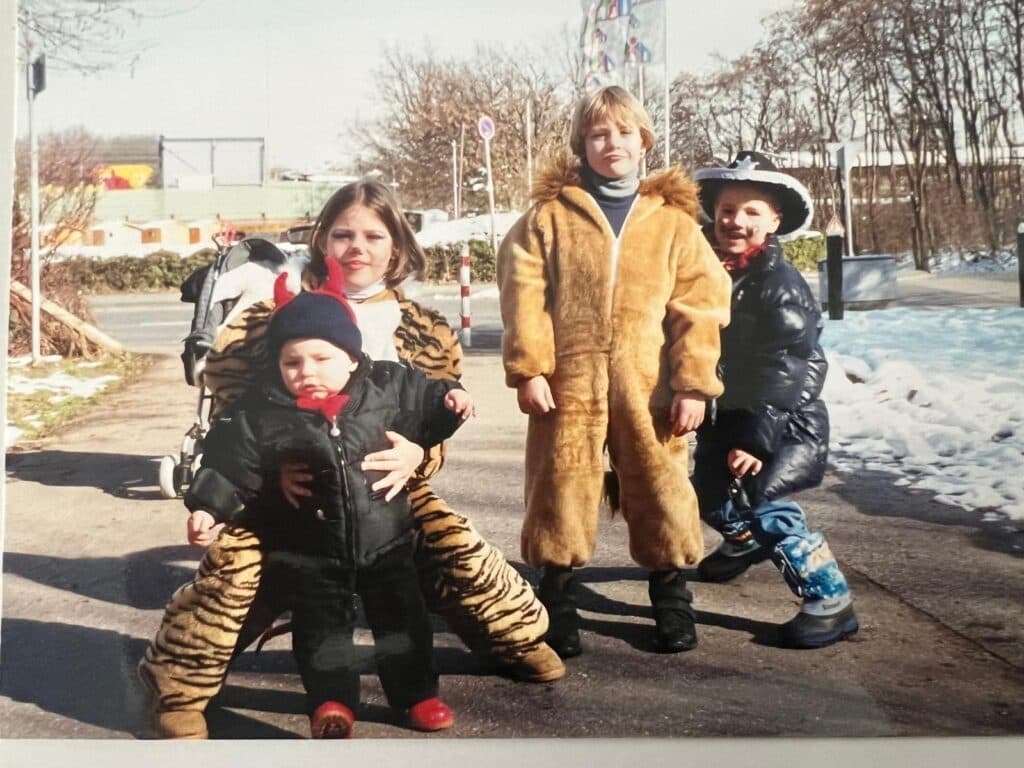
Leon and Kim (on the left) with two neighbourhood friends
Leon wears his emotions outwardly. You can tell when he’s happy or frustrated. Was he always ultracompetitive?
Sandra: For a long time, I wondered why Leon never showed any emotion after a game, regardless of whether he won or lost. The only thing that made him happy after the game was his lunch box with his lunch. I have to laugh… Mummy’s lunch box with treats. Then, at some point, after he lost a game in Iserlohn, he totally freaked out for the first time and smashed his stick. From that moment on, his ambition to win was there, and everything changed.Leon: I don’t remember the specific game, but I remember a time where I started to be more emotional and I think over time, it’s just who I am. My emotions at times get shown, and sometimes, they go a little too far. I’ve been that way for a long time. I’ve always had the ability to reflect on myself the night after. I’m a very self-aware person, and I think that’s very important when you are emotional, or when you put so much energy and emotion into games, and into situations that you’re able to reflect after, and kind of get back to even and level ground. And I’m always able to do that. So, it doesn’t affect my game.
Peter has coached for over 25 years, but he never coached Leon, how come?
Peter: It was clear very early that Leon did not feel comfortable when I tried to coach him. We tried like a few times to go to the woods, and we did some off-ice stuff, because I knew what to do because I was coaching myself. But he didn’t feel very comfortable practicing with his dad. Whether it was me or Sandra, we never put any kind of pressure on him.What we did and what he loved was going out on Sunday, when the stores were closed and in some random parking lot, and put out a net or shoot against the wall or stick handle. He loved these kinds of things. We did that a lot, basically what we call street hockey.
JUNIOR YEARS
 Peter and Sandra Draisaitl
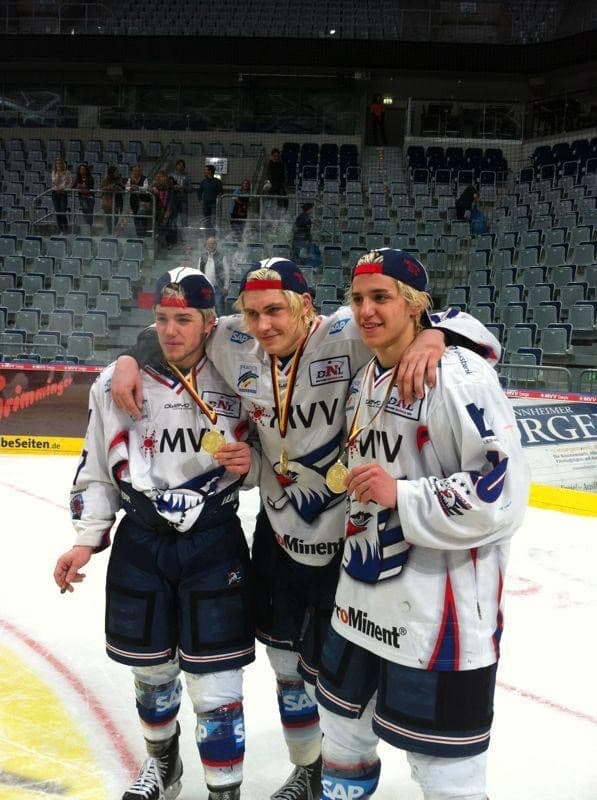
Leon was improving as a player, but unlike in Canada, where players move away from home at 16 or 17 to go play Major Junior in the WHL, OHL or QMJHL, Draisaitl had to make that decision at a much younger age. That was a tough decision for everyone in the family.
Peter: He felt like Cologne was not going the right way, so he wanted a better organization program. He was 13 when he sat in the kitchen and said he was going to Mannheim.And we were like, what, where are you going, what? Jesus, what are we talking about?Mannheim was three hours from Cologne, which seems like not much, but I had a job, and Sandra had a job. He was gone and we barely saw him during the season. It wasn’t easy for me, but I kind of went the same path when I was playing. If you want to do something with hockey, then you must go for it and be all in.I think it was much harder for Sandra. To see your 13-year-old boy go out the door was tough. He got an apartment in Mannheim with two other boys. You must grow up fast. He was homesick. I remember talking to him on the phone and he admitted he was sad and missed his family, but he never mentioned coming home. He had a goal and he stuck with it.Sandra: Somehow, I knew that Leon would go somewhere else early on, at around 18, I thought, totally naively, not at 13 years of age and the NHL was never on my radar. But I would never have stood in his way. When you see your child develop a passion and love for something, you give them the chance. The first step was Mannheim, 250 km away from Cologne, and I stood at the train station and cried.Kim: Even though it was hard to watch Leon leave at such a young age, we made staying close a priority. We talked constantly — calls, messages — whatever it took to stay part of each other’s daily lives. Whenever we did get the chance to see each other in person, we made the most of that time. I think what really kept us close was that we always supported each other. The physical space changed, but the relationship never did.Leon: At that time Mannheim was just the best program in Germany. And I wanted to be around the other great players in Germany. And for me personally, it was an easy decision at that moment, but once my parents dropped me off there, there was a couple hours where it was sad and quite emotional for me. But I think it was a lot harder for my family, probably. Luckily, Mannheim is not too far from Cologne, so I was able to see them a little bit. But that was a great step for me in my career.
Draisaitl excelled in Mannheim. In his first season he scored 48 goals and 103 points in 26 games. The next season, in 29 games, he produced 97 goals and 192 points — some eerie numerology when you see 29 and 97 together.
Oddly enough, Draisaitl wasn’t the leading scorer on his team either of those seasons. Dominik Kahun, who played three NHL seasons, including the 2021 season with the Oilers, had 126 points and 206 points. Kahun and Draisaitl dominated their league, and both were drafted in the CHL European draft in 2012. Kahun went to Sudbury, while Draisaitl went to Prince Albert.
Moving to Mannheim was tough, but moving thousand miles away to a new city and country was much more challenging.
Sandra: When he went to Prince Albert, that was a much bigger step for Leon, I think the biggest he ever did, than it was for us. Of course we missed him a lot, but he had to learn the language, the new culture and a new style of hockey and new systems. We visited him and tried to support him.I remember when I saw him play there for the first time, nothing seemed to fit, and I saw him again in Cologne after the season. Leon was growing, his legs and arms were much too long, but he started to fill out his body. After my time in Mannheim, I noticed how Leon can adapt to the game and new circumstances. He observes. At first, I wasn’t aware of it, as if he wasn’t there, and then suddenly he adapts to the game, gets involved and controls it. That ability helped him adjust to hockey and life in Canada.Peter: The dream to go to North America, well, Canada especially, it was always there. It was always present. This is what he wanted, and it was clear enough very early that he wants to go and play the game, where he thought it should be played, in Canada. I just remember Sandra and Kim went to see him once. I went once in the winter, and it was so cold. But I met his billet, Carol Ring, a wonderful woman. We owe her a lot. She took great care of Leon. She was like a grandmother to him.Leon: I talked a lot during that time with my family, with my dad, my mom, my sister, but also the other guys who went to Canada to play, like Dominik Kahun, for example. Him and I were in the same situation. At that time, it was Skype, actually. And we would FaceTime a lot or Skype a lot. And I think it brought a little sense of home for me. Yes, there were times when it was hard, of course, but I wouldn’t change it for the world. I’d do it all over again if I had to. I also had an amazing billet in Prince Albert. Carol made the transition so much easier. She is a special woman.
EMERGING TALENT

Draisaitl was always skilled as a youngster, but there are many kids with skill who never become elite NHL players, especially from Germany. He has an incredible work ethic and drive to succeed. He’s quite stubborn, but that stubbornness allows him to continually push himself to improve and be better.
While Peter never coached his son, I asked him to put on his coaching hat for a few questions.
When did you realize Leon was pretty good?
Peter: Well, first and foremost, I don’t know why, and I don’t know if it was on purpose or if it just developed that way… I never really looked at Leon that way. It was probably the best thing we ever did, as parents, we were never like let’s go, you have to do this, and you have to do that. For me as a hockey man or coach, whatever, yes, I saw he could do things that maybe some kids can’t do, call it skillset, call it talent, whatever you want to call it. But it was never me thinking he could be a great hockey player.But when he went to Mannheim, and then to PA (Prince Albert), then time flies and he is drafted pretty high for the NHL. That’s when I was like, this could happen. This is real. And then we tried to really support him, give him advice. Tell him how the dressing room works. How to behave himself. How to treat his equipment and little things like that.
He is one of the best backhand passers and shooters in the game — arguably the best passer and he does it with that massive blade. When did you notice his backhand skills?
Peter: Well, things like this, I saw out on the street when we were shooting pucks or balls against the wall, and we were trying to get that thing from forehand to backhand in one movement or from backhand to forehand and then shoot the puck. Then I realized that his hand coordination, puck or ball control, it’s in his blood.
Did you have any influence on this blade?
Peter: I looked at other kids, they were six, seven, eight, and I was like, don’t do that, and give them a curved stick. So, I gave him a straight stick. The professionals were using big curves and whatever and when he saw them, he wanted it. I was a little bit behind the times, so I always gave him a straight stick. I think the only thing I can say I had some influence on was his stick (laughs).
How would you describe his personality?
Peter: Well, not exactly loud, but people were always saying he is a funny guy. He is good at mimicking and impersonating people. He probably could do a very good Jason Gregor impression. So, in that regard, he was funny. Sometimes we were laughing so hard when he would impersonate people we knew. But other than that, he wasn’t very loud or outspoken.I would say maybe something in between not loud and not a quiet kid who sits in a corner and saying nothing. He was quite focused. I think he realized very early that he wants the hockey stuff and he wants to be good at it.
THE DRAFT YEAR
After two seasons in the WHL, Draisaitl was drafted third overall at the 2014 NHL draft. Aaron Ekblad went first to Florida while Buffalo took Sam Reinhart second. The NHL draft was very special for their family, especially for Peter.
Peter: It is hard to describe, because this is something you feel inside. And it’s not easy to put it in words and explain it to somebody. Emotionally, is it pride, excitement or a combination of all of it? I just know it was a phenomenal feeling. I remember pretty much the entire five days we were in Philadelphia, because, for us, as a family, it was new, it was exciting. It was a hell of an experience for us as a family as well. Some of the best times in our lives.When I was playing, we thought the NHL, and specifically the Oilers, were playing on the moon or something, it (the NHL) seemed so far away in terms of skill and opportunity. We admired the Oilers back then and I played with Paul Messier, and his brother Mark came to practice with us a few summers. The Oilers were our heroes, and I was lucky to meet him privately. So, when Leon got drafted by the Oilers it was pretty emotional. It was almost like it was meant to be a little bit.
GERMAN SPORTS ICON
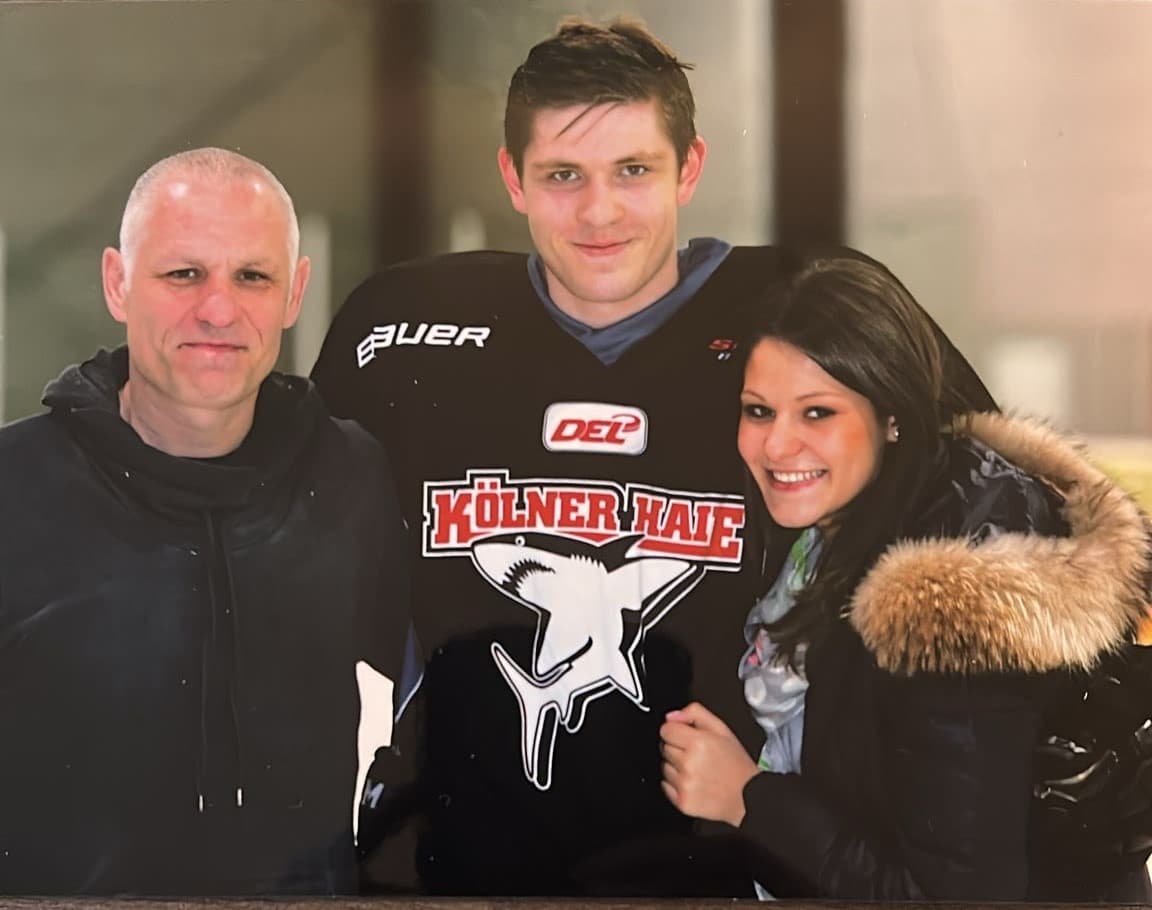 Peter and Sandra Draisaitl
Peter, Leon and Kim
Draisaitl isn’t just playing in the NHL, he’s dominating. Since the start of the 2015/16 season Draisaitl has the second most points in the NHL, second only to McDavid. He is a true superstar, the first German star player. Peter has been heavily involved in German hockey his whole life as a player, coach and now manager for Kesfed.
What does it mean for German hockey to see Leon’s success?
Peter: That’s a tough question. On one point I couldn’t be prouder of Leon, but for me, it seems a little bit surreal. I look at how he is doing and to score 1,000 NHL points, I really can’t imagine it. It is unbelievable. I never thought about stuff like that. The time goes on and now he’s 30 years old and you think about him being drafted, then going to Bakersfield for a bit and then scoring 100 points, winning trophies, and scoring titles. It is crazy, but I don’t take it for granted.It’s amazing, it’s amazing. People back home are extremely proud of what he has been able to do, but at the same time, as his father, and Sandra is the same as his mother, no matter how old your kids are we always look to see, is he happy? Is he healthy? Is he doing well? Is he enjoying his life? This is what we care about the most. I definitely do.
I asked Kim what she finds most impressive about her brother as a player and as a man.
Kim: As an athlete, Leon impresses me with his dedication — he works incredibly hard, stays disciplined, and constantly pushes himself to grow. But honestly, what stands out even more is who he is as a person. He’s humble and always willing to help others. He carries himself with kindness and maturity, and that combination of talent and character is what truly sets him apart.
The Draisaitl’s didn’t watch Leon score his 1,000th point live, due to the time zone change. That is the challenge of living so far away. They mostly watch games the next day, or just check the box score and see the highlights.
What I found most interesting is Peter’s ritual when he wakes up the morning after the Oilers play. He checks the box score, but the first thing he looks at is Leon’s time on ice. If he played 18+ minutes, then he knows he is healthy. Then he looks to see if he produced any points, but despite their son and brother’s success, Peter, Sandra and Kim care more about his health and happiness than they do his scoring prowess.
That being said, they were all extremely excited about his chase for 1,000 points. There will be many phone calls and texts congratulating him, but not just from his family. Draisaitl’s accomplishments will be celebrated across Germany.
Peter: A couple of months ago, Leon went to his old rink here in Cologne and it blew up. Many people started coming and you could see it in the eyes of the young kids who were five, six and seven, that meeting him meant a lot to them. I can feel it. People ask me all the time about Leon; nobody asks about me (laughs). Whether it is fans, businesspeople, coaches, managers, players, owners they all ask about him, and it is great. When he scores 1,000 points it will be big for the German hockey community.
COACHES
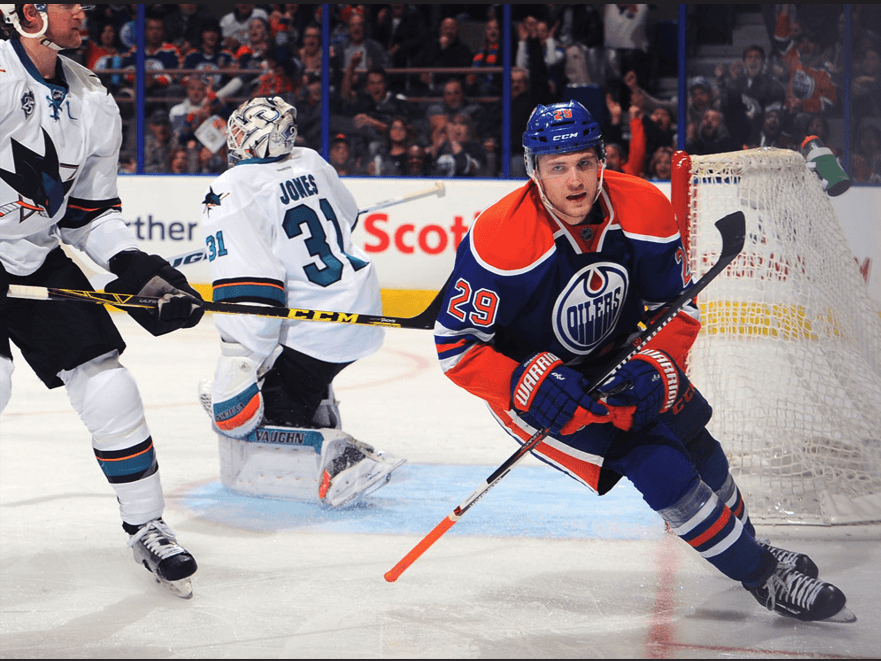 Edmonton Oilers/Andy Devlin
Draisaitl the rookie
Draisaitl has had numerous head coaches with the Oilers. They shared their thoughts on him.
Dallas Eakins (coached him in 2014 and 2015).
You coached Leon as a rookie. What were your first impressions of him as a player and his personality?
Eakins: My first impressions was that Leon was an old soul. He seemed to be very calm and measured. Very professional for his age. But when talking to him and getting to know him, you could tell that he had been raised very well. His parents should be very proud of the young man that they have raised.
What part of his game impressed you the most?
Eakins: The most impressive aspect about Leon is that he is dangerous in multiple areas. Some guys in the league are shooters and others are passers. Some guys will beat you with skill and others will beat you down with physicality. Leon is one of those guys who can just ask you: How do you want to play tonight? Do you want a skill game? Or do you want to go out in the alleyway and have it out? He’s a gamer and he is up and ready for any type of game.The other thing that I have always respected about him is his ability to wear his heart on his sleeve. He is highly competitive and you don’t have to guess what kind of mood he is in. He knows right from wrong and he is not going to “play nice” with anyone.
I asked the following four coaches the same two questions.
What part of his game impressed you the most?
Todd McLellan 2016-2019: His ability to hold people off and protect the puck while surveying the ice to make a play. Very few have been better at that.Ken Hitchcock (2018/19): Leon is an elite player because he sees the game five seconds in advance. He knows where everyone is on the ice and he sees the play developing well ahead of time. He has the unique ability to see where the players are and where they’re going to end up well before the play actually starts. It’s a very unique quality not many players can do that for me. He’s also like an old school player in the way they used to play to absorb the check, create time and look for other options. He’s terrific at it.Dave Tippett (2022-2022): I always thought Leon has three main strengths in his game:
1. His shot is deadly.
2. Amazing passing skills.
3. The most import of the three is that he has the mind to maximize the top two assets. He gets to position to shoot and has the hockey sense and the patience to give himself the best chance to score. His passing is pinpoint, forehand or backhand, at times high risk but usually successful. A high rate of success in both aspects that make him elite.Kris Knoblauch (2024-present): The way he can score with his one timer at such a terrible angle is remarkable, but I am most impressed with how powerful he is. He is much faster than most think because of his powerful long stride, and the way he can hold anyone off the puck.
When you coached him what area of his game did you challenge him to improve? And has he?
McLellan: We challenged him to be the best player on the ice. Playing with 97 that is not easy to do, but many nights he has. I’d say he has done that quite well.Hitchcock: We challenged Leon to become a 200-foot player, and he really embraced that role. He became a great player coming back into our zone being a low forward, offering support for wingers or defenders. He was really good at reading the rush defensively so we could transition offensively, and he really embraced what he was being taught. I am so proud of him for becoming the player he is right now.Leon reminds me of Gordie Howe. I know that’s significant company, but that’s the way Gordy played. He absorbed all the checks held onto the puck and found open people all the time. It is the same way Leon plays.Tippett: The area I tried to push Leon to improve was becoming an elite two-way player. He always admired (Anze) Kopitar, so I tried to push him in some high-pressure defending situations like the PK 5-on-4 and especially 5-3, defensive zone faceoffs at key times, matchups vs top players. Situations offensively and defensively to give him the opportunity to help determine the outcome of the game.He has become one of the top forwards in the game and I would love to see him and Connor get a Cup.Since Knoblauch is his current coach, I asked him a slightly different final question. How do you challenge or help improve an elite player like Leon’s game?Knoblauch: I try and surround him with players that will complement him, but it’s more like surrounding players that he will complement the most. Like all players, everyone needs reminders, but Leon is very good at assessing where his game is at.
TEAMMATES
 Edmonton Oilers/Andy Devlin
Draisaitl the 10-year veteran
Draisaitl has had 180 different teammates during his tenure with the Oilers. Some have only played one game, while three have played skated in at least 746 games with Draisaitl. I spoke to those three, Ryan Nugent-Hopkins, Connor McDavid and Darnell Nurse, because they know him the best. We discussed his skills as a hockey player, his strengths as a teammate and friend, what they respect about him and the biggest surprise I learned from them, as well as from Leon’s family, is he how good he is at impersonations.
Darnell Nurse
What was your initial impressions of Leon?
When he first came to the league, obviously the first question was how he used the blade he used (laughs). But we spent a lot of time together, not only on the ice but off the ice and getting to know each other in this league. I’ve always thought the highest of him as a person, as a friend, and as a teammate. He’s always been a very special person to me and I’m very fortunate to play with him.
The element of his game you respect the most.
I think his two-way play is very, it’s crazy to say, but underrated. There’s an element of his game that is very unique. He’s hard to play against based of the way he sees the game, is able to pick up on nuances of other skilled players around the league and kill plays in the defensive zone or neutral zone and turn that into offense. His passing was always very prevalent when he was coming into the league, and he’s an elite goal scorer now, but his two-way play has been a huge asset for us.
He’s very good at impersonations? Can he do you? What is the best one he’s done?
He’s pretty good. He can’t do me, but he’s pretty good. His best one, I can’t say publicly (laughs). But it’s very funny.
If you could have one of his skill sets incorporated into your game, which one would it be?
His ability to make plays under pressure, like with bodies and under contact. It’s impressive how he’s able to do that.
Connor McDavid
What was your initial impressions of Leon?
Just what a big man he is, even at 19, 20 years old he was a big man. I don’t think you understand until you are around him.
What makes him a good friend?
I think his sense of humor. Honestly, he’s hilarious. He always has me laughing. He’s definitely a passionate guy, passionate about hockey, passionate about the things he cares about, the people he cares about and that makes him a good friend.
I hear he can be stubborn at times. When you play non-hockey games, board games and such, is he stubborn?
He can be stubborn, definitely can be stubborn, but I think that’s part of what makes him great, honestly. It is his will to want to compete, to want to be great, but definitely a stubborn guy (laughs).
He’s good at impersonations. Which is your favourite?
McDavid with a smile: He is great at it. I’m not sure I have one specific favourite. He does different languages and accents and friends and teammates. He does it all. He’s very funny.
If you could have one of his skill sets incorporated into your game, which one would it be?
I would say his size, his skilled size and his puck protection, he’s so big and holds guys just kind of on his back and makes plays. It’s really, really impressive.
Nugent-Hopkins
What was your initial impression of Leon?
I mean, obviously, just lots of talent right away. Big kid, the way he could hold on to the puck and shed guys at 19 years old was always impressive. But I think what impressed me the most, when he first came in, is that he was more of a passer. And he really worked on his shot, and he got to a point where he’s getting 50 goals a year. When he came in, his shot wasn’t where it is now. He knew that he wanted to work on it, and he did.
What’s his best quality as a friend?
I mean, he just cares. He cares so much about guys, and not just in hockey. That’s what makes a good teammate and a good friend, and he definitely has that quality.
If you could have one skill set of his incorporated into your game, what would you want?
Yeah, that’s tough to pick just one. His puck protection is so good, but I think his one-time ability, from anywhere. That’s how you score goals. That’s how he scores so many goals. That’s something that I definitely can improve on. So, I would say his one-time is what I’d want.
I’ve learned he’s very good at doing impersonations. Has he ever done you?
(He laughs) maybe. Not that I know, but maybe. Obviously, he’s German, so he has that experience of the German accent. He’s really good at getting the Finnish guys especially.These three swore me to secrecy, but they did agree his best one is a former teammate. When I asked about that one, Draisaitl had a big grin, and said, “That one is really good. I agree.”
DRAISAITL ON HIS JOURNEY FROM COLOGNE TO 1,000 POINTS
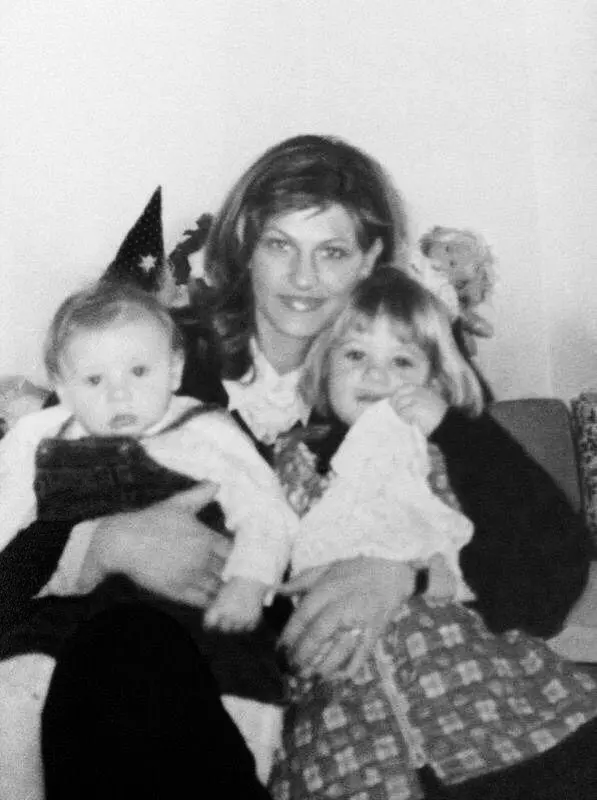 Peter and Sandra Draisaitl
Sandra with Leon and Kim
Draisaitl picked up his 1,000th point on Zach Hyman’s goal early in the first period last night in Pittsburgh. Hyman was extremely excited and raced over to Draisaitl and leapt into his arms, while the rest of his teammates came off the bench to celebrate the milestone. When Hyman scored his 50th goal of the season in 2024, Draisaitl was the first to hug him and looked happier than Hyman, and we saw the same reaction from Hyman for his teammate last night.

EINTAUSEND! Leon Draisaitl secures career point 1,000! 📹: Sportsnet
Draisaitl finished the game with four assists and 1,003 career points. Fittingly, it was Draisaitl’s 29th career four-point game. He became the fifth player to register 1,000 points as a member of the Oilers, joining Wanye Gretzky (1,669), Connor McDavid (1,138), Jari Kurri (1043) and Mark Messier (1,034). The Oilers are the only team in NHL history to have five players score 1,000 points with the franchise. It was a special evening.
“A lot of hard of hard work,” said Draisaitl when asked what comes to mind when he thinks about 1,000 points. “A lot of people who help along the way. These accomplishments are always directed at a single player, but there are so many people who play such a big part in that, and I’m highly aware of the fact I have a lot of people in my life over the last couple of years, who have kept everything off my plate and let me do what I do. I’m super thankful and a little bit proud.”
Growing up in Germany the NHL was a long way away, and at times felt like it was untouchable. It is different growing up in Cologne, where NHL games are on in the middle of the night, and you barely see highlights, compared to kids in North America who can see games, highlights and players regularly.
But Draisaitl overcame those challenges and joined an elite group of 103 players in the 1000 point-club. At his current pace he will finish the season in the top 80 scorers all time and barring anything catastrophic, he will finish his career as a top 20 scorer of all-time. No other German player has scored more than 487 points in the NHL. Draisaitl has set a new standard, and he’s become a superstar not only in the NHL, but in his home country.
How much does being the face of Germany, and being a role model for so many kids mean to you? And was the NHL your goal when you were 12 or 13 years old?
Draisaitl: I mean, yes, it was always the goal. You know, my dad always said to me, “If you’re going over there to prove yourself to be around the best, then try to be the best. Don’t go over there and try to be average or just try a little bit.” Don’t take that the wrong way. He wasn’t pressuring me to be great, but for my father it was just a mindset. My dad saw a lot of potential in me to go over there and try to be the best player in the world. And I always tried to do that, and I still try to do that. And I think that mindset has helped shape me into who I am today.
I hear you are very good at doing impersonations. When did you start it, and do you have a favourite?
Draisaitl (smiles): There’s lots of good ones. It was always something that came easy to me even as a kid. My parents used to laugh when I’d impersonate people we knew. I think my mom and my dad always said if I wasn’t a hockey player I could be a stand-up comedian of some type. I’m not so sure about that, but impressions do come easy for me at times.
It will be difficult for any player to mimic Draisaitl’s career path, but he hopes his accomplishments will inspire kids in Germany and in Edmonton to chase their dreams.
Congratulations Leon, on a wonderful accomplishment.
ARTICLE PRESENTED BY bet365


Breaking News
- Edmonton’s Most Wanted: Analyzing the NHL’s biggest Oilers killers
- NHL Notebook: Former Oiler Shawn Horcoff named Red Wings interim general manager
- The standouts, the notables, and the disappointing performances from the Oilers’ NextGen game
- Oilers reassign Ryan Cameron, release three tryouts in first camp cuts
- The Day After: Oilers top line shines in win over Flames rookies

Edmonton OilersTeam Cap Summary

Cap Summary
2027-28
2028-29
Projected Cap Hit
$88,322,500
$61,025,000
Projected Cap Space
$25,177,500
$61,975,000
Current Cap Space
$25,177,500
$61,975,000
Active Players
16/23
10/23
Draft Picks
Round
'27
'28
1
0
1
2
1
0
3
0
1