
Over the last five years, more than half of the NHL's conference finals have ended in five games or fewer. None have gone seven games. Dark days for Gary's format

OilersNation has no direct affiliation to the Edmonton Oilers, Oilers Entertainment Group, NHL, or NHLPA
Monday Musings: Which NHL Playoff Format is Better?
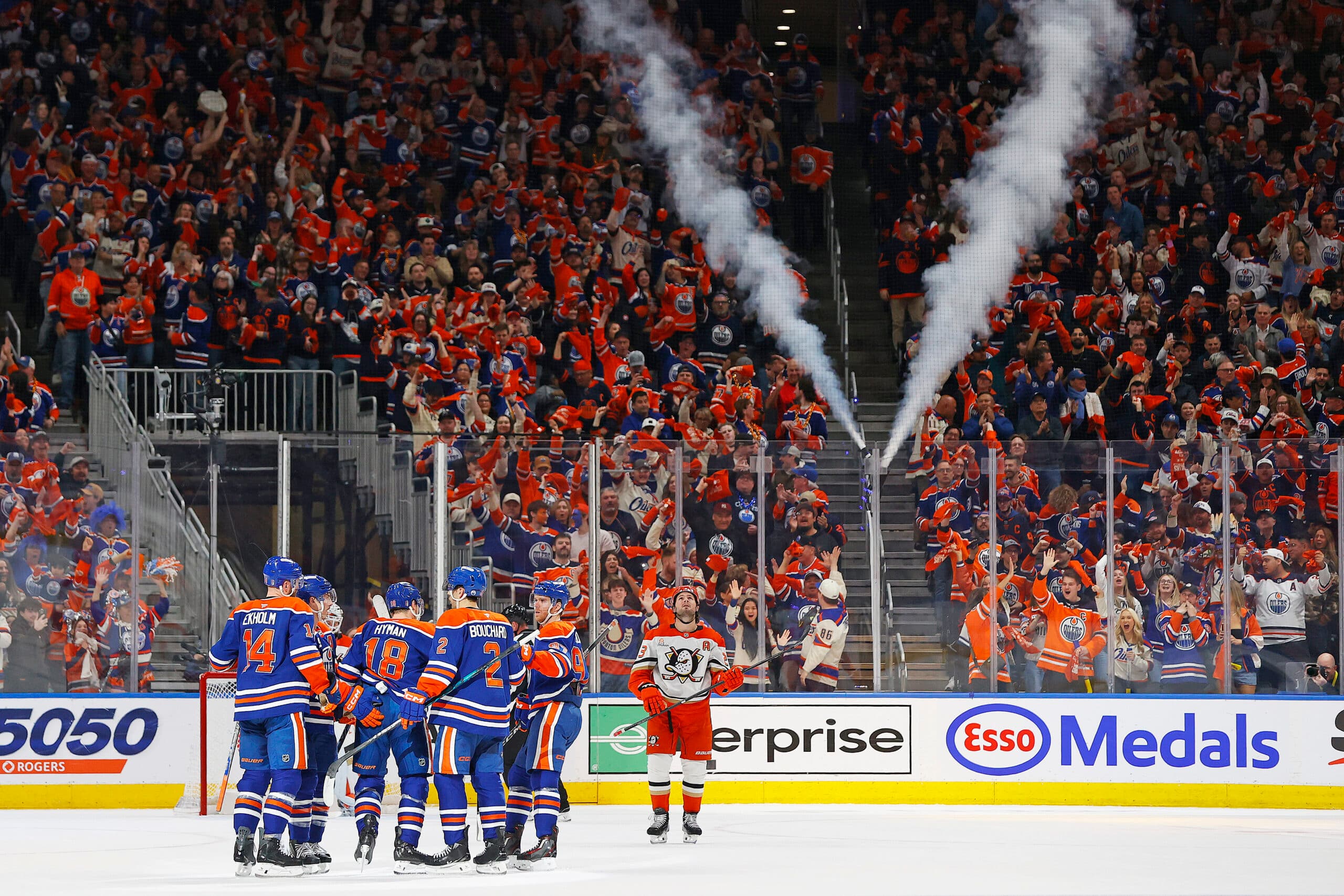
Photo credit: Perry Nelson-Imagn Images

By Jason Gregor
Jun 1, 2026, 15:00 EDTUpdated: Jun 2, 2026, 16:24 EDT
Which playoff format is better: The current one with the top three team in each division and two wildcard spots, or the previous one with the teams ranked one to eight in each Conference? Before you answer, let’s look at the results.
Pete tweeted this after Carolina eliminated Montreal in five games. Vegas swept Colorado in four. The conference finals weren’t that close. But were they close when it was 1 v. 8 format? No, in fact the series were much shorter on average.
From 2006-2013 we have the 1 v. 8 and 16 CF series.
Eleven of 16 were 4-5 game series (68.7%), three needed six games (18.8%) and two went seven games (12.5%).
Compare that to the current model (2014 to now) and we’ve had 26 CF series.
Compare that to the current model (2014 to now) and we’ve had 26 CF series.
Nine of 26 went 4-5 games (34.6%), ten finished in six games (38.5%) and seven went the distance (26.9%).
Based on Pete’s complaint, the current model has been significantly more competitive overall, if you are using series length as the baseline.
Now let’s take a deeper look at the first three rounds in the salary cap era.

In every season the Conference Final had at least one series go four or five games and three years (out of eight) both were four or five games. The first round was the best round, as far as series going longer, with 23 going 4-5 games and 41 needing 6-7 games. In the second round it was split evenly with 16 needing 4-5 and 16 needing 6-7.
Here is the current model.
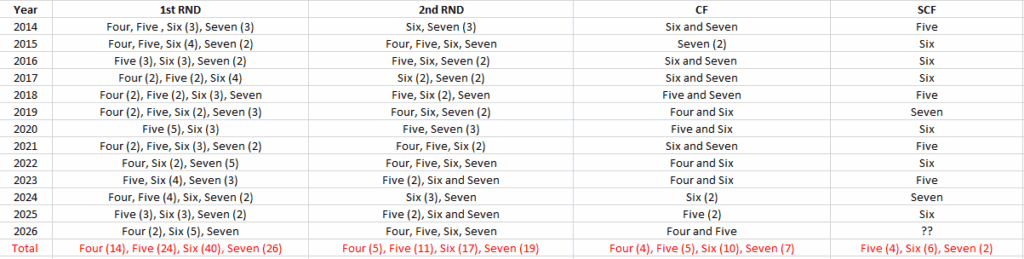
The Conference Finals have been much more competitive with 17 of 26 needing 6-7 games. The second round had 16 series go 4-5 games and 36 go 6-7, while the first round was also longer with 38 going 4-5 games and 66 needing 6-7 games.
Let’s now to do a direct comparison to the overall % of series that needed, four, five, six or seven games.
YEARS | 1st RND | 2nd RND | Conference Final | Stanley Cup Final |
2006-2013 | Four (14%), Five (21.9%), Six (34.4%), Seven (29.7%) | Four (15.6%), Five (34.4%), Six (21.9%), Seven (28.1%) | Four (18.8%), Five (50%), Six (18.8%), Seven (12.4%) | Five (12.5%), Six (50%), Seven (37.5%) |
2014-2026 | Four (13.4%), Five (23%), Six (38.5%), Seven (25%) | Four (9.6%), Five (21.1%), Six (32.7%), Seven (36.6%) | Four (15.4%), Five (19.2%), Six (38.5%), Seven (26.9%) | Five (33.3%), Six (50%), Seven (16.7%) |
The first round has been pretty even, but the second and third rounds have led to significantly more series going six or seven games. If you prefer the 1-8 format, that is fine, but it is inaccurate to suggest the format is why the past few seasons the Conference Finals have been shorter. I also don’t buy into the theory, which many fans and media pundits in the Central Division keep repeating, that those teams beat each other up in the first two rounds and are too tired in the third round. If that was true, how come the Atlantic division dominated the Metro division from 2019-2025, even though the Atlantic was a deeper division?
Colorado didn’t lose to Vegas this year because they were tired. They swept LA and beat Minnesota in five games. They played one game more than the minimum to make it to the third round. Injuries limited them, but Vegas simply played better and deserved to win.
The NHL playoffs are hard, and regardless of which playoff format you use, the regular season standings don’t mean much once the playoffs begin. It comes down to which team plays best during the series, which team gets some luck and who remains healthy. But if your goal is to have more competitive series later in the playoffs, the current formula has produced better results.
SNAPSHOTS…
— Oilers fans are wondering if the Sam O’Reilly trade for Isaac Howard is bad. The honest answer is it is still too soon to say. O’Reilly just capped of an amazing season winning the Memorial Cup with Kitchener. O’Reilly is the fourth player to win the Ontario Hockey League regular season MVP, the playoff MVP and the Memorial Cup MVP. He had an impressive season no doubt. The CHL has yet to name their player of the year, but O’Reilly will be among the favourites to win. The CHL player of the year would be a closer comparison to the Hobey Baker award, handed out to the best player in NCAA hockey, but they haven’t named a winner yet.
Let’s look at previous winners since 2015 for all three awards.
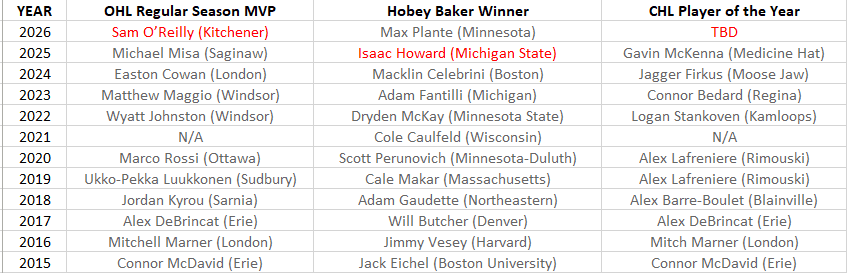
O’Reilly is in pretty good company in the OHL, while Howard also is with the Hobey Baker. Not every winner is guaranteed NHL success, but the odds are good both will be regular NHLers and possibly impact players. Howard and O’Reilly play different positions and have different strengths. Howard emerged as a goal scorer in his third season at Michigan State scoring 26 goals and 52 points in 37 games. O’Reilly tallied 29 goals and 71 points in 56 games split between London and Kitchener. O’Reilly went nuclear in the playoffs scoring 17 goals and 28 points in 18 OHL playoff games.
Howard scored 24 goals and 50 points in 47 games in his rookie campaign this year. Only Quinn Hutson (30 goals in 67 games) and Ilya Protas (29 goals in 69 games) had more goals, but they each played 20+ more games. Howard averaged 0.51 goals/game as a rookie, which is impressive in the AHL for a rookie. Howard is more of a shooter, while O’Reilly is a two-way centre. Many feel he will be an excellent third line centre, who could become a solid second liner, while Howard is projected to be a top-six scoring winger.
It would be a trade that helps both teams. Not every trade has to be a clear win to be a success. Howard has shown he can score in the AHL but taking that to the next step in the NHL is more difficult, just like it will be more difficult for O’Reilly to produce as a pro compared to junior. It will be fun to see how both players progress, but those looking for a “winner or loser” of the trade will likely need to wait another few seasons before we can even start see how they are progressing as NHL players.
— Howard only played 10 minutes at 5×5 with Leon Draisaitl last season and 29 with Connor McDavid. He scored one goal with each of them. He won’t be gifted a spot, but he will likely get more opportunities with them this season. Howard doesn’t have to score a lot to be considered an upgrade on the top two lines. Here’s a look at 5×5 goals scored by wingers last year:
Player | TOI | Goals | TOI with Draisaitl | With McDavid | With Both | Total |
Podkolzin | 1142 | 17 | 563 | 207 | 29 | 799 |
Roslovic | 973 | 15 | 277 | 95 | 36 | 408 |
Hyman | 888 | 14 | 35 | 585 | 138 | 758 |
Savoie | 991 | 9 | 173 | 315 | 21 | 509 |
RNH | 955 | 8 | 31 | 542 | 6 | 579 |
Kapanen | 537 | 7 | 158 | 42 | 10 | 210 |
How many 5×5 goals does Howard need to score to be considered a solid top six winger? Here’s a quick look at the previous seasons.
2025:
Hyman 19.
Jeff Skinner 14.
Corey Perry 13
Viktor Arvidsson 11.
Connor Brown 10.
RNH 9.
Hyman 19.
Jeff Skinner 14.
Corey Perry 13
Viktor Arvidsson 11.
Connor Brown 10.
RNH 9.
2024:
Hyman 36.
Warren Foegele 17.
Evander Kane 15.
RNH 11.
Adam Henrique 6 (22 GP).
Perry 6 (in 38 GP).
Hyman 36.
Warren Foegele 17.
Evander Kane 15.
RNH 11.
Adam Henrique 6 (22 GP).
Perry 6 (in 38 GP).
2023:
RNH 16.
Hyman 15.
Kane 14 (41 GP).
Foegele 12.
Klim Kostin 11.
Derek Ryan 10.
RNH 16.
Hyman 15.
Kane 14 (41 GP).
Foegele 12.
Klim Kostin 11.
Derek Ryan 10.
2022:
Hyman 19.
Kailer Yamamoto 14.
Kane 12 (43 GP).
Ryan 10.
Foegele 9.
Jesse Puljujarvi 9.
Hyman 19.
Kailer Yamamoto 14.
Kane 12 (43 GP).
Ryan 10.
Foegele 9.
Jesse Puljujarvi 9.
The Oilers could use a consistent 13-15 goal-scoring winger at 5×5. Can Howard be that this season? I can’t say for certain, but he should be ecstatic about the potential opportunity as it is clear they could use another finishing winger in the top six.
PRESENTED BY PRAIRIE TOYOTA DEALERS

The Toyota Tacoma is the ultimate power play. Its standard i-FORCE engine delivers more power than ever and a towing capacity of up to 6,400 lbs. It helps you take on challenging landscapes with confidence with its available Panoramic Multi-Terrain View Monitor that provides a live, underfloor view of the terrain you’re tackling. It even makes loading and unloading gear effortless with its available Power Liftgate. Whether it’s for early morning practice or weekend away games, the Tacoma is a teammate you can rely on. Visit your local Prairie Toyota dealer during Red Tag Days for limited-time offers.


Breaking News
- Oilers letters to the editor: Fan expectations for coaching accountability
- Sunday Scramble: Early injuries will test the Oilers’ core vulnerabilities right from the start
- Oilers 2026 Prospect Countdown No. 11: Beau Akey
- The top 5 Oilers moments at the Saddledome
- Four big questions for the Edmonton Oilers with four weeks until opening night

Edmonton OilersTeam Cap Summary

Cap Summary
2026-27
2027-28
Projected Cap Hit
$102,071,666
$88,322,500
Projected Cap Space
$1,928,334
$25,177,500
Current Cap Space
$1,928,334
$25,177,500
Active Players
22/23
16/23
Draft Picks
Round
'26
'27
1
0
0
2
1
1
3
1
0