
OilersNation has no direct affiliation to the Edmonton Oilers, Oilers Entertainment Group, NHL, or NHLPA
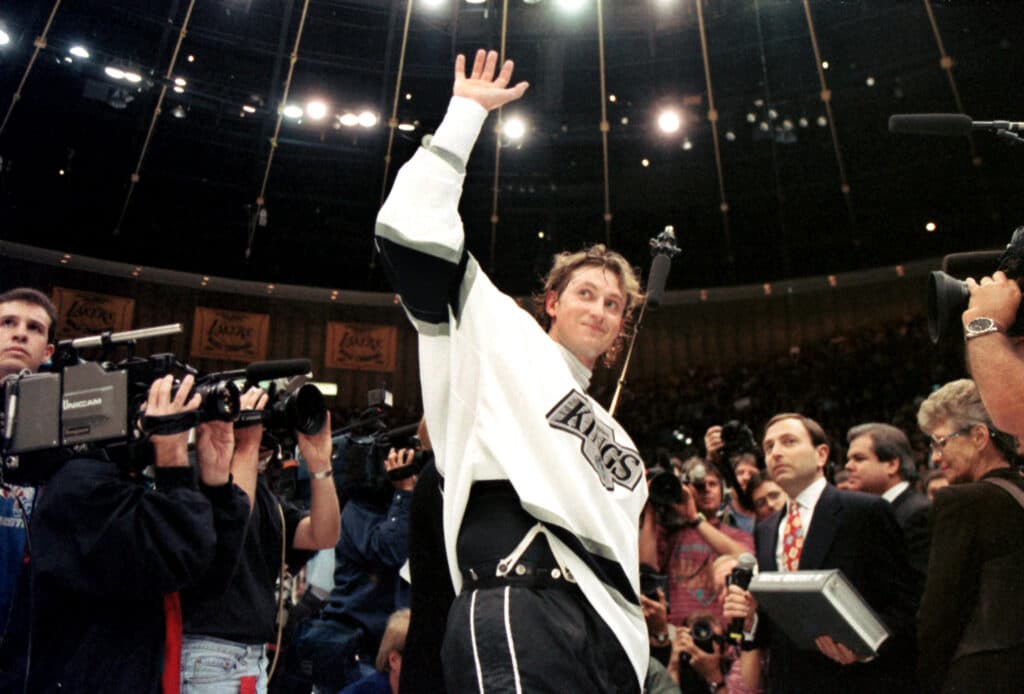
Sunday Scramble: Re-examining the Wayne Gretzky sale 38 years later
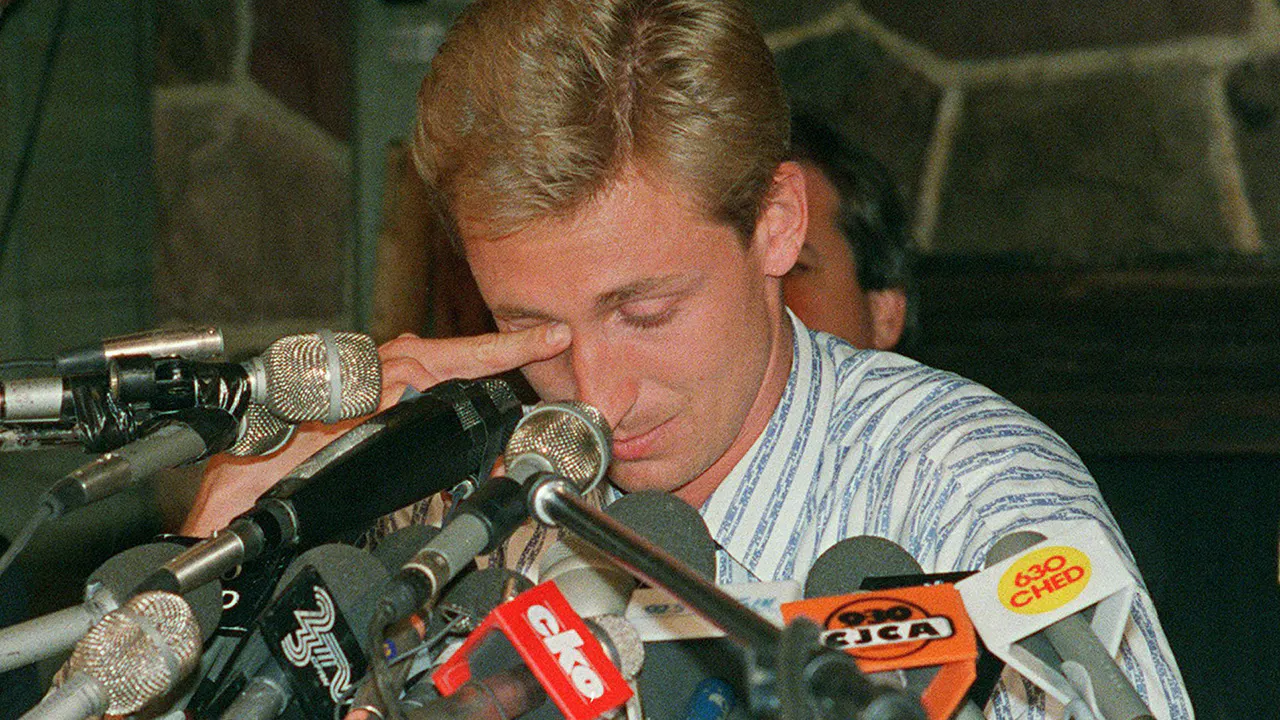
Photo credit: The Canadian Press

Aug 9, 2026, 09:00 EDTUpdated: Aug 10, 2026, 15:00 EDT


If this song had a chorus, it would be, “The Day That Music Died.”
Thirty-eight years ago, with a hockey world quiet and distracted by summer, the Edmonton Oilers (as in Peter Pocklington) sold Wayne Gretzky to the Los Angeles Kings. Its legacy has been worthy of many documentaries and books, captured well, like Don McLean’s picturesque view of innocent life disturbed.
Canada’s Superhero repackaged as American Pie.
You know the date—Aug. 9, 1988—and you know the story, one filled with many creative ironies and coincidences in the years to follow. Like, for example, how Pocklington (for a couple of days) and Kings owner Bruce McNall both spent time in jail afterward, but not for what Oilers fans would believe is the Crime of the Century.
When the major players hastily gathered in the Molson House that morning, Gretzky and McNall were rushing back to Alberta because the trade had leaked. They couldn’t contain this massive secret any longer. And yet, when they boarded that plane, McNall hadn’t wired the $15 million yet to Pocklington—the whole purpose of the deal. Part of the reason the noon presser dragged for 45 minutes before beginning was waiting for this wire transfer. No money, no Great One.
But getting on a plane with such uncertainties wasn’t all too uncommon for The Great One. A decade before, he had boarded a plane with fellow Indianapolis Racers expat Eddie Mio and Peter Driscoll without knowing exactly where they were going. Nelson Skalbania didn’t know either. Mio’s credit card helped get the players to their destination.
A few months before, Skalbania convinced the 17-year-old to give the WHA a try—a fairly significant happening for the future of the NHL—and now he was hemorrhaging cash and needed money quick. In the same way Pocklington sold Gretzky, he bought Gretzky from Skalbania. The call to the pilot came eventually that night on Nov. 2, 1978.
Destination: Edmonton.
And 10 years later, Mio would stand in St. Joseph’s Basilica as Gretzky’s best man in the Royal Wedding of Canada. Actress Janet Jones was truly the belle of the ball. Yet in just a few weeks that summer of 1988, she’d be called “Jezebel Janet” by an Edmonton Sun columnist. Playboy’s Hugh Hefner, infamously, declined his invitation due to a prior engagement.
Like any good true crime story, this one features meddling and scheming, secrets and innuendo, legends and mythologizing.
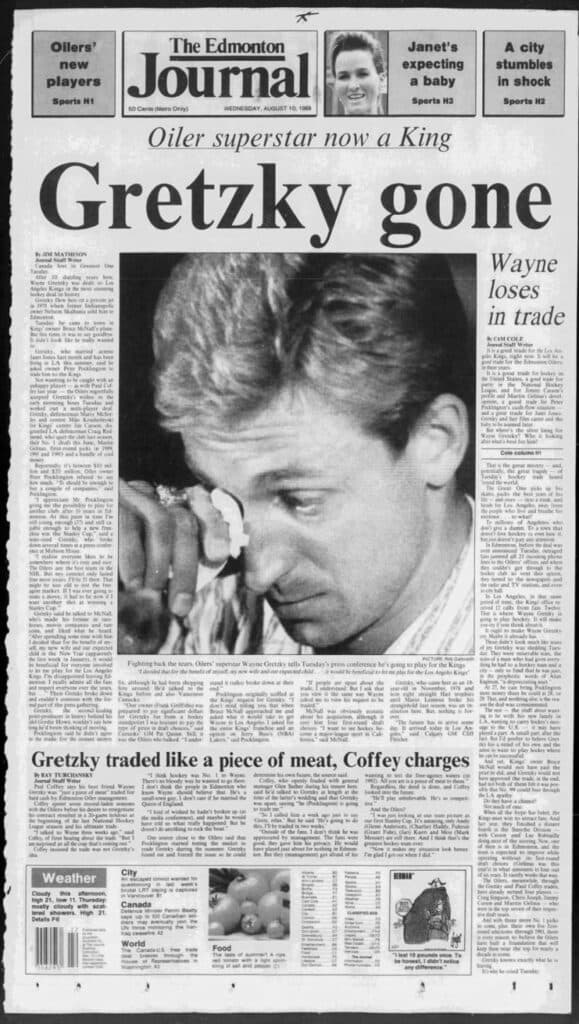
The front page of the Aug. 10, 1988 edition of the Edmonton Journal details the Edmonton Oilers’ trade of Wayne Gretzky to the Los Angeles Kings.
How the Gretzky trade to Los Angeles happened
The fundamentals are well known: Pocklington was struggling financially, the Gainers strike was in people’s minds, other businesses were failing, and he needed the money. The off-season before, Gretzky, his agent Mike Barnett, Sather, and Pocklington renegotiated the former 21-year personal services contract into a much more common one, but one that would give Gretzky an option to become a free agent in 1991.
Overall, player salaries were only pointed in one direction, and Edmonton wouldn’t be able to operate like before. Holdouts, money squabbles, and financial pressures were becoming more common in the Oilers ranks. A new age was dawning in terms of professional sport.
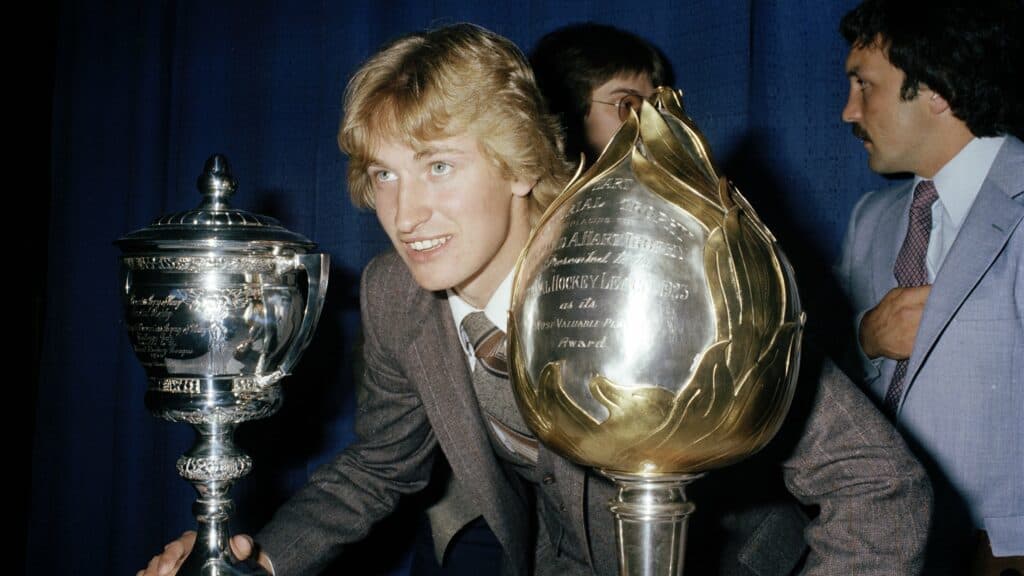
The actual trade talk got rolling at the start of the 1988 Stanley Cup playoffs. Gretzky, who had missed 18 regular-season games due to two injuries, had lost the Art Ross and Hart Trophy.
He was seen as an “asset,” and used-car salesman Pocklington (literally) started to wonder how soon that asset would depreciate, and plans began on how to frame such a large transaction under such intense scrutiny. When you have Pocklington’s ego, it isn’t that hard.
Meanwhile, Kings owner Bruce McNall got his profile thanks to his money—a collector of old coins who rose to prominence quickly. He was one of the most important people in hockey in the early 1990s, sitting as chair of the Board of Governors, tied at the hip to a business partner like Gretz.
Just six years later, everyone would find out he was a liar, creating a financial house of cards where he swindled over $200 million from banks. McNall would land in federal prison on fraud and conspiracy charges in 1994.
Before then, Wayne’s spidey senses were tingling as the clock ticked down in Game 5 of the Stanley Cup Final at Northlands Coliseum, an occasion that should’ve never happened.
An act by the Hockey Gods, his final Oilers game could’ve been in Boston for Game 4. But a power outage at the Boston Garden left the game aborted. Unbeknownst to everyone, this go-round in an Oilers sweater would be one last sendoff, and after claiming victory, Gretzky started a new tradition: the team picture on the ice with the Cup.
A moment frozen in time…His dad Walter would interrupt the festivities in the locker room after, telling his champagne-soaked son what he’d heard. Pocklington was going to trade him. Soon.
Wayne would hear it for himself right from Pocklington’s mouth, in a would-be tampering situation while Gretz listened to a phone call between the two owners that summer. With the rumours growing, and the Great One already in LA with his soon-to-be wife, he listened to the speakerphone while Pocklington unloaded all the grievances, not knowing his asset was listening.
Ego, wife, money. At one time, Gretzky and Pocklington were close. But they had grown apart over the years. That left no doubt in Wayne’s mind. It was time to go.
While Detroit was also a possibility, Los Angeles made perfect sense, and McNall needed a star to jumpstart interest in an event-saturated city. Everyone involved would make cases later about the overall growth of the game—that this was a good thing for everyone.
Gretzky, during his prepared speech at the press conference (who wrote it is still a mystery, whether it was Wayne’s input or Pocklington’s crisis manager for the job, Jeff Goodman), specifically listed Seattle and San Francisco as places that should have hockey, that the game needed to grow. How much they believed those reasons, I’m skeptical.
Later, general managers Glen Sather and Rogie Vachon would become aware of what their owners were doing. In Sather’s case, far too late to do anything about it. With his hands tied, he pleaded for Luc Robitaille to be coming the other way. Instead, it would be Jimmy Carson, Martin Gelinas, and three staggered first-round picks.
Not nothing, but not great.
Little mention of the loot during the press conference, and by design. Aired coast to coast across Canada, the presser was such a brilliantly executed PR scheme with its prepared speeches and tone. Pocklington’s other contingency with McNall in making the deal was at the forefront: “Wayne will take the heat.”
Wayne knew it, and he took it. At one point caught up in emotions: “I promised Mess I wouldn’t do this…” to moments later being composed and clinical.
Pocklington would’ve gotten away with it too, if it wasn’t for his big, fat mouth. The plan called for the $15 million bandit to jet the next day to the Arctic to fish, away from civilization. Get off the grid.
Yet before his flight was scheduled, he couldn’t help himself. Pocklington called up the Edmonton Journal’s Jim Matheson, seemingly ticked off about how well Gretzky played the part—the role Pocklington cast him to play.
“Wayne has an ego the size of Manhattan,” Pocklington said. “I understand that, though. If people had told me how great I was day in and day out for ten years, I’m sure my ego would be a pretty generous size, too.”
Pot calling kettle?
“This has nothing to do with Janet having a baby [another revelation at the presser]. All of a sudden he figures, gee, I’ll go out and conquer the market. Not only that, but he’ll conquer the United States….He’s a great actor. I thought he pulled it off beautifully where he showed how upset he was…”
Consider Pocklington’s own acting job in front of the cameras where he tried to play paternal boss, accommodating his best employee, doing what was in Gretzky’s best interest, etc. People saw through the act quickly.
As we know, that would start the downfall for Pocklington and the Oilers. His players, Sather, could never see him in the same light again. As the years passed, you could find more Calgary Flames fans in Edmonton than Pocklington fans, having ripped enough people off, lied, cheated at golf, and the whole gamut.
On the ice, the Oilers won one more Stanley Cup. Wayne got close, but no cigar. A meaningful victory at the time for Oilers infrastructure, assuredly, but hollow in the grand scheme. Everyone wonders to this day, what could’ve been?.
But it’s naive to think it could’ve just continued, as Gretzky has alluded to in recent times. Could the Oilers have won three more Stanley Cups? Five? Perhaps. But with Pocklington at the helm, a trade was always going to happen.
The Oilers franchise, Edmonton’s status as a city, were exiled from the Garden of Eden.
Although somewhat tired of the story, I revisited this saga yesterday in Stephen Brunt’s book Gretzky’s Tears in preparation for this week’s Scramble. The 30 for 30 documentary “Kings Ransom” is essential viewing, too, as I’ve presented just some of the many interesting details in a truly fascinating story.
Its uniqueness, its scope, its ramifications, especially in a quiet August hockey world, make the anniversary easy copy to write about for sites like Oilersnation.
The Gretzky myth
A few days ago, a reader pointed out in my anniversary piece on the Curtis Joseph trade that I wouldn’t really know much since I didn’t watch CuJo play.
Honestly, there’s truth to that. When you’re not around for such a seminal event, you miss some of that lived experience. On the other hand, if people could only comment about things they saw, our historical understanding of anything throughout history would be severely diminished.
All of this to say, Gretzky is a myth to me. I never watched him play live, only read the litany of absurd achievements, so mind-boggling it defies description for those who were privileged to watch him nightly in Edmonton.
Obviously I’ve watched back Gretzky play, seen how a wiry, fair-haired atypical hockey build (for that era) had a sixth sense for the flow of the game, a floating eyeball above the ice that knew where the chess pieces were going before they did.
But everyone involved in this wicked sale is a fictional character to me. I have a detachment unlike I would have for Connor McDavid or Leon Draisaitl. They are locked in an unbelievable story that echoes loudly in Edmonton and the hockey world at large: the ultimate good-ol’ Canadian boy, the prototypical spokesperson and ambassador of the game, sold to balance a crook’s balance sheet.
On the other hand, Gretzky’s professional career is full of smooth-talking egoists and hucksters. It was undoubtedly a trend. Whether it was Skalbania, Pocklington, McNall, or later Coyotes owner Steve Ellman. My first glimpses of Gretzky were of a seemingly disinterested guy standing behind a Coyotes bench. The marriage didn’t track.
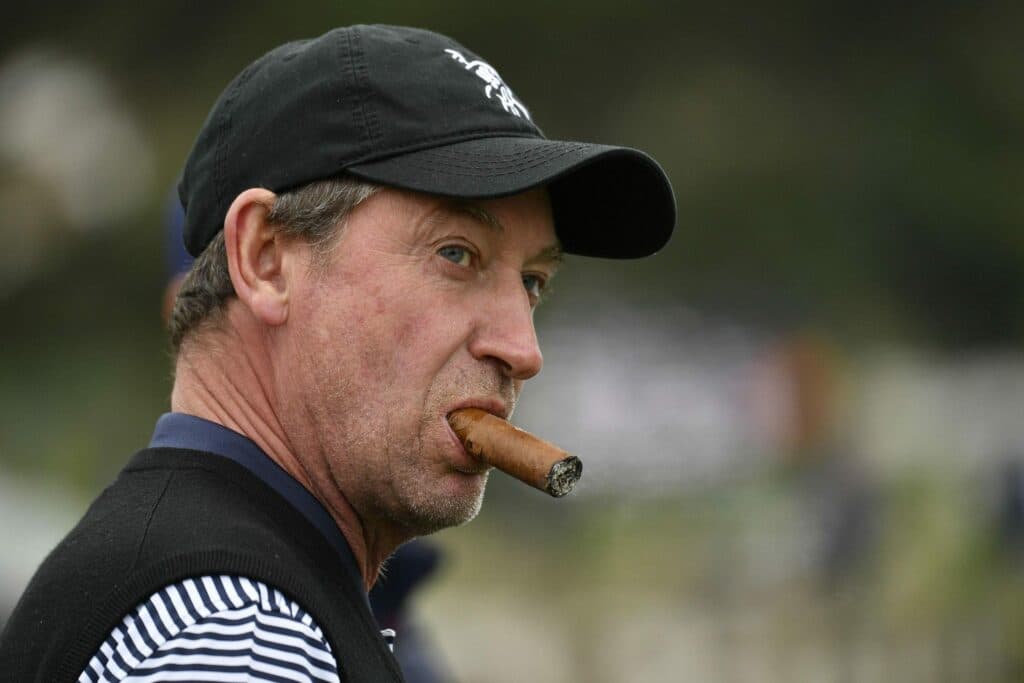 © Michael Madrid via Imagn Content Services, LLC
Wayne Gretzky smokes a cigar while surveying the scene at the AT&T Pebble Beach Pro-Am on Feb. 8, 2020. Gretzky has been at home with his family in Thousand Oaks, Calif., since the coronavirus pandemic took hold.
But his life is full of interesting details. Gretzky had theoretically signed away his chance of ever playing in the NHL on his 18th birthday for a 21-year personal services contract. Without that, without the midnight flight to Edmonton, who knows whether the Oilers exist today.
His long-term relationship with Vicki Moss seemed to break apart with distance, as she pursued her music career in Los Angeles. Of course, his time spent there led to his friendship with celebrity Alan Thicke, which led to meeting Janet, and another reason later to consider LA.
Gretz, as written in Brunt’s book, was also extremely conscious of what was said and written about him, protective of his self-image. But he was no average kid, after all, first coming to national attention at the age of 10, and moving from his hometown at 14 because of the negativity surrounding him from minor hockey parents.
Ultimately, Gretzky is revered as a legend and rightfully so. He remains the greatest genius the game has ever known. But he is also flesh and blood, a human being, like all of us. There are so many other details of his life and career that are fascinating, which take a backseat to a 92-goal season, a 215-point campaign, a 51-game point streak to begin a season.
The only thing that’s really tainted his overall reputation isn’t non-hockey related: his friendship with President Donald Trump souring his persona in some Canadians’ eyes. The gambling scandal with the Coyotes in 2006, embroiling his wife and Rick Tocchet, is long forgotten. Calling the New Jersey Devils a “Mickey Mouse franchise” is good fodder today.
The Gretzky trade created a celebrity buzz around a moribund franchise, driving A-listers to seek Kings tickets, enormous endorsement deals, a persona weighty enough to host Saturday Night Live, and financial gain he would’ve never received if he stayed in Edmonton.
This is not any ill-will to Gretz. He is undoubtedly a genius, one of the greats in all of sports.
But for a guy my age, I’m fascinated by the myth that shrouds him: an otherworldly creature who no one could touch on the ice, but more complicated than the simplistic version so often provided.
He knew the gravity of the situation. However unlikely it is that Pocklington would’ve kept Gretzky until his contract expired, would he have ever re-signed? Could Pocklington have ever come up with enough scratch? Especially since Gretzky’s salary more than doubled as soon as he was dealt?
It seems unlikely.
Where the game has grown
I don’t think it’s hyperbole to say the Gretzky sale is the most impactful financial maneuver in NHL history. Teammates like Craig Simpson believed this sale had the greatest impact on future labour negotiations.
Stars were no longer chattel for the owner. Players had power.
In terms of growing the game in the U.S., Gretzky became a household name, even a ProStars cartoon. The league spurred on other non-traditional hockey markets, but the overall “growth of the game” has been a bumpy road. The NHL has had a difficult time getting out of its own way.
To think Gretzky specifically mentioned his disappointment that the ESPN contract wasn’t renewed during that ’88 press conference, and how much that would play into hockey’s perceptions in the years that followed, and consternation with their renewed coverage today. (That’s more of an ESPN-wide issue at the moment).
But as much as things change, the more they stay the same.
 Robert Hanashiro/USA TODAY NETWORK
Mar. 23, 1994; Los Angeles, CA, USA; LA Kings Wayne Gretzky sets NHL goal scoring mark. Mandatory Credit: Robert Hanashiro/USA TODAY NETWORK
The Montreal Canadiens dashed Gretzky’s best chance at another Stanley Cup in 1993, the last Canadian franchise to win.
Meanwhile, the story of this off-season is the U.S. Olympic Team’s players seeking new homes, and the ongoing question of whether Canadian teams can keep their stars. Additionally, none of the Stanley Cup winners of the 2020s were part of the 21-team NHL in 1988, and June hockey is now routinely played in sunnier climes in Florida, Nevada, and North Carolina.
Has hockey’s cash cow and spiritual home been sold out to the Sun Belt?
This is a tension unique to the NHL, the biggest league in North America that relies on both countries to make the business work. For many, Canadian franchises are taken for granted as success drivers, while the perception is teams south of the border are catered to.
I find the talk about no Canadian team winning the Cup since 1993 as annoying as many would see the anniversary of the Gretzky trade. I’ll refer you to a Baggedmilk article from 2017.
But beyond being a “sick” social media burn, I wonder how much longer the Canadian drought can go on till it’s seen as a legitimate concern, whether the fans who are squeezed the most financially get fed up.
This isn’t to say winning the Stanley Cup is a Canadian birthright, but I could only imagine what Lord Stanley’s return to Canada would mean for the country, or the league’s financials. I wouldn’t know. It’s never happened in my time.
And looking back at this Gretzky anniversary, a moment where it became true that “we aren’t in Kansas anymore,” the Oilers have been fortunate to see another great one in McDavid play here for so long.
Two years away from free agency…The ultimate hope in pining for the Stanley Cup, and coming so close twice.
On days like today, you hope the Oilers can avoid – if possible – another date that lives in similar infamy to the Great Gretzky’s sale.
Michael Menzies is an Oilersnation columnist and co-host of PreGaming and Oilersnation After Dark. He’s also been the play-by-play voice of the Bonnyville Pontiacs in the AJHL since 2019. With seven years of news experience as the Editor-at-Large of Lakeland Connect in Bonnyville, Menzies collects vinyl, books, and stomach issues. Follow him on X at Menzies_4.
SIGN UP NOW FOR THE NATION GOLF TOURNAMENT

The Nation Golf Tournament driven by GMC is back Friday, August 28, 2026! Which means it’s once again socially acceptable to skip work on a Friday for “networking.” Join us on Friday, August 28, 2026, at Mill Woods Golf Course for an 18-hole Texas scramble shotgun start, questionable swing decisions, and enough chirping to last the entire offseason. Grab your squad and sign up now at nationexperiences.ca before it sells out!


Breaking News
- The Day After 2.0: Marjala and Leppänen shine as farmhands lead Oilers to OT win
- Instant Reaction: Viljami Marjala scores OT winner to lift Oilers over Jets 2-1
- Eduards Tralmaks on NHL ambitions: ‘I still haven’t given up on my dream yet’
- GDB -2.0: The test starts now as Oilers face Jets… again (6 PM MT, TSN3)
- Remember Ty Rattie? Revisiting ‘The Answer’ and searching for Edmonton’s next one

Edmonton OilersTeam Cap Summary

Cap Summary
2027-28
2028-29
Projected Cap Hit
$88,322,500
$61,025,000
Projected Cap Space
$25,177,500
$61,975,000
Current Cap Space
$25,177,500
$61,975,000
Active Players
16/23
10/23
Draft Picks
Round
'27
'28
1
0
1
2
1
0
3
0
1