
OilersNation has no direct affiliation to the Edmonton Oilers, Oilers Entertainment Group, NHL, or NHLPA
What’s the likelihood that Tristan Jarry will be an upgrade on Stuart Skinner?
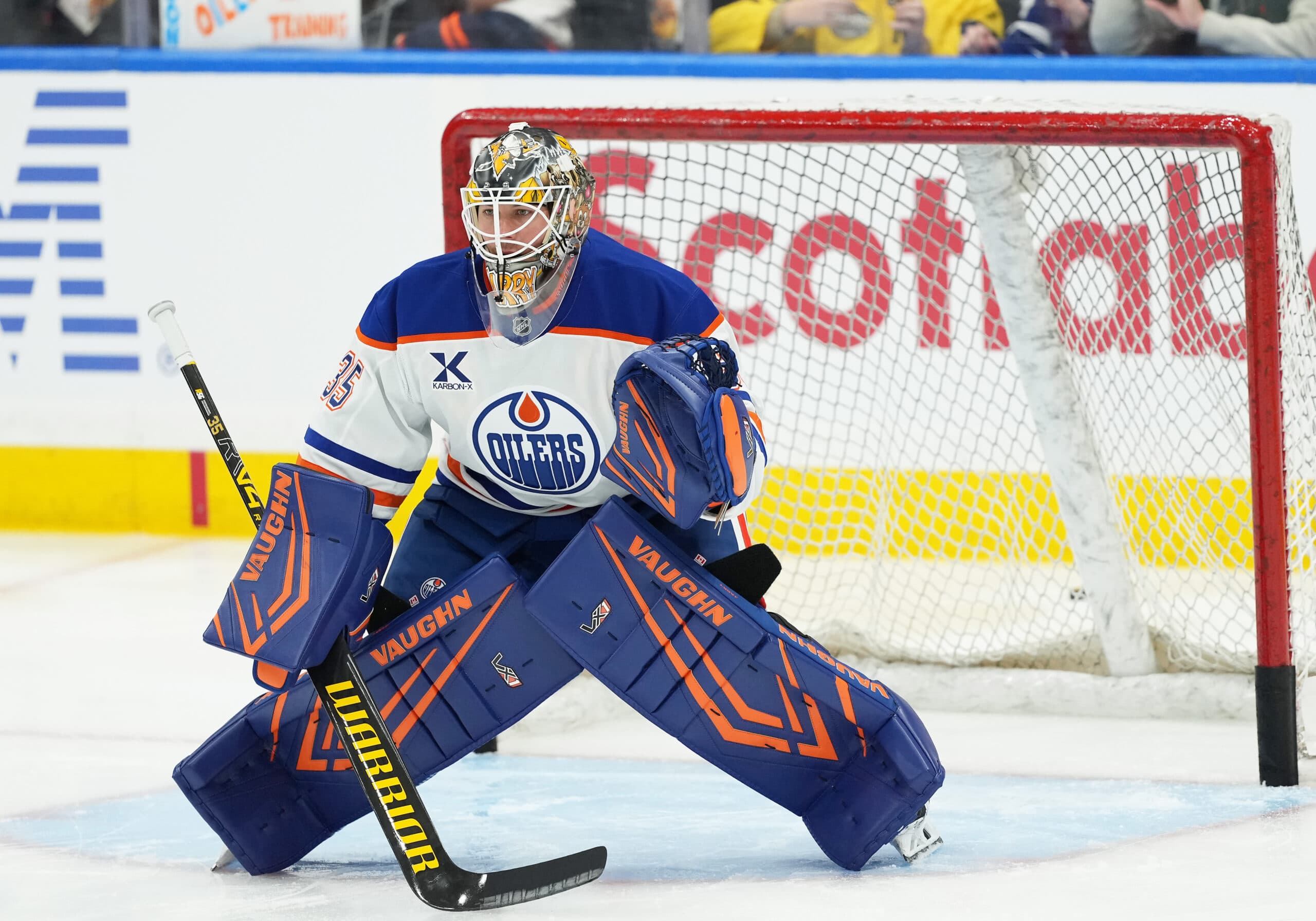
Photo credit: Nick Turchiaro-Imagn Images

On Friday morning, the Edmonton Oilers finally made their major goaltending move. It was a deal that sent their starting goalie in Stuart Skinner, alongside defenceman Brett Kulak and a 2029 second-round pick, to the Pittsburgh Penguins for goaltender Tristan Jarry.
Fans and media alike have clamoured for the Oilers to make an upgrade in net for years, and it’s certainly not difficult to see why. The team’s goaltending tandem has been wildly inconsistent, and has particularly left a lot to be desired with their performance in the playoffs. In my opinion, they should have made a goaltending change a long time ago.
That all being said, this decision by Edmonton is not exactly a surefire bet either.
Indeed, Tristan Jarry is having a fine season thus far. Glancing at the numbers, he had a .909 save percentage in 14 games with Pittsburgh, while EvolvingHockey’s model has him at roughly 9 goals saved above expected. Quite good. However, it must be mentioned that Jarry was placed on waivers not even a full year ago, having a much less appealing .893 save percentage and -4.6 GSAx in a sample size of 36 games in the 2024-25 season. It is not a guarantee that his current performance will be sustained.
So, will Jarry be an upgrade on Skinner? Can he backstop Edmonton to a Stanley Cup, or will the Oilers’ goaltending problems remain unsolved? Let’s take a closer look.
First, we’ll begin with a statistical comparison of Skinner and Jarry’s results. Specifically, I will primarily be using the metric GSAx (Goals Saved Above Expected) over raw SV%. The problem with a stat like SV% is that it treats every shot equally, whether a high-danger chance off the rush or a neutral zone dump-in that happened to land on net; what this can do is highly underrate goalies behind poor defences that allow a high number of quality chances, and vice versa. This can particularly be problematic when comparing goalies across different teams, as they each play behind different defensive groups and in different environments. Comparatively, the statistic GSAx, though not perfect, specifically weighs every shot differently based on its probability of being a goal. You can read more about the details of how GSAx is calculated right here, but at the very least, it is a much more fair measure than SV%.
Different models have different inputs and methods in how they calculate their results. So to deepen our analysis, instead of just looking at one model, here is a glance at Skinner and Jarry’s GSAx per four different public models:
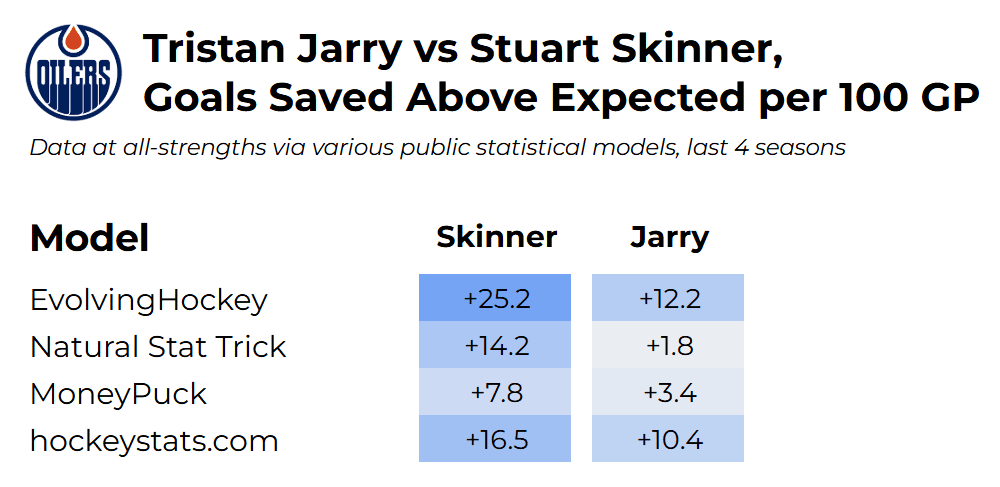
While the exact values differ from model-to-model, the final conclusion does not. Each of these four models have consistently rated Skinner’s results higher to varying degrees. To put it into more simpler terms, when adjusting for shot volume and quality against, multiple sources suggest that Skinner has saved much more goals than expected than Jarry has.
Let’s broaden our analysis even further and include sneak peaks from private models. It should be noted that these models are the ones often used by NHL teams, incorporating much more detailed inputs than public models can. Firstly, per Mike Kelly, the private model SportLogIQ rates Jarry at about ~12 goals saved above expected this season, compared to about ~11 for Skinner. That is very, very close, and roughly in line with EvolvingHockey’s model, which rates Jarry and Skinner’s GSAx at about +9 and +8 respectively.
Furthermore, per Kevin Woodley on the Jason Gregor Show, who has access to numbers from the private model CSA (Clear Sight Analytics), Jarry ranked 10th in the league in adjusted SV% this season heading into the trade. Interestingly, Woodley states that, using CSA’s Goalie Swap tool, if Jarry were to play in Skinner’s minutes over the past two seasons, the Oilers would have saved roughly 6 more goals.
Overall, these are fascinating results. Most of these models come to the conclusion that Jarry has had a better 2025-26 season than Skinner thus far, though the gap between them varies from model-to-model. However, over a larger sample, it certainly seems that Skinner has the decisive edge.
Now, what’s really interesting about this trade is that both goalies have a very similar problem; consistency.
Perhaps Skinner’s greatest issue in Edmonton was his streakiness. When he was on his game, he was outstanding, and absoultely at the level of a capable starter. But when he was not, his results would often rank near the bottom of the league. There was hardly any middle ground.
During the 2022-23 regular season, Skinner’s GSAx (per EvolvingHockey) ranked in the 81st percentile, meaning he outperformed the vast majority of NHL goalies. But in the playoffs, his numbers plummeted to just the 2nd percentile. The following year started even worse, with his results sitting in the 1st percentile over the first two months of the 2023-24 regular-season, before rebounding to the 87th percentile for the remainder of the season. But once again, the postseason brought another sharp decline down to the 5th percentile in the opening two rounds, followed by yet another dramatic recovery, climbing to the 89th percentile in the conference finals and Stanley Cup Finals combined.
I could go on and on here, but you get the picture.
Jarry does not seem significantly different in this facet. By most models, Jarry has been a net positive in 2025-26, a net negative in 2024-25, a net positive in 2023-24, and about average in 2022-23. Before that, Jarry had a pretty solid season in 2021-22, but a highly disappointing 2021 shortened season, highlighted by an abysmal playoff performance against the New York Islanders. In general, Jarry can be just as prone as Skinner to bad stretches; for instance, in the first three months of 2024-25, Jarry allowed over 8 goals than expected in 17 games, even rocking an atrocious 0.884 SV% if you were to look at the traditional numbers.
All things considered, this is certainly a risky gamble by Edmonton. Compared to Skinner, Jarry is older, more injury-prone, and has worse adjusted results by numerous different statistical models over the past few seasons. It must also be mentioned that Jarry has very little playoff experience, playing just 8 games in the post-season in his career, and in those games, his results were awful (-8.1 GSAx, 0.892 SV%). Of course, Skinner has been far from perfect in the post-season, but the fact remains that he was their primary starter for back-to-back cup final runs. Some models, like EvolvingHockey, even rated his GSAx at a positive.
Now of course, goaltending can be unpredictable. It would not surprise me whatsoever if Jarry were to finish the season hoisting the Stanley Cup in Edmonton. At the same time, it would also not surprise me if Jarry were to be in buyout conversation at the end of the season. And ultimately, that is the biggest risk about this deal; the inconsistency in Jarry’s performance.
If Jarry can carry his performance this season into Edmonton, that would be excellent news, and it would absoultely be an upgrade on Skinner. And perhaps simply making a change will provide a mental boost to the team in front of Jarry. But at this point of time, it is really not certain at all which version of Jarry that Edmonton will get.
My best guess is that this ends up being, more or less, a lateral move; swapping one streaky goaltender out for another. The hope will be that Jarry’s best stretches arrive when they matter most.
Find me on Twitter (@NHL_Sid)
ARTICLE PRESENTED BY bet365


Breaking News
- ‘He’s the perfect fit’: Oilers’ leaders endorse Mike Babcock
- McDavid goes coast-to-coast against Utah: Best Oilers goals of 2025-26
- Two former Oilers remain unsigned after a month of NHL free agency
- Ryan Nugent-Hopkins scores winner in 1,000th game: Best Oilers moments of 2025-26
- Monday Mailbag: Do the Oilers need more grit in their lineup?

Edmonton OilersTeam Cap Summary

Cap Summary
2026-27
2027-28
Projected Cap Hit
$99,274,166
$87,350,000
Projected Cap Space
$4,725,834
$26,150,000
Current Cap Space
$4,725,834
$26,150,000
Active Players
23/23
15/23
Draft Picks
Round
'26
'27
1
0
0
2
1
1
3
1
0