
OilersNation has no direct affiliation to the Edmonton Oilers, Oilers Entertainment Group, NHL, or NHLPA
Why Kris Knoblauch’s ice time decisions could backfire for the Oilers

Photo credit: © Nick Wosika-Imagn Images

By Lane Golden
Oct 19, 2025, 11:00 EDTUpdated: Oct 19, 2025, 11:09 EDT
Through five games of the 2025-26 season, Connor McDavid and Leon Draisaitl are both averaging over 23 minutes of time on ice (TOI). Not only does that lead the league for forwards, but it’s a higher rate than any forward has averaged in a season over the past decade.
While the two superstars absolutely should be among the league leaders in TOI, given their impact on the game, it’s somewhat puzzling to see their usage reach the highest rates of their careers in an Olympic year, following back-to-back lengthy playoff runs.
The heavy use of their top stars has been coupled with an underuse of younger, less-established NHLers. The Oilers have shied away from giving their youngsters meaningful minutes for quite some time. Two fantastic players, Dylan Holloway and Philip Broberg, signed offer sheets just over a year ago, partly due to a lack of opportunity to progress their careers in Edmonton.
You’d think that management would make sure to avoid having that happen again, but at least so far, it’s more of the same philosophy. Their U25 forwards, Matthew Savoie, Isaac Howard, and Vasily Podkolzin, have all averaged under 13 minutes of TOI per game.
Now, it’s still early, and Kris Knoblauch may very well manage his players’ minutes much differently as the season progresses. However, it’s still helpful to understand why it’s unfolding as it is right now. Let’s take a closer look at what’s going on.
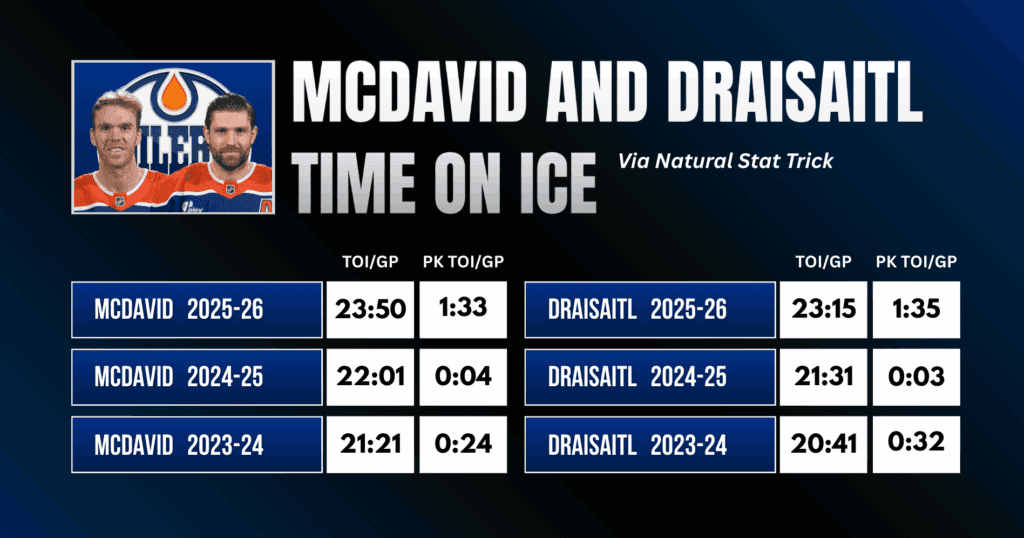
As you can see, increased deployment on the penalty kill accounts for a majority of the increase in TOI this season. In the past, coaches have either used McDavid and Draisaitl late in penalty kills to counterattack their opponents towards the end or not at all. Is this change in usage worth it?
Using McDavid and Draisaitl on the Penalty Kill
Whether coaches should utilize their top offensive stars on the penalty kill has been an ongoing debate in the hockey world for years. Having your best players kill penalties can be a huge plus when they possess the necessary skills.
Having the speed to close distance quickly, intercept passes, and attack short-handed off the rush can be a valuable asset to penalty-killing units, and McDavid and Draisaitl possess these attributes.
Reliable penalty killing matters. The last 27 Stanley Cup champions have all had a penalty kill above 80% during the postseason. I can understand the Oilers putting skilled players on the penalty kill to try to get better results, but this isn’t the playoffs; it’s October, and for players at this high of a level offensively, the cons may outweigh the pros.
The Oilers currently rank 30th in the NHL in goals per 60 minutes at 5v5. Absolutely abysmal for a team of this calibre. While their current SH% of 8.28 will surely increase, they are in far more desperate need of offence from their top stars than penalty killing help. There’s only so much ice time you can give players, so putting McDavid and Draisaitl in positions where their offensive skillsets are utilized the least is probably not the optimal approach.
And then there’s the question of fatigue. The Oilers are coming off back-to-back runs to the Stanley Cup Final, and both McDavid and Draisaitl will be representing their respective countries at the Olympics this winter. I don’t care how elite their conditioning is; that’s a lot of hockey. Adding an extra minute or more every game for these superstars to handle is not wise if Edmonton aspires to play deep into June again.
Play the Kids
When the Oilers traded Evander Kane and Viktor Arvidsson and let numerous other veterans leave in free agency, it seemed as though they were finally clearing space for youngsters who were blocked from advancing into the lineup.
So far this season, players like Savoie, Howard and Philp have been subjected to healthy scratches and limited minutes, with each outside of the top nine forwards in average TOI. The Oilers are overplaying their top stars while simultaneously holding back high upside players.
So far this season, players like Savoie, Howard and Philp have been subjected to healthy scratches and limited minutes, with each outside of the top nine forwards in average TOI. The Oilers are overplaying their top stars while simultaneously holding back high upside players.
The season is young, so there’s plenty of time for these players to earn the trust of the coaching staff and work their way up the lineup. It’s not necessarily time to hit the panic button yet. Knoblauch addressed the possibility of an elevated role for his young players less than a week ago.
“I think with some opportunities, they can contribute more offensively. Right now, we’ve got Howard and Savoie playing special teams, but maybe over a period of time they can move up in the lineup and play more regular, even-strength minutes and we’ll see how things fit in.”
Still, for Oilers fans who have a bad taste in their mouth after they witnessed the team’s lack of confidence in Holloway and Broberg, who have thrived in a bigger role in St.Louis, it’s hard to trust that this organization will do the right thing.
How should the Oilers deploy their lineup?
One thing I’ve learned is that no head coach is going to put out a lineup that will make everyone happy. We can nitpick line combinations and deployment every single game. I’m not expecting perfection from Knoblauch in every decision, and I can understand the appeal of sticking to veterans he trusts and leaning on McDavid and Draisaitl. However, so far this season, he has been excessive on both fronts. It simply can’t continue.
If the coaching staff insists on using the dynamic duo on the penalty kill, I would rather see their usage limited to around 30 seconds per night, similar to the 2023-24 season, with them mostly used in high-leverage situations or at the very end of the kill. The Oilers must manage their minutes because it could be a gruelling season with the Olympic schedule mixed in.
And at some point, you have to trust the kids. The Oilers made an investment this summer in a younger, more sustainable supporting cast for McDavid and Draisaitl. Now it’s time to give them a chance to take a step forward. October hockey isn’t the time to burn out your stars. It’s the time to build chemistry and confidence up and down the lineup.


Breaking News
- 4 Oilers primed for bounce back seasons
- Oilers prospect Rudolfs Berzkalns named captain of USHL’s Muskegon Lumberjacks
- Grading every trade of the Stan Bowman era with the Edmonton Oilers
- Why the Oilers can survive Frederik Andersen’s absence
- Oilersnation Radio: Bounce back Oilers, injury worries, and the Connor Hellebuyck situation

Edmonton OilersTeam Cap Summary

Cap Summary
2026-27
2027-28
Projected Cap Hit
$102,071,666
$88,322,500
Projected Cap Space
$1,928,334
$25,177,500
Current Cap Space
$1,928,334
$25,177,500
Active Players
22/23
16/23
Draft Picks
Round
'26
'27
1
0
0
2
1
1
3
1
0