
OilersNation has no direct affiliation to the Edmonton Oilers, Oilers Entertainment Group, NHL, or NHLPA
Identifying the key differences between Team Canada and the U.S. ahead of Olympic Gold Medal Game
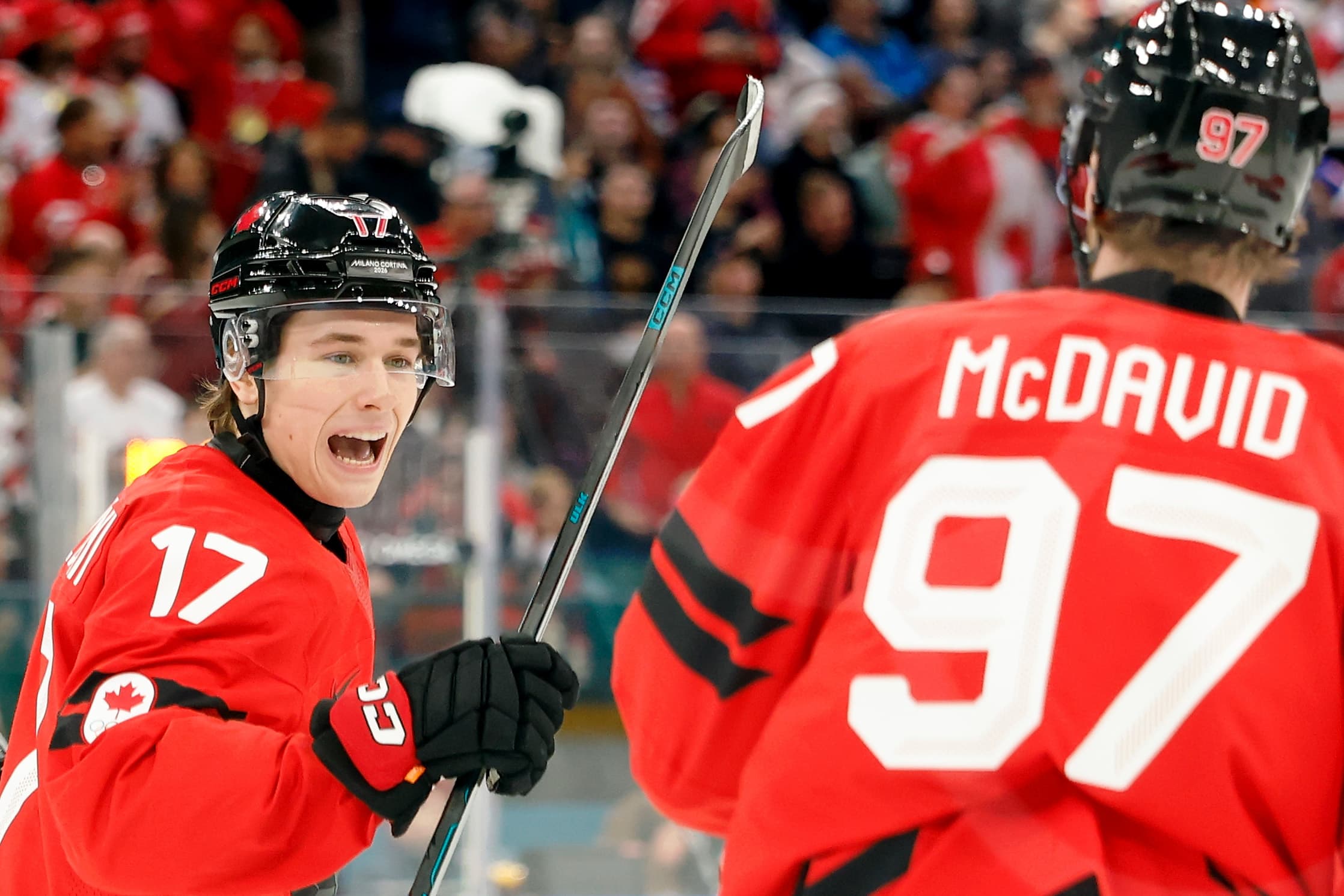
Photo credit: Geoff Burke-Imagn Images

By Lane Golden
Feb 21, 2026, 14:00 ESTUpdated: Feb 21, 2026, 14:03 EST
For the first time since the 2010 Olympic Games in Vancouver, the gold medal in men’s hockey will come down to Canada and the U.S.. While the competition across the world has never been stronger, the two North American hockey powers have established themselves as the top teams in the world, and in this tournament.
According to Dimitri Filipovic’s scoring chance tracking, Canada is the top offensive team at the tournament, having generated 180 chances in five games. The U.S. has generated 172 chances, and conceded only 72, making them the top defensive team at the Olympics.
The 4 Nations Face-Off gave us a taste of how thrilling best-on-best can be between these two teams, and a chance to do it at the Olympics in the gold medal game has been 16 years in the making. In this piece, I will break down how Canada shapes up in what will prove to be another massive game in hockey history.
Forechecking will be key
The calibre of defence in the gold medal game is too high to expect many chances off the rush. With the short neutral zones, time and space have already been severely limited, and teams have been forced to play mostly a dump-and-chase game, save for a few moments when counterattacks open up odd-man breaks.
Jon Cooper is utilizing a Florida Panthers-inspired game plan, where they rim the puck hard into the opposition zone and send forecheckers full-tilt down the far-side wall, looking to create turnovers. The speed of Macklin Celebrini and Connor McDavid to close on defenders on the forecheck, and their excellence in working the puck down low, has been an absolute sight to behold, especially when they load up with Nathan MacKinnon.
Some of Canada’s hard-nosed forwards, like Brandon Hagel and Tom Wilson, have had a relatively quiet tournament offensively. Against a stingy U.S. defensive core that retrieves and moves pucks well, their forechecking may be key to helping Canada maintain possession in the non-McDavid minutes.
As for the Americans, I expect Matt Boldy and the Tkachuk brothers to be highly physical against the Canadian defence, as they have been throughout the tournament. They may not have quite the same speed as McDavid or Celebrini when hunting down pucks, but they’re absolutely punishing.
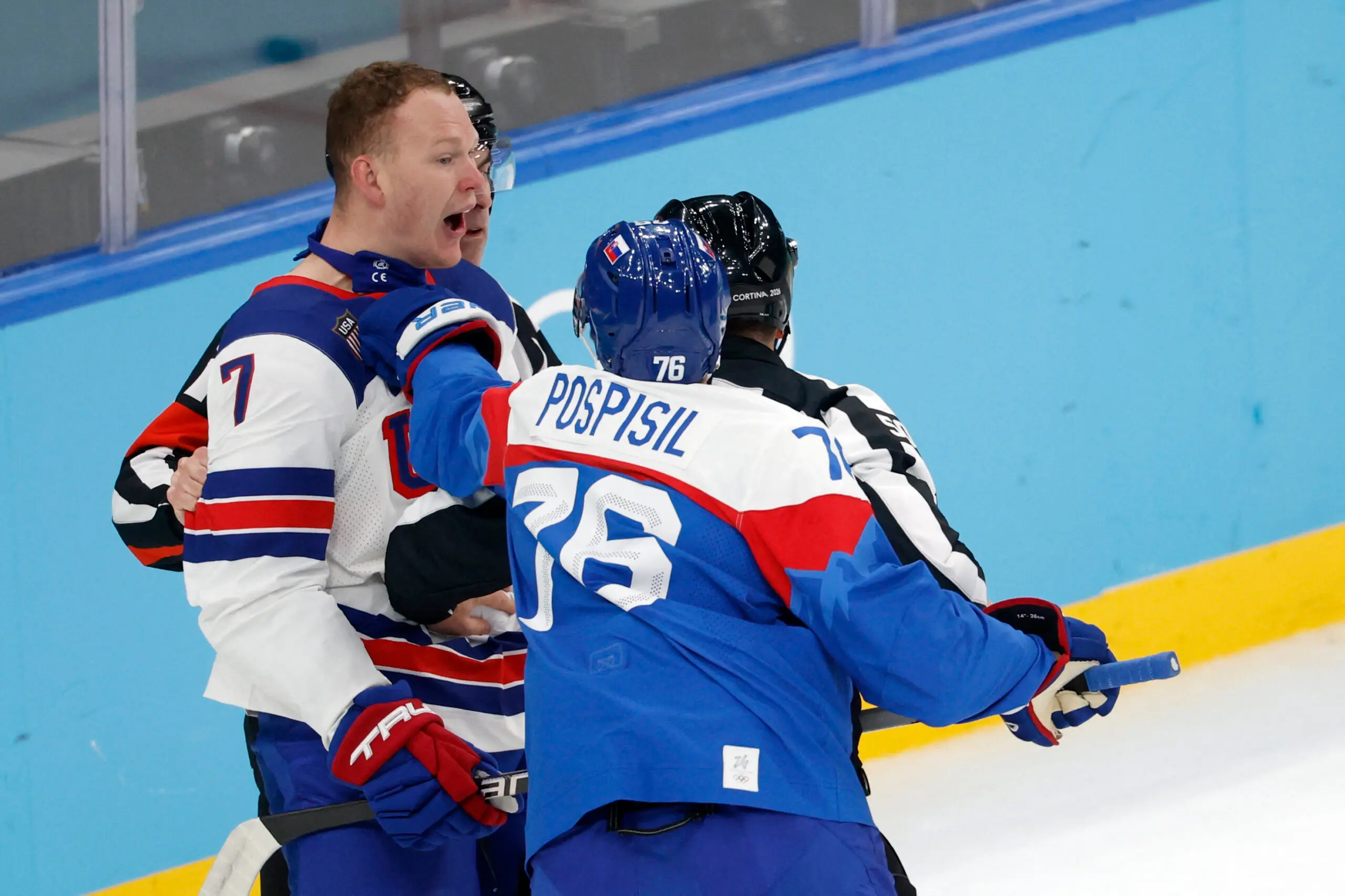 David W Cerny/Reuters via Imagn Images
[US, Mexico & Canada customers only] Feb 20, 2026; Milan, Italy; Brady Tkachuk of United States clashes with Martin Pospisil of Slovakia in a men’s ice hockey semifinal during the Milano Cortina 2026 Olympic Winter Games at Milano Santagiulia Ice Hockey Arena. Mandatory Credit: David W Cerny/Reuters via Imagn Images
Canada’s defensive core will be tested
One of the most controversial aspects of this Canadian squad is the construction of their defensive core. Leaned toward defensive specialists in Devon Toews, Colton Parayko, Travis Sanheim, and even Drew Doughty at this stage of his career.
Toews was an obvious pick given that he plays with Canada’s top defenceman, Cale Makar. Still, the decision to select all of the other three instead of allocating at least one of those roster spots to a mobile, high-upside player like Jakub Chychrun, Matthew Schaefer, or Evan Bouchard remains a choice that will be scrutinized if they fail to break through offensively against their toughest competition.
Parayko, in particular, has struggled in transition, often missing opportunities to get his forwards the puck in flight, settling for dump-ins and slower exits that allow the opposition to get set defensively. With Quinn Hughes and Zach Werenski on separate pairs, a lack of offensive creativity for the defence isn’t an issue for Americans to the same degree.
Josh Morrissey remains out of the lineup for Sunday’s game, and as one of Canada’s best transitional defencemen, his absence will be felt. I would like to see the coaching staff use Shea Theodore more to make up for that loss. He was instrumental in their comeback win against Finland and provided a little more offensive firepower than some of their other options.
Canada has trailed in each of their two playoff games so far, and both the Czechs and Finns trapped up the neutral zone and shelled up defensively to try and hang on. If Canada can score early, I would like to see how they respond when defending a lead against a strong opponent rather than chasing the game. Perhaps some of their more defensive defenders do more to justify their place on the team in that scenario.
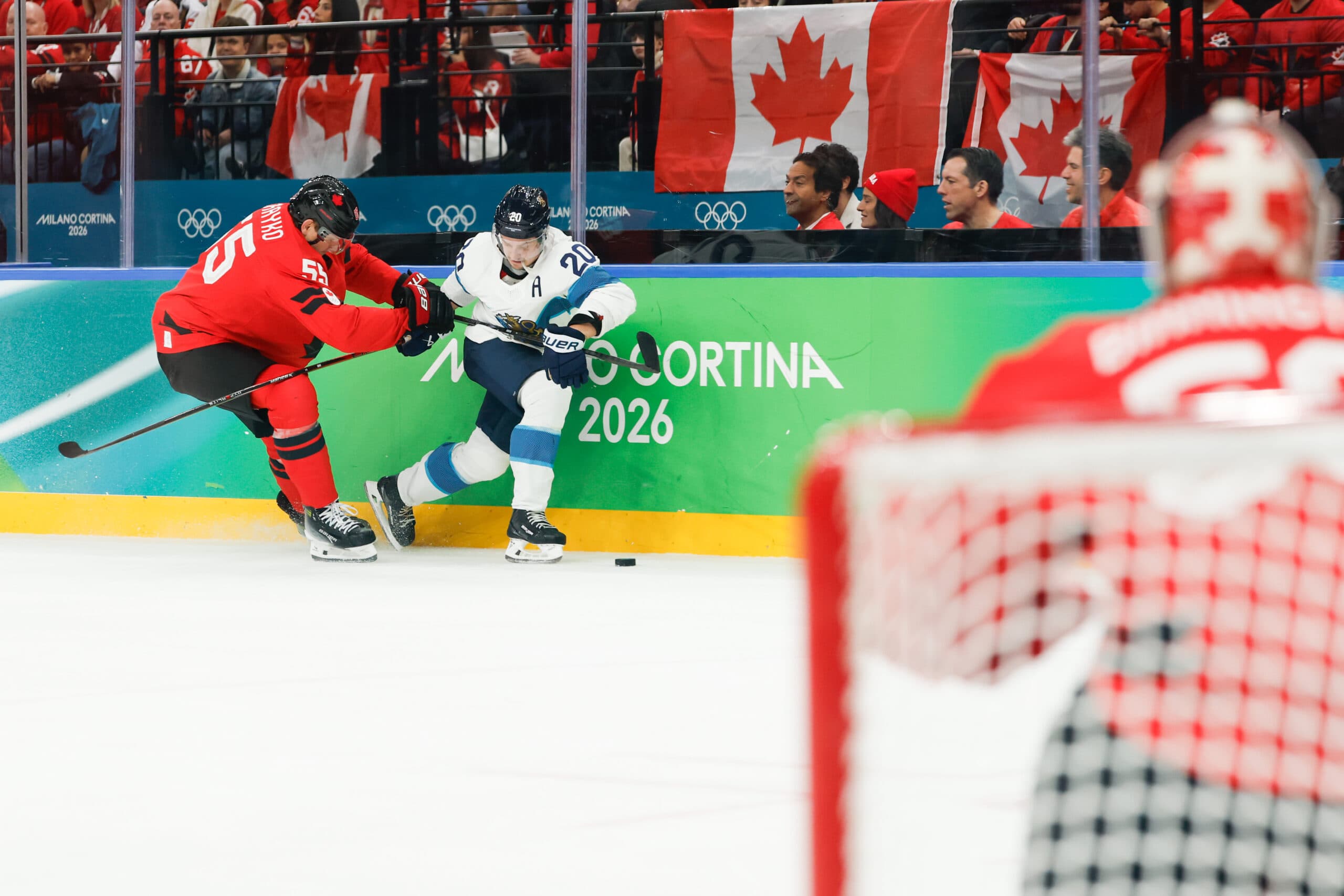 Geoff Burke-Imagn Images
Feb 20, 2026; Milan, Italy; Sebastian Aho (20) of Finland chases the puck as Colton Parayko (55) of Canada defends during the third period in a men’s ice hockey semifinal during the Milano Cortina 2026 Olympic Winter Games at Milano Santagiulia Ice Hockey Arena. Mandatory Credit: Geoff Burke-Imagn Images
Canada’s nuclear option
If there’s any way Canada might be able to separate itself from the U.S., it’s with their top line. I’ve already mentioned how quickly McDavid, Celebrini, and MacKinnon can close on defenders on the forecheck, but it’s not just that — they move at warp speed with everything they do.
They’re dangerous off the rush, and they process the game so fast. It’s a dream line that no other country in the world can throw at their opponents. Canada will have the last change for finishing first in the preliminary stage, and I expect Cooper to try to use this line in favourable matchups, away from some of the Americans best defensive players like Jaccob Slavin and Dylan Larkin.
Celebrini had eight shots on goal in the Semi-Final against Finland and led all players in scoring chances. McDavid and MacKinnon were making so many fantastic plays to get him the puck in prime scoring areas. He leads the tournament in goals with five, and yet even that seems low for how much this line generates and how great he is at finding open space to shoot from.
In Vancouver, the hero was Crosby. At the 4 Nations Face-Off, it was McDavid. Based on the dynamics of Canada’s nuclear line, the most likely candidate if Canada needs a big goal is Celebrini.
Goaltending
I won’t spend too much time on the goaltenders, but it’s undoubtedly an intriguing matchup. Jordan Binnington has been a disaster this season for the St. Louis Blues, ranking dead last in the NHL with a goals saved above expected of -28. Still, save for a bit of shaky rebound control in a couple of the games, he’s looked fine in this tournament, and even made a couple of clutch stops late against Czechia.
Hellebuyck is also having a down year in the NHL by his standards, although he hasn’t been nearly as poor as Binnington. He has been the best goalie in the tournament so far, posting a .947 save percentage, but that was also the case heading into the 4 Nations Final. It will be another legacy-defining game for Hellebuyck, who is looking to get over the hump in a big game.
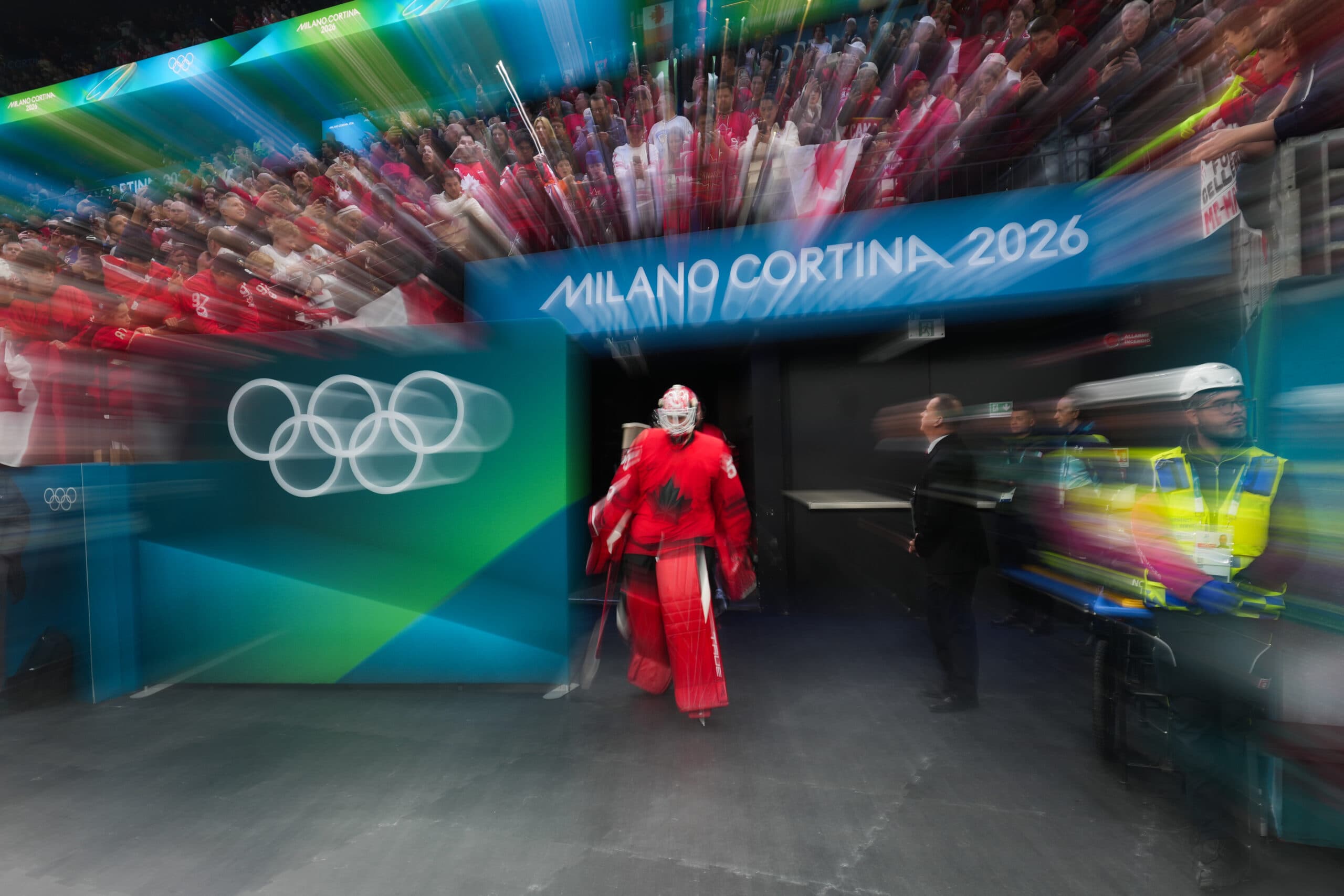 James Lang-Imagn Images
Feb 20, 2026; Milan, Italy; Jordan Binnington (50) of Canada walks through the tunnel before the game against Finland in a men’s ice hockey semifinal during the Milano Cortina 2026 Olympic Winter Games at Milano Santagiulia Ice Hockey Arena. Mandatory Credit: James Lang-Imagn Images
Faceoffs
The importance of faceoffs is typically overstated by old-school hockey people (statistical analysis in modern times has revealed how little they tip the scales). However, they still have some situational importance, and I feel like it’s more meaningful against the U.S.. Mike Sullivan loves taking advantage of set plays on offensive zone draws, and his team has been very successful scoring immediately following draws.
Canada struggled in the faceoff dot in their last game, and if Crosby isn’t available, they’ll need other centres to come up big on defensive-zone draws, and their defence will need to be quick to get to their assignments. They’ve already been burned once, as Finland scored immediately off a faceoff in their last game, when Horvat lost a draw, and Hagel couldn’t get his stick in front of a shot by Rantanen in time.
The verdict
This gold medal final will be a hotly contested, physical, tight-checking game. There is still a question mark regarding Crosby’s availability, and without him, the rest of the forwards will need to bring it. Expect another heavy dose of McDavid and Celebrini, who each played over 25 minutes against Finland.
Bet365 currently has Canada as a slight favourite at -130, a 56.5 implied win percentage, and HockeyStats’ analytics model gives Canada a 51 percent chance. Ultimately, the margin for error will be extremely thin, and the game will be won and lost in the trenches. It’s a rare opportunity to witness the sport played at its absolute ceiling that I personally cannot wait for.
PRESENTED BY DAILY FACEOFF’S OLYMPIC COVERAGE

Catch Every Goal from the 2026 Milan Games! The 2026 Milan Games are almost here, and the world’s best men’s and women’s hockey players are ready to battle for gold! The Nation Network is bringing you every game, every jaw-dropping save, and all the drama with live reaction streams and full recaps. Don’t miss a moment of Olympic hockey action—men’s, women’s, and everything in between—on the Daily Faceoff YouTube channel. Subscribe now and stay on top of every play!


Breaking News
- Sunday Scramble: The Drop showcases Michael Parkatti and analytics in Oilers’ offseason decisions
- Should Kasperi Kapanen be Leon Draisaitl’s go-to right-winger?
- Oilers from the past: Has Tobias Rieder finally started scoring goals?
- Oilers announce theme night schedule for 2026-27 season
- What if the Oilers traded for Mikko Rantanen in 2025?

Edmonton OilersTeam Cap Summary

Cap Summary
2026-27
2027-28
Projected Cap Hit
$99,274,166
$87,350,000
Projected Cap Space
$4,725,834
$26,150,000
Current Cap Space
$4,725,834
$26,150,000
Active Players
23/23
15/23
Draft Picks
Round
'26
'27
1
0
0
2
1
1
3
1
0