
OilersNation has no direct affiliation to the Edmonton Oilers, Oilers Entertainment Group, NHL, or NHLPA
Why the success of the Oilers signing John Klingberg is dependent on usage and expectations
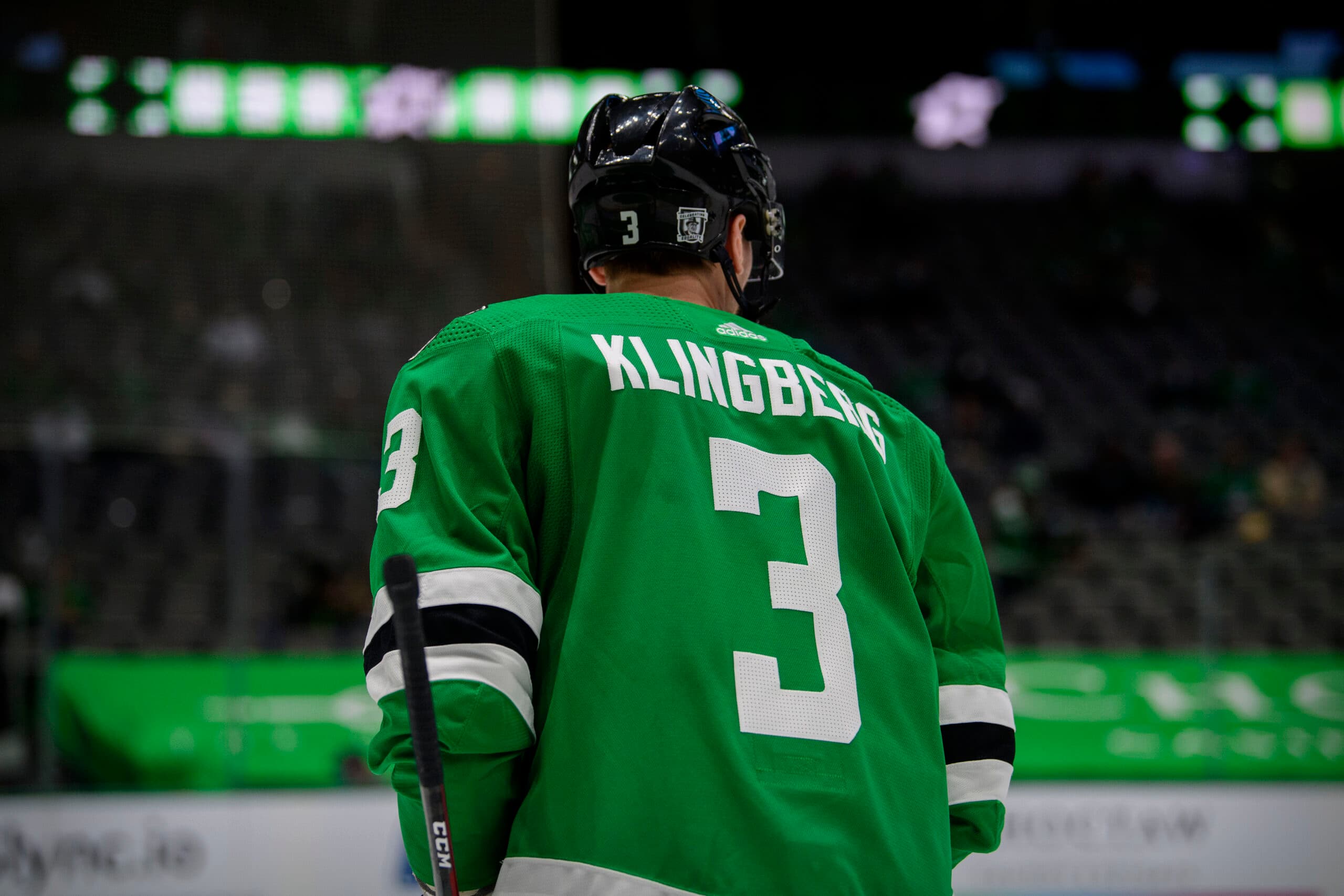
Photo credit: © Jerome Miron-Imagn Images

On January 17, the Edmonton Oilers signed free agent veteran defenceman John Klingberg to a one-year deal at a projected cap-hit of $1.74M. Klingberg is a 32-year-old Swedish defenceman who most recently played in the NHL with the Toronto Maple Leafs, but only appeared in 14 games for the team due to a hip injury that caused him to be placed on LTIR. Ever since his most recent NHL appearance in November of 2023, Klingberg has spent his time recovering from a double hip resurfacing procedure.
At first glance, this signing may seem like a perplexing decision by Edmonton’s management. Klingberg was once a superb offensive defenceman, but his best years are far behind him, and his most recent underlying defensive results in Dallas, Minnesota, Anaheim and Toronto have all been ghastly. Per Elite Prospects, the Oilers are currently projected to be the oldest team in the NHL; is a 32-year-old defenceman with major injury issues and abysmal defensive metrics what this team really needed?
But while it’s reasonable to be skeptical, I believe this signing could end up looking like a fantastic bet by the Oilers. Or at the very least, it has the potential to.
Can Klingberg still be a useful player at this stage of his career? What are his specific strengths and weaknesses? Where does he fit best on this roster? In this article, I will attempt to answer these questions as best as I can, and explain why the potential success of this signing will be contingent on the coaching staff’s deployment strategies and expectations of the player.
An analysis of Klingberg’s career results
Klingberg was drafted by the Dallas Stars in 2010 and spent the vast majority of his career there, a tenure that includes a Stanley Cup Final appearance in 2020. Ever since, he has played games with the Anaheim Ducks, Minnesota Wild, and the Toronto Maple Leafs. The Oilers will be the fifth different NHL team that Klingberg will play on.
EvolvingHockey has a useful tool called RAPM (Regularized Adjusted Plus-Minus). This tool aims to improve upon raw on-ice analytics, attempting to account for external factors that can impact those metrics such as strength of teammates, quality of competition, zone starts, etc. Using this tool, here is a career timeline of Klingberg’s offensive impact on creating scoring chances (RAPM xGF/60) and defensive impact on preventing scoring chances (RAPM xGA/60) at even-strength:
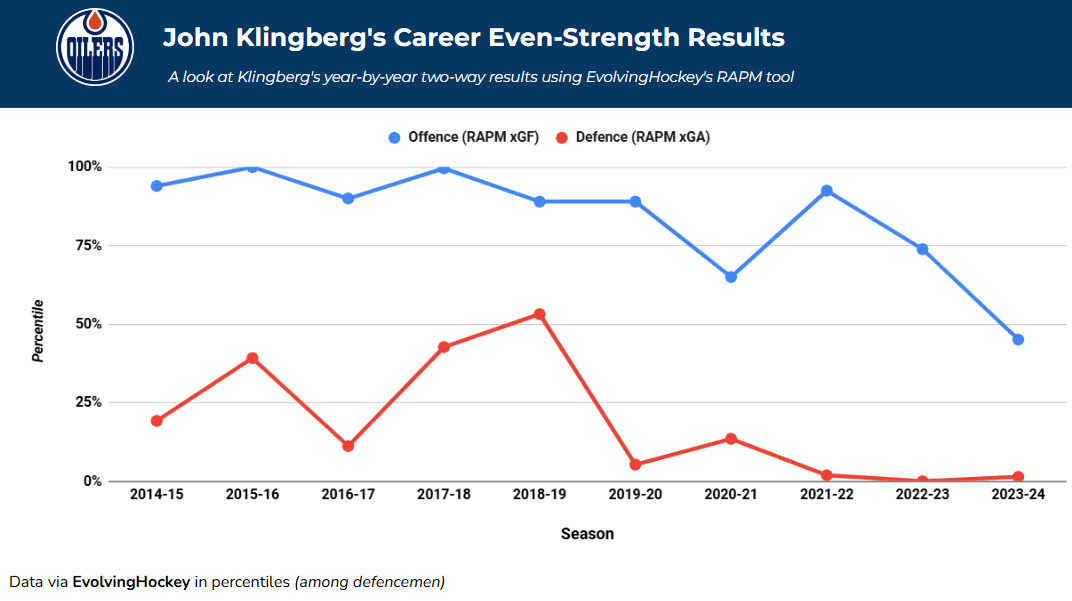
Prior to the emergence of Miro Heiskanen, Klingberg was Dallas’ top defenceman, averaging over 23 minutes per game. In my opinion, Klingberg was one of the most underrated defencemen in the league during his prime years, particularly from 2017-2020. In that time span, Klingberg’s even-strength impact on expected goal differential ranked 14th among all defencemen, and in fact, he was one of only nine defencemen to appear in the top-25 of both RAPM goal and expected goal differential, an elite list that includes the likes of Victor Hedman and Alex Pietrangelo.
It’s evident in his box score totals as well. Klingberg has hit the 40-point mark six times in his career – a feat even Darnell Nurse has yet to achieve despite playing next to Connor McDavid and Leon Draisaitl – and from 2017-18 through 2019-20, Klingberg had the exact same primary assist rate as Roman Josi. His offensive results did begin an evident decline starting 2022, but they still remained well above-average in his most recent full season (he was awful all-around in his 14 GP with Toronto, presumingly hampered by his hip issues).
However, the bigger concern here are those defensive results.
Klingberg’s defensive metrics were roughly average from 2017-2019, but ever since, they have been on a deep decline, particularly in his most recent years. In fact, from the timespan of 2022-23 through 2023-24, no defenceman in the NHL had a worse impact on suppressing scoring chances than John Klingberg. Ouch.
Now, on-ice stats like RAPM capture the “what” of a player’s results. We also need to ask “why” and “how” Klingberg achieved those results in the first place, to see if they can potentially change in a different environment. To deepen our analysis, we can also use microstats, which are essentially detailed statistics measuring specific actions or events, such as zone entries and zone exits. Using Corey Sznajder’s microstat tracking project (I highly recommend checking it out), here is a brief summary of Klingberg’s microstats in his three most recent seasons:
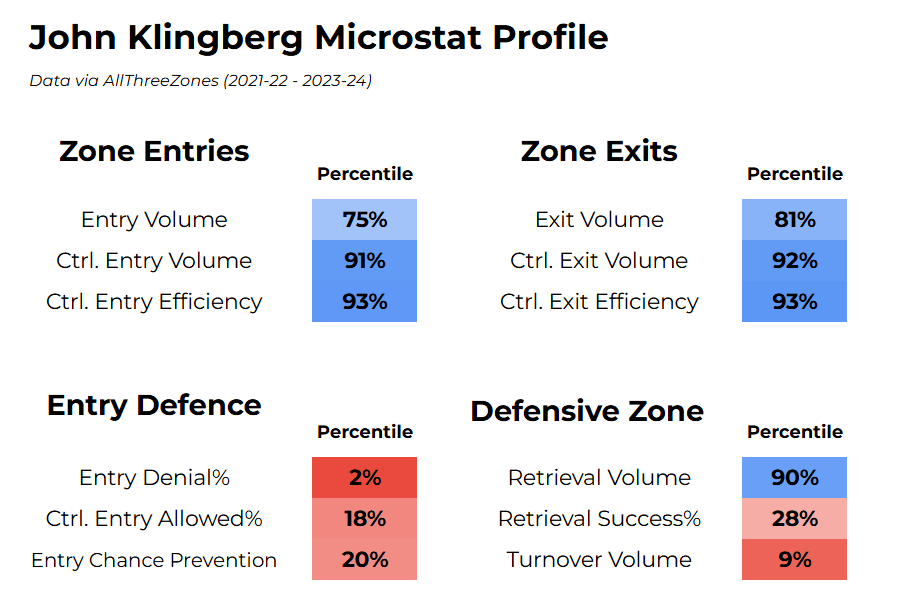
We can clearly see what makes Klingberg a talented offensive player. Klingberg is excellent at moving the puck, ranking in the 91st percentile in controlled offensive zone entries, and the 92nd percentile in controlled defensive zone exits. Even in the worst overall years of his career, Klingberg remained one of the top defencemen in the league at transitioning the puck up the ice with control and possession. While it’s not displayed on the visual above, it should also be noted that Klingberg ranks in the 88th percentile in primary shot assists per hour; it is clear he has fantastic instincts in the offensive zone and excels at setting up forwards. Not to mention, he loves to shoot high.
But, we can also see what makes Klingberg a weak defensive player. Klingberg is practically an open door in terms of allowing zone entries, as he almost never stands up the blueline. This results in opposition forwards often burning Klingberg in transition and generating high-quality rush chances. Additionally, Klingberg does retrieve loose pucks in the defensive zone at high volumes, but the problem is, he struggles to consistently move the puck without giving it up; his turnover volume in his own zone ranks at a dreadful 9th percentile.
Now, pivoting and overall mobility are a substantial part of entry defending and retrieving pucks, which can be quite difficult (and painful) with hip issues. It’s reasonable to say that hip issues could be a considerable factor behind those defensive results, and maybe this hip surgery could allow him to improve in that regard. But in general, Klingberg simply has very poor defensive instincts. His career defensive results strongly suggest that, even with the hip issues in mind, he is just not a smart defensive player, and is prone to making poor decisions and coverage errors in his own end. Former Toronto Marlies assistant coach Jack Han made a brief video analysis of Klingberg’s defensive play during time in Toronto, which I recommend checking out.
All-in-all, it is evident that there are areas where Klingberg can be valuable for Edmonton, but also detrimental. Adding a skilled puck-mover to the bottom-six could be heavily beneficial, particularly for Adam Henrique’s line, and he could potentially quarterback Edmonton’s second PP unit as well. But, having a player of Klingberg’s defensive caliber could also turn out to be costly in crucial moments in the playoffs.
So, is there a role for Klingberg on the Oilers?
At the current moment, I believe the Oilers have four different options in terms of how to deploy and use Klingberg.
The first option is to simply slot in Klingberg at 3RD in place of Ty Emberson. I am not a fan of this option at all, as Emberson has been strong defensively at 5-on-5 and a vital part of Edmonton’s penalty-kill. I don’t think Klingberg’s potential offensive value would outweigh the defensive value that Emberson has provided.
The second option is to play Klingberg at 2RD next to Darnell Nurse. Now, the Oilers have pursued a top-four defensive partner for Nurse for quite some time; from 2022-23 through 2023-24, Cody Ceci was primarily in that spot, but Nurse and Ceci’s results together were mediocre in the regular-season, and flat-out awful in the playoffs. Heading into this season, the Oilers did not have a bonafide 2RD, and it was arguably their most pressing need. Historically, Nurse has performed best next to a puck-mover, so perhaps one could argue there’s potential in Nurse – Klingberg in that regard.
But defensively, Nurse and Klingberg are an awful stylistic defensive fit. Nurse has also performed best next to players that can effectively defend entries, and Klingberg is simply not that. At best, a full-time Nurse – Klingberg pairing would be extremely high-event, and their rush defence would be absolutely exposed in the playoffs.
The third option is to separate Edmonton’s top-pairing of Mattias Ekholm and Evan Bouchard, and deploy a top-four of Nurse – Bouchard and Ekholm – Klingberg. Now, perhaps there’s a possibility that Ekholm’s elite defensive skills could make up for Klingberg’s deficiencies in his own end, and for what it’s worth, Nurse – Bouchard did produce strong underlying numbers the last time they played as a full-time pair. But although I’m not totally opposed to at least giving this setup a look, I’m still not an avid fan of it in the long term, as I believe the Oilers are best when Ekholm and Bouchard are paired together. Furthermore, there are still serious doubts if Klingberg can be an effective top-four defenceman, and pairing him with Ekholm may just be a waste of Ekholm’s defensive shutdown talents.
In my opinion, the fourth option they have is the best one.
Now, let’s first talk about Darnell Nurse, who is enjoying some very strong on-ice results this season. With Nurse on-ice at even-strength, the Oilers have controlled 57 percent of the goals, the highest rate in his career. Although Nurse has improved his individual play, Edmonton’s coaching staff deserve significant credit here.
While the Oilers don’t have a bonafide 2RD, head coach Kris Knoblauch and defence coach Paul Coffey fortunately devised a unique and effective deployment strategy with the current roster. Ever since late October, the Oilers have not run a consistent second-pairing set in stone; instead, Troy Stecher – a natural right-defenceman – and Brett Kulak – a natural left-defenceman with some experience at RD – have alternated at the 2RD spot depending on the game situation.
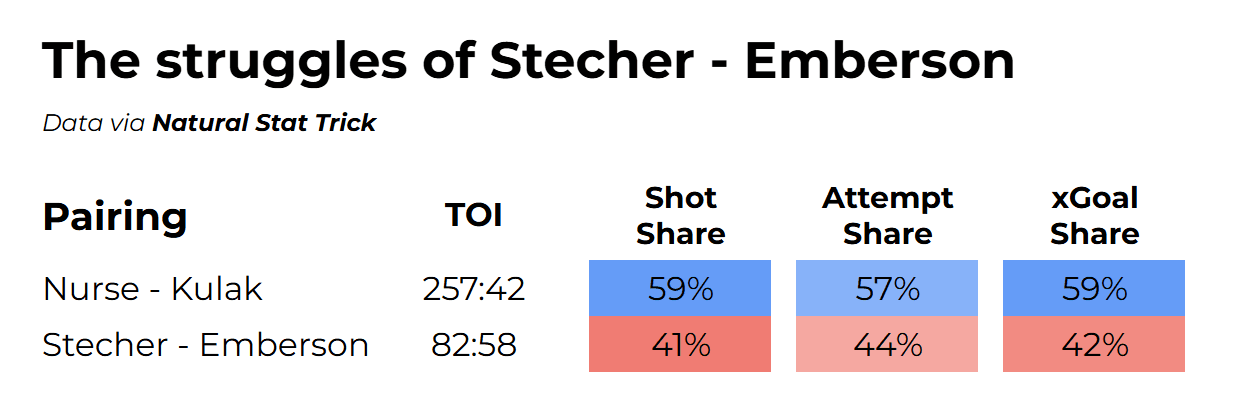
Here are the results:
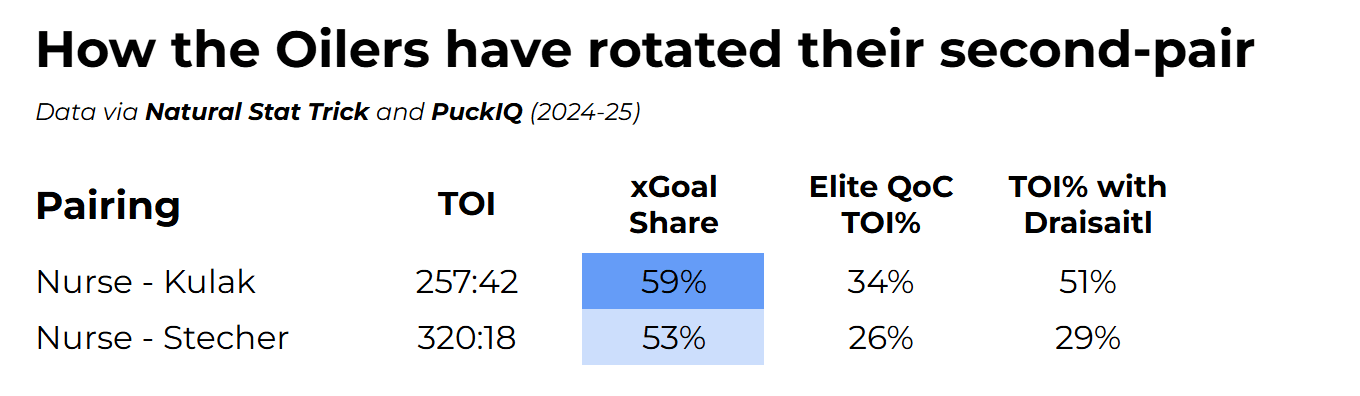
When Leon Draisaitl’s line is on-ice with Nurse, and/or Nurse is playing against elite competition, the coaching staff have deployed Kulak as his defensive partner. Meanwhile, when Nurse is on-ice with Edmonton’s bottom-six and/or against weaker competition, it is Stecher who’s more often paired with Nurse. This deployment strategy has done wonders for the Oilers, as the Nurse – Kulak pairing owns an outstanding 59 percent expected goal differential in some pretty difficult deployment, while Nurse – Stecher have managed to be above-average in sheltered minutes. Having a legit second-pair in important game situations is one of many reasons why the Oilers may finally win the Pacific Divison this year.
So, what if the Oilers try John Klingberg in a role similar to what Troy Stecher is in?
This is a suggestion I first saw mentioned from Jonathan Willis, and I believe there is a possibility it could work. Now, Troy Stecher has done fine in this role, but he’s far from irreplaceable, and it could be beneficial to upgrade on Stecher for the playoffs.
What the coaching staff could potentially do is deploy Nurse and Klingberg in purely offensive situations. So, if Leon Draisaitl’s line is lining up to have an offensive zone start, or the opposition team is sitting back and the Oilers are in desperate need of a goal, they could send out Nurse – Klingberg. On the other hand, if the Oilers are up against top opposition in the defensive zone, or they need to protect a lead, they can bring out Nurse – Kulak. Put simply, this is the same thought process as the current Kulak/Stecher rotation strategy, but more extreme.
If used correctly, there is a legitimate possibility this strategy could work well. I could easily see Klingberg be an upgrade on Stecher and provide value in a purely offensive rule.
That being said, are there still risks to this deployment? Absolutely. Even with the most optimal deployment possible, Nurse – Klingberg could remain vulnerable to ill-advised pinches or turnovers in the OZ leading to a quality chance the other way. Furthermore, there have been times this season when Ekholm – Bouchard played one shift, and Nurse – Kulak received the subsequent shift, causing Stecher – Emberson to occasionally play the next one; when they have, their results are not pretty.
Now technically, there is a fifth option, but it is dependent on Edmonton’s deadline plans. Ideally, regardless of how Klingberg plays, the Oilers should not be finished adding defenceman. They could still benefit from a defensively-minded depth left defenceman.
In the scenario that the Oilers acquire a 3LD, an 11 forward/7 defenceman setup could be perfect for the Oilers in the playoffs. Depending on the game state, they could play this 3LD or Klingberg more minutes. So, if the Oilers are in need of a goal, their bottom-six defensive pairs could be Nurse – Klingberg and Kulak – Emberson, but when they’re protecting a lead, they could shift to Nurse – Kulak and “3LD” – Emberson. This is another twist on the Kulak/Stecher rotation, but with a seventh defenceman, which adds even more flexibility and prevents them from being forced to play Klingberg – Emberson.
But again, it depends on what type of defenceman the Oilers add at the deadline, if they do at all.
Final Thoughts
The NHL Trade Deadline is on March 7th. That is 47 days from now, or nearly 7 weeks.
It’s a smart idea by the Oilers management to sign Klingberg now and see how he performs over these next few weeks. Depending on his play, the Oilers could have a much better idea on what type of player to spend significant assets on during the trade deadline.
All things considered, Klingberg’s potential success in Edmonton will be defined by the coaching staff’s deployment and expectations of him. If Knoblauch and Coffey are hoping that Klingberg can be the regular top-four defenceman that he was in 2019, it is likely that this signing will not turn out well. Klingberg’s defensive results have been abysmal for half a decade now, he’s 32, and he has not played an NHL game since November of 2023; while nothing is impossible, these factors make it highly improbable that Klingberg returns to his 2019 form. Unless his putrid defensive metrics were entirely the result of hip issues (not likely considering his track record and defensive style of play, as mentioned earlier), and his double hip resurfacing procedure miraculously returns his hips to what they were six years ago, Klingberg will be exposed in that role in the playoffs, especially if deployed in a full-time pairing next to Darnell Nurse.
But, if the coaching staff recognizes Klingberg’s defensive deficiencies, and deploys him in a modified version of the “Troy Stecher role,” there is a realistic possibility it could turn out well. If used correctly and put in a position that allows him to play to his strengths, Klingberg could an extremely valuable offensive asset for Edmonton’s forwards. There are many elements of his game that could complement McDavid and Draisaitl quite nicely, and he could be a huge offensive boost to Edmonton’s depth scoring as well.
At the very least, Klingberg will be an upgrade as a 7th defenceman option over Josh Brown. There’s not significant risk in this signing.
All-in-all, this is a fascinating bet by the Oilers management that could go many different ways. Only time will tell how it does.
Find me on Twitter (@NHL_Sid)
ARTICLE PRESENTED BY bet365


Breaking News
- Oilers superfan ‘Mama Stanley’ says she won’t support team after Formenton signing
- Better Lait Than Never: The Oilers sign Alex Formenton and the reaction was exactly as expected
- Oilers bold prediction: An Edmonton goalie scores a goal this season
- Trying to make sense of why the Oilers signed Alex Formenton
- Evan Bouchard’s contract is aging well amid the NHL’s salary cap boom

Edmonton OilersTeam Cap Summary

Cap Summary
2026-27
2027-28
Projected Cap Hit
$102,921,666
$88,322,500
Projected Cap Space
$1,078,334
$25,177,500
Current Cap Space
$1,078,334
$25,177,500
Active Players
23/23
16/23
Draft Picks
Round
'26
'27
1
0
0
2
1
1
3
1
0