
OilersNation has no direct affiliation to the Edmonton Oilers, Oilers Entertainment Group, NHL, or NHLPA
Analyzing what the Edmonton Oilers can expect from Andrew Mangiapane

Photo credit: © Geoff Burke-Imagn Images


Though the 2025 NHL off-season thus far has been rather uneventful compared to summers of the past, the Edmonton Oilers have nevertheless made multiple changes to their roster, particularly (and almost exclusively) towards their forward core. Their most notable move is the signing of 29-year-old forward Andrew Mangiapane.
Many Oilers fans should recall Mangiapane from his days in Calgary, where he played the first seven seasons of his NHL career as a Flame. He remarkably put up a 35-goal season in 2021-22. Then, in the 2024 off-season, he was dealt to the Washington Capitals for a second-round pick, playing exactly one season for the team before ultimately signing with the Oilers during the current free agency period.
This summer, several notable forwards have left the Oilers organization through trade or free agency, such as Viktor Arvidsson, Evander Kane, Corey Perry, and Connor Brown. It is likely that Jeff Skinner will be signing with a different team as well. On the other hand, aside from depth signings Curtis Lazar and SHL forward David Tomasek, Mangiapane is the only notable new face on the Oilers’ forward core. While prospect Matthew Savoie is expected to be a lock in the Oilers’ top-nine, there will still be significant pressure on Mangiapane to make up for a lot of the secondary scoring that the Oilers lost this off-season.
So, how impactful can Mangiapane be, and where does he fit best on the Oilers? Let’s take a closer look.
Firstly, we’ll begin by diving into some career timelines of Mangiapane’s results. Here are his year-by-year production rates at 5-on-5.
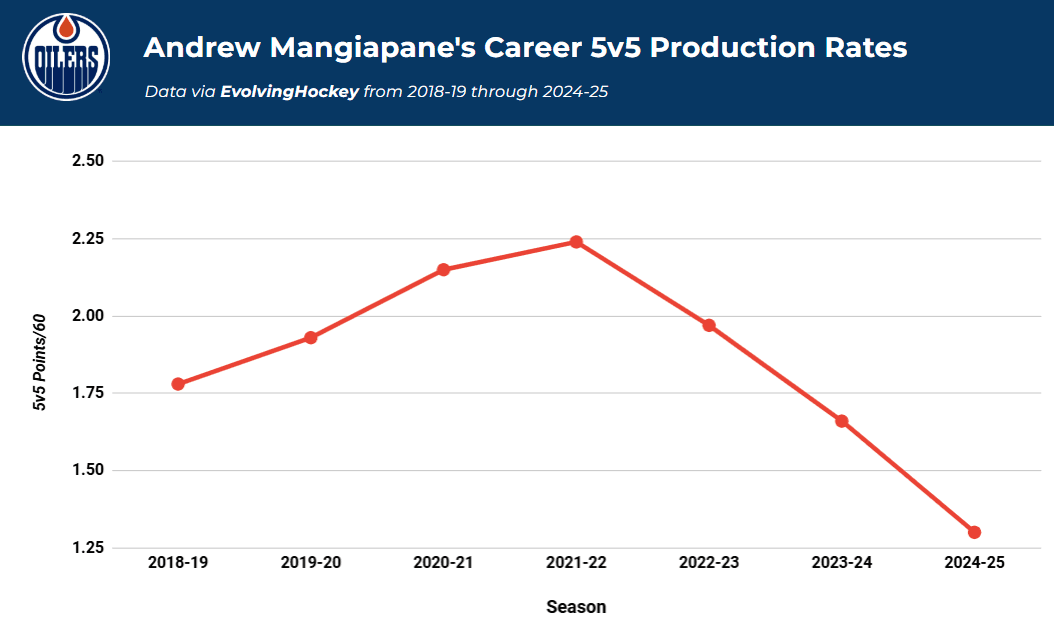
Some may argue that Mangiapane was on an unsustainable shooting percentage heater that season, as he held an 18.9 percent SH%. Fair point. Still, his SH% in his prior two seasons remained at a very strong 17.5%. Based on the available data at that point in time, it was quite reasonable to deduce that he was an excellent shooter, nevertheless. Perhaps he wouldn’t score 35 goals again, but expecting ~25-30 goals was not unreasonable at all.
However, it seems that 2021-22 was Mangiapane’s peak, as he gradually declined more and more in every season since. In his most recent season with the Capitals, Mangiapane averaged just 1.3 points per hour, well below the rate of a typical top-six forward.
To dive even deeper, let’s take a look at Mangiapane’s overall on-ice impacts offensively and defensively:
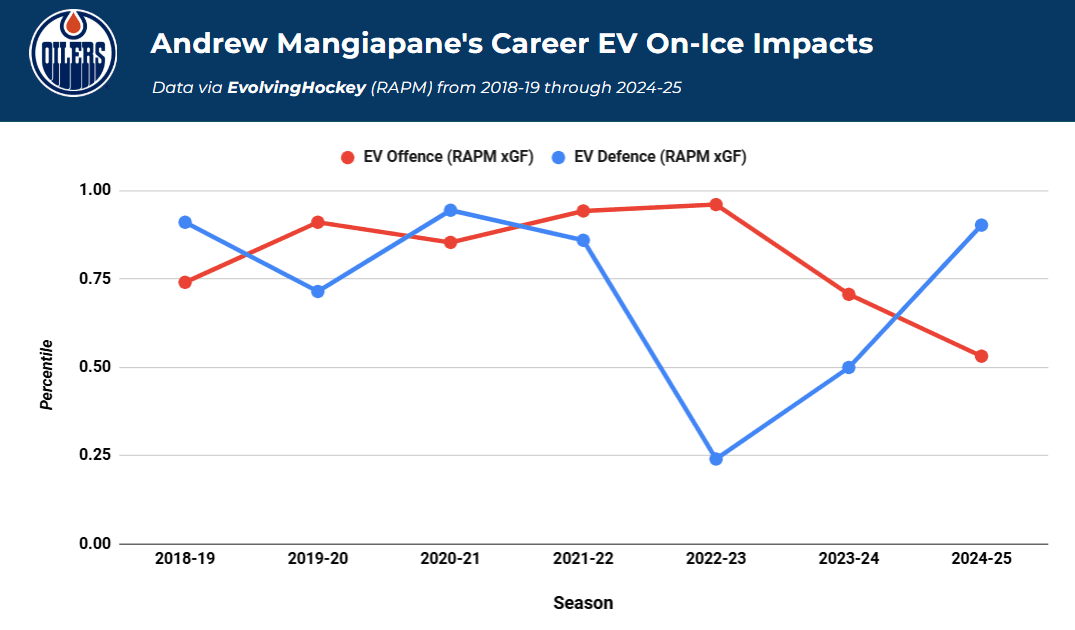
Defensively, Mangiapane has been much more consistent. He had a rough season in that regard in 2022-23, but it seems to be a statistical outlier; otherwise, his defensive impacts have been excellent. This season, the Capitals allowed 1.75 goals against per hour with Mangiapane on-ice, while allowing 2.56 goals per hour without him, close to a full 50 percent decrease in goals against. While Mangiapane did play in a relatively limited role with the Capitals in 2024-25, it’s certainly worth noting that he led the Flames in percent of time-on-ice spent against elite competition from 2022-23 through 2023-24; he does have plenty of experience playing against the opposition’s best lines.
This further extends to his penalty-killing ability. While he was not a regular penalty-killer in Washington, he was consistently deployed there throughout his tenure with Calgary, as from 2021-22 through 2023-24, Mangiapane was on-ice for 5.8 goals and 5.6 expected goals against per hour on the PK, while the Flames allowed 6.7 goals and 7.3 expected goals per hour without Mangiapane on-ice. His net PK impact (measured using EvolvingHockey’s short-handed defence GAR model) ranked in the 72nd percentile among all forwards in that span.
All things considered, these are intriguing results. For the first half of his career, Mangiapane was a textbook “analytical darling.” The Flames controlled 57 percent of the total scoring chances with Mangiapane on-ice in that span, compared to 51 percent without him on-ice. But while his defensive impacts have generally remained consistent, his on-ice offensive impacts and production rates have gradually declined over the past three years.
Now, there are two key things to note about these results.
Firstly, there seems to be a significant correlation between Mangiapane’s declining offence and his shoulder injuries. Mangiapane underwent shoulder surgery after the 2022-23 season, and right after that surgery, Mangiapane’s offensive results all-around saw a dip. He went from averaging 1.11 goals and 8.05 shots per hour in the prior two seasons to just 0.56 goals and 5.39 shots per hour from 2023-24 through 2024-25. It certainly seems to explain why his defensive ability mainly remained intact, while his offence – especially his individual scoring – substantially regressed.
Furthermore, Mangiapane most commonly played in a bottom-six role with centre Lars Eller with the Capitals in 2024-25. And, there was a stark difference in his results with and without Eller as seen below.
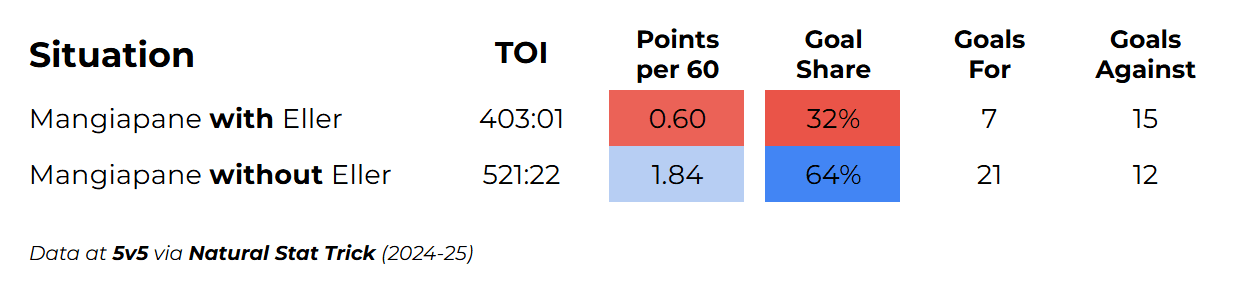 It should be noted that, throughout his tenure in Calgary, Mangiapane primarily played with the Flames’ top centres, most notably Mikael Backlund and Elias Lindholm. The drop in his quality of teammates likely played a significant role in his overall subpar production rates with Washington, as his results in Calgary, combined with his results away from Eller in Washington, showcase there is legitimate offensive potential for him next to higher-calibre players.
So, with all of that in mind, I believe there are a couple of reasonable conclusions that can be made from these results.
Defensively, Mangiapane is extremely useful. His teams have consistently allowed fewer goals and scoring chances with Mangiapane on the ice, whether it’s at even strength or on the penalty kill, and in both a challenging top-six role and a limited bottom-six environment. Considering that many of Edmonton’s wingers who left this summer were below-average or even quite poor defensively, namely Evander Kane, Mangiapane seems to be a fresh breath of air in this regard. I believe this could make a significant difference in the playoffs.
However, the big question with Mangiapane is what his offensive impact will look like. Perhaps the answer lies in the middle of all of this; considering how his offensive rates and volume shooting immediately declined following his shoulder surgery, it’s reasonable to assume that we may not see the 35-goal Mangiapane from 2021-22 again. But considering his results without Eller, there still is genuine potential here.
Mangiapane seems to be a strong, versatile two-way complementary player. He may not be able to drive offence on his own in a bottom-six role, but his track record suggests that he can excel next to skill in a top-six role. For that reason, he should obtain consistent time next to Connor McDavid or Leon Draisaitl, and you should expect a considerable rise in production.
Granted he stays healthy, it’s reasonable to project at least ~35-40 points, a 5v5 points/60 rate ranging around ~1.6-1.8, and excellent defence (both at EV and on the PK) from Mangiapane in 2024-25. These results would be well worth his cap hit.
Find me on Twitter (@NHL_Sid)


Breaking News
- ‘We all don’t have to agree’: Oilers’ Bowman addresses controversial Formenton signing
- Oilers injury update: Regula and Janmark ahead of Savoie and Andersen in rehab timeline
- Oilers bold predictions: Stan Bowman swings big before trade deadline
- Top 100 Oilers: No. 14 — Ales Hemsky
- Edmonton’s Most Wanted: Analyzing the NHL’s biggest Oilers killers

Edmonton OilersTeam Cap Summary

Cap Summary
2027-28
2028-29
Projected Cap Hit
$88,322,500
$61,025,000
Projected Cap Space
$25,177,500
$61,975,000
Current Cap Space
$25,177,500
$61,975,000
Active Players
16/23
10/23
Draft Picks
Round
'27
'28
1
0
1
2
1
0
3
0
1