
OilersNation has no direct affiliation to the Edmonton Oilers, Oilers Entertainment Group, NHL, or NHLPA
Analyzing what Eduards Tralmaks could bring to the Oilers
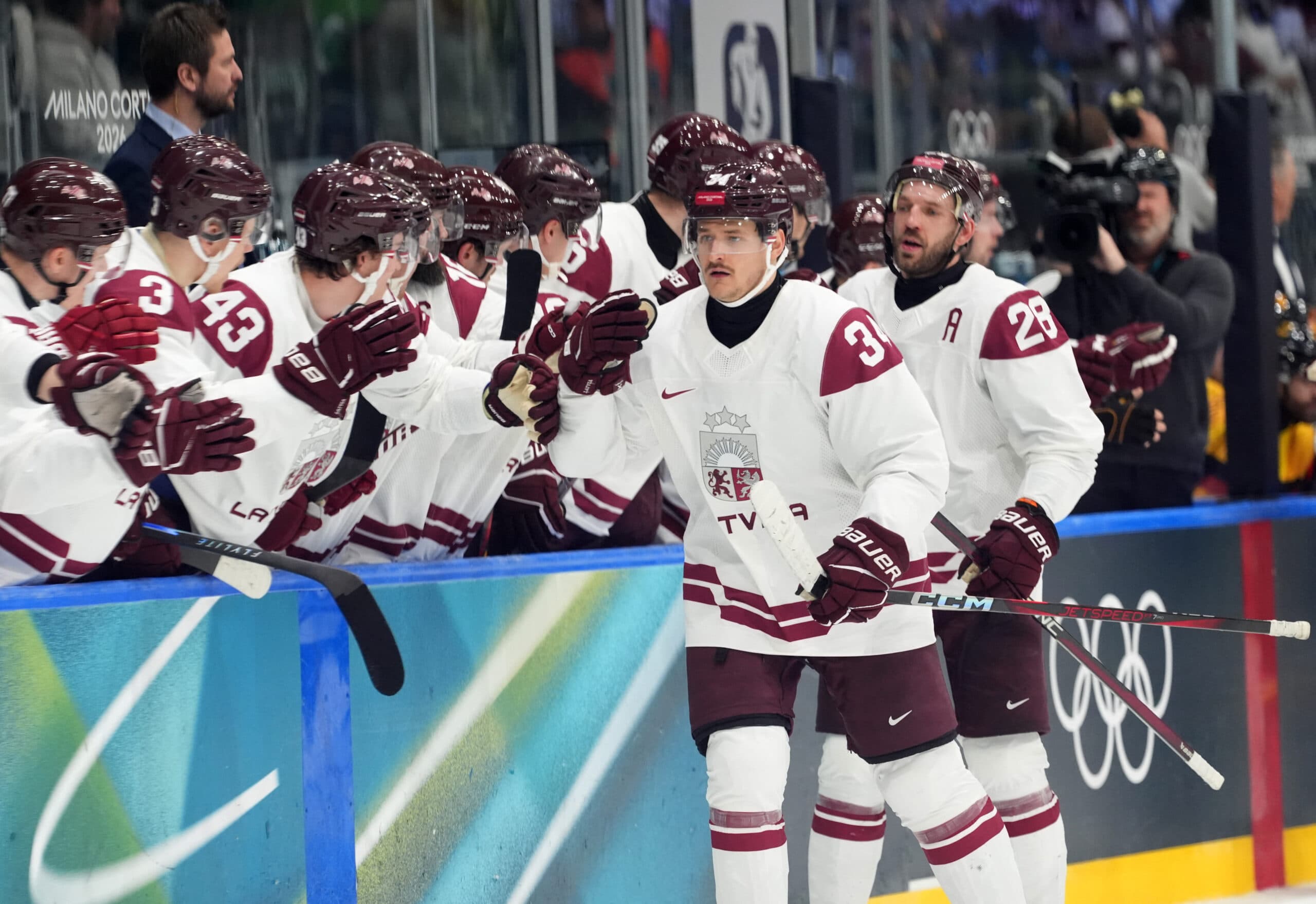
Photo credit: © Amber Searls-Imagn Images

One intriguing dark-horse candidate to crack the Edmonton Oilers’ bottom-six in 2026-27 is Eduards Tralmaks.
The 29-year-old winger from Riga, Latvia was signed by Edmonton in free agency to a one-year contract at a $850K AAV on July 1.
Tralmaks’ career has spanned multiple leagues on both sides of the Atlantic. After winning the 2013 Latvian U18 championship with hometown team SK Riga, he moved to the United States, playing in the USHL, NCAA and AHL over the next ten years. He would then play two seasons with the Kladno Knights of the Czech Extraliga, leading the Czech league in scoring in 2024-25 and earning a two-way contract with the Detroit Red Wings. He spent the 2025-26 season with the Grand Rapids Griffins, Detroit’s AHL affiliate. Tralmaks also has extensive international experience, representing Latvia at the past three IIHF World Championships and the 2026 Winter Olympics.
However, one key accomplishment remains missing from his resume: playing in the highest league in the world.
“My whole life, I’ve been battling to get an opportunity to play in the NHL,” said Tralmaks last December. “At the end of the day, the goal is to play at least one game in the NHL.”
I would say Edmonton has eight forwards who are locks to make the NHL roster: Connor McDavid, Leon Draisaitl, Zach Hyman, Ryan Nugent-Hopkins, Vasily Podkolzin, Matt Savoie, Jason Dickinson and Kasperi Kapanen. From there, prospect Isaac Howard should get a long look in the top-nine, while Trent Frederic, Colton Dach, Mathieu Joseph, Mattias Janmark, and Josh Samanski are in the mix for the remaining spots. Max Jones and Quinn Hutson could also be in contention.
That gives Edmonton a total of 16 other forwards either already penciled into the lineup or competing for a spot. GM Stan Bowman has also stated he’d like to add another forward, either this summer or closer to the trade deadline.
Needless to say, Tralmaks faces a difficult path to NHL minutes.
So, what exactly are the Oilers getting in Tralmaks? Can he earn a role in Edmonton’s lineup, and perhaps even make an impact in 2026-27? Let’s dig into the numbers and the video to see what this player can bring to the Oilers.
Tralmaks has excellent scoring totals in lower leagues and international tournaments
The first thing that stands out about Tralmaks is his goal-scoring over the past three seasons. Much of that offence has come at even strength, an important detail given that he’s unlikely to see meaningful power-play opportunity in Edmonton.
Here is a closer look into his scoring rates over the past three seasons in the AHL and Czech Extraliga:
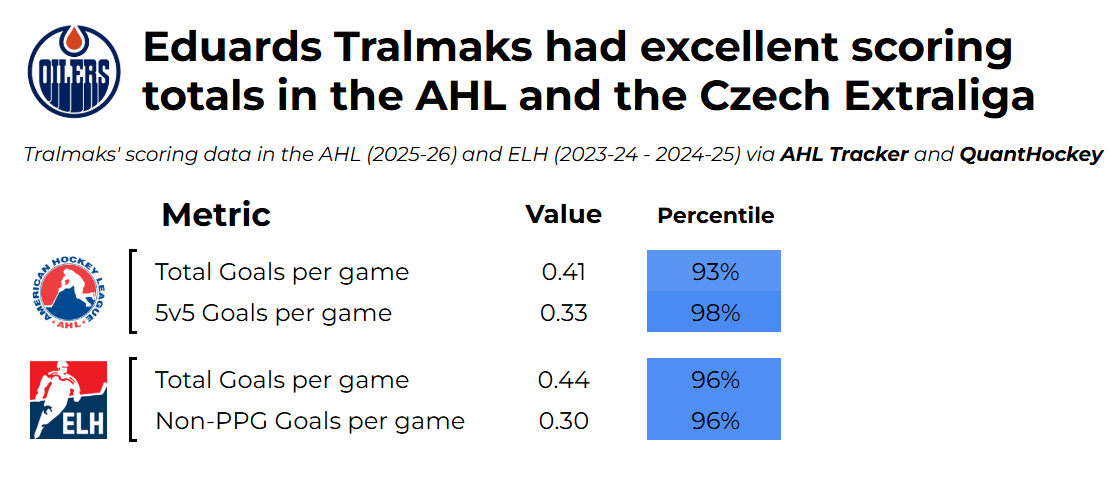
From 2023-24 to 2024-25, Tralmaks scored 44 goals in 100 Czech Extraliga games, a scoring rate that ranked in the 96th percentile (i.e. superior to 96 per cent of the league’s forwards). 5-on-5 scoring data for the league is not publicly available, but the available power-play data allows us to calculate non-power-play goals, which serve as a decently reasonable proxy for even-strength scoring ability. By that measure, Tralmaks remains in the 96th percentile. Notably, just two of Tralmaks’ 23 goals in 2024-25 came on the man-advantage.
In 2025-26 with the Grand Rapids Griffins of the AHL, Tralmaks scored 26 goals in 64 games. Fortunately, we have public access to 5-on-5 data for the AHL, which indicates that Tralmaks scored 21 goals at 5-on-5, tied for second in the AHL.
I watched through all of Tralmaks’ 5-on-5 goals with Grand Rapids to identify any potential patterns in how he scores. While he has a quick release and a solid one-timer, what stood out most was his ability to generate offence around the front of the net.
Tralmaks consistently found space in the slot, excelling at capitalizing on rebounds and getting his stick on deflections or tip-ins. In fact, I counted 12 of his 21 5v5 goals as a rebound or deflection, with a total of 18 goals coming in the slot area and 13 in the inner slot. A video compilation of some of his rebound and deflection goals is shown above.
This was also evident at the 2026 Winter Olympics, where we have public access to more granular shot location data.
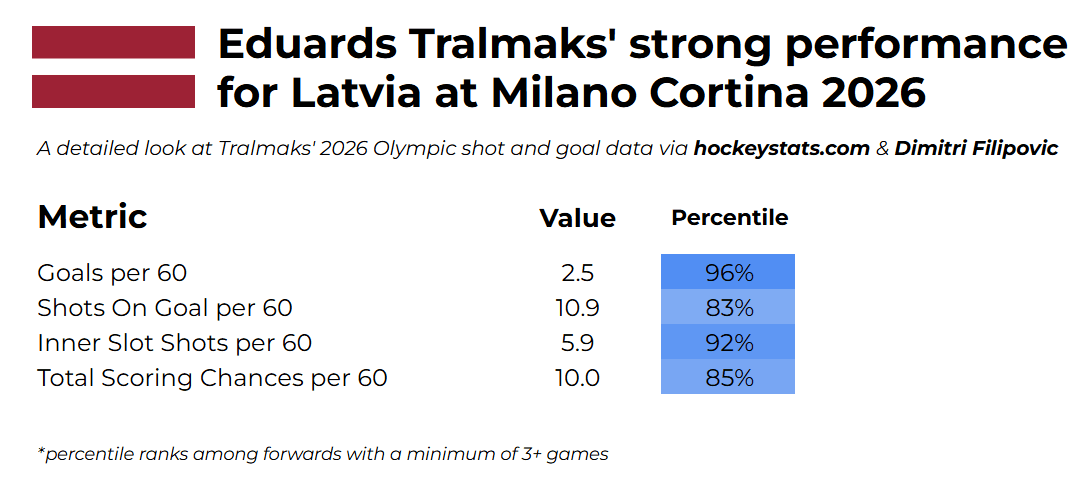
Tralmaks averaged 10.9 shots per hour, and nearly 6 of them came in the inner slot area. That ranks in the superb 92nd percentile. Yet again, he was excellent at generating net-front chances, most notably scoring another rebound goal in Latvia’s match against a very good Sweden team. Overall, he generated scoring chances at the 85th percentile.
Of course, four games is a small sample, but it is worth noting nevertheless as it was Tralmaks’ first experience against the best of the best in the world, and he fared quite well.
Tralmaks brings size, strength and forechecking
During my research for this article, I watched through all of Tralmaks’ shifts in the 2026 Olympics, as well as shifts from three Grand Rapids games in 2025-26 and most offensive AHL highlights (goals, assists, on-ice goals for). Albeit not the greatest sample, but I was able to support many of my observations with available data and other evidence. One key observation I made was that Tralmaks was an effective and aggressive forechecker.
At 6-foot-4 and 225 pounds, Tralmaks has a big frame, and not only does it allow him to be an excellent net-front presence, but it also helps him win puck battles in the corners, protect the puck along the boards, and force turnovers.
This video example above is Tralmaks at his best. An aggressive, physical forecheck on a dump-in causes a turnover by the opposition defender on their retrieval attempt. The puck gets back to the point for a shot attempt, and Tralmaks is able to bury the rebound in front.
This is a great play as well. You can see Tralmaks use his size and strength on the forecheck to protect the puck against the defender along the boards, and he makes an excellent play from behind the net to set up a goal.
I thought Tralmaks was also an effective forechecker during the Olympics, though unfortunately, I am unable to directly include clips here due to copyright restrictions. Still, you can view one example by clicking this timestamp link from CBC Sports’ full-game YouTube replay of Latvia’s match against Sweden, showing a notable shift in which Tralmaks’ forecheck forced a turnover from Phillip Broberg, leading to nearly a full minute of offensive-zone time for Latvia. Here is another where his tenacity forces a turnover from 2026 Norris nominee Rasmus Dahlin.
“On the ice, he’s got a physical presence,” Griffins head coach Dan Watson had said on Tralmaks in December. “He has a good shot and is a guy we need offensively, but even his understanding of the defensive side of the game is improving. We need that big, physical presence on the forecheck, around the net, and contributing to our offensive-zone numbers right now.”
Tralmaks’ puck skills are limited and his transition ability is lacking
While Tralmaks’ scoring stood out to me in my viewings, his playmaking was far less impressive.
Tralmaks’ puck skills are rather limited. He can make nice plays along the boards or on the forecheck using his size (as seen above), but he seems to lack the hands and creativity to consistently beat defenders or create dangerous chances through his passing.
These observations are supported by available data. With Grand Rapids, Tralmaks’ primary assist rate at 5-on-5 ranked in the 53rd percentile; above-average, but unexceptional and not a strong indicator that passing will be a strength at the NHL level. It is also worth noting he only ranked in the 20th percentile in scoring chance assists per 60 at the Olympics.
A bigger drawback in Tralmaks’ game is his transitional ability. Tralmaks generates very little offence in transition, scoring just two 5-on-5 goals off the rush in 64 games with Grand Rapids. Some of this stems from his lack of puck skills, but I believe it can also be attributed to his skating. He is not a particularly dynamic or mobile skater with the puck, lacking the ability to effectively beat defenders one-on-one at the blueline. Tralmaks himself has acknowledged before that skating is a weakness of his, while Griffins coach Dan Watson has also commented that it is an area of improvement for him.
One more observation I made was Tralmaks’ tendency to get caught behind the play, partly due to his skating limitations and partly due to slow defensive reads. I noticed this a few times at the Olympics, and you can see a video example from the AHL playoffs below.
The right-defender makes a failed pinch on this play, but Tralmaks is late recognizing the eventual goal-scorer as the second forward joining the rush and fails to cover. This puts him behind the play, and he doesn’t have the foot speed or skating to catch up on the backcheck. This would ultimately be the series-winning goal for the Chicago Wolves against Grand Rapids.
In a way, I see a lot of Pat Maroon in Tralmaks’ game. He is an excellent net-front presence when possession is established in the offensive zone and aggressive on the forecheck, but whether he can keep up with the pace of NHL play is ultimately my biggest concern about his game.
Final Thoughts
There is a compelling argument against giving Tralmaks NHL minutes that could instead go to Edmonton’s younger, faster, and skilled players with more upside, such as Howard, Dach and Samanski. In general, I would argue that the Oilers should be placing significant emphasis on youth and speed as much of their core moves into their 30s. Even if you disagree, the Oilers also possess several veteran options with more established NHL track records than Tralmaks. With everything in mind, it seems much more likely than not that Tralmaks plays most of the season with the Bakersfield Condors barring significant injury troubles for Edmonton.
Still, Tralmaks possesses a crucial trait that makes him stand out as an option: even-strength scoring potential.
In 2025-26, Edmonton’s bottom-six was out-scored 86 to 55 at 5-on-5. While that GA number clearly needs to go down, it also demonstrates a severe lack of depth scoring. Edmonton’s bottom-six generated fewer than 1.7 goals per hour at 5v5 last season, a significant decline from their scoring rate of 2.0 in 2021-22 and 2.4 in 2022-23. In particular, 2022-23 was the best season for Edmonton’s bottom-six in the McDavid and Draisaitl era, with 11 different forwards reaching double-digit goal totals.
So, why not give an extended look to a player who has consistently produced 5-on-5 goals at every level he has played to date?
Most of Edmonton’s current bottom-six forwards have limited offensive upside. If Howard develops into a valuable NHL scorer, it is more likely than not that he’ll be on McDavid or Draisaitl’s wing rather than in the bottom-six. Hutson has finishing potential, but he was out-scored by Tralmaks at 5-on-5 this past season.
Furthermore, Tralmaks’ size and forechecking are quite noteworthy, as they are attributes which may allow him to have some value in the postseason. I could see the team deploy an effective fourth-line of Tralmaks, Dach and Joseph that can crash the net and create chances off the forecheck. In theory, Dach and Joseph’s speed could help compensate for Tralmaks’ limitations in that regard, while Tralmaks provides a net-front scoring touch. I could also see a fit next to a defensively responsible centre in Samanski.
Ultimately, finding a place on a forechecking line next to players that can transition the puck up the ice is likely Tralmaks’ best chance of success in the NHL. He faces long odds, but his combination of traits gives Edmonton a unique depth option in a crowded forward group. Expect him to be part of a competitive training camp in September.
Find me on Twitter (@NHL_Sid)


Breaking News
- Team identities in the Pacific Division pillow fight
- Edmonton Oilers reveal new jersey numbers for 2026-27 season
- 31 Oilers Questions: Can Tristan Jarry bounce back in 2026-27?
- Shakir Mukhamadullin opens up on Sharks rift, Edmonton Oilers trade
- 31 Oilers Questions: Can Colton Dach have a breakout season?

Edmonton OilersTeam Cap Summary

Cap Summary
2026-27
2027-28
Projected Cap Hit
$99,274,166
$87,350,000
Projected Cap Space
$4,725,834
$26,150,000
Current Cap Space
$4,725,834
$26,150,000
Active Players
23/23
15/23
Draft Picks
Round
'26
'27
1
0
0
2
1
1
3
1
0