
OilersNation has no direct affiliation to the Edmonton Oilers, Oilers Entertainment Group, NHL, or NHLPA
What Shakir Mukhamadullin brings to the Oilers’ blue line
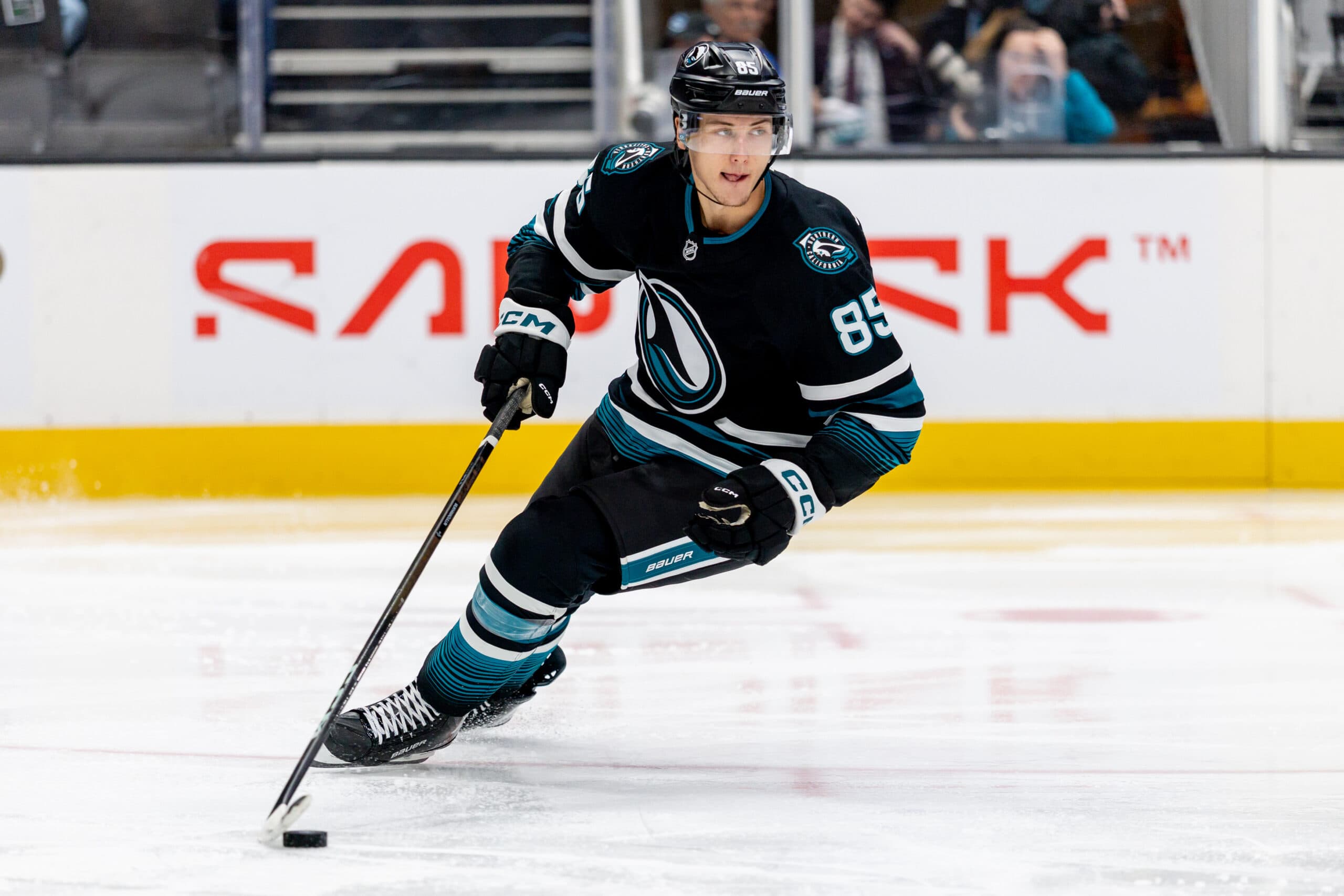
Photo credit: © Bob Kupbens-Imagn Images

On Thursday, I released a piece analyzing Ryan Shea, one of the two NHL defencemen that the Edmonton Oilers added on Free Agency Day.
The other defender is Shakir Mukhamadullin, acquired from the San Jose Sharks in a trade that sent Darnell Nurse the other way, who also signed a two-year contract extension with the team yesterday morning. This article will focus on Mukhamadullin and what he may bring to Edmonton.
Mukhamadullin, a 24-year-old left-shot defenceman from Ufa, Russia, was drafted 20th overall in the 2020 NHL Draft. In February of 2023, he was traded to the San Jose Sharks in a blockbuster deal involving Timo Meier, and played his first NHL game in the 2023-24 season. In 2024‑25, he split time between the NHL and AHL, playing 30 games with the Sharks and 21 with the San Jose Barracuda. His first full NHL season came in 2025‑26, during which he missed some time with back injuries but still appeared in 50 games.
There was legitimate concern about Edmonton’s left‑shot defensive depth heading into July 1. Mattias Ekholm, the club’s top LHD, turns 37 next season, and the organization’s prospect pool on the left side is relatively thin. As such, acquiring a younger LHD with first-round pedigree in exchange for Nurse was a sensible move by management.
But, the big question is, what type of impact can Shakir Mukhamadullin make with the Oilers? For this article, I dove deep into Mukhamadullin’s underlying numbers, ranging from microstats to advanced WAR model outputs, while also watching a few of his games myself in the second half of 2025-26, shift by shift. Here is an in-depth analysis of this player, outlining what I believe are his major strengths and weaknesses.
*All microstats via AllThreeZones, all on-ice stats via EvolvingHockey unless stated otherwise
Oilersnation wants to hear from you, the reader, in our new weekly “Letters to the Editor” segment. Letters can be emailed to Oilersnation’s managing editor Zach Laing (zach.laing@bettercollective.com), titled “Letters to the Editor.” Please include a letter up to 200 words, including your name, place of residence (city, town, province, or state). Your letters may be edited for length and/or clarity. Letters must be submitted by 6 p.m. MT Saturday night to be considered for feature on Sunday mornings.
What physical tools does Shakir Mukhamadullin bring to the Oilers?
The first thing that stands out with Mukhamadullin is his physical toolset.
This is a tall, 6-foot-4 defenceman with a big frame and a wide reach. He clearly adds size to Edmonton’s defensive core, joining Mattias Ekholm and Connor Murphy in that regard.
Furthermore, Mukhamadullin is a smooth, mobile skater with decent speed, using this attribute to his advantage with zone exits. Per AllThreeZones, Mukhamadullin ranks in the 66th percentile in carried zone exits per 60; put differently, he ranks superior to 66 percent of NHL defencemen when it comes to carrying the puck with control out of his defensive zone.
One more notable aspect of Mukhamadullin is his shot. He averaged 0.39 5-on-5 goals per hour in 2025-26, which ranked 23rd among all NHL defencemen. He also ranked 34th in goals per game among defencemen in the AHL back in 2023-24. This seems to be a decent strength of his.
Some fans may recall that Mukhamadullin scored the game-winning goal in San Jose’s 5-4 victory against Edmonton this season in February.
All-in-all, there are a lot of tools here for a very effective player.
What do the analytics say about Shakir Mukhamadullin’s defensive impact?
I often like to use the components that make up EvolvingHockey’s WAR model for player analysis, specifically their EVD (even-strength defence value) and SHD (short-handed defence value) metrics to evaluate defensive play. In simpler terms, EvolvingHockey uses a regression model to isolate a player’s on-ice defensive results from contextual factors such as teammate quality, competition level, zone starts, and more. The goal is to estimate how much a player contributes to suppressing dangerous scoring chances against. It is certainly not perfect, but these are stats that I personally find great value in. You can read the full writeup and process behind their model right here.
Here is how EvolvingHockey rates Mukhamadullin’s defensive impacts over the past two seasons:
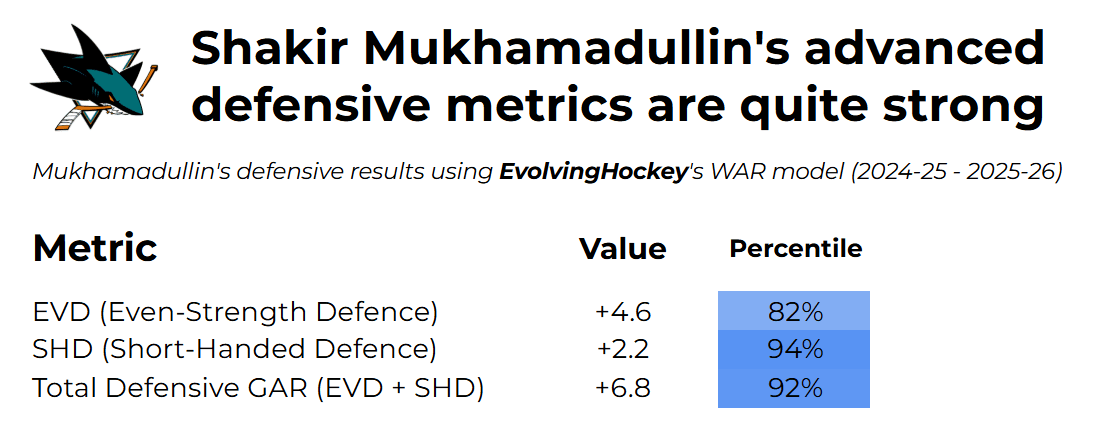
These are superb results. Mukhamadullin’s even-strength defence ranks in the 82nd percentile, and his PK defence ranks in the 94th. Overall, his total defensive WAR is in the 92nd percentile among all NHL defencemen. Very, very good.
With that being said, it’s interesting to note that not all models agree to the same degree. For example, JFreshHockey’s well-known player cards rate Mukhamadullin’s EV defence in the 73rd percentile, and the PK defence in the 58th; still solid, but not quite at the level suggested by EvolvingHockey. I am not fully sure on what seems to be the discrepancy here. Nevertheless, regardless of which model should be considered “better” here, it is quite reasonable to, at minimum, make the claim that Mukhamadullin’s defensive results are considerably above-average.
From watching his games, I believe Mukhamadullin’s most consistent defensive strength is his excellent stick and long reach, which he uses to disrupt passing lanes and break up plays before they develop. He is particularly effective at shutting down slot passes, a key reason why his chance‑suppression metrics are so strong. Below are a few examples.
(Note: I apologize if the video quality isn’t great on your end; you may have to adjust the quality settings to view them more clearly).
Matched up in a shift against Boston’s top line with David Pastrnak, Morgan Geekie attempts to pass the puck into the slot onto Pavel Zacha’s stick, but Mukhamadullin is in position to effectively disrupt and clear it. That may have saved a goal.
Here is another sequence in the aforementioned game against Edmonton in February. In the same shift, Mukhamadullin is able to successfully block two passes off decently dangerous rushes from the Leon Draisaitl line to boot.
Speaking of rush defence, Mukhamadullin has a zone entry denial rate of about 10.9% per AllThreeZones, a tad bit higher than the league average of about 10%. While it’s nothing to write home about, there are some key notes to make here.
I have seen some compare Mukhamadullin to Darnell Nurse, suggesting that he is essentially a “younger Nurse.” While I agree with this claim in a couple of ways, which will be evident later in this piece, one crucial potential difference between the two may be entry defending.
There are many aspects that fans disliked when it came to Nurse’s game, from iffy coverage reads to a plethora of unforced icings, but for me, it was the rush defence that was most frustrating. Nurse had all the tools to be an elite entry defender, with speed and size and reach, but he was always quite subpar in that regard. His gap control was incredibly disappointing, giving opponents far too much space at the blueline. The result is that his entry denial rate ranks in the 17th percentile.
Mukhamadullin, by contrast, appears more willing to use his tools assertively at the blueline.
Take this video clip on the PK as an example. The Bruins’ top PP unit attempts to gain the zone. Mukhamadullin is able to use his skating and long reach to aggressively deny the attempt, and it leads to a decent short-handed rush shot for his teammate. It’s not the flashiest play, but consistently making these reads is a hallmark of the league’s best rush defenders; just ask 2026 Stanley Cup-winner Jaccob Slavin.
Now, AllThreeZones also tracks what percentage of the controlled zone entries that a defenceman allows leads to a scoring chance, and that number for Mukhamadullin ranks in the 35th percentile, which is fairly below-average. So, while Mukhamadullin denies an entry more often than not compared to the average defenceman, the entries he does allow lead to a decent number of scoring chances.
Still, this pattern is not totally uncommon for young defencemen. Some defenceman can initially excel at denials but lag behind in entry‑chance suppression until their reads and timing improve. It’s also worth noting that those entry chance numbers above are not adjusted for quality of teammates, and Mukhamadullin played on a pretty poor defensive team.
The fact remains that Mukhamadullin has all the tools to become an extremely effective entry defender, and his entry denial rate already points in that direction, suggesting upside and potential in this area. I sincerely hope the coaching staff specifically develops this area with him to fully unlock his potential, unlike what happened with Darnell Nurse.
Finally, it’s also worth noting that Mukhamadullin ranks in the 70th percentile in 5-on-5 blocked shots per 60. He is solid at using his big frame to get in the way of pucks.
Why does Shakir Mukhamadullin struggle with puck retrievals?
One of the most underrated aspects of defending, in my view, is puck retrievals. It takes speed, strength, and smarts to be able to consistently retrieve dump-ins and loose pucks with limited time and space under forecheck pressure. It is the sort of thing that can often make or break a defenceman. This is an area where Oilers defenceman Mattias Ekholm has been elite, which is a huge reason for his excellent chemistry with Evan Bouchard and outstanding analytics.
Unfortunately, this is an area where Mukhamadullin has significantly struggled.
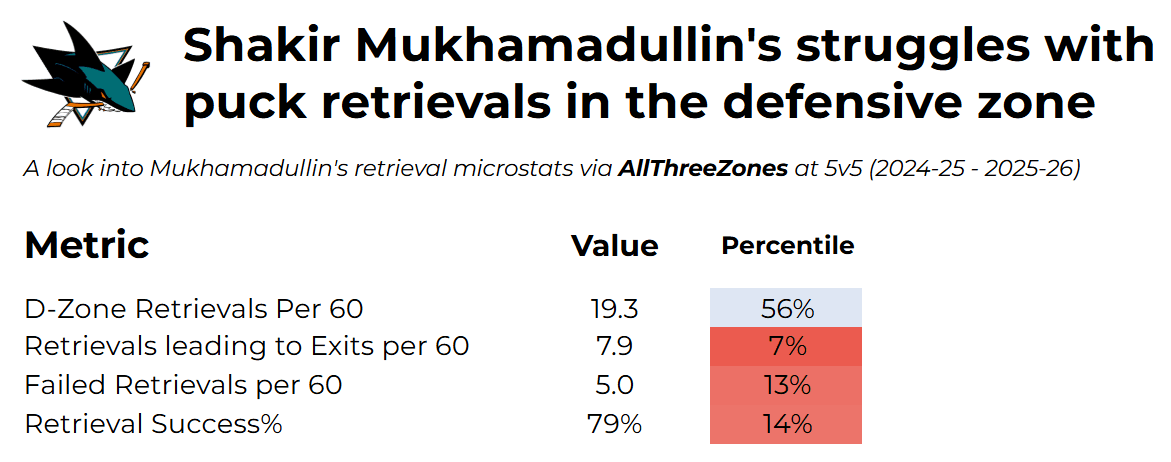
One thing I appreciate about the data at AllThreeZones is that, not only do they track defensive zone retrievals for each player, but they also track if those retrievals eventually led to a zone exit or a turnover, with the latter being classified as a failed or botched retrieval.
When it comes to retrieval volume, Mukhamadullin is fine. He averages over 19 retrievals per 60, placing him in the 56th percentile. However, less than 8 of those retrievals have led to a zone exit, which merely ranks in the 7th percentile. Even more concerning is that a large portion of his retrievals end in turnovers, with his failed retrieval rate sitting in the 13th percentile.
So, what this means is that Mukhamadullin can use his skating to get to loose pucks, but once he has them, his decision‑making under pressure often breaks down. He can often panic under oncoming forecheck pressure, or simply make the incorrect read and choose a low-percentage pass.
Take this example. What should be a routine retrieval with multiple passing options turns into a turnover when Mukhamadullin sends the puck up the boards. Montreal sustains nearly 20 seconds of zone time as a result. They don’t generate a dangerous chance, but with Macklin Celebrini on the ice, it’s a missed opportunity to transition up ice for a rush chance.
Here’s another example from the same game. Mukhamadullin is able to initially retrieve the puck, but once again turns it over along the boards. This leads to a dangerous shot that goes off the post. Now, I won’t entirely blame Mukhamadullin here, as there was inadequate forward support, but nevertheless, it was not a good play and nearly directly led to a goal against.
Here is one more example. Another botched retrieval by Mukhamadullin on a dump-in leads to a decent scoring chance and several seconds of offensive zone time for the opposition team. I could go on and on here with even more examples, but I think you get the point.
It seems that Mukhamadullin’s retrieval abilities have not significantly hampered his on-ice defensive impacts, but I would wonder if quality of competition plays a factor here. Thus far, Mukhamadullin has primarily been a third-pairing defenceman in the NHL, ranking 5th on the Sharks in percentage of TOI against elite competition via PuckIQ. While the WAR model outputs above do attempt to account for this, they are not perfect, and players with good results in a third-pairing role will not necessarily repeat them in a top-four role. It is certainly a much different beast to retrieve pucks under pressure from the likes of Aleksander Barkov or Tom Wilson compared to third and fourth liners.
One path to improvement is physical strength. GM Stan Bowman has already noted that Mukhamadullin can add more weight, and increased strength could help him better absorb contact and protect pucks along the boards.
Still, Mukhamadullin’s overall decision-making under pressure is likely his biggest flaw that currently holds him back from becoming a top-four defenceman. Whether he substantially improves in this facet or not at 24 will remain to be seen.
How limited is Shakir Mukhamadullin’s passing and offensive game?
By all available metrics, Mukhamadullin’s passing is not eye-popping.
Like Nurse, this is a player that prefers to carry the puck out of his zone rather than pass it, with his carried exits per 60 ranking relatively higher than his passed exits per 60.
Mukhamadullin’s possession exit rate is in the 38th percentile. This means that, more often than not, Mukhamadullin’s exit attempt is uncontrolled (e.g., a zone clear or missed pass) rather than controlled (carry-out or pass-out with possession). Some of this stems from his lacklustre decision-making under pressure, but the underlying passing skill itself appears limited.
Furthermore, Mukhamadullin generates minimal offence with his passing. Mukhamadullin has averaged 5.4 shot assists and 0.9 scoring chance assists per 60, ranking in the fifth and 17th percentiles, respectively. EvolvingHockey projects his overall impact on generating even-strength scoring chances at the 10th percentile, and JFresh projects it at the 2nd percentile.
Now, I am aware that many people care little about offensive production for non-elite defencemen, and understandably so. I am certainly not expecting Mukhamadullin to rack up 50+ points or develop into a left-handed Evan Bouchard.
Still, this is worth noting, as this limits Mukhamadullin’s ceiling and because, at the end of the day, you have to out-score your opponents to win hockey games. Being totally one-dimensional offensively or defensively isn’t a very good thing. For context, even Connor Murphy – a defensively-inclined player – ranks in the 37th percentile in chance generation, which is enough to complement his elite 99th percentile defensive impact and make him a solid 2RD.
EvolvingHockey projects Mukhamadullin’s net impact on even-strength goal differential over the past two seasons to be slightly below-average (47th percentile). Not terrible at all by any means for a third-pairing defenceman, but the point remains that if Mukhamadullin is to eventually develop into a top-four defender, he will need at least modest improvement in his passing and offensive play-driving.
Where does Shakir Mukhamadullin fit in the Oilers’ lineup?
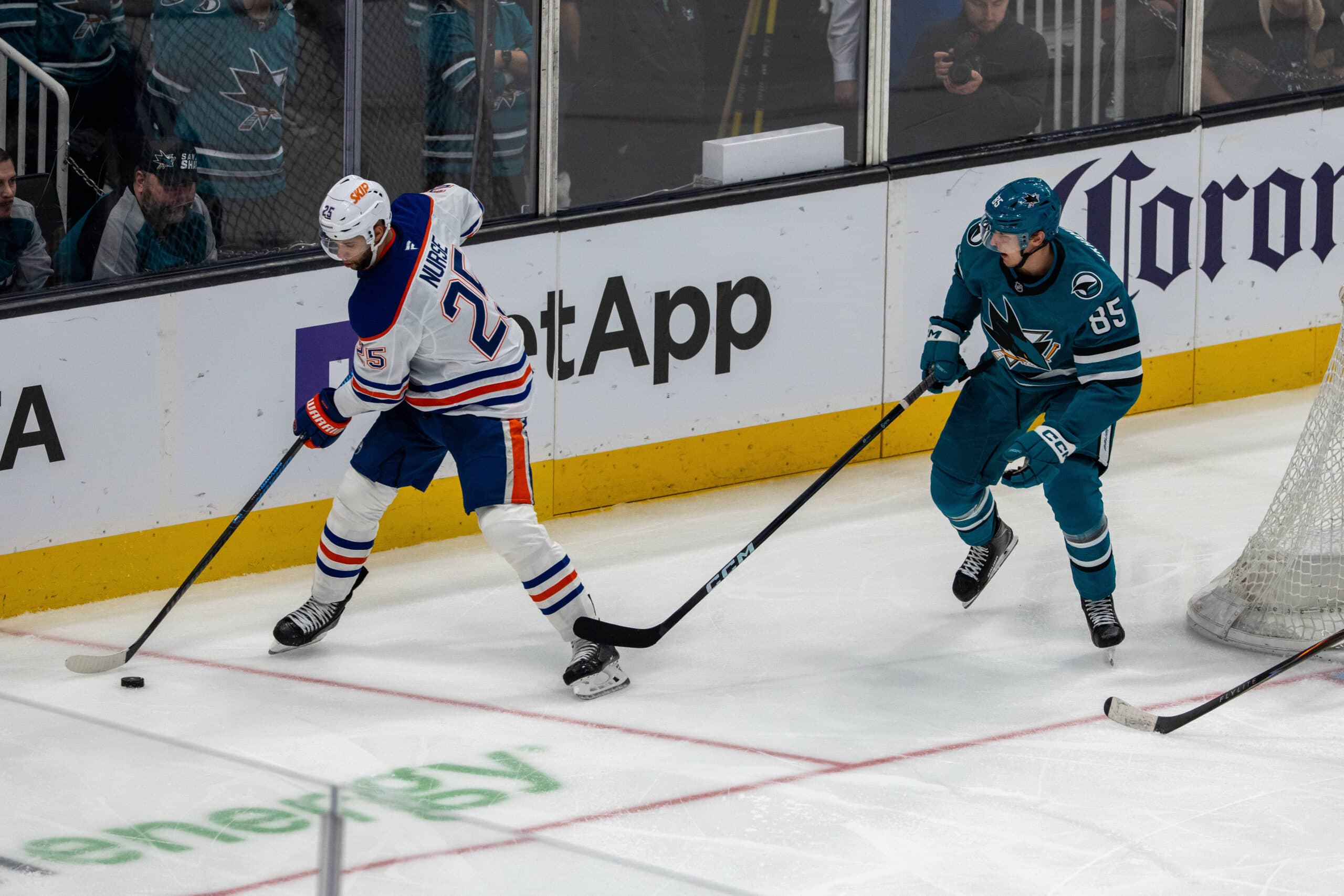 © Neville E. Guard-Imagn Images
Feb 28, 2026; San Jose, California, USA; Edmonton Oilers defenseman Darnell Nurse (25) looks to pass the puck from behind the net against San Jose Sharks defenseman Shakir Mukhamadullin (85) during the third period at SAP Center at San Jose. Mandatory Credit: Neville E. Guard-Imagn Images
Mukhamadullin will likely be in a battle with Ty Emberson for the sixth spot on the blue line to begin the season. If Mukhamadullin does win that roster battle, I would expect him to kill penalties and start with Ryan Shea on the third pair, which would be a good decision.
Their skill sets complement each other; Shea is strong on puck retrievals but weaker on rush defence (as I mentioned in my previous article), while Mukhamadullin shows promise in entry defending but struggles with retrievals. Both can play the right side, with Mukhamadullin in particular spending much of 2025‑26 at RD, giving the coaching staff flexibility.
Someone asked me if Mukhamadullin could eventually develop into a 1LD for Evan Bouchard in a few years. I have my doubts. One of many things that makes Mattias Ekholm an incredible partner for Bouchard is his retrieval ability. Ekholm’s ability to consistently and reliably retrieve pucks under pressure even from the best-of-the-best allows more time with the puck on Bouchard’s stick, who is elite at moving it up the ice. For Mukhamadullin to be a truly effective partner for Bouchard, he will have to massively improve in this facet. Of course, he theoretically could, but at this stage of his career, I am skeptical if those chances are high.
A more realistic ceiling is a defensive-leaning 2LD, potentially within a year or two and perhaps next to Connor Murphy. With proper coaching and increased strength, I could see Mukhamadullin become a top-notch entry defender and at least move closer to average at puck retrievals.
At minimum, I believe Mukhamadullin should be a solid third-pairing defenceman for Edmonton, providing some much-needed LHD depth. Like Nurse, Mukhamadullin has all the physical tools to become even more than that. Time will tell if he can make the most of it.
Find me on Twitter (@NHL_Sid)
ARTICLE PRESENTED BY bet365


Breaking News
- What a successful season looks like for Ike Howard
- Oilers 2026 Prospect Countdown No. 14: Zack Sharp
- Wall Street filing proposes first Edmonton Oilers-tied ETF in league-wide index
- ‘This is utter nonsense’: Gamers react to McDavid’s 99 overall rating on EA’s NHL
- 31 Oilers Questions: Which offseason acquisition will have the greatest impact on the Oilers?

Edmonton OilersTeam Cap Summary

Cap Summary
2026-27
2027-28
Projected Cap Hit
$99,274,166
$87,350,000
Projected Cap Space
$4,725,834
$26,150,000
Current Cap Space
$4,725,834
$26,150,000
Active Players
23/23
15/23
Draft Picks
Round
'26
'27
1
0
0
2
1
1
3
1
0