
OilersNation has no direct affiliation to the Edmonton Oilers, Oilers Entertainment Group, NHL, or NHLPA
Why the Oilers should make re-signing Connor Murphy a top priority
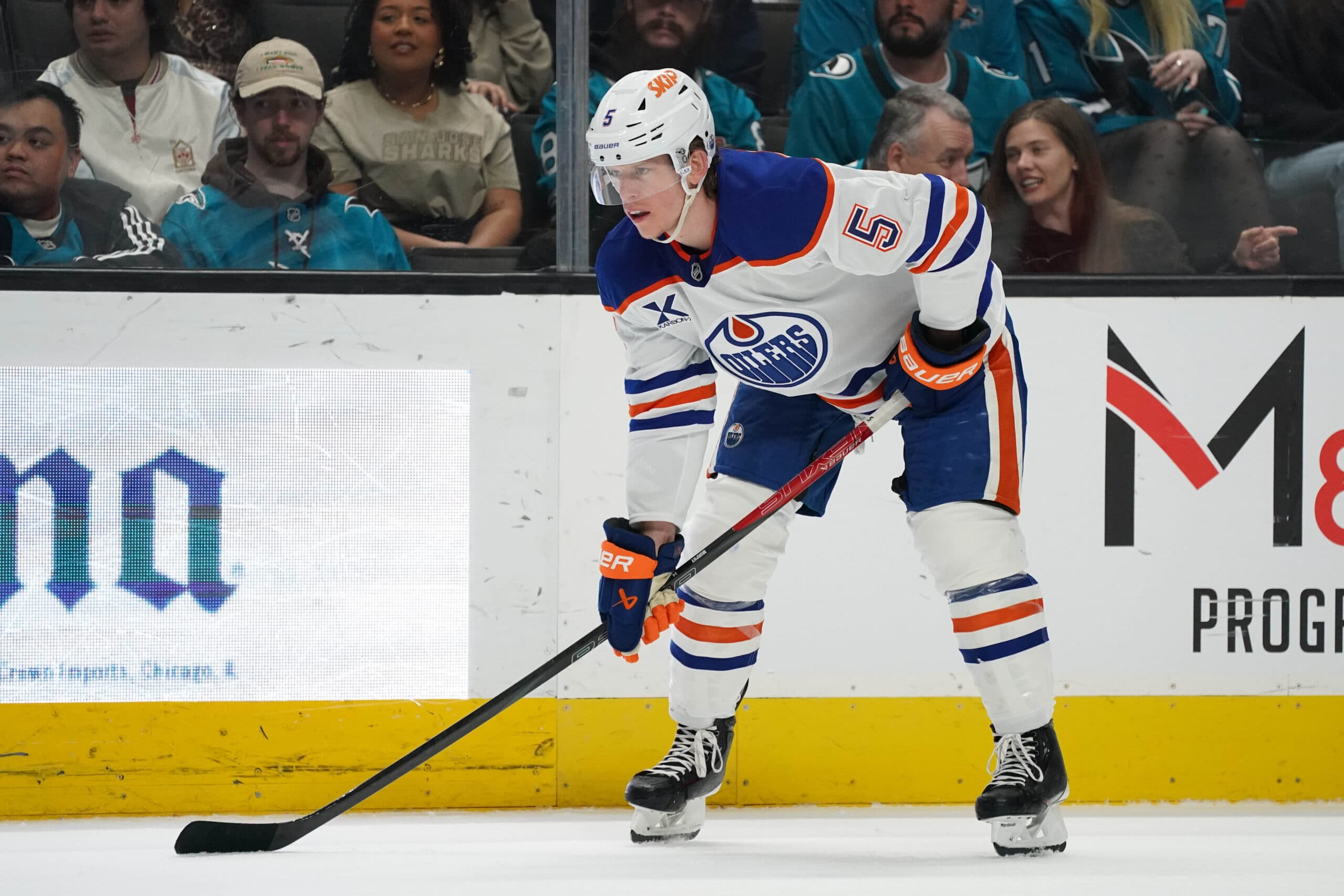
Photo credit: © David Gonzales-Imagn Images


The Edmonton Oilers have a long list of pending free agents this summer. But among them, I would argue that Connor Murphy should be at the top of their priority list to re‑sign.
It has seemed that a second-pairing right defenceman has been on Edmonton’s wish list essentially every off-season and trade deadline since Adam Larsson’s departure in 2021. Evan Bouchard is locked in as Edmonton’s top-pairing right defenceman, but the right side on the second pair has been a gaping hole for quite some time. At least, that was the case until the 2026 trade deadline, during which the Oilers finally dealt for a second-pairing RHD in Murphy.
With Murphy set to become a UFA this summer, here’s why I believe the Oilers should make a strong effort to re-sign and keep him.
*All stats via EvolvingHockey, Natural Stat Trick, HockeyStats, PuckIQ and AllThreeZones
Reason #1: Murphy’s stellar defensive results
The ultimate goal of defending in hockey is to suppress goals and scoring chances as much as possible. Few players have done that more consistently than Connor Murphy.
One metric I often look to for evaluating defensive play at even strength is EvolvingHockey’s EVD (Even-Strength Defence) model, which attempts to isolate a player’s impact on suppressing even-strength quality scoring chances by factoring in quality of teammates, quality of competition, zone starts, and more. It is by no means a perfect measure, but I find it quite valuable when used and interpreted correctly.
Here is a timeline of Murphy’s EVD per 60 minutes of play, and where it has ranked each season among all defencemen in terms of percentiles:
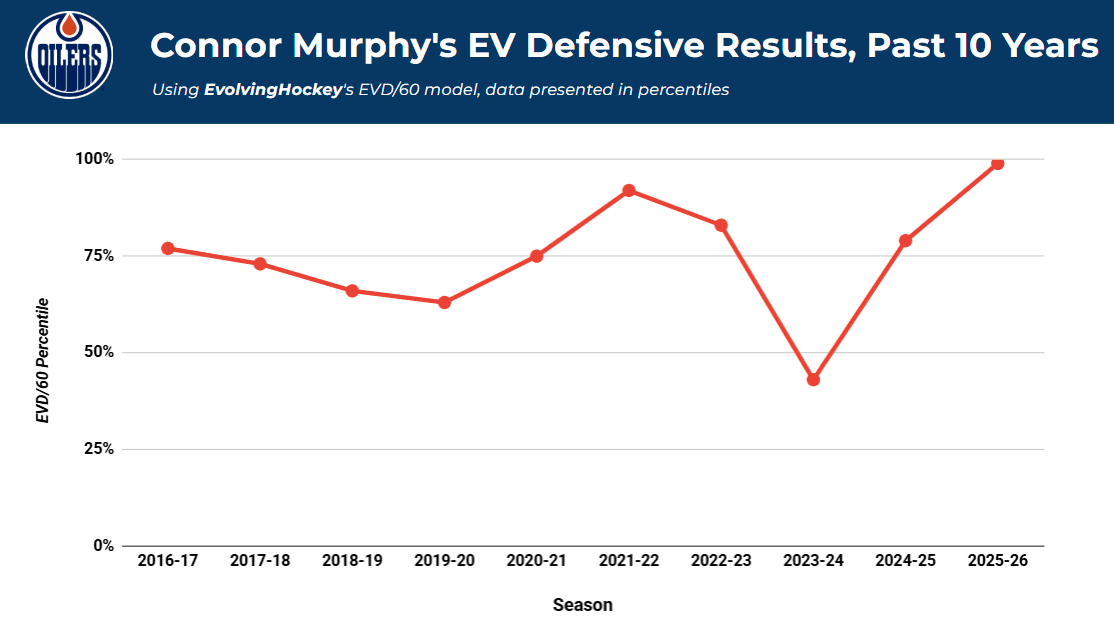
In the past 10 years, Murphy’s defensive impact has ranked above the 63rd percentile in nine of them. It has exceeded the 80th percentile on numerous occasions as well, and in fact, this past season in 2025-26, Murphy ranked fourth among all defencemen with an EVD of +9.4.
To put that into perspective, in the entirety of the analytics era (post-2007), only 11 other defencemen have had an EVD rating higher than 9.4 in a single season, names like Marc-Edouard Vlasic and Niklas Hjalmarsson in their primes.
And it is not just EvolvingHockey’s model where Murphy ranks well. Per the EVD model on hockeystats.com, Murphy’s even-strength defensive impact ranked at an even better third place among all defencemen this past season. Very, very impressive.
Now, both these EVD models are primarily built around expected goals against. The thought process behind this is to separate a skater’s results from the goaltending behind them, because models built around actual goals against would end up unfairly penalizing good defensive players playing with bad goaltending, and undeservingly benefiting bad defensive players with good goaltending.
Nevertheless, even if you are skeptical of modern expected goal models, Murphy’s teammate-relative impact on actual goals against per 60 minutes in the past two seasons ranks 24th among all defencemen. Still very strong, especially given that he has largely played behind questionable goaltending in Chicago.
Although his regular-season sample with Edmonton is not huge, also note that he ranked first among Edmonton’s defencemen in both actual and expected goals against per 60 at 5-on-5.
As for the penalty kill, publicly available advanced stats are not as reliable here, but nevertheless, we have sufficient data to conclude that Murphy has also generally been a strong penalty-killer. Prior to his trade to Edmonton, the Blackhawks had the best penalty kill in the NHL, and Murphy led Chicago with 172 minutes on their top unit. In 20 regular-season games with Edmonton, Murphy was also on-ice for the fewest PK goals against per 60. He struggled in that facet in the playoffs, but it’s a smaller sample in which I would place much more blame on Edmonton’s PK system (which has been poor for quite some time, as I outlined in an article last week about the coaching staff) and injuries to key penalty-killing forwards.
I have seen some claim that Murphy is more suited as a third-pairing defenceman over a 2RD. However, per PuckIQ, Murphy’s TOI% against elite competition ranks in the 58th percentile among all defencemen in the past three seasons; not a pure matchup defenceman by any means, but this comfortably remains in standard second-pairing territory. Furthermore, over that span, no Chicago defenceman was on ice for fewer DFA (dangerous unblocked shots against) per 60 against elite competition than Murphy. Adjusted for teammates, Murphy’s DFA/60 against elites ranks 28th among all defenders.
All-in-all, Murphy’s defensive resume is remarkably strong. Very few defencemen in the league can match the shot‑suppression results he posted this season, and even fewer have a decade‑long track record of consistently positive defensive impacts. For an Oilers team that mightily struggled defensively throughout the year, a proven defender like Murphy is extremely useful.
Reason #2: Murphy’s versatility with Edmonton’s defensive group
I believe Murphy is a nice stylistic fit in Edmonton’s defensive core.
One area of Evan Bouchard’s game for which he gets little credit for is his zone entry defending. Per AllThreeZones, Bouchard’s entry denial rate ranked in the top twenty percent of defencemen this season, and his controlled entry allowed rate ranked in the top six percent. He is very good in the neutral zone. Where Bouchard specifically has flaws is in-zone without the puck, as he is not very efficient at breaking up cycles and can be prone to coverage errors near the front of the net.
Fortunately, in-zone defending without the puck is precisely where Murphy excels.
Murphy isn’t as aggressive in the neutral zone, and will allow more controlled entries than Bouchard. But once the puck is set up in the defensive zone, he’s outstanding at shutting plays down. He excels his size, physicality, and stick positioning to win battles along the boards and protect the middle of the ice. As an added benefit, Murphy’s shot blocks per shot attempt ranks better than 98 percent of all NHL defencemen over the past three seasons.
In that sense, I would say that re-signing Murphy allows you to have a very well-rounded RHD core, with a dynamic offensive 1RD in Bouchard that can defend the rush, and a defensively minded 2RD in Murphy that can defend in-zone.
Additionally, Murphy also has potential to be effective with multiple of Edmonton’s defenders.
So far, Murphy has almost exclusively played with Darnell Nurse in Edmonton. Now, their results are somewhat of a mixed bag; on the bright side, their actual goal share is quite good, as they have out-scored opponents 8-6 in the regular season (57 GF%) and even 7-to-2 (78 GF%) in the first round against Anaheim despite their series loss. However, their expected goals percentage has been a less impressive 50 per cent and 45 per cent in the regular season and playoffs respectively, indicating some unsustainable puck luck and suggesting their goal share is unsustainable.
Nevertheless, the Nurse-Murphy pair did a very good job at limiting quality scoring chances. With Murphy, Nurse was on-ice for about 24 scoring chances against per hour, compared to over 30 chances against per hour without Murphy. That pair did not generate much offensively, but it is a noteworthy feat by Murphy to drive Nurse to those defensive results.
In Edmonton’s 2024 and 2025 cup final runs, Nurse had a dreadful 41 percent goal share. There is an argument to be made that, if the Nurse pairing was simply just net-even for those runs, Connor McDavid would have two Stanley Cup rings by now, and so perhaps carrying Nurse to a simple dead-even goal share is sufficient at this point. I could see Murphy doing that, and that’s something that you can’t say for a lot of defencemen.
For a more well-rounded, two-way pairing, I would like to see what a potential duo of Jake Walman and Murphy could do over a larger sample size. I believe Walman would fit best next to a more defensively reliable partner, and Murphy fits best with a strong puck-mover. Now, Walman did have a poor season in 2025-26, but he was plagued by injuries, and I do believe he has the potential to bounce back (as a side note, I will be writing a full article on Walman later this off-season). I can absolutely see the Oilers win with a second pair of Walman and Murphy.
There’s even potential for a defensively inclined shutdown pair of Ekholm-Murphy. You could then pair Walman and Bouchard together and have an all-out offensive pairing. Depending on how Edmonton structures their forward lines, this too could be a very viable and intriguing option.
All-in-all, Murphy offers the Oilers strong flexibility. This is a player that could have success with each of Nurse, Walman, and Ekholm in different ways.
Reason #3: Lack of definitively better alternatives
Now, Murphy is by no means a flawless player. He turned 33 years old in March. In a perfect world, you also probably want a 2RD with more puck-moving ability and faster skating.
However, right defence is perhaps the most scarce position in hockey. There is not exactly a long list of viable top-four RHD on the market.
When you look at the UFA class, the list of options is quite limited. John Carlson and Darren Raddysh will obviously cost too much, and as offensively minded RHD, aren’t a great fit with Edmonton in the first place. The same is true with Jacob Trouba. Rasmus Andersson has expressed his disinterest in playing in Edmonton, and regardless, his underlying numbers have always been subpar. Perhaps Carson Soucy has upside, but his defensive results are not nearly on Murphy’s level.
The trade route doesn’t offer many clean solutions either. Colton Parayko has been a notable RHD on the market for quite some time, but he has an NTC and a huge cap hit. There may be younger RFA options out there, such as NYR’s Braden Schneider or Anaheim’s Pavel Mintyukov, and it could be wise for Edmonton to at least explore those possibilities. However, even if their teams were willing to move them, it is unclear whether the Oilers have the trade assets required to acquire one of those players while still addressing the rest of the roster. In that sense, retaining Murphy and preserving assets for help at wing, in goal, or for sweeteners in a potential Darnell Nurse trade seems to be a much more optimal approach.
AFPAnalytics projects Murphy at $3.6M for 2 years. I think that is a very fair deal, particularly with a rising cap ceiling, and certainly makes him a much better option than the other UFAs.
With everything in mind, Murphy is likely the best 2RD option for the Oilers available. Time will tell if management agrees.
Find me on Twitter (@NHL_Sid)


Breaking News
- Will Oilers fans put a new player in the doghouse?
- Ryan Shea’s strong Oilers debut, in sync with the top unit, comes as no surprise
- Mike Babcock praises Colton Dach as Oilers test him at centre
- ‘He taught us how to work’: Sean Avery endorses Oilers hiring Mike Babcock
- Monday Musings: New pre-season rules, schedule quirks, Evan Bouchard and more…

Edmonton OilersTeam Cap Summary

Cap Summary
2027-28
2028-29
Projected Cap Hit
$88,322,500
$61,025,000
Projected Cap Space
$25,177,500
$61,975,000
Current Cap Space
$25,177,500
$61,975,000
Active Players
16/23
10/23
Draft Picks
Round
'27
'28
1
0
1
2
1
0
3
0
1