
OilersNation has no direct affiliation to the Edmonton Oilers, Oilers Entertainment Group, NHL, or NHLPA
Why it’s time for the Oilers to make a coaching change
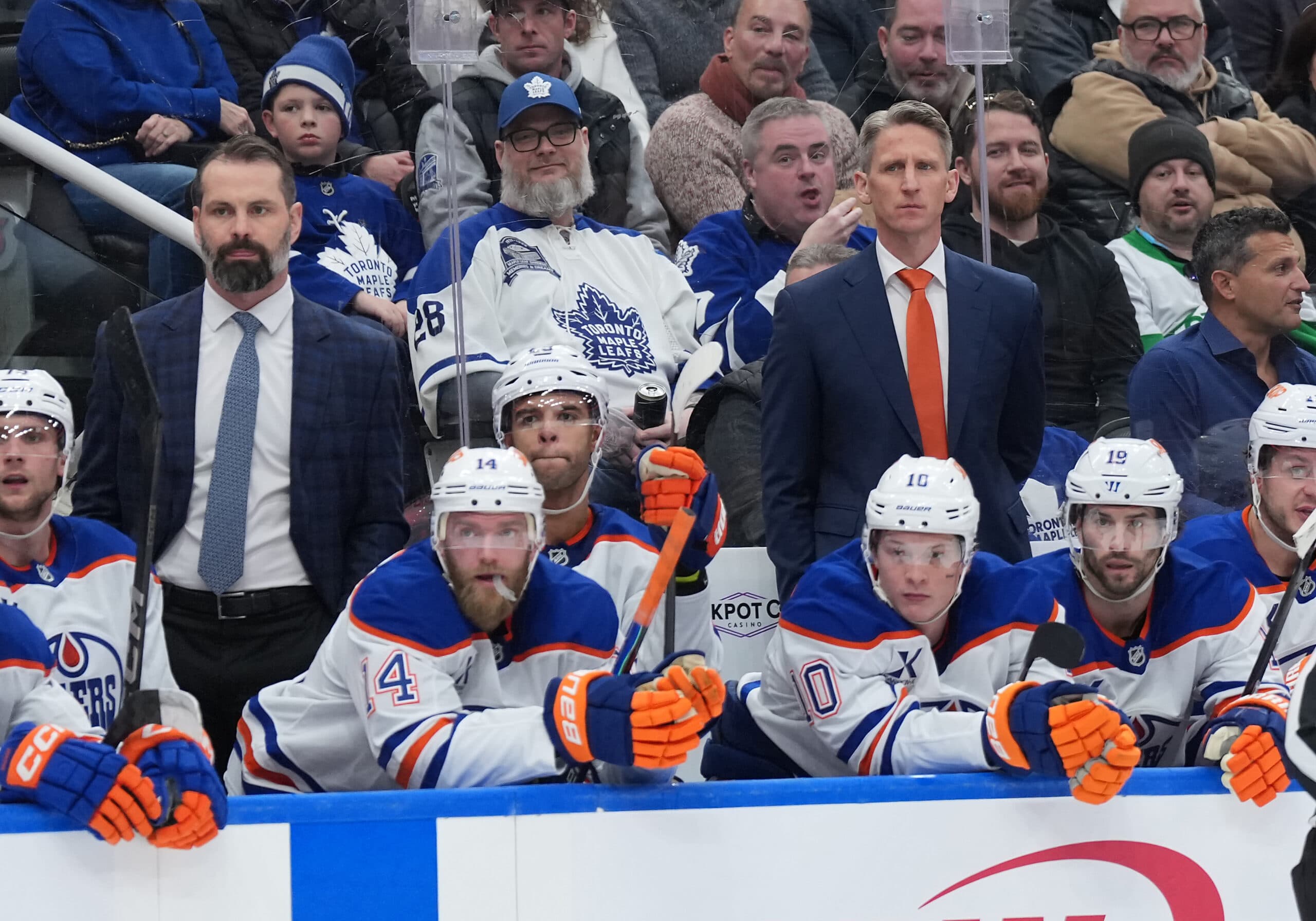
Photo credit: © Nick Turchiaro-Imagn Images


In the Edmonton Oilers’ final season before Connor McDavid turns 30 years old, they were eliminated in the first round of the playoffs by the Anaheim Ducks. In general, it was a mediocre season for the team all year long. As McDavid put it, they were an “average team with high expectations.”
Plenty of blame has been directed across the organization, from the star players to management to ownership. But in this piece, I would like to specifically focus on the coaching staff.
Without any further ado, here is a deep dive into Edmonton’s coaching and why I strongly believe it is best for the team to make a change.
*All stats via Natural Stat Trick and EvolvingHockey, unless stated otherwise
First, a deeper look into the all-around results under Knoblauch
Let’s begin with a deeper dive into Edmonton’s regular-season results. Firstly, there is no doubt that the Oilers saw a massive improvement upon head coach Kris Knoblauch’s initial arrival. In the first thirteen games of the 2023-24 regular-season under then-HC Jay Woodcroft, the Oilers had an atrocious 3-9-1 start (0.269 PTS%), the absolute worst start in franchise history. Under Knoblauch, the Oilers recovered to an outstanding record of 46-18-5 (0.703 PTS%).
However, I believe it would be an oversimplification to reduce this to a neat-and-tidy narrative of “Woodcroft bad, Knoblauch good.” Two important details must be noted here.
First, much of the Oilers’ horrendous start in 2023-24 simply came down to injuries and plain old bad puck luck. Mattias Ekholm was injured to start that season and Connor McDavid played through an injury as well. Overall, the team also held an unsustainably low shooting percentage of six per cent and save percentage of 88.9 per cent. Considering that the team significantly controlled the play (54 per cent of the shots, 57 per cent of the scoring chances), regression to the mean was inevitable at some point.
Now, that’s not to imply that Knoblauch had no effect. There were indeed significant areas the new coaching staff had (initially) changed for the better – notably rush defending and the penalty-kill – and I was personally satisfied with most of Knoblauch’s decision-making in his first season here. But, the point is that the Oilers’ poor start would simply have never been sustained. No team has ever had a combined shooting and save percentage (a.k.a. PDO) that low over a full season. This is important to note in order to assess Knoblauch’s true impact.
Second, while the Oilers nevertheless improved under Knoblauch in his first season no matter how you look at it, many red flags began to appear during his two full seasons with the team. Take a look below at a timeline of Edmonton’s goal share at five-on-five during the McDavid and Draisaitl era:
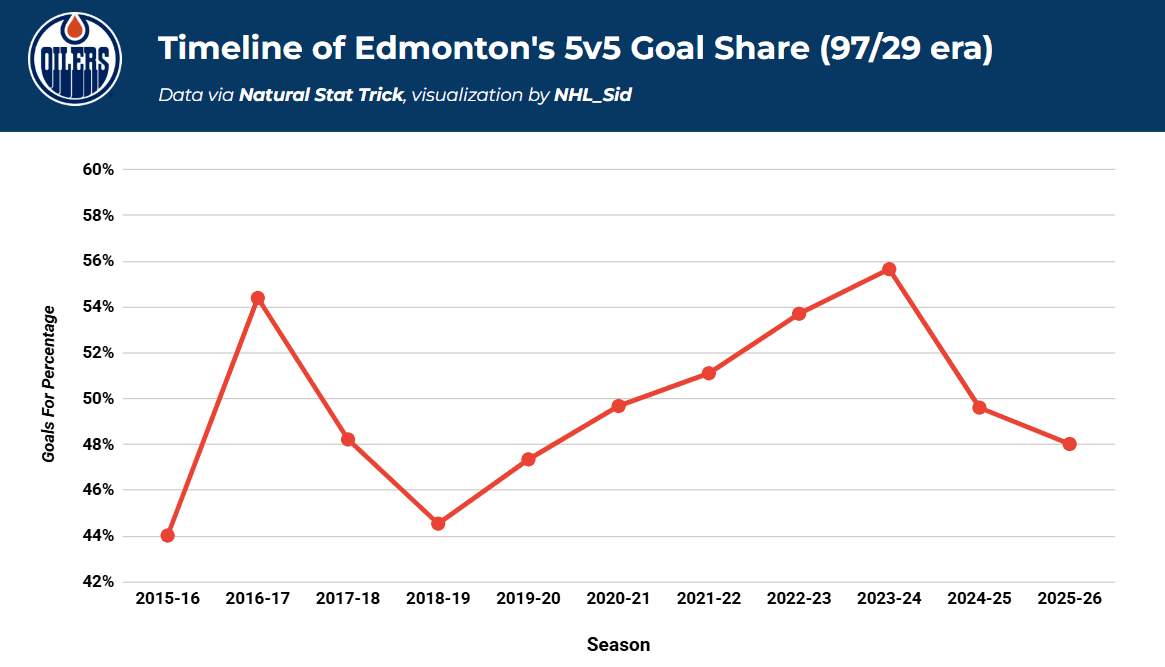
Following Peter Chiarelli’s firing, you can see that the Oilers gradually but steadily improved their five-on-five goal differential every season ever since, from 2019-20 to 2023-24. But, that trend took a steep drop-off in 2024-25 and 2025-26, i.e. Kris Knoblauch’s two and only full seasons with the team.
In fact, not only did the Oilers decline, but they fell into a net negative at five-on-five. In 2024-25, the Oilers were outscored 168 to 171 at five-on-five. In 2025-26, that worsened to a differential of 174 to 188. For a team with Connor McDavid and Leon Draisaitl to be outscored at five-on-five in two consecutive seasons is flat-out unacceptable. There’s just no other way to put it.
We can see an even more revealing trend with Edmonton’s expected goal share, which (essentially) is a measure of how well Edmonton controlled the quantity and quality of the scoring chances on-ice:
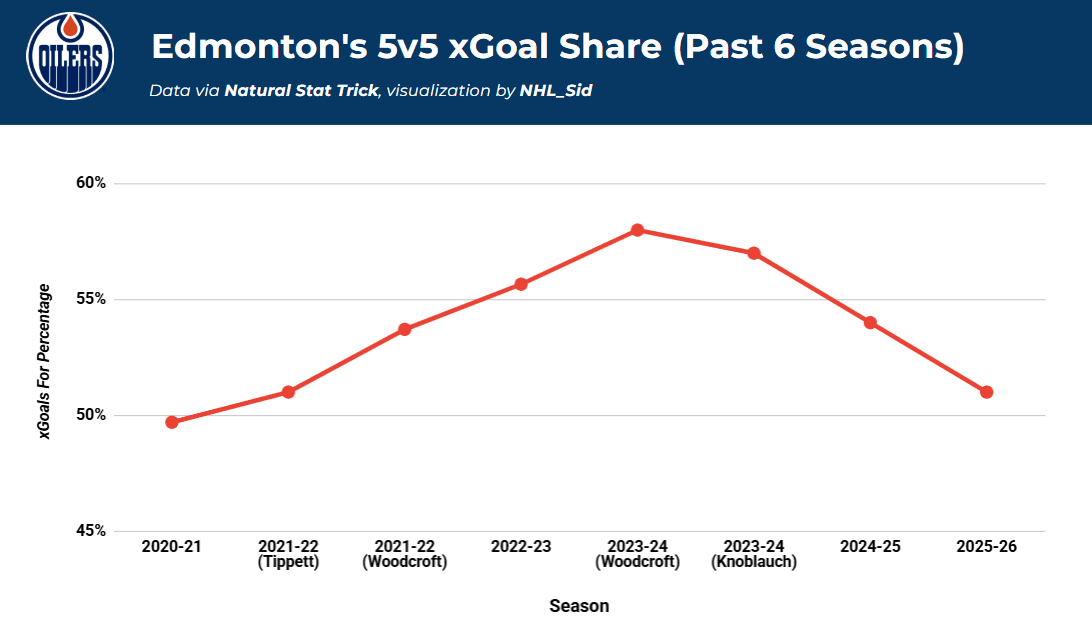
At their peak, the Oilers were possession juggernauts. They consistently controlled play, ranking near or even at the very top of the league in shot, expected goal, and high-danger chance differential at five-on-five. But, that peak generally came under Woodcroft. We can see a very clear decline in Edmonton’s play-driving since Knoblauch’s arrival. In the entirety of the analytics era, there has been no player more prolific at generating scoring chances than Connor McDavid, and so again, these results are just not satisfactory keeping in mind the level of talent on this roster, especially considering how strongly they previously were in this facet.
This has clearly reflected in the standings as well. Edmonton had 93 points in the 2025-26 regular-season, their lowest total over the past six years. They were fortunate to have played in an exceedingly weak Pacific Division.
Now, with all that in mind, there are numerous obvious retorts one may have to what I have presented so far. The most evident one is post-season success.
The biggest case for keeping Knoblauch is the very simple fact that the Oilers reached two consecutive Stanley Cup Finals with him behind the bench. In all fairness, it is a very, very compelling case.
The other major counter‑argument is the question of attribution. How much of these results truly fall on the coaching staff? What about management? After all, there has been considerable roster turnover. What about fatigue after playing more games than any other team over the past three seasons? We just saw the Florida Panthers miss the playoffs entirely after reaching three straight Cup Finals. And, what about the players and leadership core themselves?
My short answer to these counter-arguments can be summarized as follows: process matters. Results are obviously important, but to consistently and sustainably repeat good results, good process is essential. The Oilers have certainly seen some excellent results with Knoblauch in the playoffs, reaching back-to-back Cup Finals with him at the helm, but if they want to return to the finals and go all the way next time, the organization must evaluate the process behind those results. And, there are several areas where that process, particularly on the coaching side, is deeply concerning for me.
For the longer and much more detailed answer, let’s break down some more specific concerns regarding this team and why so many of them point back to the bench.
The decline of the depth scoring
We’ll start with a closer look into Edmonton’s offence. In 2022-23, Jay Woodcroft’s first and only full season behind Edmonton’s bench, the Oilers scored 2.9 goals per hour at five-on-five, fifth in the league. In fact, their all-strength scoring rate that year remains the second highest among any team in a single season in the analytics era (post-2007). But in 2025-26, their five-on-five scoring rate dropped to 2.56, 14th in the NHL.
Is it because of a drop-off in the performance of their superstars? Well, in 2022-23, the Oilers scored 3.33 goals per hour at five-on-five with at least one of Connor McDavid or Leon Draisaitl on-ice. In 2025-26, that number was at 3.38. So if anything, Edmonton’s stars have actually produced slightly more offence for the team this past season.
The main reason why Edmonton’s scoring has so considerably dropped off ever since is because of their significant decline in depth scoring. In 2022-23, the Oilers averaged 2.42 goals without McDavid and Draisaitl, but in 2025-26, that plummeted to a mere 1.67.
Here is a general look at Edmonton’s five-on-five goal share without McDavid and Draisaitl:
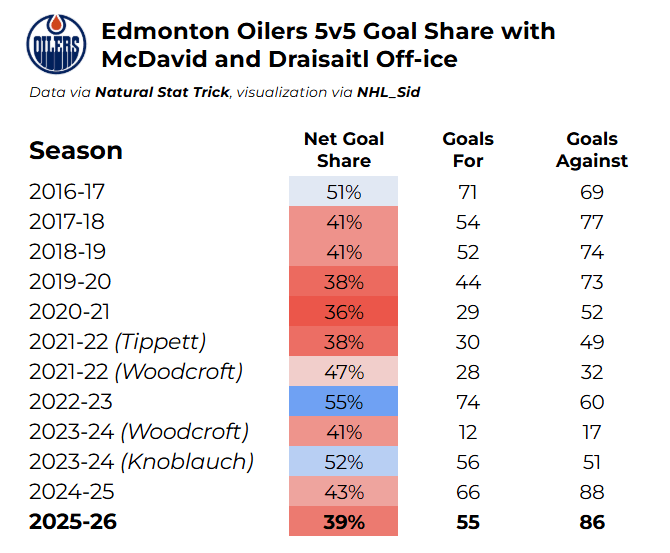
Overall, the Oilers were outscored 55 to 86 without their two stars on-ice, working out to an ugly 39 per cent goal share. That’s far below the 55 per cent mark they posted in Woodcroft’s only full season in 2022-23, and it’s still worse than what they managed during the disastrous 3‑9‑1 start under Woodcroft to begin 2023-24. It’s also even lower than each and every one of the Peter Chiarelli years!
Of course, management has obviously played a big role in this. Multiple depth contributors like Ryan McLeod, Dylan Holloway, Warren Foegele, and Connor Brown have left the organization, and perhaps the Oilers haven’t found suitable replacements for them, particularly in terms of youth and speed.
But, just take a moment to Google Edmonton’s rosters in 2017-18 and 2018-19 to refresh your memory. Sure, Edmonton’s current roster has its flaws, but should they be posting worse results than the Chiarelli-era teams?
It’s one thing to see some level of decline under Knoblauch due to their roster turnover, but should they be this bad? Even the roster’s biggest critics should agree that the answer here is a resounding no.
As for the playoffs, the results are more mixed, though the conclusion generally remains the same. In 2023-24, the Oilers also had an abysmal 36 per cent goal share without McDavid and Draisaitl on-ice. Their cup final run that season was largely due to excellent play from their top players plus an elite penalty-kill. In 2024-25 however, their depth goal share was an outstanding 64 per cent. But, was it a fluke? Unfortunately, the data suggests yes, as the Oilers’ bottom-six was out-chanced 215 to 273. And so while it was a fun run, those results are likely highly unsustainable.
Forward deployment and usage
To expand on the “why” behind Edmonton’s poor results from their depth under Knoblauch, I believe that much of it primarily comes down to usage and deployment rather than personnel. First, Knoblauch’s constant line shuffling and his tendency to immediately load up McDavid and Draisaitl at the first sign of adversity has made it extremely difficult for depth forwards to build any chemistry or consistency.
In 2025-26, 30 out of 32 teams had at least two forward lines with 200+ TOI together at five-on-five, with some teams even having four-to-five lines hit that mark. But, the Oilers were not among those 30 teams; they had just a single forward line play over 200 minutes together all season long. In general, I’m not sure if there was a stretch of even four-to-five games this season where the Oilers kept their forward lines intact.
Viktor Arvidsson’s relative success in Boston has perhaps made this issue evident. In Edmonton last season, Arvidsson played over 20 minutes on seven different line combinations. He never found a consistent role in the lineup, and his net results generally fell below expectations. But with the Boston Bruins this season, he has spent essentially the entire season with the same linemates in Pavel Zacha and Casey Mittelstadt. The result was Arvidsson doubling his production in Boston, and even playing at a rough ~30-goal pace.
Arvidsson is also not the only player who performed worse in Edmonton; other additions like Jeff Skinner, Andrew Mangiapane and Trent Frederic all declined upon their arrival in Edmonton despite the fact that they obtained TOI next to two of the best players in the league. Of course, there are other factors that influenced these players’ performance in Edmonton, such as Frederic’s ankle injury and Mangiapane’s general regression since his shoulder surgery, but can we dismiss disappointing performances from all of them as sheer coincidence? I’m not so sure.
I also believe that Knoblauch is far too risk-averse and unwilling to give his younger, higher-upside players more opportunity. Even as Edmonton’s veteran bottom-six players struggled for most of the season, he would shuffle the combinations around with the same players but rarely made any meaningful structural changes, whether that meant trying something fundamentally different with the lineup (e.g. giving Ryan Nugent-Hopkins an extended run at 3C) or granting younger players a legitimate, sustained look.
This is my issue with the counter-argument regarding fatigue. If indeed the Oilers’ as a whole have felt significant fatigue after back-to-back deep playoff runs and short summers, to the extent that it has considerably affected their play, why not give more chances to younger, fresher legs throughout the regular-season and see what they can do?
Why did it take until after the Olympic break for Matt Savoie to have a lengthy, consistent opportunity? Why have Isaac Howard and Quinn Hutson not been given greater chances given the struggles of the bottom-six? Why did 36-year-old Adam Henrique average more TOI than Josh Samanski? Just very confusing and frustrating stubbornness from the coaching staff all around here.
We have seen the impact that coaching alone can have on the bottom-six. Simply look at the 2021-22 season as an example, when the Oilers saw a massive 14 per cent improvement in goal share following Dave Tippett’s dismissal and Woodcroft’s hiring. And so even with flawed management, it’s just very difficult not to point fingers at the coaching here. Simply put, Knoblauch is not getting the most out of his forwards.
Edmonton’s tendency to sit back on leads
One more specific factor that I believe has affected Edmonton’s offence is their tendency to sit back on leads. This has particularly been an issue in the playoffs. Take a look below at Edmonton’s underlying results split by score state in the playoffs:
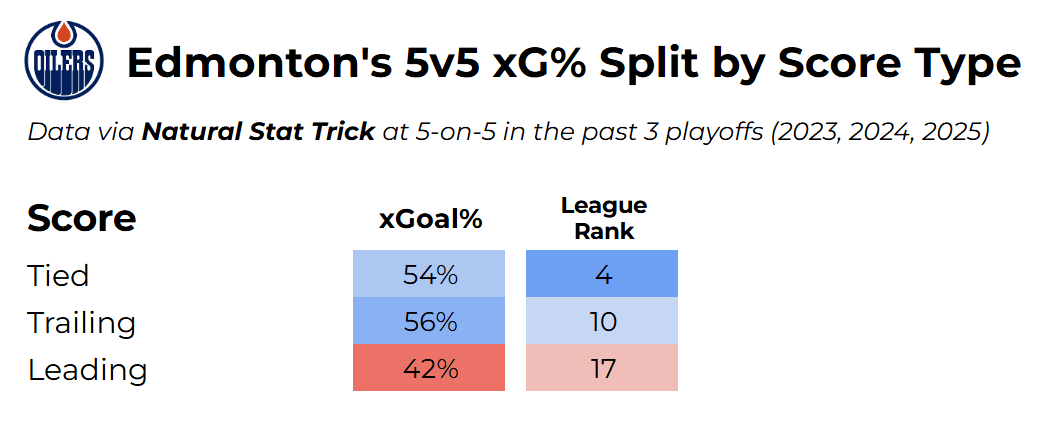
When tied, the Oilers’ expected goal share in the playoffs ranks at 54 per cent, 4th in the league. Their xG% when trailing also ranks at a modest 56 per cent. But, their xG% when leading drops down to an awful 42%.
Now, essentially every team will go into some form of defensive shell when leading, playing much more conservatively and taking less chances, and so some level of drop-off is expected here. But that’s why I also provide the league rank here, which shows that even relative to other teams, the Oilers perform far worse when leading in the playoffs. For specific reference, note that the cup-winning Florida Panthers teams remained above 50 per cent in xG% when leading, and the 2022 Colorado Avalanche in particular were at an outstanding 57 per cent; that was a team that never took its foot off the gas pedal. But, the same can’t be said for Edmonton.
Far too often when they obtain a lead, the Oilers resort to sloppy zone clears and dump-and-chase hockey instead of looking for controlled transition plays. This issue was on display in Edmonton’s round 1 loss to Anaheim, where they lost multi-goal leads in both Game 1 and Game 4, and were fortunate it didn’t cost them in Game 5.
It’s worth noting that under Woodcroft, the Oilers posted a 54 per cent xG% when leading. Combined with their much stronger numbers when tied or trailing, it’s clear the roster has the ability to be better, but they simply limit themselves and stop pushing for more once they get ahead. Either this is an intentional tactical choice by the current staff, or Knoblauch has been unable to correct the issue for three straight postseasons.
The rush defence
We have spent most of this article focusing on the offence, but the defensive play too has been an issue under Knoblauch, specifically off the rush.
Unfortunately, more granular full-season shot data, such as shots off passes, shots off the rush, etc are not publicly available. Those sorts of numbers are tracked by private stat companies and NHL teams. We will have to work with snippets of private models in this section, though what we do have does paint a clear picture.
Per Mike Kelly, the Director of Analytics and Insights at the private stats company SportLogIQ, the Oilers ranked dead last in the league in rush chances allowed as of March 3. Furthermore, per Kelly again, the Ducks out-chanced Edmonton 50 to 31 off the rush in the first round of the playoffs. While we’re missing data from most of March and all of April, which albeit was a very good defensive stretch for the team, the Oilers nevertheless have greatly struggled to defend the transition for the vast majority of the season, including at the most important time.
Much of the Oilers’ rush chances allowed, especially in their series against Anaheim, have been counter-attacks caused by players caught too deep in their zone and being late on the backcheck. Anaheim’s 2-0 goal in Game 6 is a prime example. Some of that is simply on individual mistakes, but Knoblauch also failed to adjust to Anaheim’s transition game. The team never consistently kept enough forward support underneath the puck in the offensive zone to prevent getting exposed the other way, and it clearly cost them. I will also say that, in general, I would have liked to see a much more aggressive team in the neutral zone. Per Corey Sznajder’s tracking at AllThreeZones, the majority of Edmonton’s defenceman saw a considerable increase in controlled entries allowed, essentially meaning they gave up the blue line much more frequently.
As one last note here, I think one important detail to remember is that Woodcroft never had one full season of Mattias Ekholm. And yet, the Oilers allowed far fewer dangerous scoring chances in 2022-23 compared to 2025-26. With the additions of both Jake Walman and Connor Murphy as well, I really do believe this team should have been much better defensively.
The penalty-kill
We’ll now focus on penalty-kill coach Mark Stuart here.
One of, if not the biggest issues under Jay Woodcroft’s Oilers was the penalty-kill. It had remained very subpar and inconsistent under his coaching staff. Following the coaching change in 2023-24, the Oilers initially saw a massive improvement, particularly in the 2024 playoffs. That post-season, the Oilers ranked first among all playoff teams with an outstanding 94 per cent penalty-kill percentage, allowing a mere four goals on the penalty-kill in 25 playoff games, three of which came in the second round alone.
But their PK success has only declined ever since. Take a look at their results over the past two regular-seasons and post-seasons:
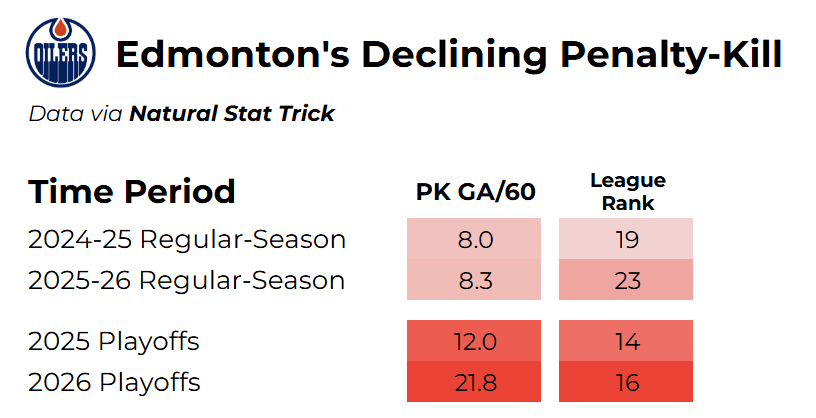
In the past two regular-seasons, their PK has been well below-average, while it has been flat-out awful in the past two playoffs. In fact, perhaps the penalty-kill was the biggest reason Edmonton was eliminated by Anaheim. They allowed eight goals in less than 23 minutes!
Injuries to Edmonton’s centre depth played a role this year, but the problem is, these results were also poor in the prior playoffs and remained quite subpar throughout the entirety of the past two regular-seasons. Simply put, there’s no excuse for these results here, and there is little justification to bring Mark Stuart back as the penalty‑kill coach next season.
Final Thoughts
I should clarify that I am not entirely blaming the coaching for Edmonton’s early playoff exit this season. One big factor was obviously the fact that each of McDavid, Draisaitl and Hyman were playing through injuries. Even the best coaches will clearly have a difficult time getting past that.
Nevertheless, much of the arguments in this piece come down to my belief that the roster, though flawed, should be much, much better than what they have shown, and it is very difficult not to point fingers at the coaching staff for underwhelming results. Even in the regular-season with a healthy roster, the Oilers were mediocre, as it was the second consecutive season in which they had a net negative goal share at five-on-five. The roster is clearly not as strong as a team like Colorado or Tampa, but ranking in the net negatives is simply far too inadequate.
Perhaps one may argue I have been too dismissive of the back-to-back Cup Finals runs. That is by no means an easy feat. But hockey, like anything driven by probability, is about maximizing your chances. Can the Oilers win a Stanley Cup with Knoblauch? Of course they can. But do they increase their odds moving forward by keeping the current staff in place? In my view, they don’t.
It is obvious that a large part of Edmonton’s playoff success in 2024 and 2025 simply came down to the brilliance from their superstars, and many of the other factors that fuelled those playoff runs have either sharply regressed, such as the 2024 penalty-kill, or were not sustainable moving forward, such as their 2025 bottom-six. In general, there have simply been too many red flags in structure, deployment, and process that have persisted for multiple seasons, some of which ultimately contributed to Edmonton’s playoff loss to Anaheim. And, of course, the regular-season still matters; it is a much larger sample, and had the Oilers had a stronger start, they could have rested more players with injuries heading into the playoffs. It should not be outright dismissed.
All things considered, I believe it is time for the Edmonton Oilers to move on and seek a new voice behind their bench.
Find me on Twitter (@NHL_Sid)
PRESENTED BY VIVID SEATS

Take $20 off your first Vivid Seats order of $200+ using promo code OILERSNATION (new


Breaking News
- Edmonton’s Most Wanted: Analyzing the NHL’s biggest Oilers killers
- NHL Notebook: Former Oiler Shawn Horcoff named Red Wings interim general manager
- The standouts, the notables, and the disappointing performances from the Oilers’ NextGen game
- Oilers reassign Ryan Cameron, release three tryouts in first camp cuts
- The Day After: Oilers top line shines in win over Flames rookies

Edmonton OilersTeam Cap Summary
Cap Summary
2027-28
2028-29
Projected Cap Hit
$88,322,500
$61,025,000
Projected Cap Space
$25,177,500
$61,975,000
Current Cap Space
$25,177,500
$61,975,000
Active Players
16/23
10/23
Draft Picks
Round
'27
'28
1
0
1
2
1
0
3
0
1