
OilersNation has no direct affiliation to the Edmonton Oilers, Oilers Entertainment Group, NHL, or NHLPA
What specific roster adjustments is McDavid likely to request this summer?
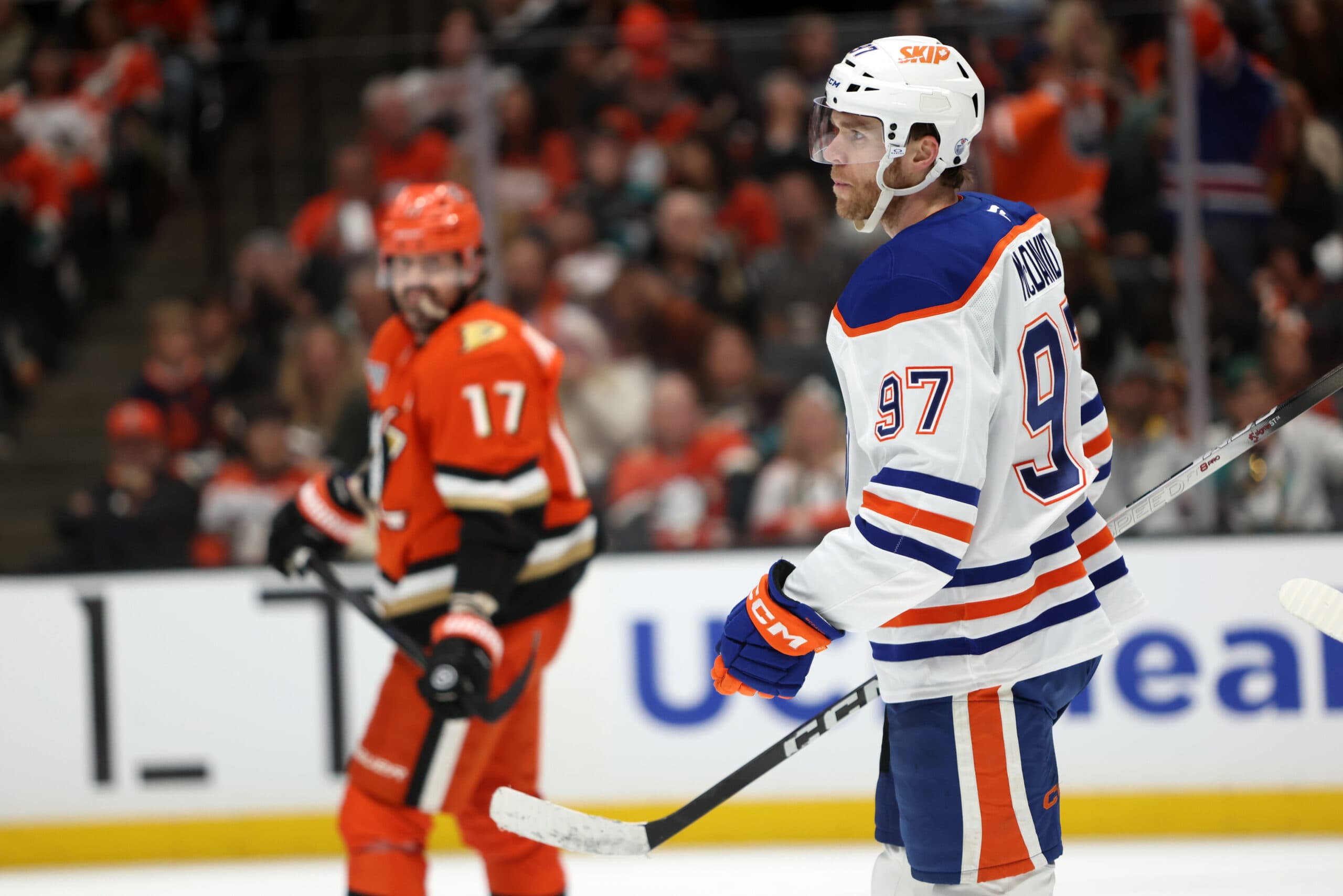
Photo credit: Kiyoshi Mio-Imagn Images

May 3, 2026, 11:00 EDTUpdated: May 4, 2026, 11:56 EDT


It’s going to be a long off-season for the Edmonton Oilers.
Not just because they were bounced in the first round, but because there’ll be a lot of noise surrounding Connor McDavid. The Oilers’ captain cemented the fact that he wants to win in Edmonton during the end-of-season press conference, but with two years left on his contract, the Oilers have to make moves.
Shortly following the loss, Sean Gentille and Chris Johnston of The Athletic reported that “[McDavid] is likely going to expect management to deliver on specific roster adjustments this summer.” That begs the question, what could those roster adjustments be?
Goaltending
I think everyone and their cat knows that the Oilers’ biggest need this off-season is finding an actual starter, something they’ve been looking for since Cam Talbot in 2016-17, and Dwayne Roloson before that. However, that’s easier said than done.
In the McDavid/Leon Draisaitl era, the Oilers have had a revolving door of netminders. Some were in the twilight of their career, such as Mike Smith. Another, like Mikko Koskinen, had good results in Europe, but was nothing more than a backup in the NHL. Then you have a netminder that they developed, namely Stuart Skinner.
They’ve tried to swing big a couple of times now as well. In the 2022 off-season, the Oilers signed Campbell to a five-year deal worth $25 million a year. Campbell was coming off two good seasons with the Toronto Maple Leafs, posting a .914 save percentage and 2.64 goals against average in 49 games in 2021-22.
Campbell’s tenure was the polar opposite in Alberta, finishing his first season with an .888 percentage and 3.41 goals against average in 2022-23. Then in 2023-24, he played just five NHL games, where he had an .873 save percentage, before being sent to the American Hockey League to end the season. At the end of the season, the Oilers bought out Campbell’s contract.
Then you have Tristan Jarry, whom the Oilers acquired in December 2025 for Skinner, Brett Kulak, and a second-rounder. It stands to reason that if the Oilers look to improve their goaltending, something that they will basically need to do to keep McDavid a career Oiler, Jarry would have to be moved.
Again, finding a game-changing goalie is easier said than done. There are goalies, such as Daniel Vladař this postseason, who perform well on a not-so-great team. The Oilers can’t take that type of chance on a free agent goalie, because that’s exactly what they did with Campbell.
A true game-changing netminder will have to be found through a trade. There are really just a few goalies in the league that fit that category, such as Connor Hellebuyck of the Winnipeg Jets. It’ll cost a lot, but it’s a move they need to make.
Coaching change
Another change that McDavid may ask for is to the coaching staff.
Kris Knoblauch isn’t a bad coach by any means, and whenever the Oilers make a coaching change, we’ll likely see him behind another NHL team’s bench at some point in the future. That said, the Oilers need a new voice behind the bench.
Despite being hired early into the 2023-24 season, Knoblauch is now the 10th-longest-tenured coach in the NHL. Coaches just don’t last long in the NHL, with only Tampa Bay Lightning’s Jon Cooper, Colorado Avalanche’s Jared Bednar, and Carolina Hurricanes’ Rod Brind’Amour having a tenure longer than five years.
Two of those three coaches have won a Stanley Cup in that tenure. There just so happens to be another Stanley Cup-winning coach available in the coaching free agency, Bruce Cassidy.
Joining the Vegas Golden Knights for the 2022-23 season, he led the team to their first Stanley Cup in only their sixth season of existence. Four years prior, Cassidy led the Boston Bruins to the Stanley Cup Finals, where they lost to the St. Louis Blues.
With the Pacific Division being as weak as it was in 2025-26, Cassidy was let go late in the season by the Knights and replaced by John Tortorella. The Golden Knights ended the season 7-0-1 and moved to the second round after beating the Utah Mammoth in six games.
It was a fairly weak schedule with only two matchups against teams that made the postseason. However, diving deeper into the stats, the Golden Knights were just plain unlucky from the end of the Olympic break until Cassidy’s firing.
PDO is a stat that measures team shooting percentage and team save percentage. A PDO of 1.000 is the base line, with anything below that being considered unlucky, and everything above 1.000 being considered lucky.
The Golden Knights’ PDO during five-on-five action from the end of the Olympic break (Feb. 25) until Cassidy’s firing (March 28th) was a league-low 0.937. Their goaltending wasn’t good, and really hasn’t been all year, but they were shooting just 6.81 per cent, also a league worst in that month and change.
That was down from a 0.987 PDO before the Olympic break and a well down from their 1.044 PDO following Tortorella’s hiring.
It’s unclear whether or not Cassidy lost the room, or if it was just a move to get the team going, but that 5-10-2 slump the Golden Knights were on following the break was fuelled by poor goaltending and a very low shooting percentage.
Improving the penalty kill
The Oilers penalty kill was a problem this postseason, and it’s not out of the question McDavid asks to bring in some penalty killers.
One of the biggest reasons that the Oilers made it to the 2024 Stanley Cup Finals was because of their penalty kill. In the first round, the Oilers killed off all 12 opportunities that the Los Angeles Kings had. They played the Vancouver Canucks in the second round (remember when they were good?) and allowed an Elias Pettersson power play goal in Game 2.
They didn’t allow another goal on their penalty kill until Game 2 of the Stanley Cup Finals when Evan Rodrigues beat Skinner on a rush. Even then, they had killed off the first 1:54 seconds of the power play.
That was the Panthers’ one and only power play goal of the series, giving the Oilers an incredible 94.3 penalty kill percentage that postseason. From that Game 2 goal in the second round until the Panthers beat Skinner in the dying seconds of a power play, the Oilers killed off 34 consecutive penalty kills, tied for one of, if not the longest, streak in NHL postseason history.
The Oilers made the Stanley Cup Finals again in 2025, but their penalty kill dropped off a cliff, killing 67.1 percent of the power plays they issued. Their penalty kill performance in the first round nearly sunk them before the run even began.
Then, their penalty kill actually sunk them this postseason. The Oilers were maybe the better team in two of the periods that they played against the Anaheim Ducks. Even then, had their penalty kill not allowed eight goals in 16 attempts, they probably could’ve found a way to win the series.
The issue here is that the Oilers have to find a way to get good penalty killers who can chip in offensively during five-on-five action. Again, it’s easier said than done.
Acquiring a top-six forward
It’s been a while since the Oilers added a bona fide top-six forward, and with Ryan Nugent-Hopkins’ decline, it could be adjustment this off-season.
Before the 2023 trade deadline, the Oilers traded 2022 first-round pick Reid Schaefer, Tyson Barrie, and a few other assets to the Nashville Predators for Mattias Ekholm. It’s undeniably a good trade for the Oilers, but it also marks their biggest “all-in” trade in the McDavid/Draisaitl era.
Since then, the Oilers have mainly prioritized their bottom six and defence core before the trade deadline. In 2024, they acquired Adam Henrique, Sam Carrick, and Troy Stecher. They added Jake Walman, Trent Frederic, and Max Jones in 2025, then Connor Murphy, Colton Dach, and Jason Dickinson in 2026.
At no point at any deadline since McDavid broke into the league have the Oilers ever acquired a bonafide top-six forward through trade. They found one in Zach Hyman, but he was a free agent signing. Vasily Podkolzin has the potential to be, taking a big step in 2025-26 by scoring 19 goals and 37 points. Matthew Savoie is in the same boat, and his end to the season is encouraging for the future.
With the free agency class being as weak as it is, any addition to the Oilers’ top six would likely either come internally (worst-case scenario) or through a trade.
The biggest trade candidate who could be available this off-season is Dallas Stars’ forward Jason Robertson. A pending restricted free agent, Robertson has reached the 40-goal mark on three separate occasions in his career, with a 35-goal season in the mix as well. Talk about bonafide.
Now, the Oilers probably don’t have the assets to pull off a trade for Robertson. And an offer sheet doesn’t seem realistic either given it’ll probably cost their next four first round picks, one of which belongs to the Chicago Blackhawks. But good teams find a way to get better, and it’s something the Oilers may have to do this off-season.
Re-signing a handful of UFAs
Despite the early exit from the playoffs, the Oilers still have a good team on paper, with a few of those good players hitting free agency on Canada Day.
The Oilers will have quite a bit of cap to play with this off-season, just under $16.5 million. Their current top six is locked up, as McDavid, Draisaitl, Podkolzin, Nugent-Hopkins, Hyman, and Savoie are all signed next season. However, their bottom six is a different story.
Adam Henrique, Jason Dickinson, Curtis Lazar, Jack Roslovic, Kasperi Kapanen, and Max Jones are all set to reach free agency on July 1. Roslovic and Kapanen could be classified as middle six forwards, and the Oilers should re-sign Kapanen without question.
Roslovic scored 21 goals and 36 points in 69 games on a low-cost, high-reward type deal, but was unnoticeable in the playoffs. Maybe there’s a pathway to bringing him back, but only if he’s cheap.
As for the other four forward UFAs, Henrique, Dickinson, and Jones, two of them were important penalty killers who centred the two lines of the bottom six. Jones is not one of those players, but he looked solid in limited minutes before getting injured last season. The Oilers were better with Lazar in the lineup, but he’s another depth option like Jones.
They could probably replace Henrique, either internally, through free agency, or through a trade. But a Jason Dickinson reunion for the third-line centre role is a good option. He’s only 30 years old and looked great in the playoffs despite suffering a fractured ankle in his final regular season game.
Dickinson and Connor Murphy were not just acquired before the trade deadline from the Chicago Blackhawks, but also made up half of the best penalty-killing until before the deadline. Like Dickinson, Murphy is a UFA that the Oilers should consider bringing back. He’s a shutdown defenceman who also chipped in with two goals in the playoffs.
Finally, Connor Ingram is set to become an unrestricted free agent. This really depends on what they plan to do with Jarry, because if Jarry is traded, re-signing Ingram as their backup netminder seems like an okay move.
Although the Oilers are projected to have just under $16.5 million in cap, things can change if they decide to shed payroll, which would come in the form of trading Jarry or Darnell Nurse. This will lead to a pretty interesting off-season.
Continuing to improve the prospect pool
The thing that Stan Bowman has done best since joining the Oilers is improve their prospect pool. He’s had his fair share of bad moves, such as re-signing Trent Frederic to an eight-year deal, not matching Dylan Holloway or Philip Broberg, and trading for Jarry. But the Oilers actually have a somewhat decent prospect pool now.
And they need to for their future. One thing McDavid made clear when re-signing in October was that they need to improve the farm system for sustained success. With limited draft capital the past two years, the Oilers have turned to Europe and the NCAA, acquiring Josh Samanski and a few others from Europe, and Quinn Hutson following his team’s departure from the national tournament.
The Oilers also acquired Ike Howard in an off-season move last year. Howard, who won the Hobey Baker Award in 2024-25, is a scorer who has a litany of potential outcomes, ranging from a top-six forward to a career AHLer. He’ll get an opportunity next season.
Bowman has only been at the helm of the Oilers for one draft. Last June, the Oilers drafted Tommy Lafrenière in the third round, David Lewandowski in the fourth round, Asher Barnett in the fifth round, goaltender Daniel Salonen in the sixth round, and Aidan Park in the seventh round.
Lafrenière, Lewandowski, and Barnett all look like solid selections for the draft pool. This past season, Lafrenière scored 41 goals and 77 points in 67 games for the Kamloops Blazers of the Western Hockey League. Lewandowski took a step forward, finishing with 17 goals and 65 points in 57 games, then another four goals and nine points in 11 postseason games for the WHL’s Saskatoon Blades.
Barnett, a defenceman, played for Michigan in 2025-26, scoring five goals and 18 points in 40 games and helping the team make the Frozen Four. He was teammates with Park, who scored eight goals and 16 points in 39 games.
The Oilers will have to simultaneously trade to acquire a goaltender and perhaps a top-six winger while making sure their farm system is respectable. As it stands, they only have four picks in June’s draft, their second, third, sixth, and seventh.
It’s going to be a long and fun off-season, as the Oilers have a lot of needs they’ll have to focus on. One thing is certain, the Oilers will look much different in 2026-27.
Ryley Delaney is a Nation Network writer for Oilersnation, FlamesNation, and Blue Jays Nation. Follow her on Twitter @Ryley__Delaney.
ARTICLE PRESENTED BY bet365


Breaking News
- Edmonton’s Most Wanted: Analyzing the NHL’s biggest Oilers killers
- NHL Notebook: Former Oiler Shawn Horcoff named Red Wings interim general manager
- The standouts, the notables, and the disappointing performances from the Oilers’ NextGen game
- Oilers reassign Ryan Cameron, release three tryouts in first camp cuts
- The Day After: Oilers top line shines in win over Flames rookies

Edmonton OilersTeam Cap Summary
Cap Summary
2027-28
2028-29
Projected Cap Hit
$88,322,500
$61,025,000
Projected Cap Space
$25,177,500
$61,975,000
Current Cap Space
$25,177,500
$61,975,000
Active Players
16/23
10/23
Draft Picks
Round
'27
'28
1
0
1
2
1
0
3
0
1