


Oilers PK the past few seasons: 2024 reg. season: 79.5% 2024 playoffs: 94.3% 2025 season: 78.2% 2025 playoffs: 67.1% 2026 season: 77.8%. 2026 playoffs: 50% Claims the PK was a strength in 2024 is misleading. Got hot for 22 games in 2024 playoffs.

OilersNation has no direct affiliation to the Edmonton Oilers, Oilers Entertainment Group, NHL, or NHLPA
The three top priorities for the Oilers this offseason
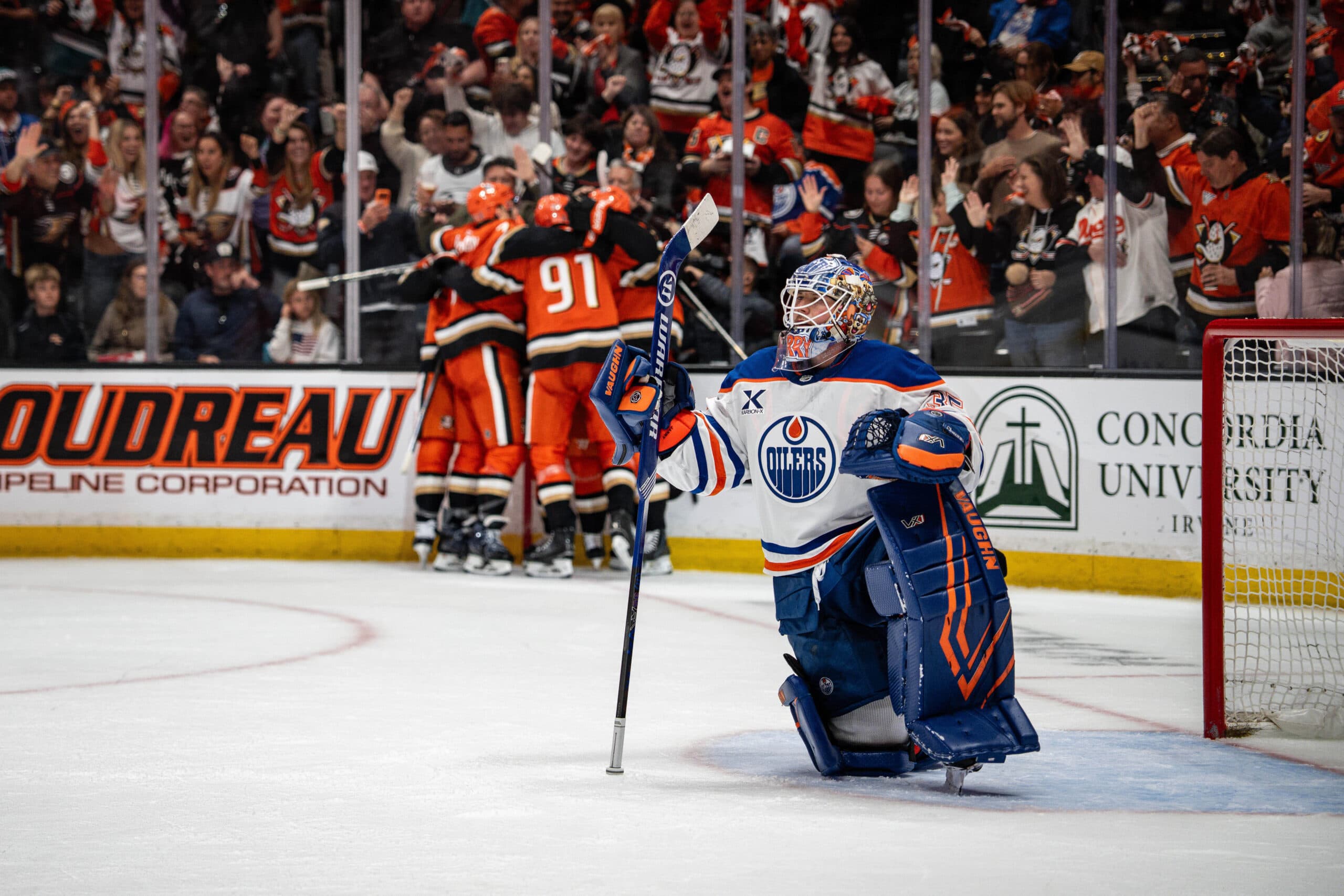
Photo credit: Corinne Votaw-Imagn Images

By Lane Golden
May 3, 2026, 09:00 EDTUpdated: May 4, 2026, 11:58 EDT
The Edmonton Oilers bowed out of the Stanley Cup Playoffs with a whimper this week, setting in motion the most important offseason in franchise history.
After back-to-back defeats in the Stanley Cup Final, the team entered the 2025 offseason in a tough spot. McDavid’s contract was one year from expiring, and Edmonton’s roster was the oldest in the league.
They had to walk a delicate line between retooling for the future and icing a contender, all while navigating limited cap space and a thin prospect pipeline. Replacing key veterans without many internal solutions left management with limited ways to improve the team.
McDavid signed a two-year extension in the fall, which bought the organization more time, but he can’t be happy with how this season went. The Oilers were never the same juggernaut of the Western Conference that they had been in the previous few years. They couldn’t even win the Pacific Division pillow fight.
The big win streaks and dominant runs never came. The underlying numbers never looked as strong. The goaltending never got hot. They were painfully average.
Not all hope is lost, however. Edmonton still has the most star power at the top of their lineup, and this summer, they have the cap space to fill a lot of holes.
On a recent episode of The Sheet, NHL insider David Pagnotta shared his thoughts on their 2026 offseason. “I think the Edmonton Oilers are going to go very bold this summer,” he said. “This summer is as important as ever with respect to the longevity of McDavid’s future in Edmonton.”
Remodelling a group of underperforming depth players can be done quickly with smart, aggressive moves. Look no further than the Colorado Avalanche, who entered last season as a shell of their 2022 Cup-winning team. Just a year and a half later, they won the Presidents’ Trophy and are favourites heading into the second round of the playoffs.
The question isn’t whether it’s possible for the Oilers to extend their window and return to the Final. It’s whether their management group can be trusted to get it done. If they are going to make the right moves, they need to identify the correct priorities. Let’s look at the key areas the Oilers need to focus on if they want to get back into Cup contention next season and beyond.
Make coaching changes
Kris Knoblauch’s time with the Oilers has likely come to an end, and that’s for the best. That may feel harsh for a coach who reached back-to-back Finals, but the underlying trends point in the wrong direction. Edmonton’s even-strength play has declined each year since they fired Jay Woodcroft and replaced him with Knoblauch in the fall of 2023. The more time Knoblauch has had to exert his influence, the less dominant they have become.
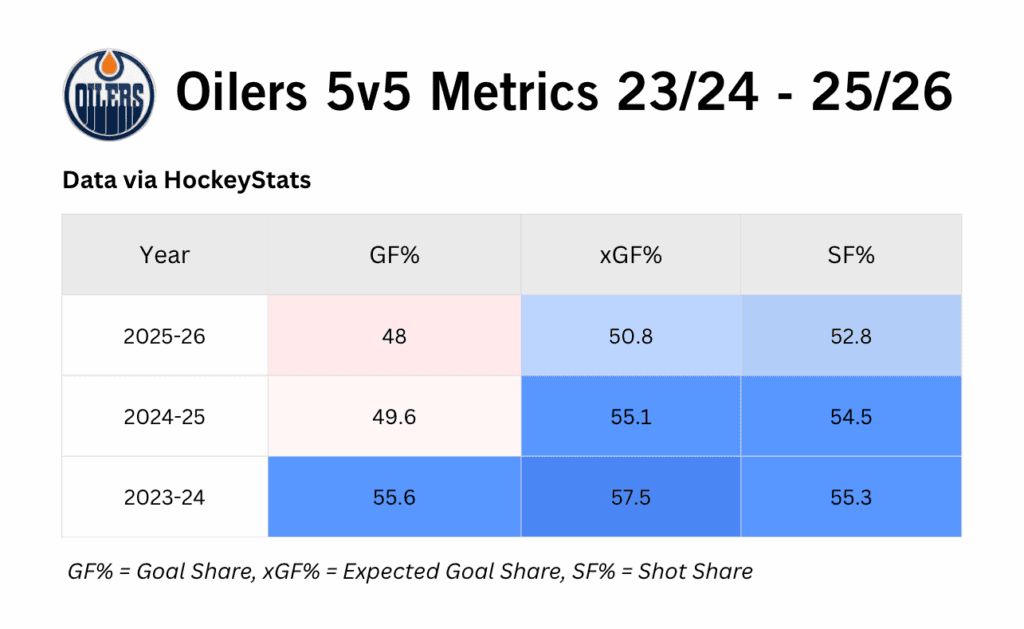
The consistent decline in 5-on-5 possession and scoring chance metrics across Knoblauch’s tenure is far from the only issue. Several recent free agents haven’t delivered their expected value either. Management deserves the bulk of the blame for roster construction, but coaching hasn’t done much to elevate these bets. I want to refer to a passage from an article by OilersNation writer NHL_Sid, published on February 1, discussing why things went wrong for Andrew Mangiapane in Edmonton. He sums up the familiar pattern quite well:
“Jeff Skinner, Viktor Arvidsson, Adam Henrique, and (especially) Trent Frederic have all seen drops in points per hour (at five‑on‑five and across all strengths) compared to their numbers with previous teams. Sure, one could make specific explanations for each player’s decline; Henrique’s age, Arvidsson’s back injury, Frederic’s ankle injuries, and so on. But, can five separate cases really be dismissed as a simple coincidence?”
There was plenty of statistical evidence to suggest most of these acquisitions were good bets. But for one reason or another, they didn’t pan out. It’s hard to ignore Arvidsson’s success with the Boston Bruins this season after Knoblauch often buried him in the bottom six and even healthy scratched him in the playoffs.
Whether it’s the overall decline in team performance, disappointing results from newly acquired players, or a lack of innovation and tactical creativity to solve problems beyond bombing away on point shots, the red flags have piled up enough to justify a change.
Knoblauch isn’t the only member of this staff that the Oilers should look at moving on from. Mark Stuart, who was in charge of the struggling penalty kill, should also be on the hot seat. Despite the banged-up lineup, the Oilers outscored the Anaheim Ducks 17-14 at 5-on-5 during their first-round playoff series. It was their brutal 50% penalty kill that sunk them.
Out of the last 27 Stanley Cup Champions, 24 of them have had a playoff penalty kill success rate of at least 80%. Aside from a hot run in 2024, Stuart has failed to implement an effective system. That, and his unsuccessful run as defensive coach, which lasted less than five months, likely spells the end of his tenure.
There are plenty of interesting coaching candidates out there for the Oilers to explore. Former Vegas Golden Knights head coach Bruce Cassidy is certainly the headliner this summer to watch for.
Trade Darnell Nurse
It’s time for management to have an uncomfortable conversation with Darnell Nurse. The second pairing defenceman still has four years remaining on his bloated contract, and with his performance declining and the team’s desperation rising, the time has come to move on.
Nurse’s underlying metrics have nosedived. He failed to both outscore and outchance the opposition at 5-on-5 for the first time since 2019-20. His impact on the penalty kill, where he led all Oiler defenders in goals against per hour, remained dreadful. With Nurse on the ice, the penalty kill’s rate of goals against increased by 44.5 percent versus when he was off the ice.
If his play-driving and penalty kill woes weren’t a big enough problem, Nurse appears to have also developed a knack for scoring on his own net. According to David Staples, columnist for the Edmonton Journal, he deflected more Grade-A shots on his own net this season than every other Oiler defenceman combined.
In the regular season Nurse deflected on net 14 pucks for Grade A shots against, all other Oilers d-men 13. In the playoffs, it's Nurse three, all other Oilers d-men 3.

Darnell Nurse needed to anticipate, get over and block that Gauther shot with his pads, not reach for it with his stick. 3-1 Ducks on the second deflected in goal from Nurse with series, this one fully his fault.
It’s increasingly difficult to imagine Nurse’s tenure in Edmonton being salvageable. The gap between performance and contract is too crippling for a team in their position not to make a change. He never lived up to the $9.25 million price tag, but right now, it would be generous to say he provides even half that value.
His no-movement clause complicates things, but surely Nurse sees the writing on the wall. His contract switches to a modified no-trade clause in the summer of 2027, and I can’t see a scenario in which the Oilers don’t do everything in their power to move him. If he agrees to waive this offseason, he will have more control over where he goes.
It might take some salary retention or another overpaid player coming back the other way for a Nurse trade to happen, but that’s a cost worth paying.
Address the Goaltending
Poor goaltending has plagued the Oilers organization for the entire McDavid era. Eleven years is long enough.
Early in McDavid’s career, Cam Talbot put together a near-Vezina-level campaign. When his game fell off in subsequent seasons, the team began making bets on a rotating door of goalies who never panned out.
First, it was Mikko Koskinen, whom Peter Chiarelli inexplicably signed to a three-year extension with an AAV of $4.5 million. He was 31 years old with 30 games of NHL experience.
Then it was Mike Smith. He was a decent stopgap, but the aging veteran’s body had begun to break down on him. He had difficulty staying healthy and was prone to cold spells.
“Surely Jack Campbell could be the answer then,” they thought, inking him to a five-year deal worth $5 million per season. He didn’t even last two seasons before being exiled to Bakersfield.
Their young goaltender, Stuart Skinner, was then thrust into a starting role well ahead of schedule. He posted decent underlying metrics in aggregate over three seasons and change with the Oilers. Still, Skinner’s streakiness and annual playoff implosions scared Stan Bowman into making a panic trade midseason for Tristan Jarry—a goaltender with worse numbers than Skinner over a three-year sample. Like Campbell, he played himself out of the league just a year prior.
Jarry had a hot start to the season in Pittsburgh, but after arriving in Edmonton, he posted a disastrous .858 save percentage in 19 starts. His -11 goals saved above expected was 6th worst in the NHL since the trade on December 12.
Connor Ingram, whom the Oilers added for future considerations this fall, was a decent buy-low, but he had a very shaky playoff. He can be a solid 30-35 game goalie for the Oilers, but the same can be said for many of their goalies during the McDavid era. Enough with the tandem goalies and reclamation projects. They need to find a legit starting goaltender.
How can they tackle this? Firstly, they should explore any possible way to move Jarry and his $5.375 million cap hit. Who could they replace him with? Bob Stauffer has hinted at the Oilers targeting a young, high-upside goalie. Top prospect Sebastian Cossa seems like a likely candidate given the Red Wings’ crowded goalie depth chart. The 23-year-old has posted a save percentage above .910 in each of his last three AHL campaigns.
As far as established NHL starting goalies are concerned, the options are limited. There isn’t anyone of note available on the UFA market this summer, so a trade would need to be explored. If they can move off Jarry’s contract, it would be interesting to see them take a stab at Filip Gustavsson out of Minnesota. The Wild already have their franchise goalie of the future in Jesper Wallstedt, making Gustavsson expendable—something worth monitoring.
The bottom line
This season, poor defence, goaltending, coaching decisions, and penalty killing all became significant issues that lowered the Oilers’ ceiling. It’s a long list, but with a small handful of acquisitions and a fresh coaching staff, it’s far from impossible to fix.
The margin for error is so thin, though, that management will have to craft its offseason game plan with extreme care. The decisions the Oilers make over the next few months will be forever remembered as the ones that either saved the McDavid-era Cup window or slammed it shut for good.
ARTICLE PRESENTED BY bet365


Breaking News
- The standouts, the notables, and the disappointing performances from the Oilers’ NextGen game
- Oilers reassign Ryan Cameron, release three tryouts in first camp cuts
- The Day After: Oilers top line shines in win over Flames rookies
- Oilers 2026 Prospect Countdown No. 3: Josh Samanski
- Instant Reaction: Oilers rookies douse Flames in 6-1 win

Edmonton OilersTeam Cap Summary
Cap Summary
2027-28
2028-29
Projected Cap Hit
$88,322,500
$61,025,000
Projected Cap Space
$25,177,500
$61,975,000
Current Cap Space
$25,177,500
$61,975,000
Active Players
16/23
10/23
Draft Picks
Round
'27
'28
1
0
1
2
1
0
3
0
1