
OilersNation has no direct affiliation to the Edmonton Oilers, Oilers Entertainment Group, NHL, or NHLPA
How Ryan Shea will reshape the Edmonton Oilers’ blue line

Photo credit: © Charles LeClaire-Imagn Images

This year’s NHL Free Agency day was a busy one for the Edmonton Oilers, as it saw the team significantly restructure the outline of their back end.
The first major move was finally parting ways with Darnell Nurse’s nine-million-dollar contract, trading his full cap hit to the San Jose Sharks in exchange for 24-year-old defenceman Shakir Mukhamadullin and defensive prospect Zack Sharp. Shortly after, the Oilers used a substantial portion of the cap space freed from the Nurse trade to sign free agent defenceman Ryan Shea to a five‑year contract carrying a four‑million‑dollar AAV. This article will focus on Shea and what he may bring to Edmonton.
Shea has had a rather unique career. The 29-year-old left-shot defenseman from Milton, Mass., was drafted by current Oilers GM Stan Bowman in Chicago in the fourth round of the 2015 NHL Draft. He spent four consecutive seasons from 2016 to 2020 playing college hockey with Northeastern University in the NCAA. Following his tenure with Northeastern, Shea signed with the Dallas Stars as a free agent, spending the next three years with Dallas’ AHL affiliate with the Texas Stars.
Shea would then sign a contract with the Pittsburgh Penguins on July 1, 2023 – exactly three years ago from yesterday – and his first NHL stint would come in the 2023-24 season at the age of 26. His breakout season came in 2025-26 at the age of 29, as he averaged top-four minutes for the Penguins, produced 35 points, and even led the team with a +22 on-ice goal differential at even strength.
So, what type of player is Ryan Shea? Where does he fit in Edmonton’s lineup? And can he realistically represent an upgrade over Darnell Nurse? This piece will attempt to answer those questions and more.
What do the analytics say about Shea’s puck-moving ability?
Firstly, Shea’s most notable attribute is his ability to exit the defensive zone with possession and control.
The primary public source for defensive zone exit data is Corey Sznajder’s microstat tracking project at AllThreeZones, which I highly recommend checking out. Here is what Sznajder’s metrics have to say about Shea’s ability to move the puck out of his own end over the past two seasons:
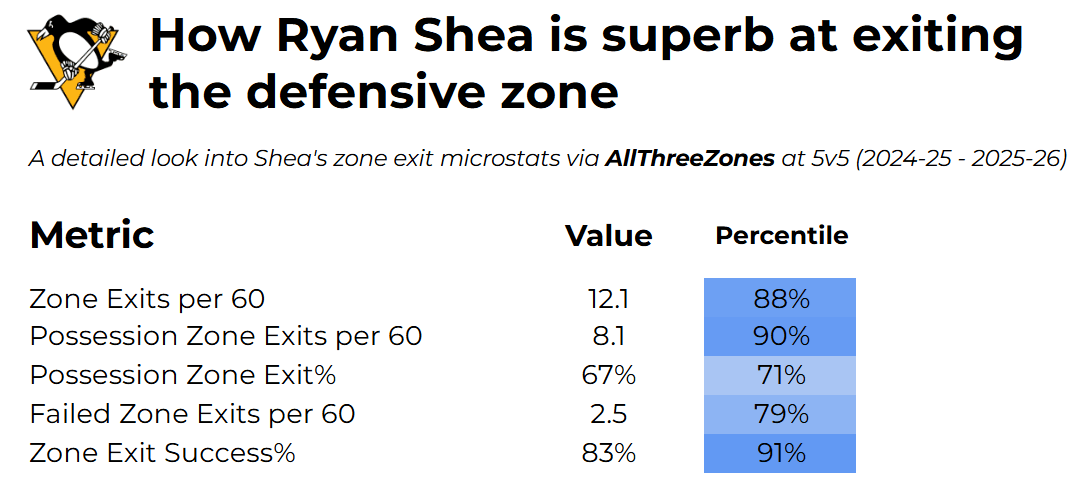
Shea has averaged 12.1 zone exits per 60 over the past two seasons, ranking in the 88th percentile. In simpler terms, this means that his exit volume rate ranks superior to 88 percent of NHL defencemen.
Furthermore, 67 percent of his exits have been with possession, as he averages a total of 8.1 exits with possession per 60, ranking at an even better 90th percentile. It’s worth noting that he ranks ahead of several well‑known, puck‑moving defencemen in this area, including Josh Morrissey and Thomas Chabot.
In addition to his ability to exit the zone with control, he does an excellent job of limiting turnovers. Shea has averaged just 2.5 failed exits per hour, and his zone exit success rate is an excellent 83 percent, ranking at a superb 91st percentile. This is not a defenceman who defaults to glass‑and‑out when attempting to get the puck out of his zone; he consistently carries or passes the puck out with control and success.
Sznajder’s data aligns with a glimpse of proprietary data from SportLogIQ – a private analytics provider used by many NHL teams – referenced from this piece by Sportsnet. SportLogIQ’s numbers show that Shea’s completion rate on outlet passes ranked 32nd among 200 defencemen with a minimum of 40 games played, and his turnover rate ranked 29th. Very, very good.
Let’s go over two video examples that illustrate these strengths.
This sequence begins with Shea breaking up a play in the defensive zone with his stick. Moments later, he makes a clean breakout pass off the boards to Ben Kindel, who springs Anthony Mantha for a breakaway goal. Shea earns the secondary assist. It’s a strong five‑man effort overall, but Shea’s defensive stick and composed outlet pass initiate the play.
Here’s another example. Following a retrieval by Kris Letang, Shea delivers a well‑timed stretch pass under forecheck pressure that leads directly to a breakout goal for Ben Kindel. Shea records the primary assist.
Now, this is not a very flashy player. Don’t expect many Makar-esque highlight reel plays from him. Instead, Shea is a defenceman that is very good at making subtle, simple, but highly effective breakout passes under pressure, the kinds of touches that consistently tilt the ice in a team’s favour. He is much better in this facet than Nurse ever was, who, contrastingly, ranks in the 47th percentile in possession exits.
How does Shea impact the Edmonton Oilers’ penalty kill?
It is no secret that Edmonton’s penalty kill has been quite disappointing over the past two seasons. In the past two regular-seasons, their goals-against per 60 rate on the PK ranks 19th and 23rd, respectively, among all teams.
It has been even worse in the postseason, ranking 14th out of 16 teams in the 2025 playoffs, and dead last in the 2026 playoffs which saw the team get eliminated in the first round by Anaheim. The Ducks scored a whopping eight goals on the power play in just less than 23 minutes against the Oilers in that series! It’s a big reason why Edmonton ultimately made a coaching change, not only firing head coach Kris Knoblauch but also relieving PK coach Mark Stuart of his duties.
Fortunately, this is an area where Shea may be able to provide immense value.
We’ll use EvolvingHockey’s SHD (Short-Handed Defence) model to measure Shea’s PK ability here, which attempts to isolate a player’s impact on suppressing PK scoring chances by using ridge regression to account for external factors such as quality of teammates, quality of competition, zone starts, and more. It is far from a flawless model, but I find it quite useful when interpreted correctly. Here are the model’s outputs in each of Shea’s three NHL seasons and where they rank in terms of percentiles:
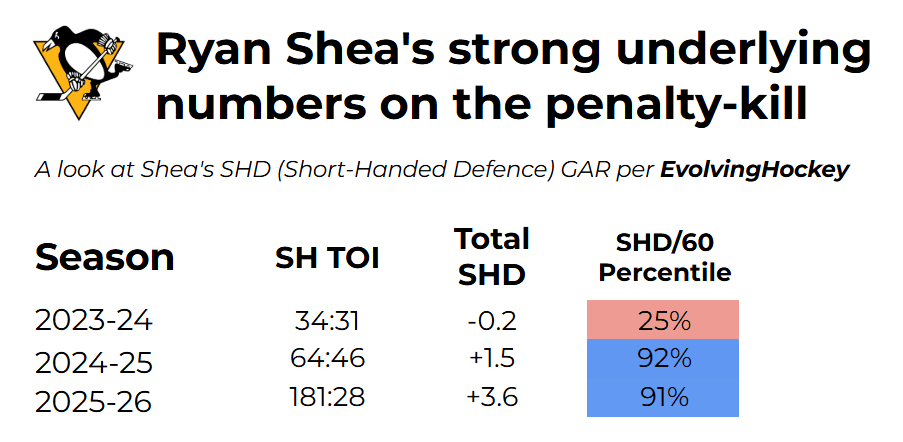
Shea did not play very much on the PK in 2023-24, with only about 34 minutes. But his TOI considerably increased in 2024-25, and so did his results. His total SHD was +1.5, very impressive for just about 64 minutes as his SHD/60 ranked in the 92nd percentile.
In 2025-26, his PK workload increased significantly. He and Parker Wotherspoon led the Penguins in PK TOI, averaging well over 2 minutes per game shorthanded, and Shea flourished in this increased capacity. His total SHD was +3.6, ranking third best among all NHL defencemen, and his SHD/60 remained at an elite 91st percentile. These are tremendous results.
Now, for what it’s worth, EvolvingHockey’s SHD model is primarily built on expected goals against rather than actual goals. The reason for this is to separate a player’s results from their goaltending, so good defenders with bad goaltending are not unfairly penalized and vice versa. However, because public xG models are less precise on the PK than private team‑level models, these results should be interpreted with some caution.
Nevertheless, the fact that Shea’s xGoal results are elite to this degree, combined with his excellent raw shot-attempt suppression and words of praise from his coaches on his PK ability, suggest that this is a genuinely strong penalty killer.
For this article, I also went back and watched some of Shea’s PK shifts myself throughout two of his games in March. One thing I immediately noticed is how strong he is at using his stick and reach to disrupt passing lanes. While public blocked‑pass data isn’t available, I would presume that he could rank quite well in this area.
Here is one notable example:
Midway through a Buffalo power play, Shea breaks up a pass attempt from Josh Norris with strong positioning and an active stick. He then subtly lifts Josh Doan’s stick, allowing his teammate to retrieve the puck cleanly. The sequence eventually leads to a shorthanded rush and a Bryan Rust goal. Shea doesn’t record a point, but the play doesn’t happen without his read and disruption.
It’s worth noting that this was part of an excellent PK performance overall. Shea logged over six shorthanded minutes in that game against Buffalo, allowed just five shots against in those minutes, and was not on the ice for a single goal against. He also spent a full minute defending a 5‑on‑3.
All‑in‑all, there is substantial evidence that Shea should, at minimum, provide a clear upgrade on the penalty-kill for Edmonton compared to Nurse, whose SHD has ranked fourth‑worst among all defencemen over the past two seasons.
Can Shea stabilize the Oilers’ even-strength defence?
We’ve discussed Shea’s defensive zone breakout abilities with the puck and his penalty-killing defence in great detail. But what about his even-strength defence?
Let’s use EvolvingHockey’s model again, this time using their EVD (Even-Strength Defence) model to measure Shea’s defending at even-strength:
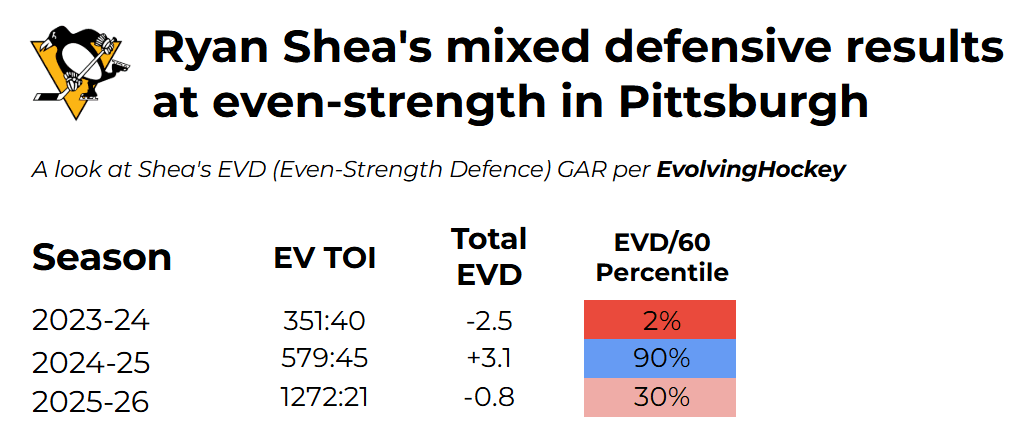
In 2025-26, Shea was promoted to top-four minutes for most of the season, ranking fourth on the team in TOI against elite competition per PuckIQ, and his defensive results were in the 30th percentile; certainly not as poor as his first season, but not nearly as strong as his results from 2024-25 in a third-pair environment. Overall, it’s a mixed profile.
Let’s dive a bit deeper and describe Shea’s defensive game in more specific detail. First, Shea’s defensive strengths seem to lie in-zone. Beyond his ability to exit cleanly and limit turnovers, he also excels at breaking up plays and retrieving pucks under pressure. Here are his defensive zone retrieval microstats per AllThreeZones:
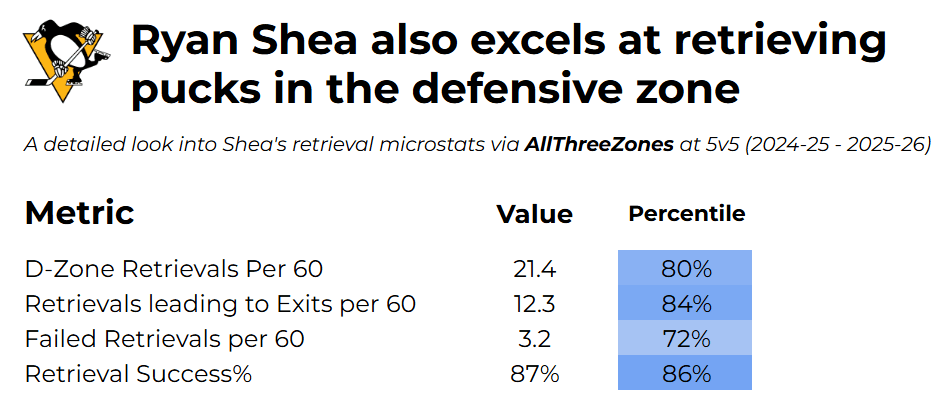
Shea has averaged over 21 successful retrievals per 60 in the defensive zone over the past two seasons at 5-on-5, ranking in the 80th percentile. Over 12 of them per 60 have led to zone exits, ranking at the 84th percentile, and his success rate at retrieving pucks without turning them over is at even better 86th percentile. So clearly, Shea is a highly effective and reliable player with the puck on his stick in the defensive zone.
However, Shea’s defending in transition is not so good. Here is a look at how Shea has defended controlled zone entries and rush chances:
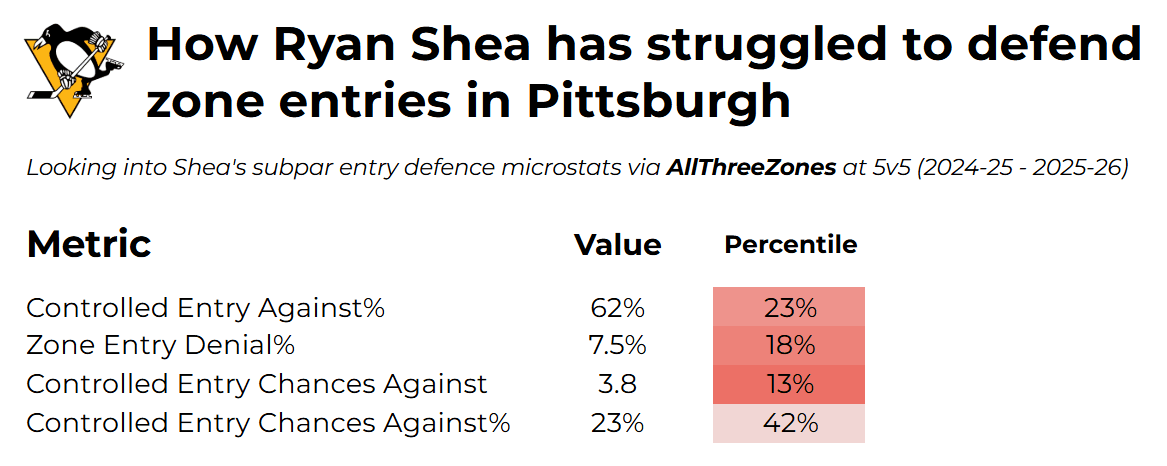
Against the average NHL defenceman, opponents will gain the zone with control roughly 57% of the time. Against Shea, that number rises to 62%, placing him in the 23rd percentile. His entry‑denial rate is 7.5%, compared to a league average of ~10%, ranking in the 18th percentile.
What this means is that Shea has not done a very effective job of preventing controlled zone entries, as opposing forwards have generally found it easier to gain the zone against him compared to Pittsburgh’s other defencemen. From the shifts I reviewed, Shea’s issue appears less about getting caught too high or beaten cleanly off the rush on goals against, and more about playing with overly passive gap control at the blue line.
As a result, he has allowed over 3.8 quality scoring chances per 60 off controlled entries, ranking in the lowly 13th percentile among NHL defencemen.
Now, in fairness, Shea is slightly better in this area than Nurse, who ranked in the 2nd percentile in that metric in 2025-26, but that’s not exactly a high bar. The fact remains that neither of them are strong rush defenders.
This unfortunately does pose some stylistic concerns in terms of his fit on the left side. Mattias Ekholm is a strong rush defender, but as he enters his late 30s, he may see a decline in his foot speed and thus his ability to limit entries. As for Jake Walman, rush defending has been a consistent weakness for much of his career. As such, this could be a team that may still have struggles at defending dynamic rush teams like Colorado in the playoffs.
With all of this considered, it is difficult to precisely project how strong Shea’s even‑strength defensive results will be in Edmonton. The coaching staff will need to utilize him in a role that makes the most of his zone exit and retrieval abilities while limiting his minutes against the best rush players, leaving those tough assignments for Evan Bouchard’s pair.
Were Shea’s box score totals in 2025-26 season a fluke?
When the Shea signing was announced, I assume many Oiler fans took a glance at his NHL dot com profile and were very impressed. This is a defenceman with 35 points and a +30 plus/minus rating in 2025-26. That seems outstanding at raw glance, and just what this team needed! However, are these results sustainable?
The first potential red flag is Shea’s career trajectory. Before 2025‑26, he had recorded just six NHL points, then suddenly jumped to 35 in his age‑29 season. There have been cases of late‑blooming defencemen — Mark Giordano is a notable example, establishing himself as a top‑tier defender only in his early 30s — so Shea’s breakout isn’t impossible to believe. Still, it does warrant caution.
The larger concern for me are Shea’s on‑ice percentages, particularly his PDO. PDO combines a player’s on‑ice shooting percentage and save percentage, and is commonly used as a proxy for puck luck. The league average is 1.00. For most players, a PDO around 1.02-1.03+ indicates significantly good fortune, while a PDO around 0.98 or lower suggests the opposite. Only a very small group of elite players consistently maintain PDOs far from 1.00 over multiple seasons.
Here are Shea’s 5‑on‑5 on‑ice percentages:
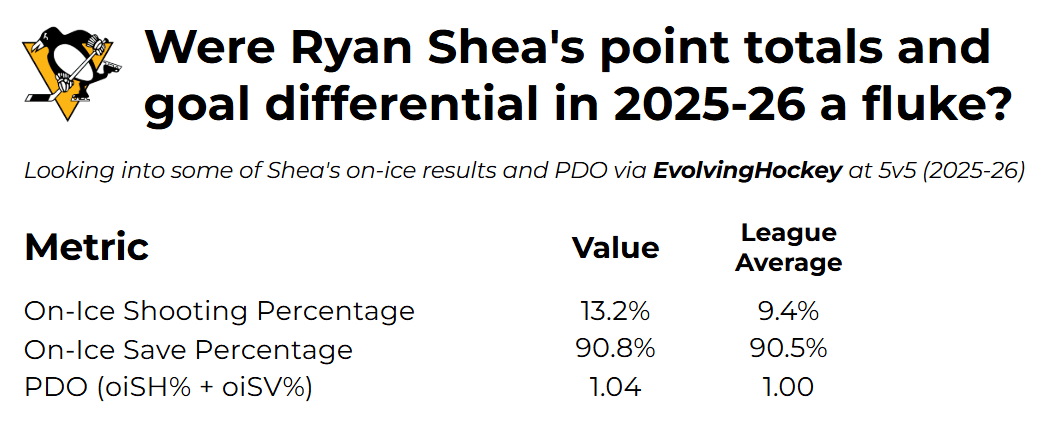
Shea had a PDO of about 1.04 in 2025-26, ranking 7th in the league. Specifically, what stands out is his on-ice shooting percentage of 13.2% here, well above the league average of 9.4%.
13% is extremely high for a defenceman. For context, neither Cale Makar nor Quinn Hughes has ever posted an on‑ice shooting percentage above 12.5% in any season in their careers, and no defenceman in the public analytics era (i.e. post-2007) has sustained an on‑ice SH% above 13% across two consecutive seasons with 20+ games played. EvolvingHockey projects that Shea was on-ice for about 66 expected goals, but 77 actual goals.
It is therefore very fair to say Shea benefited from a significant degree of offensive puck luck in 2025‑26. It is extremely unlikely he repeats a +30 rating or sustains his 1.56 points per 60 scoring rate (11th among NHL defencemen, ahead of the likes of Quinn Hughes and Erik Karlsson).
With all of that being said, this shouldn’t imply Shea didn’t perform well last season, as he absolutely did. His underlying offensive impacts remained strong, with EvolvingHockey projecting his impact on generating expected goals at the 83rd percentile. His transitional microstats have also been strong in each of the past two seasons, suggesting that 2025-26 wasn’t merely a one-off. Overall, his relative expected goal differential ranked higher than his (former) teammate in Erik Karlsson.
So, two things can be true at once:
- Shea’s 2025‑26 box‑score totals are not sustainable.
- Shea remains an effective defenceman who should produce a reasonable number of points and a comfortably positive goal differential in 2026‑27.
Where does Shea fit on Edmonton’s roster at 5-on-5?
There are arguments to be made for Shea to play on any one of Edmonton’s three defensive pairs.
At the moment, the most likely scenario is that Shea begins the season on the third pair, assuming Mattias Ekholm remains the 1LD next to Evan Bouchard and Jake Walman slots in as 2LD. Walman struggled through injuries in 2025‑26, but he performed very well in that role during the 2025 playoffs.
This results in a highly dynamic defensive core, as you would now have a strong puck-mover on each of the three pairs (Bouchard, Walman, Shea). Playing Shea at 3LD could also be significantly beneficial for the bottom-six, as the group would consistently play with a defenceman that is borderline elite at getting them the puck out of the defensive zone.
There is also a case for Shea as the 2LD, playing top‑four minutes as he did in Pittsburgh last season. In that scenario, he would likely pair with Connor Murphy, whose defensive abilities would benefit Shea and potentially limit his rush defence concerns.
In a way, Shea also serves as insurance for Walman. Historically, Walman has a strong track record of top-four play, but he was Edmonton’s weakest defender in 2025-26 and has a concerning injury history. In the scenario that Walman is injured again or does not bounce back, I can absolutely see Shea stepping in and performing as an effective 2LD.
There may even be a case to play Shea on the top pair with Evan Bouchard. Shea struggles at rush defending, but he is reliable in‑zone and excellent at retrieving pucks. Bouchard is quite good at rush defending, much better than given credit for, but he can struggle without the puck in his own zone, and he performs best with a partner that can retrieve pucks for him to break out, hence his fantastic chemistry with Ekholm. In theory, Shea and Bouchard could complement each other’s weaknesses and form a balanced pairing, allowing the Oilers to have the option of using Ekholm with Murphy in a shutdown role, or simply limiting Ekholm’s minutes down the stretch as he nears 37.
Shea is also quite versatile, as he played significant time on the right side in Pittsburgh. Perhaps the Oilers could try pairs of Ekholm – Shea or Walman – Shea if they ever desire.
All things considered, I like this addition by the Oilers. Shea does have some flaws, particularly in terms of defending the rush, and his 2025‑26 box‑score totals were inflated by puck luck, but he remains an effective defenceman who can play top‑four minutes, move the puck with control, retrieve pucks with efficiency in his own end, and effectively kill penalties. I am quite confident that he will be an upgrade on Darnell Nurse in Edmonton.
Find me on Twitter (@NHL_Sid)
PRESENTED BY LeaseBusters

LeaseBusters is Canada’s premier lease takeover marketplace, helping drivers get out of their current vehicle leases without costly penalties or negative equity. Instead of paying thousands to break a lease, sellers connect with qualified buyers ready to take it over—saving money and avoiding financial stress. Buyers benefit from shorter-term commitments and often better monthly payments, while dealerships retain a replacement customer and leasing companies keep contracts active. It’s a smarter, more efficient solution for everyone involved. Four parties, four wins—only with LeaseBusters. For more information, check out www.LeaseBusters.com.


Breaking News
- ‘I lost who I was’: Trent Frederic opens up about tough Oilers season
- Oilersnation Radio: Let’s talk about Daily Faceoff Edmonton
- 31 Oilers Questions: Is winning a Stanley Cup the only way McDavid will re-sign?
- Oilers building goaltending pipeline with Emil Vinni signing
- Former Oilers forward Jeff Skinner signs in Switzerland with EHC Biel-Bienne

Edmonton OilersTeam Cap Summary

Cap Summary
2026-27
2027-28
Projected Cap Hit
$99,274,166
$87,350,000
Projected Cap Space
$4,725,834
$26,150,000
Current Cap Space
$4,725,834
$26,150,000
Active Players
23/23
15/23
Draft Picks
Round
'26
'27
1
0
0
2
1
1
3
1
0