
OilersNation has no direct affiliation to the Edmonton Oilers, Oilers Entertainment Group, NHL, or NHLPA
What does a shutdown third line around Jason Dickinson look like?
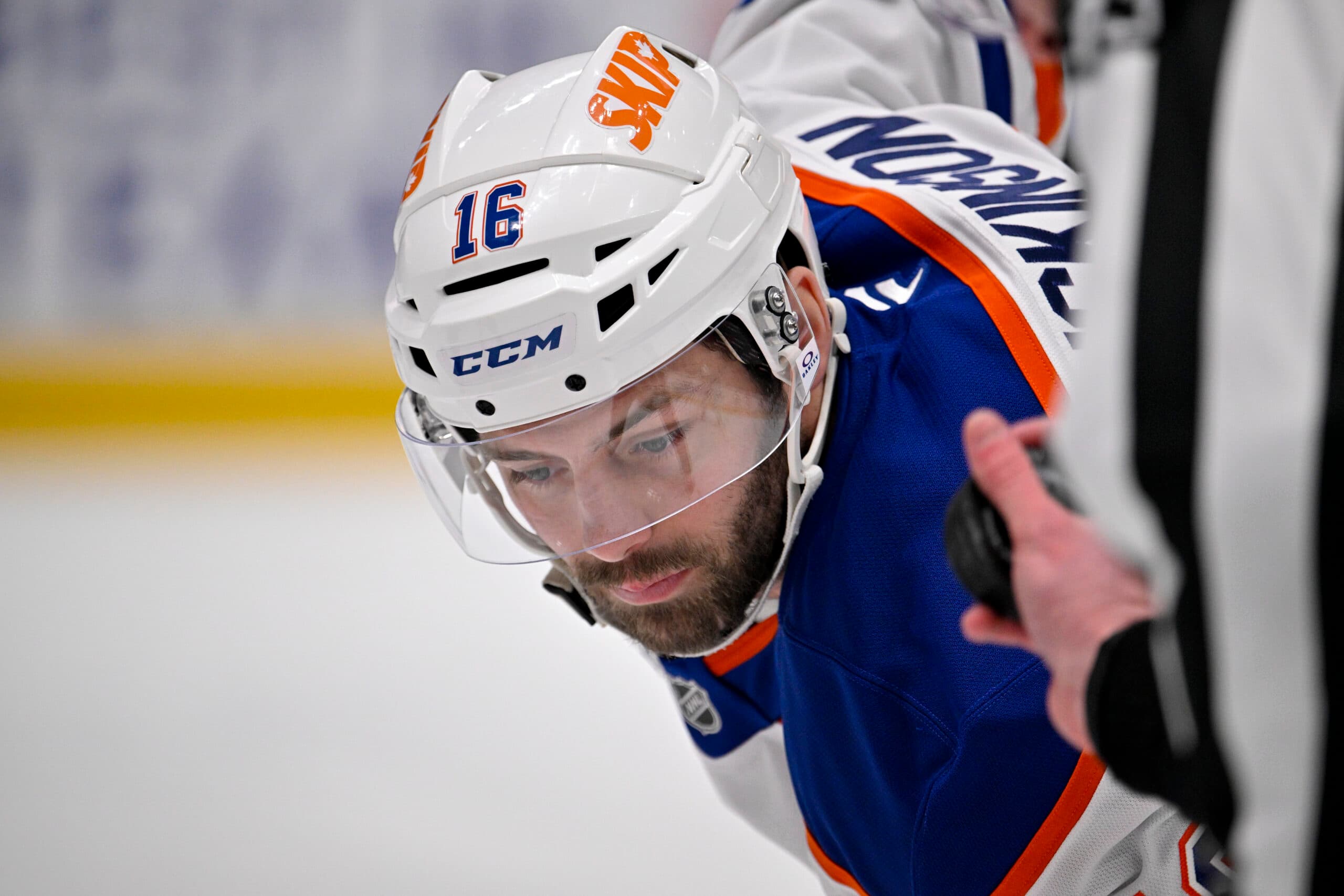
Photo credit: © Jerome Miron-Imagn Images

Recent Stanley Cup champions have shown how much value an elite third line can provide.
The 2026 Carolina Hurricanes’ cup run was driven in large part by captain Jordan Staal’s exceptional performance on the third line, which earned him the Conn Smythe. The year before, the 2025 Florida Panthers were another remarkably deep team that benefited greatly from Brad Marchand’s presence on their third line, where he recorded 20 points in 23 playoff games en route to Florida’s second consecutive Cup.
For the Edmonton Oilers, they have spent much of the Connor McDavid and Leon Draisaitl era searching for a reliable third-line centre, and that lack of success is a key reason for the team’s bottom-six struggles, particularly in 2025-26. Without their two superstars on the ice, the Oilers were brutally out-scored 86 to 55 at five-on-five this past season.
But this summer, it seems that the Oilers have finally made a long-term commitment to filling that hole at 3C. After acquiring him at the 2026 Trade Deadline, the Oilers signed centre Jason Dickinson to a five-year contract carrying an average annual value of $4 million on June 21.
It is evident that the Oilers are aiming for a defensive matchup line behind McDavid and Draisaitl. Dickinson’s main calling card is his ability to play extremely tough minutes and put up top-notch defensive results. But what exactly could this look like in practice? Who should be Dickinson’s wingers on the optimal third line, and what sort of impact can the trio make? These are the questions this piece will attempt to answer.
First, we will discuss Dickinson as a player. Take a look at some of his defensive and deployment numbers below.
What do Jason Dickinson’s defensive metrics look like?
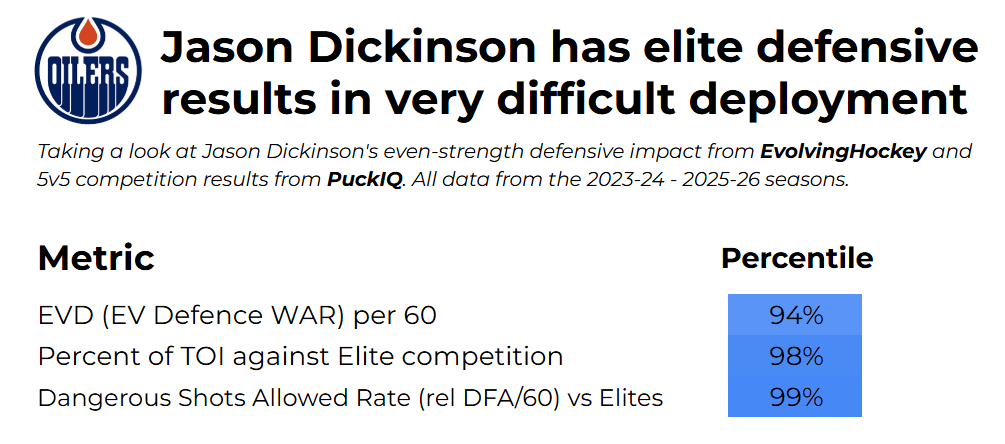
Over the past three seasons, Dickinson has earned a lot of trust from his coaches, playing about 41 per cent of his five-on-five minutes against elite competition. That ranks ninth among all forwards. In 2025-26 alone, that number is at 48.4 per cent, meaning Dickinson spent nearly half of his minutes matched up against the best of the best.
That level of usage isn’t by accident either. Dickinson has rightfully earned it, ranking second among all forwards in suppressing dangerous shots from elite competition (relative to team).
Overall, Evolving-Hockey’s WAR model places his even-strength defensive impact in the 94th percentile among NHL forwards. Those are exceptional results, and it is easy to see why Edmonton’s management values him so highly.
With that in mind, there is one key question that I have about Dickinson: Can he drive a third line to a goal differential over 50 per cent?
For Edmonton, that benchmark has seemed impossible to hit. Only twice have the Oilers’ depth forwards produced a positive goal share over a full season. Meanwhile, every Cup winner in the last decade has enjoyed a net‑positive goal differential without its top two centres on the ice.
Out‑scoring opponents without your best players has become a defining trait of championship teams, which makes Dickinson’s ability to push the needle at 3C a pivotal question.
Let’s use EvolvingHockey’s RAPM model to help answer this question, a model that attempts to estimate how much a player impacts their team’s goal and scoring‑chance differential.
Essentially, it takes a player’s on-ice results and tries to strip away external factors – such as quality of teammates, quality of competition, zone starts, and more – to get a clearer picture of their individual impact. This process is not perfect, but it’s far more informative than looking at raw on‑ice results for someone like Dickinson, who spent the past few seasons on a struggling Chicago team.
So, here is how the model has measured Dickinson’s impacts over each of the past five seasons:
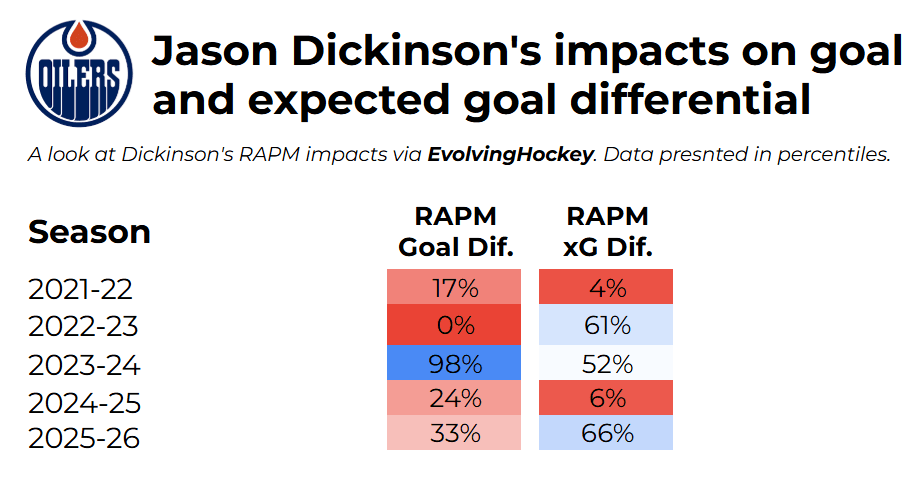
Fortunately, the expected differential impacts do give some hope. Aside from a poor 2024-25 season, Dickinson’s impact on driving quality scoring chances has been net-positive in three of the past four seasons. This suggests that Dickinson’s goal share in Chicago was significantly brought down by poor goaltending and subpar linemate finishing.
Still, the picture is mixed. Right now, it is difficult to say with confidence that Dickinson will drive a net‑positive goal share as Edmonton’s 3C next season. And, that is primarily because of his lacklustre offensive output.
Now, I understand that many fans are not expecting much offence from a shutdown 3C making non-superstar money, and obviously so. With Dickinson putting up elite defensive results against the league’s top scorers, you certainly don’t need something like 30 goals and 60 points from him to drive a net-positive third line.
But it’s one thing for a defensive player to, justifiably, have lower offensive expectations, and it’s another to generate so little that you still get out-scored. And the concern here is that the Oilers have committed a five-year contract to a 30-year-old player who has yet to prove he can consistently out-score opponents. One-dimensional lines – whether they’re all offence or all defence – are simply not ideal.
Furthermore, I believe depth scoring remains important.
In 2025-26, the Oilers’ bottom-six averaged just 1.7 goals per hour, far lower than their rate of 2.4 from just four seasons ago. There is no doubt a shutdown line can be valuable, particularly in playoff matchup situations, but relying exclusively on McDavid and Draisaitl for offence is just not a strategy I am a fan of, and it is certainly not one that has worked in the past.
To ice a truly effective contender-worthy third line, I believe there should be some minimum level of offence. The perfect third line for this team is one that can effectively play against opposition top lines and shut down chances, while still being able to move the puck and generate chances off the forecheck/cycle at a decent rate. So, what does that look like?
Let’s talk about Dickinson’s offensive limitations in a bit more detail. Now, I don’t think Dickinson has zero offensive ability. He has scored 30 points twice in his career, and interestingly, his individual finishing efficiency is quite solid (73rd percentile). The problem, however, is that he doesn’t spend enough time in the offensive zone and nor does he create much through passing. He is mediocre at entering the offensive zone with control, and is quite poor at generating shots off the cycle or forecheck, especially more dangerous chances.
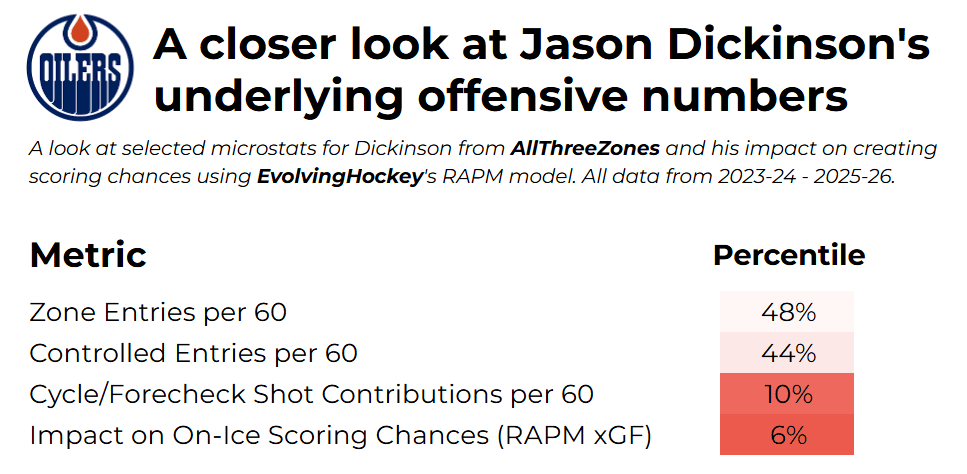
Thus, I believe Dickinson needs wingers who can help carry the puck up the ice and sustain pressure in the offensive zone, while still being defensively responsible enough to play on a shutdown line. That may sound like a very specific set of criteria, but the Oilers do have realistic options who fit this profile.
Who fits on Jason Dickinson’s wing?
I think the most obvious winger for Dickinson is Ryan Nugent-Hopkins. I wrote an article about Nugent-Hopkins back in May, but the short version is that his five-on-five production is not adequate anymore for a top‑six player.
However, there are strong indicators he could thrive on a third line. Nugent‑Hopkins remains excellent on the cycle, has a long track record of offensive contribution, plenty of experience against elite competition, and is responsible defensively, particularly on the backcheck and in his own zone. I believe he can help Dickinson anchor a much more well-rounded two-way line.
That leaves the question of who should play 3RW. Ideally, this winger should be able to forecheck and help tilt the ice in Dickinson’s favour.
Mathieu Joseph stands out as a particularly strong fit for this line. I also wrote an article about Joseph last week, so I won’t go into the same level of detail here, but to summarize, Joseph brings excellent defensive results driven by his speed, clean defensive‑zone exits, and relentless forechecking.
He even has a positive goal differential against elite competition over the past three seasons. Though his most recent stint with the LA Kings was rather underwhelming, I think there is a player here. On paper, Joseph looks like a stylistic match, and I would say he deserves at least a 10-15 game run to see what he can do.
Vasily Podkolzin also offers traits that could work well on Dickinson’s wing. His agility and forechecking fit the mold of what this line needs. However, he has developed outstanding chemistry with Leon Draisaitl on the second line, which I argue is too good to break up. Given how well that duo has clicked, I would keep Podkolzin in the top-six rather than using him in a shutdown role.
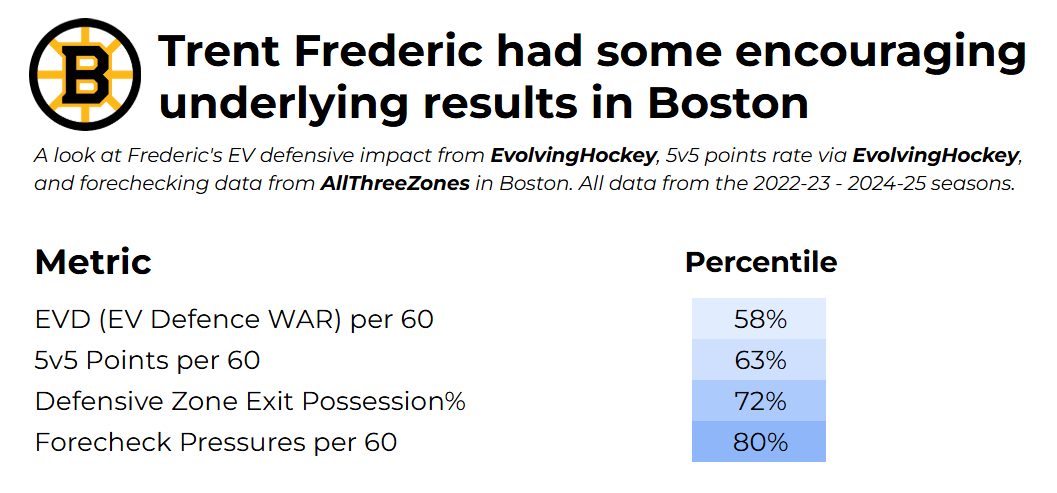
During his time in Boston, Frederic generally posted net‑positive defensive impacts, excelling at exiting the zone with possession and applying forecheck pressure. He also produced 1.76 points per 60 at 5‑on‑5, which is actually low-end second line scoring. That’s a rate that ranked ahead of the likes of Brad Marchand, Tomas Hertl, and Nugent‑Hopkins! Frederic absolutely warrants an extended look as a potential 3RW if he can bounce back.
Matt Savoie brings effective forechecking, strong work ethic, and great offensive skill. He isn’t my first choice for this line, as I would argue he should be playing alongside McDavid or Draisaitl instead, but he does have traits that could make him part of an effective two‑way third line if needed.
Kasperi Kapanen is a solid forechecker, but I am not convinced he fits this line. His defensive results are inconsistent, and away from Draisaitl he has posted an awful 36 per cent goal share and 46 per cent expected‑goal share. While Kapanen has shown legit chemistry next to Draisaitl, I have major doubts about his ability to be effective on a shutdown line without him unless that consistency improves.
Isaac Howard should also not be on Dickinson’s wing. Good scoring potential, but I don’t believe he will be strong enough away from the puck next season to justify that type of usage.
Josh Samanski is a smart defensive player and could complement Dickinson in that regard. However, Dickinson, Nugent‑Hopkins, and Samanski have all primarily played centre or left wing throughout their careers, meaning one of them would need to shift to their off‑wing in this configuration. Because of that, it seems more likely Samanski will compete for a fourth line role instead. Still, if the Oilers decide to move Nugent‑Hopkins back into the top six, I could see Samanski fitting at 3LW, though offence remains a concern.
Hyman and Nugent-Hopkins could be ideal
Zach Hyman is a very intriguing option.
Stan Bowman has mentioned that the Oilers are looking to add another forward, and they still have cap space to make a decently big splash. If Edmonton were to bring in a top‑six winger for McDavid, it could open the door for Hyman to slide onto the third line. Though Hyman isn’t exactly a defensive stalwart, he is elite at sustaining offensive‑zone possession through puck protection skill and tenacity. A third line of RNH – Dickinson – Hyman is one I would be fully confident deploying against top competition on a nightly basis and producing strong two‑way results.
All things considered, Edmonton’s coaching staff has a range of options to explore. My preferred look on opening night would be Dickinson centering Nugent‑Hopkins and one of Joseph or Frederic. But, the Oilers should be willing to experiment throughout the season, testing different combinations to see what works and what doesn’t before the playoffs begin.
Ultimately, Dickinson’s ability to thrive at 3C will hinge on deployment and linemates. His defensive impact is undeniable, but the Oilers need to surround him with wingers who can elevate the two‑way effectiveness of his line. If Edmonton finds the right mix, they could finally ice a third line capable of winning its minutes, something that has been missing for most of the McDavid and Draisaitl era.
Find me on Twitter (@NHL_Sid)
SIGN UP NOW FOR THE NATION GOLF TOURNAMENT

The Nation Golf Tournament driven by GMC is back Friday, August 28, 2026! Which means it’s once again socially acceptable to skip work on a Friday for “networking.” Join us on Friday, August 28, 2026, at Mill Woods Golf Course for an 18-hole Texas scramble shotgun start, questionable swing decisions, and enough chirping to last the entire offseason. Grab your squad and sign up now at nationexperiences.ca before it sells out!


Breaking News
- Oilersnation celebrates 2026 Battle of the Donairs winner Famous Donair
- Bowman: Oilers unlikely to offer professional tryouts
- ‘Offensive player or bust’: Steven Ellis breaks down Isaac Howard’s drop off Daily Faceoff’s prospect list
- Oilers’ McDavid remains on top in The Athletic’s annual NHL player tiers
- Will Connor McDavid surpass Mario Lemieux’s best decade in NHL history?

Edmonton OilersTeam Cap Summary
Cap Summary
2026-27
2027-28
Projected Cap Hit
$102,071,666
$88,322,500
Projected Cap Space
$1,928,334
$25,177,500
Current Cap Space
$1,928,334
$25,177,500
Active Players
22/23
16/23
Draft Picks
Round
'26
'27
1
0
0
2
1
1
3
1
0