
OilersNation has no direct affiliation to the Edmonton Oilers, Oilers Entertainment Group, NHL, or NHLPA
Should Kasperi Kapanen be Leon Draisaitl’s go-to right-winger?

Photo credit: Perry Nelson-Imagn Images

Though the Edmonton Oilers had a disappointing exit in the 2026 playoffs at the hands of the Anaheim Ducks, one clear bright spot was the performance of their second line.
The trio of Leon Draisaitl, Vasily Podkolzin and Kasperi Kapanen was excellent. Across Edmonton’s six games against Anaheim, the line produced six goals and didn’t allow a single goal against at 5‑on‑5.
Kapanen’s performance is particularly notable. He finished with four goals and two assists in Edmonton’s six playoff games, tying Connor McDavid with 6 points. This is not the first time he has been an impactful playoff performer for the Oilers either; in the 2025 postseason, he scored the series‑winning overtime goal against the Vegas Golden Knights in Game 5 of the second round.
Overall, he finished the 2025 playoffs with a solid six points and an excellent 61 per cent 5‑on‑5 goal share across 12 games. This certainly raises the question of whether he should be a regular, long‑term fixture on Draisaitl’s wing.
However, Kapanen is not exactly a de facto top-six winger. He has reached the 20‑goal, 40‑point threshold only once – back in 2018‑19 – and he was placed on waivers less than two years ago. He has mightily struggled with consistency throughout his career. It is very reasonable to argue that an aspiring Cup contender like the Oilers should be aiming much higher for a top-six winger.
Given their chemistry together, I believe Vasily Podkolzin should be a lock on Draisaitl’s wing on the second line. The real question is who should occupy the other wing. Is Kasperi Kapanen the right fit for that spot in 2026-27? Let’s take a closer look.
How strong are Draisaitl’s results with Kapanen?
Let’s dive deeper into Draisaitl’s results with Kapanen. First, here are the results of the Podkolzin – Draisaitl – Kapanen line over each of the past two regular and post-seasons:
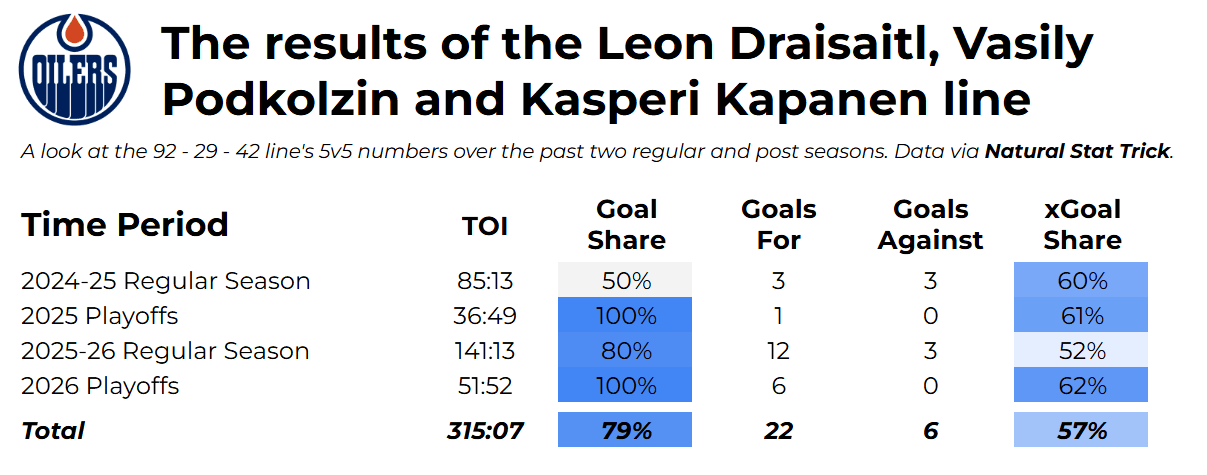
Though the sample sizes aren’t large, we can see flashes of potential in their metrics from 2024-25. They posted a 60 and 61 per cent expected goal share in the regular season and playoffs, respectively, at 5-on-5 that season.
The 2025-26 regular season provides the largest single sample for this line so far, with 141 minutes, and they clearly thrived here. In that span, they outscored opponents 12-3, equating to an outstanding 80 percent goal share. And, as noted earlier, their playoff performance managed to be even more impressive.
Overall, in a combined 315 minutes over the past two seasons, this line has outscored opponents 22-6, equating to a 79 per cent goal share. While this is clearly unsustainable, their expected goal share remains at a very strong 57 per cent.
Now, the concern here is that these results come from a collection of relatively small samples. This trio has yet to surpass 200 minutes in any single regular season or postseason. Even when aggregated, 315 minutes is a solid, but not definitive sample.
I would feel far more confident drawing firm conclusions if the total were closer to 600 or 700 minutes.
Are there any indicators that their success can sustain long-term?
There are two potential indicators that potentially suggest their success is sustainable.
First, as noted earlier, the line’s 57 per cent expected goal differential indicates that their results are not simply the product of a PDO heater or short‑term luck. Given Draisaitl’s proven ability to consistently finish chances at an elite rate and drive goal share above expected, it is entirely reasonable to project that this line could maintain a goal share somewhere in the ~60 per cent range. That would be elite performance for a second line.
Second, there is a clear trend throughout Draisaitl’s career regarding the types of wingers he performs best with. I wrote a deep dive on this a few months back, but I’ll briefly summarize here.
Historically, and interestingly, Draisaitl’s underlying numbers alongside pure scoring wingers have ranged from mediocre to outright poor. His defensive results with Evander Kane were abysmal, his limited minutes with Jeff Skinner were underwhelming, and in 2025-26, the Draisaitl line was thoroughly outchanced with Jack Roslovic. The Podkolzin – Draisaitl – Roslovic trio posted a brutal 39 per cent high‑danger chance share. It’s also worth noting that he struggled to generate meaningful chemistry with Viktor Arvidsson, whose game is built around high‑volume rush shooting.
Instead, Draisaitl’s strongest 5-on-5 results have consistently come next to tenacious, defensively responsible forecheckers, even those with a limited offensive ceiling. Think 2019-20 Kailer Yamamoto, 2022-2024 Warren Foegele and now Vasily Podkolzin over the past two seasons. Simply put, Draisaitl seems to be maximized when flanked by effective forechecking wingers rather than one‑dimensional scorers.
Kapanen fits much more closely into the former category. On the one hand, it is true that Kapanen’s production has been inconsistent throughout his career, and in an ideal world, you would have a more productive second line winger than him.
However, per AllThreeZones, he was Edmonton’s team leader in forecheck pressures per 60 in 2025-26. He excelled at using his speed and positioning to consistently force opposing defenders into making turnovers on breakouts. And although he’s far from stellar defensively, especially in his own zone, it is also worth noting that EvolvingHockey’s WAR model rates Kapanen’s overall even-strength defensive impact as above-average in two of the past three seasons. At the very least, unlike Kane or Roslovic, I would not classify Kapanen as a defensive liability.
Taken together, this trend provides compelling evidence that Kapanen’s success alongside Draisaitl may not just be a fluke.
Final Thoughts: What are the advantages of having Kapanen at 2RW?
One team I often look to as a model for the Oilers is the 2016 Stanley Cup-winning Pittsburgh Penguins. The defining strength of that roster was its elite forward depth; Pittsburgh deployed Sidney Crosby, Evgeni Malkin, and Phil Kessel on three separate lines.
Most teams will stack their best wingers alongside their best centers. The Penguins, however, were unique and fortunate in that they had two elite centers capable of driving play regardless of who flanked them. Crosby and Malkin’s ability to elevate their linemates and thrive even with the likes of Conor Sheary and Chris Kunitz on their wings allowed Pittsburgh to comfortably place Kessel on the third line. The result was a three‑line offensive attack that was nigh impossible to line‑match against.
More recent champions also reinforce the value of a fully rounded lineup. The 2025 Florida Panthers deployed Brad Marchand on their third line. The 2026 Carolina Hurricanes saw their third‑line center, Jordan Staal, win the Conn Smythe Trophy.
The same principle applies here for the Oilers. On paper, Edmonton should absolutely aim higher for a more consistent and more productive top‑six winger than Kapanen. But if the Podkolzin – Draisaitl – Kapanen line’s performance is legitimate and can sustain through the 2026-27 regular season and into the 2027 playoffs, the implications for the Oilers are significant. It would allow them to deploy their stronger wingers throughout the rest of the lineup and create a much more balanced and dangerous forward group.
In that scenario, Edmonton could use its remaining cap space to target a top‑six winger for Connor McDavid, potentially slotting Matt Savoie on the other wing. That would enable the Oilers to run a superb third line of Ryan Nugent‑Hopkins, Zach Hyman, and Jason Dickinson. And, if they manage to acquire a top‑six winger without moving Isaac Howard, he becomes another option somewhere in the top nine.
All things considered, the Podkolzin – Draisaitl – Kapanen trio deserves a lengthy, extended look before the trade deadline to gather more evidence on whether their success is sustainable.
If Kapanen’s performance on Draisaitl’s wing proves to be a fluke or ultimately unsustainable, the Oilers have alternatives. They could try Matt Savoie there – the Podkolzin – Draisaitl – Savoie line notably outscored opponents 6-1 in 105 minutes last season – or explore the trade market for a more established option.
But if Kapanen can genuinely hold down the 2RW spot next season, the Oilers have the potential to run a very deep forward lineup provided they play their cards right.
Find me on Twitter (@NHL_Sid)
The Future is Daily Faceoff Edmonton

The future of hockey coverage is bigger than one team, one market, or one platform. By bringing our local hockey brands together under Daily Faceoff, we’re creating a more complete hockey experience — one that gives fans the best of local passion and league-wide expertise, all in one place. The community remains at the centre. The experience is simply expanding as part of the next evolution of how we cover the game.
Welcome to Daily Faceoff Edmonton — Driven by hockey.


Breaking News
- Should Kasperi Kapanen be Leon Draisaitl’s go-to right-winger?
- Oilers from the past: Has Tobias Rieder finally started scoring goals?
- Oilers announce theme night schedule for 2026-27 season
- What if the Oilers traded for Mikko Rantanen in 2025?
- Leon Draisaitl welcomes Mike Babcock’s accountability, but will it apply to every Oiler?

Edmonton OilersTeam Cap Summary

Cap Summary
2026-27
2027-28
Projected Cap Hit
$99,274,166
$87,350,000
Projected Cap Space
$4,725,834
$26,150,000
Current Cap Space
$4,725,834
$26,150,000
Active Players
23/23
15/23
Draft Picks
Round
'26
'27
1
0
0
2
1
1
3
1
0