
OilersNation has no direct affiliation to the Edmonton Oilers, Oilers Entertainment Group, NHL, or NHLPA
Why Mathieu Joseph could be a highly useful defensive forward for the Oilers
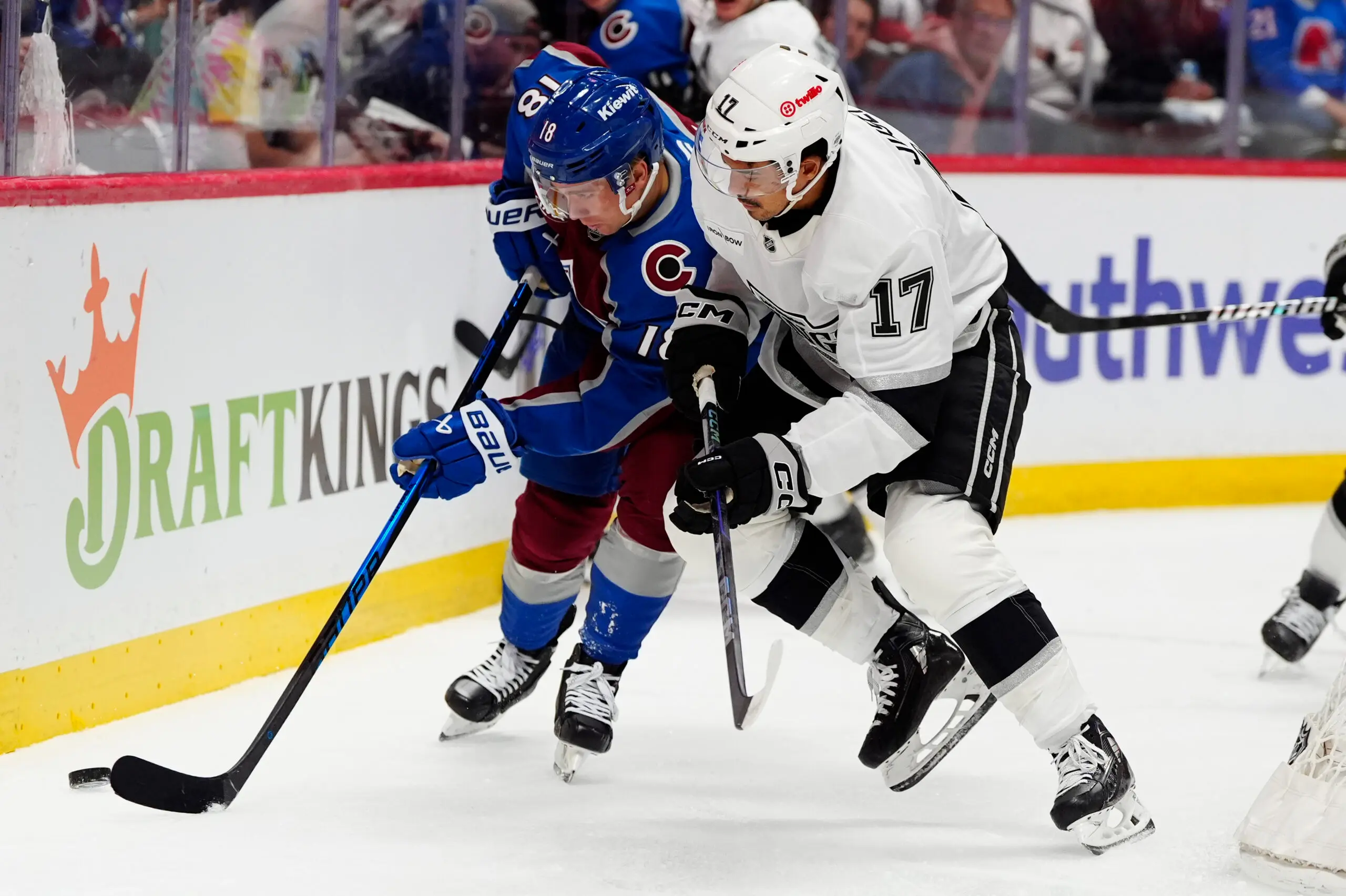
Photo credit: © Ron Chenoy-Imagn Images

Most of the Edmonton Oilers’ moves this off-season, particularly the more significant ones, have focused on improving the back end and the goaltending. One signing that flew under the radar amid the flurry of activity on July 1 was the addition of forward Mathieu Joseph.
Joseph, a 29-year-old left-shot winger from Laval, signed for one year at a one-million-dollar AAV. Across his eight-year NHL career, he has played with the Tampa Bay Lightning, Ottawa Senators, St. Louis Blues, and the Los Angeles Kings. This past season, he played 39 games with the Blues and 12 games with the Kings.
At a glance, the signing seems unremarkable. Edmonton already has a crowded group of forwards competing for roster spots, and Joseph’s most recent NHL stint with the Kings was rather underwhelming, as he failed to record a single point through 12 regular-season games and 2 postseason games. It’s easy to see why some may consider him as little more than a potential 13th forward on this roster.
However, there may be more value here than initially meets the eye. Joseph possesses several traits that could make him a highly useful player for the Oilers. I believe he has a legitimate chance to not only earn a roster spot, but carve out a meaningful role if given the chance in Edmonton’s bottom-six.
Using a combination of data and some video analysis, this article will dive deep into Joseph and what he could bring to this team.
Mathieu Joseph’s defensive numbers are excellent
As evident in my recent articles about Ryan Shea and Shakir Mukhamadullin, I am quite fond of using the components that make EvolvingHockey’s WAR model in player analysis, particularly their EVD (even-strength defence value) and SHD (short-handed defence value) metrics to assess defensive play.
In short, these models use regression to isolate a player’s results from certain external factors (quality of teammates, quality of competition, zone starts, and more) in an attempt to determine their individual impact on suppressing quality scoring chances (xGA). The model is not flawless, but I find it quite useful. And in our case, the model absolutely adores Joseph’s defence.
In the past three seasons, EvolvingHockey has Mathieu Joseph at a +8.0 EVD rating. That ranks 24th among all NHL forwards. His EVD value per 60 minutes of play ranks in the 92nd percentile; in simpler terms, his even-strength defensive impact rate is superior to 92 percent of all NHL forwards (minimum 500 TOI). These are outstanding results.
Just to put these numbers into perspective, we can compare them to some of the depth forwards that Joseph will be competing with for a roster spot:
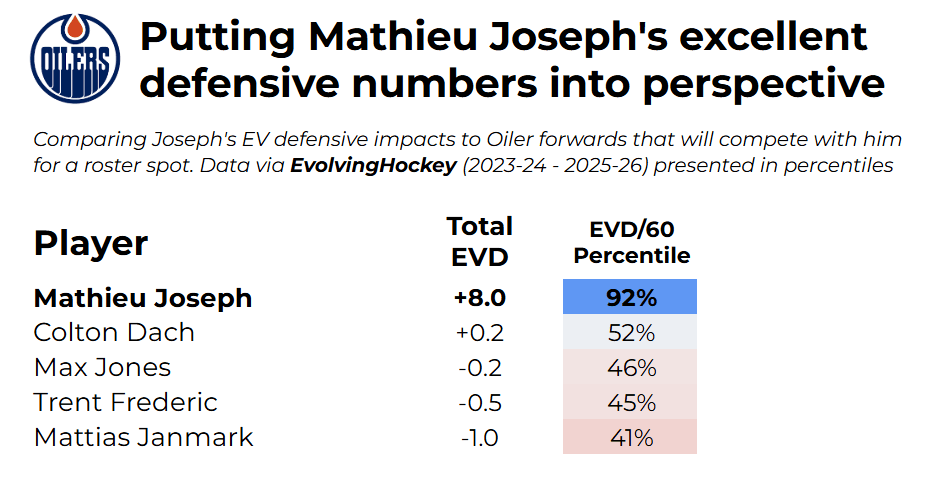
In terms of EVD, none of Colton Dach, Max Jones, Trent Frederic, or Mattias Janmark comes close to Joseph. Dach is slightly above-average, Jones is slightly below-average, Frederic was solid in Boston but declined in Edmonton, and Mattias Janmark has been subpar in this regard despite his reputation as a defensive forward.
Joseph is also quite consistent in this regard. His EVD value has been net-positive in 6 of his 8 NHL seasons, and above the 70th percentile in each of the past three seasons on three separate teams. The Senators, Blues, and Kings all saw a sharp decline in high-danger scoring chances allowed per hour with Joseph on-ice.
In addition to his even-strength defending, Joseph has been a very reliable penalty-killer throughout his career. Though he didn’t kill penalties as frequently in 2025-26, he played over 320 minutes on the penalty-kill from 2022-23 through 2024-25, and his SHD per 60 ranked at a very solid 63rd percentile. To use a perspective from a different model, JFreshHockey’s famous player cards rated Joseph’s penalty-killing in the 95th percentile back in 2024. Not bad!
All things considered, it is evident that Joseph’s underlying defensive numbers are superb. In 2025-26, Edmonton’s bottom-six was out-scored 55 to 86 at 5-on-5, and the team’s playoff PK goals against rate was the worst in the league; Joseph could help bring that GA rate down considerably in both situations.
What does Joseph do that lead to these defensive results?
Results matter most, but understanding how a player produces those results can be just as important, especially if you wish to determine whether their performance is sustainable or likely to translate to a different environment.
So, I’ve told you that Joseph has great advanced defensive numbers. But why? What exactly is he doing that leads to these results?
I believe there are two primary reasons. First of all, Joseph has been one of the league’s best forwards at exiting the defensive zone.
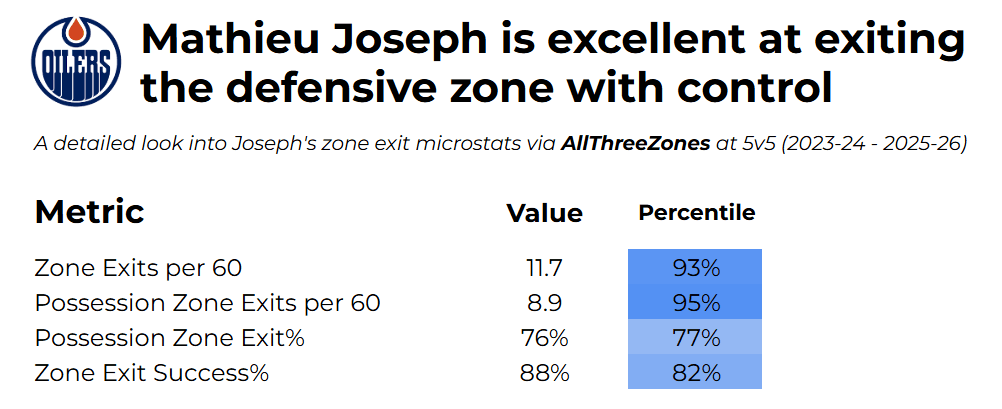
Over the past three seasons, Joseph has averaged about 11.7 zone exits per 60, ranking in the 93rd percentile among all forwards. Of those exits, 8.9 of them per 60 have been with possession, which ranks at an even better 95th percentile. Not to mention, he is able to exit the zone efficiently while limiting turnovers, holding a very strong 88 percent exit success rate.
As you watch Joseph play, his speed is likely his most noticeable attribute, and he uses this to his advantage with zone exits. Ranking in the 82nd percentile in 22 MPH+ speed bursts per NHL EDGE, Joseph is a very fast skater. His ability to get the puck out of the zone quickly and efficiently is a huge reason why his teams have such strong defensive results with him on-ice. The only Oilers superior to Joseph at carrying the puck out of the defensive zone with control are Leon Draisaitl and Connor McDavid.
One of the two goals that Joseph scored in 2025-26 came off a short-handed defensive zone breakup and zone exit.
This is technically an offensive highlight, but it is worth noting here nevertheless as a demonstration of Joseph’s defensive smarts and the speed that he uses with his zone exits. They don’t often lead to goals, but they certainly result in less time in his own end.
In addition to exits, Joseph is a top-notch forechecker.
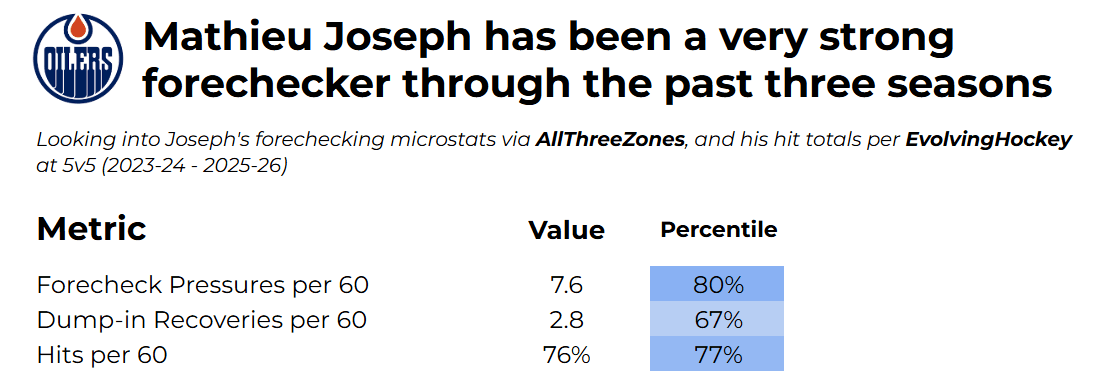
AllThreeZones tracks how often players pressure and disrupt the opposition as they attempt to exit their zone. Joseph has averaged about 7.6 such forecheck pressures per hour, placing him in the 80th percentile among all forwards. His combination of aggressiveness, tenacity and physicality makes it quite difficult for opposing defenders to execute clean breakouts against him. Joseph’s aforementioned speed and skating ability also shine here on the forecheck, which he uses to efficiently recover dump-ins, ranking at a very respectable 67th percentile.
Joseph’s forechecking plays a major role in his defensive impact, and it ties into a central idea in modern hockey analytics discourse: the best defence is not necessarily a good offence, but rather good puck possession. The more you have the puck, particularly in the offensive zone, the less time you spend in the defensive zone, thus resulting in fewer chances and goals against. This is a sentiment echoed by several NHL coaches over the years as well.
“If you have the puck, the other team is not scoring,” Pete DeBoer once said. “The best defense is to have the puck, preferably in the offensive zone.”
“The game’s changed. They think there’s defending in today’s game. Nah, it’s how much you have the puck,” said Darryl Sutter many years back.
This is why you will often see forechecking forwards, like Joseph, have sparkling defensive analytics. Their ability to disrupt exits and recover loose pucks on the forecheck won’t always guarantee offence, but at minimum, it keeps the puck away from their own end by hemming the opposition into their own zone. This in turn leads to fewer goals against.
To demonstrate this, let’s go back to Joseph’s third game as a LA King against the Utah Mammoth on March 22. Take a look at the following video compilation.
You can see Joseph’s excellent speed and tenacity on the forecheck on display here. This is a compilation of multiple instances where Joseph (LAK #17) forced a turnover or recovered a dump-in leading to a long shift in the offensive zone. He also often used his physicality and hockey IQ in these clips to win more puck battles in-zone and keep the cycle alive. None of these plays are particularly fancy or eye-popping in isolation, but the ability to repeatedly and consistently make them can pay dividends, because you can see just how much time he spent in the offensive zone.
In this game, the Kings allowed a total of 29 shots, 10 high-danger chances, and 3 goals against at 5-on-5 per Natural Stat Trick. But in the 12 minutes that Joseph played, the Kings allowed just 1 shot, 0 high-danger chances, and 0 goals. Overall, Joseph led all LA players with a fantastic 89 percent expected goal share, and a 100 percent high danger chance share. He spent the majority of his ice time in the offensive zone due to his forechecking, and had to play very little in his own end.
The best way to defend is to simply spend less time defending at all. This is clearly reflected through Mathieu Joseph’s game.
Of course, expectations must still be tempered
With everything in mind, there remain several obvious flaws with this player, and they primarily lie on the offensive side of the game.
We have discussed in detail how strong WAR models rate Joseph’s defence. Unfortunately, EvolvingHockey rates his offensive WAR in just the 20th percentile among all forwards over the past three seasons. If you look at the past two seasons specifically, that drops down to the mere 6th percentile.
While Joseph can use his speed to get the puck out of his zone, he struggles to do much with it once he has it in the offensive zone. His pucks skills and play-making are severely lacking. Perhaps the most frustrating aspect of his game, something often mentioned by fans of his former teams, is his lacklustre finishing ability:
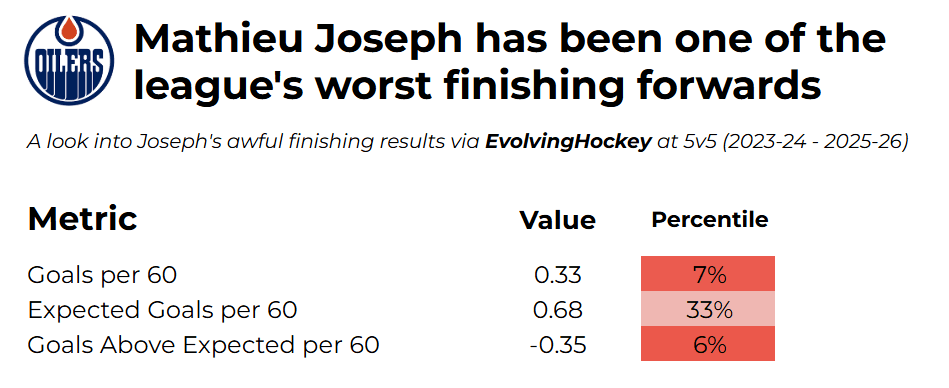
Over the past few years, Joseph has been among the league’s worst finishing forwards. He can occasionally generate rush chances or breakaways with his speed, but he mightily struggles to consistently capitalize on them. In this sense, he is not the best stylistic fit for this team, as they already possess numerous forwards who are poor at finishing.
With that in mind, Joseph did have a productive season with Ottawa back in 2023-24. He had 35 points in 72 games, with 31 of them coming at 5v5. For reference, Ryan Nugent-Hopkins had 30 5v5 points that season playing mostly on a line with Connor McDavid. So, it’s not as if there is no offensive ability here.
Still, aside from that season, Joseph’s production has been unremarkable and quite inconsistent. EvolvingHockey does rate his scoring chance differential impact (RAPM xG +/-) to be net-positive, but the lack of offence and finishing in his game is likely to be his biggest drawback.
Final Thoughts
The Mathieu Joseph signing is a move with essentially no risk, and potential for decently high reward.
The “worst” case scenario here is that Joseph simply doesn’t pan out for Edmonton, for whatever reason. In this case, the Oilers can either keep him as 13th forward in case of injury, or put him on waivers to play in Bakersfield. He’s only signed for one year, and his cap-hit is fully buriable in the AHL. Not a big problem.
A reasonable prediction for his upcoming season is that he develops into a very useful defensive fourth-liner, perhaps as part of an energetic checking line with Dach and/or Frederic. He can absolutely be a much more effective version of Mattias Janmark.
Perhaps a more optimistic scenario is that he finds a role on a defensive shutdown third-line next to Jason Dickinson. Now, Joseph is not often deployed by his coaches against elite competition, as he has spent about 27 percent of his 5v5 minutes against elite competition over the past three seasons per PuckIQ, ranking in the 37th percentile. So, most of his defensive results have come against weaker opponents.
However, in the minutes that Joseph has played against elite competition (592 TOI), he has a positive goal share of 51 percent, and a net positive impact on suppressing dangerous shots (relative DFA/60). I could see the team running an effective shutdown line of RNH – Dickinson – Joseph.
Could Joseph even have the potential to succeed as a top-six winger, perhaps next to Leon Draisaitl? It probably seems unlikely given his inconsistent offence, and I would want a much better finisher on Draisaitl’s wing. That being said, I wrote an article just less than two months ago where I outlined how Draisaitl’s numbers are at their best with speedy forecheckers on his wing, like Vasily Podkolzin and Warren Foegele. If Joseph can produce as he did three years ago, could he find some chemistry on Draisaitl’s wing? Again, the chances are not very high, but I wouldn’t totally rule out the possibility either.
All things considered, Mathieu Joseph brings several valuable traits to the Oilers, from his ability to make speedy zone exits to his relentless forechecking. If given the chance by the coaching staff, I believe he has the tools to become a reliable and effective bottom-six forward for Edmonton.
As one final note, if you have frequently followed my articles, you will notice that I can often be critical of this team, and perhaps even very negative at times. However, I have been very pleased with the moves that Edmonton’s management has made thus far. Each of Ryan Shea, Shakir Mukhamadullin, and Mathieu Joseph have some very encouraging underlying numbers in one way or the other, and it seems quite evident that the team’s analytics department has played a big role in decision-making this summer. This is very nice to see.
Find me on Twitter (@NHL_Sid)
PRESENTED BY PRAIRIE TOYOTA DEALERS

It’s time for a truck that can play in every zone. Which means, it’s time to Toyota! Its standard i-FORCE engine delivers more power than ever and a towing capacity of up to 6,400 lbs. It helps you take on challenging landscapes with confidence with its available Panoramic Multi-Terrain View Monitor that provides a live, underfloor view of the terrain your tackling. It even makes loading and unloading gear effortless with its available Power Liftgate. Whether it’s for early morning practice or weekend away games, the Tacoma is a teammate you can rely on. Visit your local Prairie Toyota dealer today.


Breaking News
- What if the Oilers traded for Mikko Rantanen in 2025?
- Leon Draisaitl welcomes Mike Babcock’s accountability, but will it apply to every Oiler?
- Oilers’ Josh Samanski goes incognito at German festival to find romance
- Draisaitl proud to play NHL games in native Germany: ‘This is very special’
- Oilersnation Radio: We want to go watch the Oilers play in Germany

Edmonton OilersTeam Cap Summary

Cap Summary
2026-27
2027-28
Projected Cap Hit
$99,274,166
$87,350,000
Projected Cap Space
$4,725,834
$26,150,000
Current Cap Space
$4,725,834
$26,150,000
Active Players
23/23
15/23
Draft Picks
Round
'26
'27
1
0
0
2
1
1
3
1
0