
OilersNation has no direct affiliation to the Edmonton Oilers, Oilers Entertainment Group, NHL, or NHLPA
Oilers need to build their third line around Nugent-Hopkins
Photo credit: © Bob Frid-Imagn Images

As the longest-serving player on the Edmonton Oilers’ current roster, Ryan Nugent-Hopkins has been extremely important for the organization in more ways than one. Often referred to as the team’s “Swiss Army Knife,” Nugent-Hopkins has been exceptionally versatile, able to play both centre and wing at 5-on-5 while also being a key contributor on both the power play and the penalty kill.
In particular, perhaps where Nugent-Hopkins has been most valuable is on the man advantage. Here’s a crazy stat: in the 2025-26 season, Edmonton’s top power-play unit generated 15.4 goals per hour with RNH on it. Without him, it dropped to just 7.5. Pretty incredible split.
However, as Nugent-Hopkins nears his mid-thirties, some concerning trends in his underlying numbers have emerged, suggesting it may be time to reassess how he’s deployed within the roster.
Specifically, these concerns concern his performance at even strength, where he has spent the vast majority of his time in the top six. But for reasons that we will discuss in this article, perhaps it would be best for that to change.
We’ll start with a very simple overview of RNH’s 5v5 points per hour rate in each of the past five seasons:
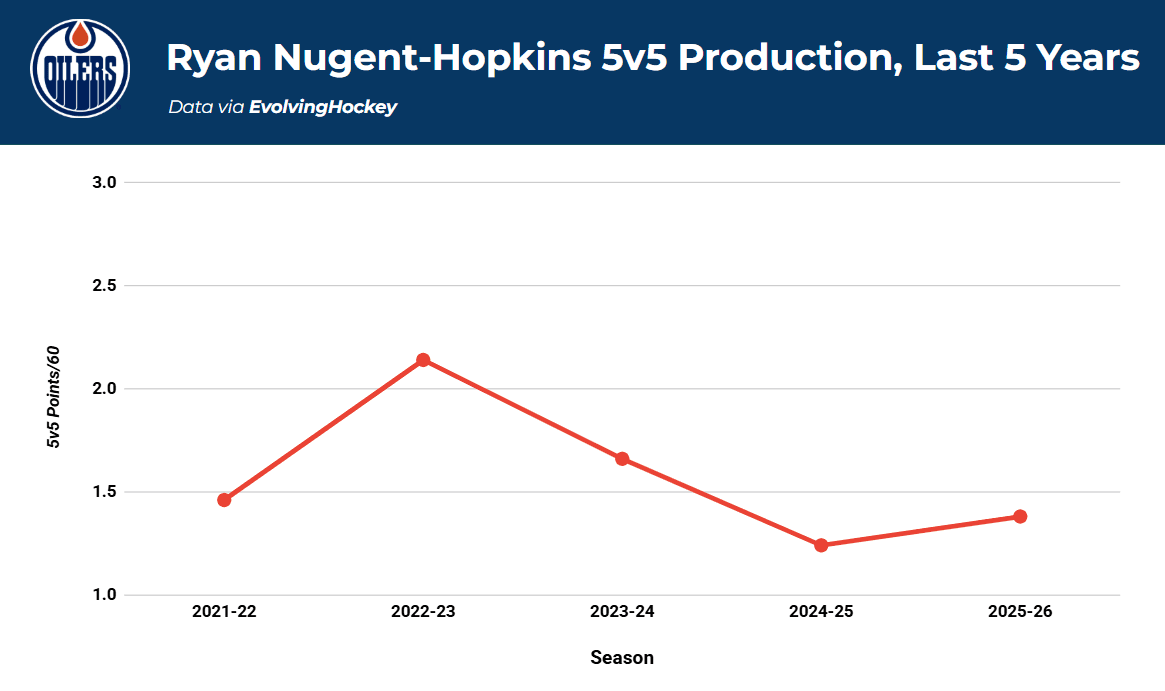
However, there has been a clear drop-off ever since.
In the past two seasons, Nugent-Hopkins’ 5-on-5 points per hour rate sits at just 1.31. Among all players with a minimum of 750 minutes played over that timespan, that rate ranks at a lowly 339th place. Ouch.
Perhaps one may argue that rate stats can overrate fourth-liners who play fewer minutes, but even if you look at raw totals, RNH sits at 277th in the league in total 5-on-5 points at 43. He had fewer points at 5-on-5 than the likes of Nick Cousins and Jordan Martinook in 2025-26.
Take into account that Connor McDavid has been his most common linemate over the past two seasons at 5-on-5, and these results are, frankly, quite ugly for RNH. Simply put, these production rates are not nearly at the level of an adequate top-six player.
Now, with all of that said, points are not everything, particularly in this case for two reasons.
First, while a player who most frequently plays with Connor McDavid should be producing more in theory, RNH’s other most common linemates include Zach Hyman and Evan Bouchard. McDavid, Hyman, and Bouchard are all players who love to have the puck on their stick, and with only three points available on any goal, the other forward on that line won’t always rack up big totals even if they’re genuinely contributing. Whether it’s breaking up a pass in the defensive zone to start a rush, extending an offensive‑zone cycle, or providing a screen in front of the goalie, there are countless ways to drive offence that don’t show up in point totals. This is why, even though points are a simple and familiar metric, many public analysts today are fond of evaluating offensive impact by measuring the player’s impact on total on‑ice goals instead of just points.
Secondly, defensive value also matters quite a bit. A big reason the Florida Panthers won back-to-back Stanley Cups is due to the outstanding two-way play from their top-six forwards, particularly from Aleksander Barkov and Sam Reinhart. It’s not all about offence.
So, we need a deeper look into RNH’s true on-ice impact. We’ll use EvolvingHockey’s RAPM model here, which attempts to isolate a player’s on-ice metrics for various external factors such as quality of teammates, quality of competition, zone starts, and more. It’s far from perfect, but I find it very useful, and you can read all about it right here.
Using percentiles, let’s take a glance at RNH’s RAPM 5v5 on-ice goals per 60 to measure his offensive impact, and his RAPM 5v5 on-ice expected goals against per 60 to measure his defensive impact (I use expected instead of actual goals against to filter out goaltending impact; this way, good defensive forwards playing in front of bad goaltending don’t get penalized, and vice versa):
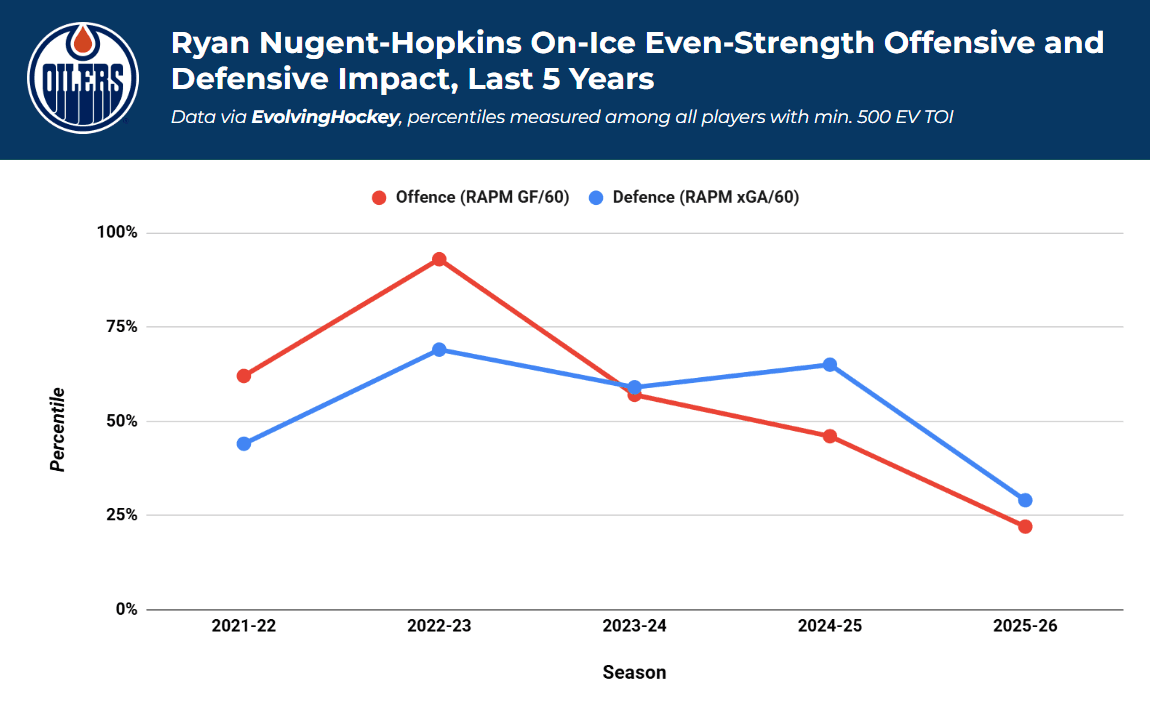
The long answer is that the RAPM GF results relay a similar story to the points per 60 timeline in terms of offence – peak in 2022-23 followed by a significant decline — while defensively, RNH was generally solid in terms of RAPM xGA from 2022-23 through 2024-25, but he took a sharp decline in 2025-26.
Unfortunately, the brutal reality here is that, no matter how you want to look at this, it is very difficult to come to the conclusion that Nugent-Hopkins has played at the level of a satisfactory top-six forward over the past two seasons at 5-on-5.
RNH has most frequently played on Edmonton’s top line with McDavid and Hyman over the past three seasons. In 2023-24, that line was spectacular. But in the past two seasons, although that trio has driven shots and scoring chances quite well, they have greatly struggled to finish, to the point that the RNH – McDavid – Hyman was outscored by the opposition when on ice. And a big reason for this is RNH’s lacklustre production. While the play-driving results cannot be ignored, the Oilers need a top line that finishes their scoring chances at a much higher rate, and for that to happen, it likely means that RNH should not be on it.
So, the question becomes: where does RNH fit best in Edmonton’s lineup?
Last week, I wrote about what types of players have chemistry with both McDavid and Draisaitl. The conclusion I came to with regards to Draisaitl was that he performs best with forechecking wingers, which is not exactly an area where RNH excels in, at least anymore. Perhaps in theory, a line of RNH, Draisaitl and Vasily Podkolzin could work, but not only would that require Podkolzin to play at RW (he has primarily been Draisaitl’s LW), a second forechecker – like Kasperi Kapanen, for example – may be more effective in that spot.
Instead, I believe the best spot for Nugent-Hopkins is on the third line. I have several reasons for this.
First, as discussed above in extensive detail, RNH is simply not an effective top-six player at this stage. He filled that role well for most of his career, but the results simply don’t justify it anymore. A better coaching system could help him rebound, but perhaps his results can simply be largely attributed to age decline, as RNH turns 34 next year. There may also be superior stylistic fits for McDavid and Draisaitl in the top six than RNH, as I discussed in my piece last week.
Second, the bottom six has simply been awful over the past two seasons, as it has been out-scored 121 to 174. Much of that stems from Kris Knoblauch’s suboptimal deployment, and the next coaching staff will need a fundamentally different approach in some way or another to how the third and fourth lines are used.
Third, several indicators suggest that Nugent‑Hopkins could thrive in a third‑line environment. One of the clearest is his performance against weaker competition. Take a look below:
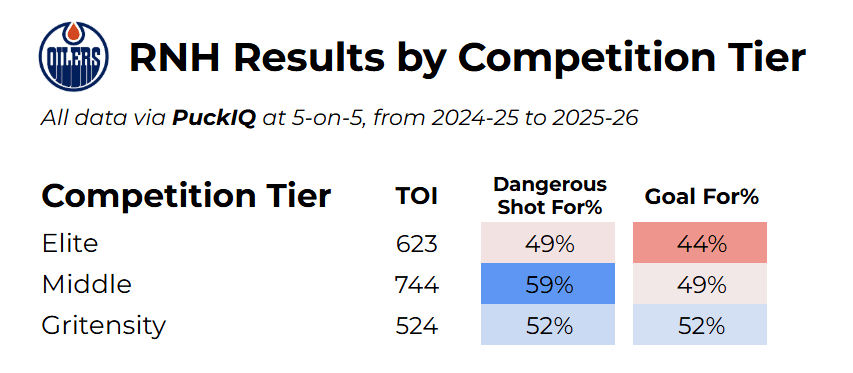
PuckIQ splits players into three tiers of competition: elite, middle, and gritensity. RNH’s GF% (goal for percentage) and DFF% (dangerous shot for percentage) against elite competition are underwater, but they improve substantially against the middle and gritensity tiers. In fact, his DFF% against the middle tier over the past two seasons is higher than both Bouchard and Draisaitl! There has been a lack of on-ice finishing, but it suggests real potential against weaker competition.
Now, it’s true the Oilers have tried Nugent‑Hopkins as a third‑line centre before, and the results weren’t great. Before 2024-25, it was indeed most optimal to deploy RNH as a top-six winger. However, I believe a big reason for RNH’s mediocre results as 3C was the quality of his wingers.
When the Oilers ran McDavid, Draisaitl, and RNH down the middle, their two superstars got the cream of the crop when it comes to their wingers. Given how thin Edmonton’s winger depth was for years, that often left RNH with very subpar linemates at 3C. Today, however, the Oilers’ winger depth is far stronger, making it much more viable to deploy RNH as a 3C. And while it’s not extremely substantial, there is evidence of RNH performing much better next to more talented wingers.
For example, in 2024-25, the third line of RNH, Vasily Podkolzin and Viktor Arvidsson, had a 75 percent goal share and 68 percent expected goal share in about 70 minutes. In 2023-24, the line of RNH, Warren Foegele, and Zach Hyman had a 59 percent goal share and 53 percent expected goal share in about 40 minutes. These are certainly not huge samples, but again, they suggest meaningful potential.
When it comes to lineup options, there is a large variety of ways the Oilers could deploy an effective third line with RNH. For instance, if the Oilers re-sign Jason Dickinson, perhaps the Oilers could run a defensive third-line with RNH and Dickinson, one that eats up a lot of defensive zone starts, freeing McDavid and Draisaitl for more offensive starts.
Or, if the Oilers use their cap space on a top-six winger instead of Dickinson, the top six could feature that addition alongside Zach Hyman, Vasily Podkolzin, and Matt Savoie. In that scenario, a third line built around Nugent‑Hopkins and Isaac Howard could have real offensive upside, with the flexibility to swap Howard and Savoie if needed.
It could even be viable to run a third line featuring Nugent‑Hopkins and Hyman. When Draisaitl was injured in the final month of 2025-26, the Oilers had used a top line of Podkolzin, McDavid, and Savoie at one point with considerable success, while RNH and Hyman were paired together. If Isaac Howard breaks out, or if Kasperi Kapanen continues his chemistry with Draisaitl, Edmonton could ice a strong top-six with Savoie, Podkolzin, and two of Howard, Kapanen, or a new top‑six winger, leaving RNH and Hyman to form a highly effective third line.
I could list even more combinations, but I think you get my point. There is significant potential to build a strong third line around Nugent‑Hopkins, something the Oilers have dearly lacked for the past two seasons. We’ll wait and see whether Edmonton’s management and the new coaching staff reach the same conclusion.
*All data via Natural Stat Trick, EvolvingHockey and PuckIQ
Find me on Twitter (@NHL_Sid)
ARTICLE PRESENTED BY bet365


Breaking News
- What Oilers could become go-to guys this season?
- First NHL professional tryouts signed ahead of 2026-27 training camps
- Five players who could be inducted into the Oilers Hall of Fame this season
- ‘A home run hire’: Oilers fans react to hiring of Misha Donskov
- ‘We’re not worried about this’: Oilers GM Stan Bowman on Savoie, Andersen injuries

Edmonton OilersTeam Cap Summary
Cap Summary
2026-27
2027-28
Projected Cap Hit
$102,071,666
$88,322,500
Projected Cap Space
$1,928,334
$25,177,500
Current Cap Space
$1,928,334
$25,177,500
Active Players
22/23
16/23
Draft Picks
Round
'26
'27
1
0
0
2
1
1
3
1
0