
OilersNation has no direct affiliation to the Edmonton Oilers, Oilers Entertainment Group, NHL, or NHLPA
It’s time for the Oilers to limit Ryan Nugent-Hopkins’ role
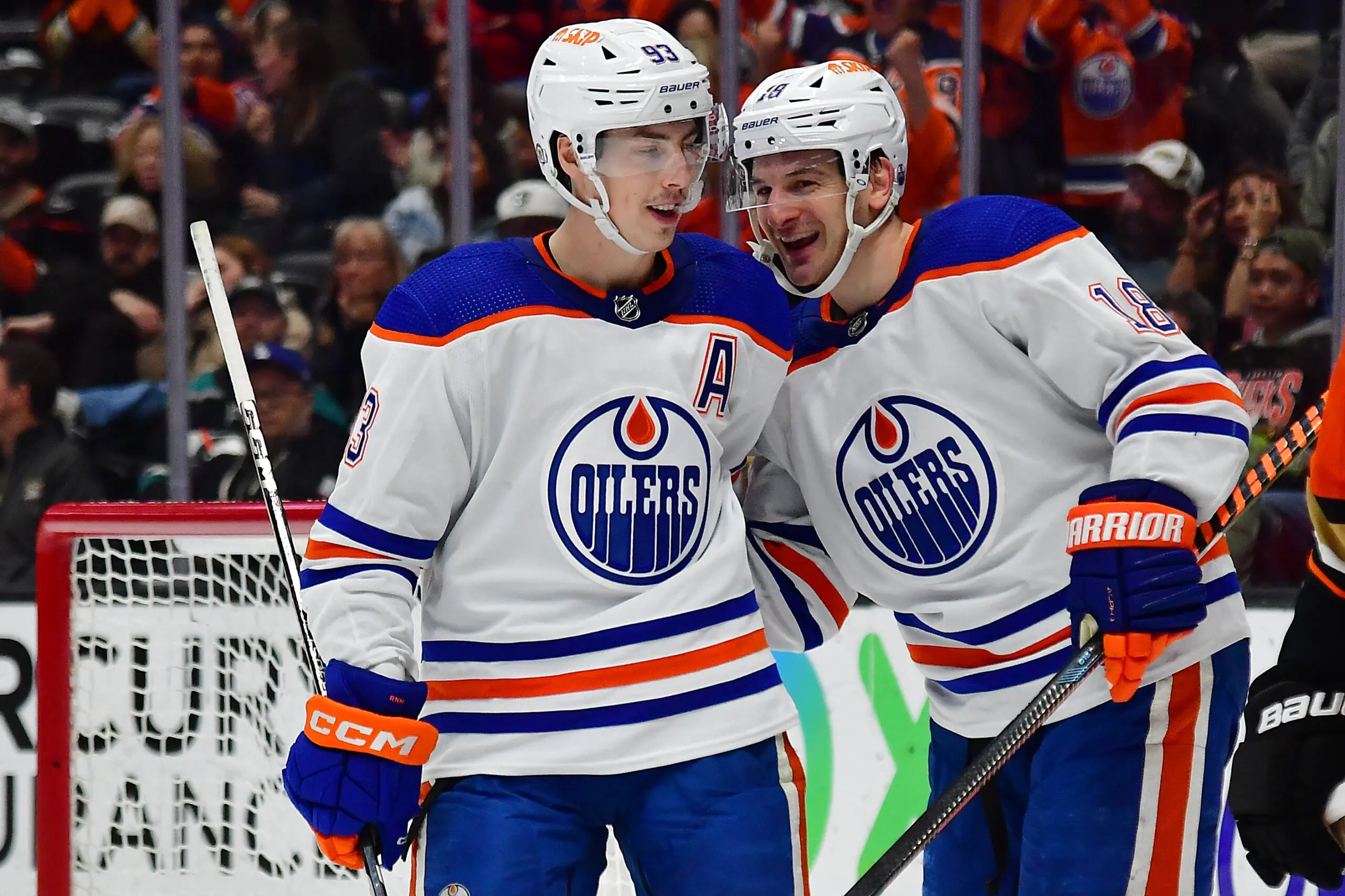
Photo credit: Gary A. Vasquez-USA TODAY Sports

By Lane Golden
May 4, 2026, 17:00 EDTUpdated: May 5, 2026, 17:34 EDT


Ryan Nugent-Hopkins has been through it all for the Edmonton Oilers.
He’s stuck with the team, whether they finished last place or fought tooth and nail in Game 7 of the 2024 Stanley Cup Final. As the last holdover from the Decade of Darkness, he’s been a fixture in the top six for 15 years. That’s about to change.
Nugent-Hopkins’ decline is difficult to discuss in this city. As a loyal, toolsy, hard-working player, he’s reached a level of popularity in Edmonton perhaps only rivalled by Ryan Smyth. But the reality is, he’s 33 years old, and Father Time is undefeated.
He possesses a diverse enough skill set to add value to the team, but at this point, there are better options to maximize minutes at the top of the lineup next to Connor McDavid. Going into next season, the Oilers will need to adjust their expectations for Nugent-Hopkins and find the best spot for him to succeed.
Offensive decline
As a former first overall pick, the Oilers have expected Nugent-Hopkins to provide offence for his entire career. In 2025-26, he hit 50 points for the ninth time. Raw point totals don’t tell the whole story, however. He still contributes and collects his points on the top power play unit, but his five-on-five totals have slipped significantly.
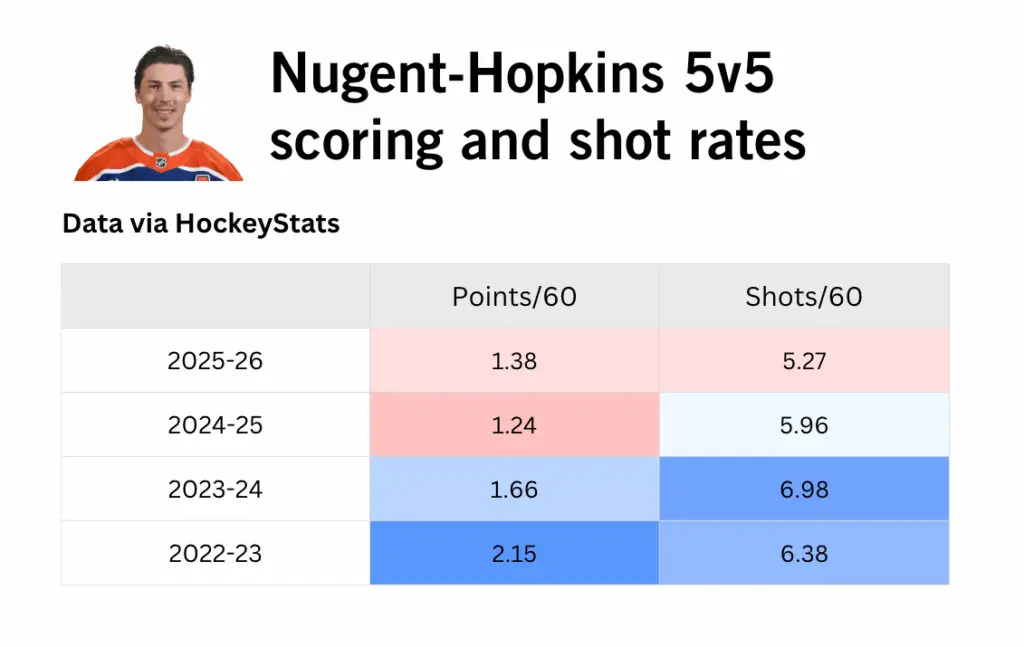
This season, Nugent-Hopkins’ production was well below average for a top-six forward, despite playing over half of his minutes on McDavid’s wing. Among forwards who played at least half of Edmonton’s games, he ranked eighth in five-on-five points per hour. He produced less than middle-six wingers like Kasperi Kapanen, Jack Roslovic, and 22-year-old Matt Savoie.
McDavid’s on-ice goal, expected goal, and shot shares all decreased in the minutes he spent with Nugent-Hopkins. The top line featuring Nugent-Hopkins, McDavid, and Hyman still had their moments, but they didn’t strike the same fear into the opposition as they have in the past.
Instead, it was Savoie who grabbed hold of that spot post-Olympic break and never looked back. He produced at a 65-point pace after late February and finished with a better goal share with McDavid than Nugent-Hopkins did. Perhaps what’s even more exciting is that there’s still plenty of upside for a young forward like Savoie. The youth, speed, and growth potential are precisely what the Oilers need at the top of the lineup going forward.
Special teams
Nugent-Hopkins hasn’t just been a top-line fixture for the Oilers over the years — he’s also played a massive role on both special teams units. He ranked in the top two among Oilers forwards in time-on-ice per game on the penalty kill each year since 2021-22, but that finally dropped this season.
Mark Stuart deployed Nugent-Hopkins in fewer minutes on average than Jason Dickinson, Adam Henrique, Mattias Janmark, and Savoie. It’s hard to blame him. Nugent-Hopkins was on the ice for 11.8 goals against per hour on the PK, while the team only gave up 6.9 per hour without him.
If anything, reducing his penalty kill minutes even more might benefit the Oilers. At his age, having more rest and fewer responsibilities might be what he needs to be at his best. And the penalty kill has been far more efficient without him in recent years.
As for the power-play, Nugent-Hopkins remains effective. He scored 11 power-play goals this season, just two fewer than McDavid. Unlike the penalty kill, Edmonton’s power play fared better when he was in the lineup.
Nugent-Hopkins has played on the top unit for a long time, and he’s found a way to remain useful there despite his offensive decline at five-on-five. He knows how to execute their set plays, and he knows how to occupy the right space when McDavid and Draisaitl rotate around the offensive zone.
That doesn’t mean his spot on the main unit is a lock in the future, however. With young offensive players like Savoie on the rise, the coaching staff will closely monitor their power play in 2026-27. If they hit a snag at any point during the season, it wouldn’t surprise me at all to see them experiment with other players — especially ones who can shoot the puck from the bumper position.
The ideal role
A grizzled veteran with defensive acumen like Nugent-Hopkins can plug in anywhere in the lineup, but his ideal spot moving forward is on the third line. His versatility allows him to play third-line centre or stay on the left wing if the Oilers re-sign Jason Dickinson.
His offensive production fits firmly into a third-line level, and at this stage, he’s more likely to make a positive impact in a shutdown role next to Dickinson.
Nugent-Hopkins will likely start next season playing on both special teams units, but that’s a situation to monitor closely. If he can’t improve under a new penalty kill system, it might be wise to continue fading him there. And while he’s continued to deliver so far on the power play, his spot is far from guaranteed going forward.
There’s a changing of the guard taking place in Edmonton’s forward group. Young forwards like Savoie and Podkolzin are knocking on the door, and Nugent-Hopkins is trending down with age. He can still be a useful player for the Oilers for the remaining three years of his contract. But it won’t be on the top line.
ARTICLE PRESENTED BY bet365


Breaking News
- Sharks off-season review: San Jose gets better thanks to some luck and good drafting
- Bowman on Savoie extension: ‘I’m confident that’s going to work itself out in time’
- Bowman: Babcock will build right habits, have Oilers ‘very prepared’
- Oilers announce 56-player training camp roster absent two 2026 draft picks
- ‘We all don’t have to agree’: Oilers’ Bowman addresses controversial Formenton signing

Edmonton OilersTeam Cap Summary

Cap Summary
2027-28
2028-29
Projected Cap Hit
$88,322,500
$61,025,000
Projected Cap Space
$25,177,500
$61,975,000
Current Cap Space
$25,177,500
$61,975,000
Active Players
16/23
10/23
Draft Picks
Round
'27
'28
1
0
1
2
1
0
3
0
1