
OilersNation has no direct affiliation to the Edmonton Oilers, Oilers Entertainment Group, NHL, or NHLPA
A closer look into the early results of Edmonton’s defensive core thus far
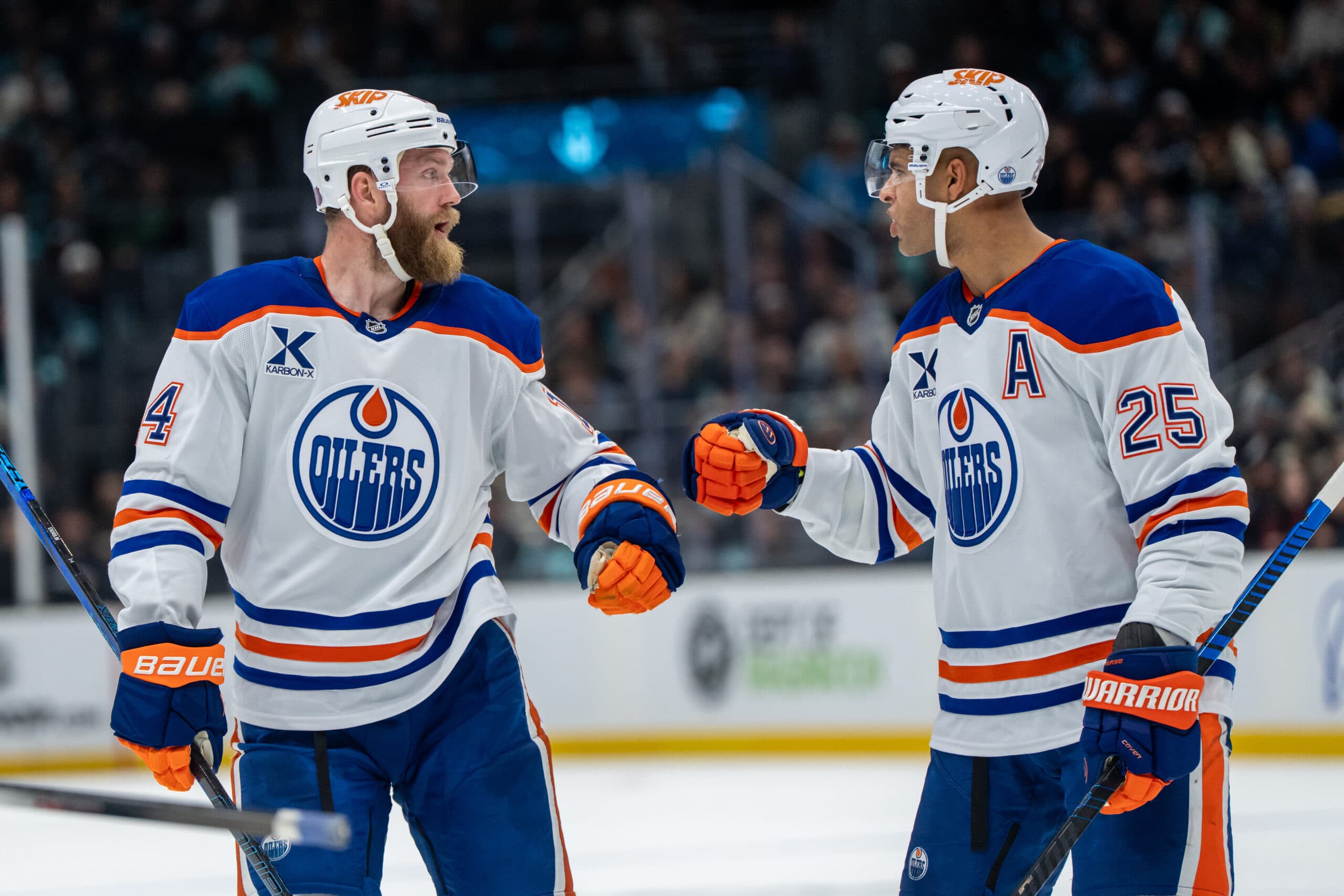
Photo credit: Stephen Brashear-Imagn Images

The Edmonton Oilers have begun the 2025-26 regular-season with a 4-4-1 record in their first nine games. This is identical to their 4-4-1 record in the first nine games of 2024-25. While there are numerous things to be concerned about thus far, a mediocre start is far from new for this team, and I would actually argue that there is some reason for optimism moving forward.
Last week, I took an early look into Edmonton’s forward deployment, specifically their younger forwards and why the coaching staff should give them a longer leash. For this week, I would like to analyze the early results of Edmonton’s defensive core thus far this season.
To begin, here is a basic look at the on-ice results of each of the eight defencemen that have suited up for the Oilers in the first nine games:
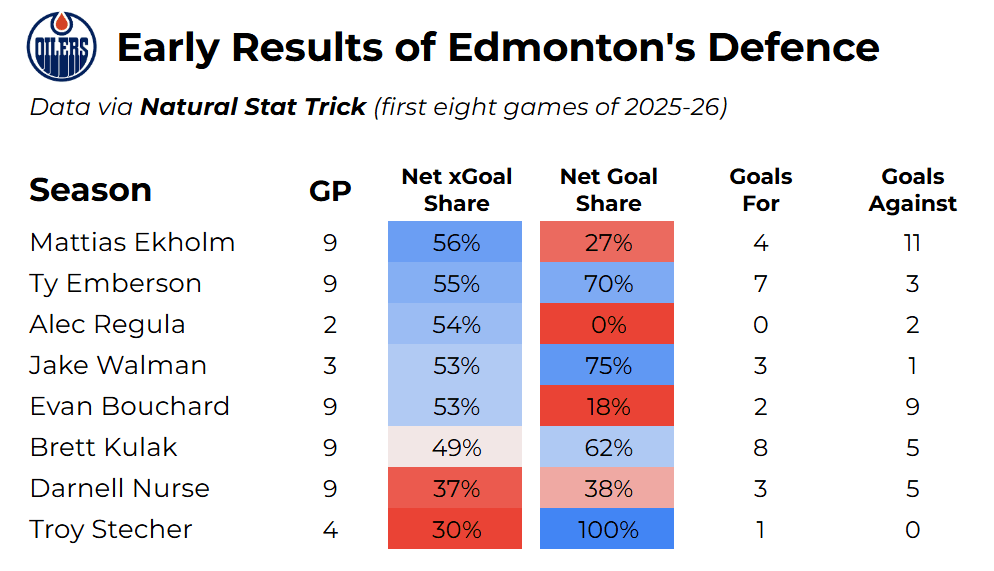
There are a couple of takeaways to be made from these early results.
Let’s start with a closer look into Edmonton’s top-pairing. With Evan Bouchard and Mattias Ekholm on-ice, the Oilers have controlled 61 percent of the shots and 55 percent of the high-danger chances. Pretty good. Note that their possession numbers are not drastically lower than they were in 2024-25.
However, Ekholm and Bouchard have been on-ice for a mere one goal at 5-on-5, while on-ice for a whopping eight against. That equates to an absoultely awful 11 percent actual goal share.
A lot of ink has been spilled over Bouchard’s costly errors already, and indeed, he has made several mistakes leading to goals against. It is an area he must clean up. Still, this is far from something new.
Back in 2023-24, Bouchard had a 58 percent expected goal share, but an atrocious 36 percent actual goal share in the month of October, and again, his defensive play was heavily under fire. However, he was incredibly unlucky, as his goalies had a mere 0.855 save percentage with him on-ice. What this did was make Bouchard’s errors far more glaring and frequent than they truly were. Predictably, his results regressed to the mean, and he finished the season with a fantastic 62 percent goal share and a total of 82 points, while also ranking fifth place in Norris Trophy voting.
We’re seeing somewhat similar results to begin this season. So far, Bouchard has a 0.885 on-ice save percentage, alongside an even unluckier 2.1 percent on-ice shooting percentage; Bouchard has been on-ice for 80 scoring chances at 5-on-5, but only two have gone into the back of the net.
I believe it is reasonable to say that two things can be true at once here. One, Bouchard simply needs to be better. Even by the advanced metrics that he historically ranks well in, Bouchard is worse than he was compared to each of the past two seasons. However, he has been extraordinarily unlucky, and you can expect his results to substantially improve much sooner than later.
The same can generally be said for Mattias Ekholm, who leads Edmonton’s defencemen with a 56 percent xG%, but has been out-scored 4 to 11, with an even worse 0.817 on-ice save percentage. While he could also clean up his defensive play, his numbers too will regress to the mean as the season progresses.
Nextly, the third-pairing of Brett Kulak and Ty Emberson has been generally solid. They have out-scored opponents 6 to 3, while controlling over 50 percent of the shots and expected goals. Emberson’s underlying numbers thus far in sheltered minutes are quite good, which is encouraging. It’s also worth noting that Alec Regula — currently on injured reserve — could also substitute in for Emberson at 3RD from time-to-time, as his underlying metrics were decent in the two games he played.
And finally, let’s discuss the second-pair, which has significantly rotated already through nine games. In the first two games, it was Darnell Nurse and Alec Regula, but Regula was injured during the second game. Then, it was Nurse and Troy Stecher for the next four games, and for the last three, it has been Nurse and Jake Walman after the latter returned from a pre-season injury.
On the one hand, the aggregate results of the Nurse pairing are… not good. They have been out-scored 3 to 5, and out-chanced 43 to 74. Specifically, the second-pair has mightily struggled to generate consistent offence; the Oilers have generated a mere 1.1 goals and 1.5 expected goals per hour with Nurse on-ice, compared to 2.3 goals and 2.7 expected goals per hour without him. And unlike Bouchard, it isn’t just a simple case of poor puck luck; Nurse’s metrics all-around have just been dreadful.
However, there is reason to believe that this will not last.
It is obviously a small sample, but so far, the Nurse pairing has already seen a drastic improvement next to Jake Walman. The two have out-scored opponents 2 to 1 alongside a 52 percent xG%. Note that in 105 minutes last season in 2024-25, Nurse and Walman had an excellent 61 percent expected goal share, out-scoring opponents 8 to 2. Again, another small sample, but another reason to believe that Nurse and Walman could form a very solid second-pair as they build chemistry and consistency over a larger sample. Even on paper, the two defenders are a good stylistic match, as Walman’s excellent puck-moving has already been incredibly beneficial for Nurse, who historically struggles when he is the primary puck-mover on his pair.
All-in-all, the Oilers possess a top-pairing that has controlled play but been incredibly unlucky, a second-pairing with real potential, and a reliable third pairing. As Ekholm – Bouchard regresses to the mean, and while Nurse – Walman develops chemistry, there is strong reason to expect a significant improvement in Edmonton’s overall results sooner than later.
*All data via Natural Stat Trick and EvolvingHockey unless stated otherwise
Find me on Twitter (@NHL_Sid)
ARTICLE PRESENTED BY bet365


Breaking News
- Inside Perry Pearn’s coaching mind: Mike Babcock and the Oilers
- ‘He’s the perfect fit’: Oilers’ leaders endorse Mike Babcock
- McDavid goes coast-to-coast against Utah: Best Oilers goals of 2025-26
- Two former Oilers remain unsigned after a month of NHL free agency
- Ryan Nugent-Hopkins scores winner in 1,000th game: Best Oilers moments of 2025-26

Edmonton OilersTeam Cap Summary
Cap Summary
2026-27
2027-28
Projected Cap Hit
$99,274,166
$87,350,000
Projected Cap Space
$4,725,834
$26,150,000
Current Cap Space
$4,725,834
$26,150,000
Active Players
23/23
15/23
Draft Picks
Round
'26
'27
1
0
0
2
1
1
3
1
0