
OilersNation has no direct affiliation to the Edmonton Oilers, Oilers Entertainment Group, NHL, or NHLPA
How the Oilers can fix their depth by defining forward roles for 2026-27
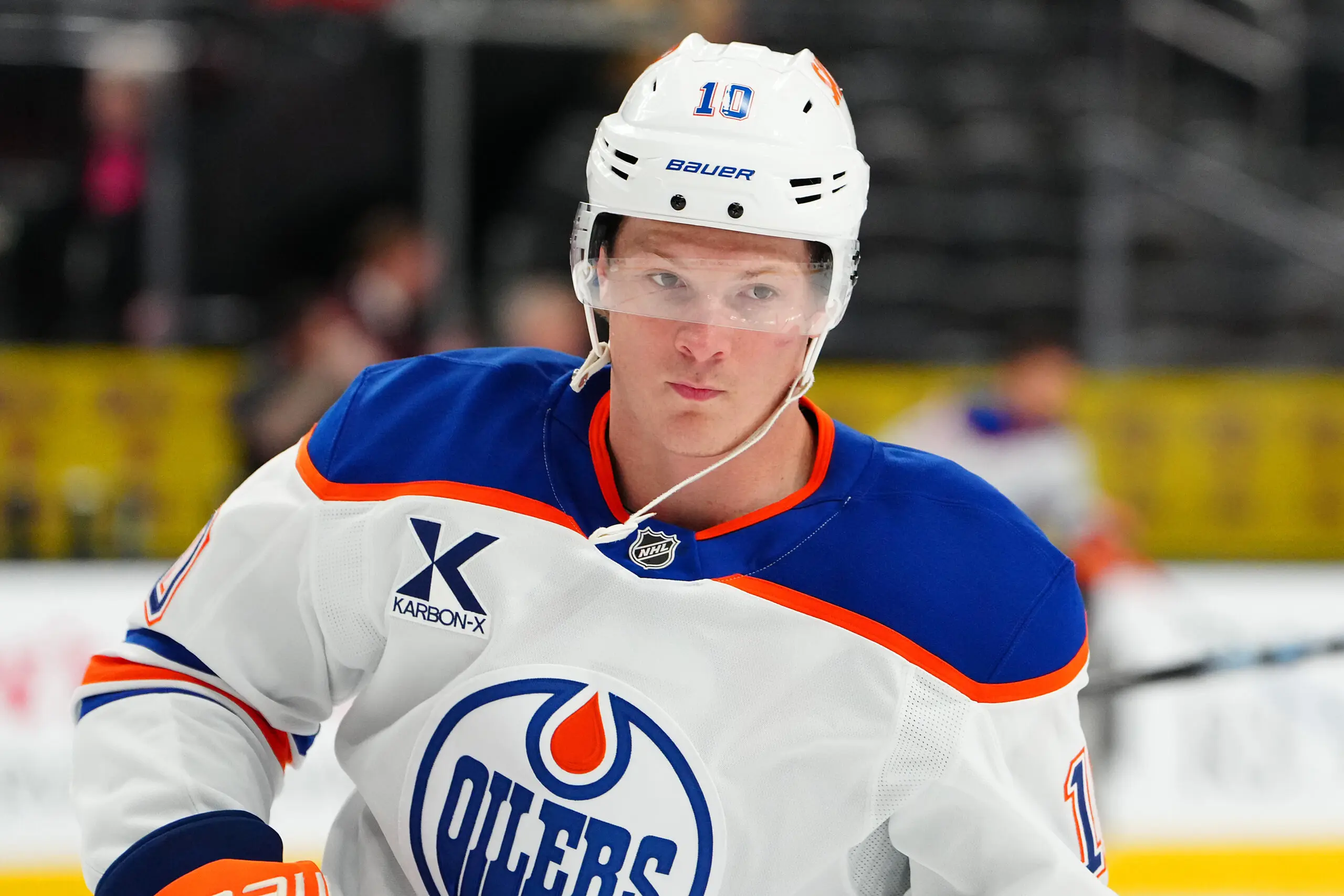
Photo credit: Stephen R. Sylvanie-Imagn Images

By Kelvin Cech
May 10, 2026, 19:00 EDTUpdated: May 11, 2026, 11:36 EDT


“And just like that, it’s like everything you fear the most rushing at you all at once.”
It’s a quote I recall hearing in the wake of the Edmonton Oilers Game 7 loss in 2006, and one that I’ve carried with me into my own coaching career. That Oilers team was destined for greatness, and while they ultimately fell a couple of goals short of the Cup (because of goaltending, imagine that!), I still think they were a team of destiny. That team capped an era of blue-collar hockey for the Oilers while adding the skill necessary to put the puck in and keep the puck out of the net.
That team was filled with players who excelled in the roles they were given. They were lucky, too, because they didn’t have boatloads of skill in reserve.
Imagine a team that possesses above-average skill while also deploying players in important roles for which they’re suited.
In the aftermath of the Oilers first-round defeat to the webbed feet of the Ducks, the tea leaves suggest the squad will largely return intact. Maybe they blow it all up or make a handful of significant moves, but really, how? They’ve got massive contracts to move or players they just acquired with massive contracts. In any case, who’s here and who isn’t is out of the coaches’ hands.
So what can the coaches control?
Trent Frederic
I read a comment somewhere that stated Trent Frederic was never given a sufficient chance to play a key role this season. This is true, but for the wrong reasons. Trent Frederic started the season on the first line with two of the best to ever do it. He was in front of the net on the power play. This is the move of a coach who wants to prove his general manager right.
Following that experiment, he spent the rest of the season playing all three forward positions on nearly every line, including the fifth. He was given a massive opportunity that didn’t work for him, and it didn’t work for the team.
When I’m conducting exit interviews, I like to get the players talking.
“When you’re at your best, what does that look like?”
What is Trent Frederic when he’s at his best? How would he answer that question? I bet he’d say he’s hard to play against and can chip in on the offence occasionally. Perfect. That’s a valuable third-line player. Plan to play him there in a role he’s suited for, and then it’s up to him to prepare for it all summer. Frederic is just one player, but he’s a good example.
Hockey players are simple. Just tell them what to do, and they’ll do it if they can. If they can’t, then something is out of alignment.
Before you can assign roles, you have to define what those roles look like. As a coaching staff, do you believe in hard matches? Do you prefer starting players in specific zones?
Optimal lines and pairing
I believe strongly in matchups, but I also like things to be simple. It’s tougher to get the matchups you want on the road, but I think you can cover for that with a combination match and zone-start approach. The lines will change, of course. Ideally, not in the first 10 minutes of the first period in Game 1. I think roles are valuable because players are focused and their energy is maximized.
We can probably agree that this year’s version of the Oilers was not focused and did not have enough energy to compete with the Ducks, but maybe not — I’m not the trainer, I’m just some guy.
Here’s how I’d build roles for each line and the type of players I’d look for in these roles.
Line 1: O-zone starts / Powerplay players (counted on for offence)
Line 2: D-zone & O-Zone Starts / PP / Matchup (hard to play against)
Line 3: D-zone starts / Hard Matchup (excited to play against the other team’s best)
Line 4: D-zone starts / Neutral zone starts / Start the game (trusted to play a bit against anybody)
At one point in round one, Joel Quenneville’s fourth line was on the ice after a TV timeout against McDavid, Draisaitl, Hyman, Ekholm, and Bouchard. That’s what, $40 million on the ice against less than $5 million? Incredible. But that doesn’t start in the playoffs, that starts at the beginning of the season. That’s how you build trust. Quenneville did the same thing in Chicago when they won cups. I believe it was Andrew Shaw centring the fourth line that was on the ice when they won.
Pair 1: Hard Matchup (can play against anybody)
Pair 2: DZ starts / Matchup (take the fight to the neutral zone)
Pair 3: OZ starts (keep the puck alive in the O-zone)
Are these players here? Or do they need to go out and get them? Again, not the GM, so let’s build lines now with who the Oilers have, and then give out summer tasks to our staff so we come back prepared, fresh, and eager.
Line 1: Isaac Howard – Connor McDavid – Zach Hyman
Line 2: Vasily Podkolzin – Leon Draisaitl – Kasperi Kapanen
Line 3: Trent Frederic – Ryan Nugent-Hopkins – Matt Savoie
Line 4: Colton Dach – Josh Samanski – Quinn Hutson
Line 1: Isaac Howard – Connor McDavid – Zach Hyman
Line 2: Vasily Podkolzin – Leon Draisaitl – Kasperi Kapanen
Line 3: Trent Frederic – Ryan Nugent-Hopkins – Matt Savoie
Line 4: Colton Dach – Josh Samanski – Quinn Hutson
The first line will start in the offensive zone, and when they’re at home, the coaches can find them clean air by putting them out after the second line to avoid the other team’s matchups. This gives McDavid and Hyman some smooth sailing while also giving them the most exciting prospect in the system, a player who can score goals if someone gets him the puck.
The second line was proven in the playoffs. Kapanen is inconsistent, but he tries to play hard, and his consistency issues are just part of it. Coach him through the ups and downs and stick with it because he’s proven you can count on him when it matters most.
That third line, though. Play them against the other team’s best. Savoie can handle it, and it’s nothing new to Nugent-Hopkins. It also gives Frederic a defined role. This line has smarts, speed, and a bit of pugnacity.
The fourth line is young, but they’ve proved they belong in the league. I’d have them in the starting lineup come the first game of the season. Honestly, why not?
With the lines set up like this, you’re counting on your middle six to play against the other team’s best players while maximizing the energy of your first line in the offensive zone. You’re building trust for the playoffs by sending the message that the playoffs are not guaranteed. You can’t make the playoffs in October or November, but you can sure AF miss them.
On special teams, I’d start with the penalty kill. The power play isn’t going to change, and it’s all anyone ever talks about. Let’s focus on the PK. The penalty kill is a privilege, which brings us back to 2006 and the Carolina Hurricanes.
The current Hurricanes are maximizing their roles to perfection, and it starts with their penalty kill. Try not to have a jammer just watching the clip here. This is a sensational effort. More ice time for Edmonton’s top players doesn’t equal more quality ice time. This is how I’d build PK pairings with the above lines in mind.
Podkolzin – Savoie
Frederic – Kapanen
Samanski – Hutson
Frederic – Kapanen
Samanski – Hutson
Now watch this Brind’Amourian effort.
Prior to this clip, in this penalty kill, Carolina’s forwards rotated like this:
- Start Staal / Martinook for the faceoff, clear, and off
- Aho and Jarvis are on within 30 seconds, defend, clear
- Jankowski / Robinson on for one faceoff; puck goes over the glass; they come off for a now-rested Staal and Martinook
- Back to Staal and Martinook for a faceoff with 1:17 remaining.
Six different forwards, and then back to the original two, for a total of eight rested forwards in 43 seconds. A penalty kill energy masterclass that will undoubtedly inspire the rest of the bench to follow up with enthusiasm. And wouldn’t you know it, Carolina tied the game late and won in double overtime. They had more energy!
Here’s the full post over at The Coaches Site if you want the full tactical breakdown of Carolina’s PK vs. Philly’s power play.
The Oilers need a jolt on their penalty kill, and I believe that will bleed throughout every aspect of their lineup. You’re fixing the greatest area of weakness and turning it into a strength.
Pressure is a privilege, and vibes are contagious. Sail through the storm. The obstacle is the way.
Define roles clearly and build trust on a daily basis the minute training camp starts by focusing on the penalty killers. The star forwards would benefit from not being the centre of attention, and they can follow the emotional lead of someone else for a change.
ARTICLE PRESENTED BY bet365


Breaking News
- Eduards Tralmaks on NHL ambitions: ‘I still haven’t given up on my dream yet’
- GDB -2.0: The test starts now as Oilers face Jets… again (6 PM MT, TSN3)
- Remember Ty Rattie? Revisiting ‘The Answer’ and searching for Edmonton’s next one
- Will Oilers fans put a new player in the doghouse?
- Ryan Shea’s strong Oilers debut, in sync with the top unit, comes as no surprise

Edmonton OilersTeam Cap Summary
Cap Summary
2027-28
2028-29
Projected Cap Hit
$88,322,500
$61,025,000
Projected Cap Space
$25,177,500
$61,975,000
Current Cap Space
$25,177,500
$61,975,000
Active Players
16/23
10/23
Draft Picks
Round
'27
'28
1
0
1
2
1
0
3
0
1