
OilersNation has no direct affiliation to the Edmonton Oilers, Oilers Entertainment Group, NHL, or NHLPA
Why one analytics model graded the Oilers off-season poorly


By Lane Golden
Jul 20, 2026, 18:00 EDTUpdated: Jul 27, 2026, 16:31 EDT
While there are still two months until the puck drops on opening night for the Edmonton Oilers, we’ve reached the point in the NHL off-season where most of the action is behind us. The big trades have happened, the marquee free agents have signed, and projections for 2026-27 have begun.
Every year, The Athletic’s analytics expert, Dom Luszczyszyn, releases his rankings for the most improved teams during the offseason. This year, the Oilers rank 25th.
“On the roster, Ryan Shea makes a lot of sense replacing Darnell Nurse, given the price difference,” wrote Luszczyszyn. “Frederik Andersen, when healthy, is an upgrade in net too. But the Oilers could still use a middle-six forward to replace Jack Roslovic, even if he was incredibly inconsistent.”
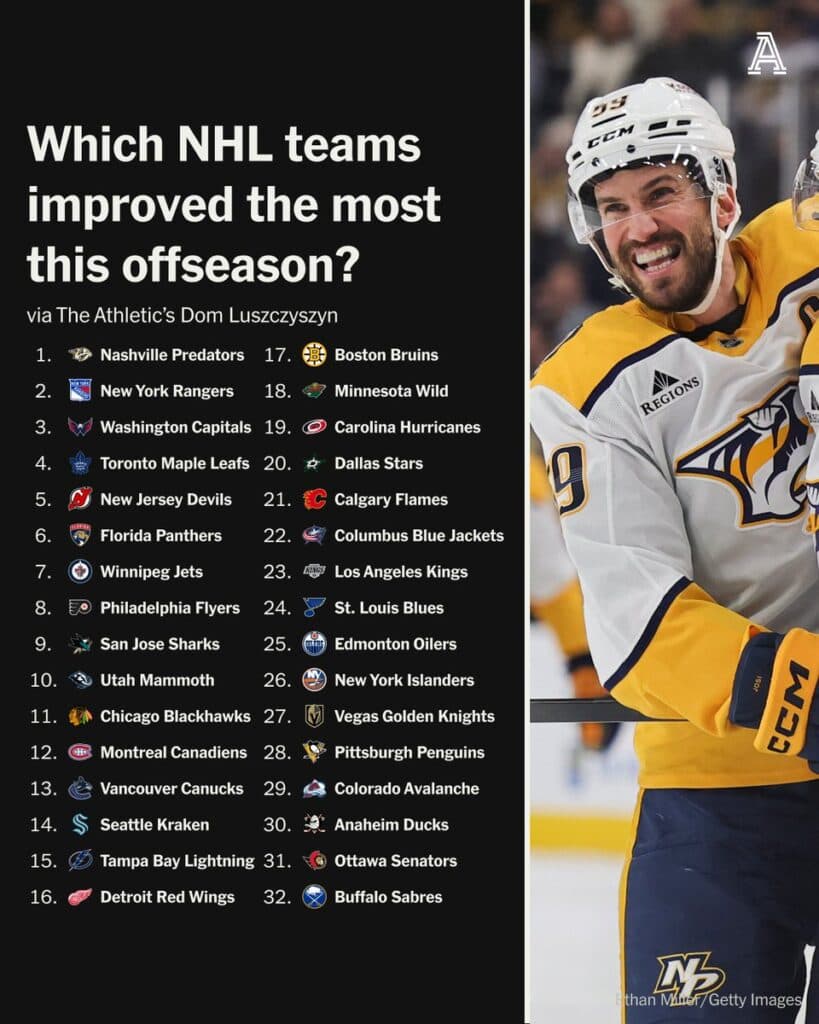
It’s been a rough summer for the Pacific Division — the San Jose Sharks were the only team ranked inside the top 10 most improved, while the Anaheim Ducks, Vegas Golden Knights, Los Angeles Kings, and Edmonton Oilers all ranked in the bottom 10.
A division so bad it was labelled a “pillow fight” by Oilers captain Connor McDavid last season has become even weaker.
The Ducks, Golden Knights, and Kings all lost major pieces without acquiring replacements. It’s no mystery why they ended up near the bottom of the rankings. But Edmonton’s 25th-place ranking is a little surprising given the overwhelmingly positive reception to Stan Bowman’s work over the last month.
Swapping out Connor Ingram for a pair of high-upside goaltenders in Frederik Andersen and Devon Levi is intriguing. And adding Ryan Shea to replace Darnell Nurse is a solid bet given Shea’s attributes and career trajectory.
So why the low ranking? Part of the reason is the set of criteria Luszczyszyn uses.
What analytics model ranked the Oilers so low in off-season improvements?
Luszczyszyn’s most improved team ranking isn’t based on subjective opinion; it’s entirely based on analytics. Specifically, a metric he created called Net Rating.
Net Rating is used to evaluate a player’s overall impact on their team’s success, factoring in offensive and defensive results, play-driving, and other relevant aspects. Using this strict metric, the Oilers’ roster has experienced a minus-8 decline in Net Rating.
While I think there’s value in metrics like Wins Above Replacement (WAR) or Net Rating to approximate player value, predicting a team’s future performance isn’t entirely as simple as plugging a roster into a model. There are plenty of other relevant factors at play that aren’t so easy to measure, like coaching. Mike Babcock is an addition to the Oilers that’s invisible in most models, but tangible once the team hits the ice.
Kris Knoblauch had a tough season last year. Edmonton’s lines were in a constant blender, McDavid and Draisaitl were overplayed and out of gas by the playoffs, and several players had difficulty finding a role. The Oilers weren’t a perfect roster, but Knoblauch didn’t do enough to maximize his roster.
That’s where the team could see its biggest change. Whatever your opinion is on Babcock’s off-ice conduct, most would agree he’s a brilliant hockey mind. If he can instill more structure and synergy in the Oilers, he could provide a significant boost that won’t be captured by analytics.
Even Luszczyszyn concedes this point. “From a pure results perspective, [Babcock] projects to provide a major impact given how the Leafs improved under the hood in his first season there,” he said.
His model also doesn’t factor in chemistry and playstyle. It might spit out a lower projection for Shea compared to Nurse, for example, but Shea’s ability to retrieve and move pucks up ice is a better fit with Edmonton’s forward group than Nurse’s skillset.
How can the Oilers exceed off-season analytics projections?
Coaching and playstyle aside, I can understand why the Oilers might rank lower in some models.
The defence is relatively similar, but the forward group lost Jack Roslovic, who wasn’t replaced in free agency. If you plug Isaac Howard into Roslovic’s spot, their forward group appears worse on paper, but players of Howard’s age and pedigree are plenty capable of breakout seasons.
Even if Howard can’t replace Roslovic’s contributions, the Oilers still have a bullet in the chamber, and that’s their $4.725 million of cap space, according to PuckPedia. If they sit back and accrue cap space over the course of the season, they’ll have enough room to fit any additional contract—no “hockey trades” or “money-in, money-out” requirements. With McDavid locked in for just two years, you have to think Bowman will pull the trigger on something big.
Luszczyszyn is a quality analyst with legitimate expertise in analytics, but his model isn’t gospel for future projections. With improved coaching and the cap flexibility for a game-changing addition, the Oilers have set themselves up for a higher ceiling in 2026-27. Regardless of what this model says.
PRESENTED BY VIVID SEATS

Take $20 off your first Vivid Seats order of $200+ using promo code OILERSNATION (new


Breaking News
- What does a successful 2026-27 season look like for Oilers’ Colton Dach?
- Oilers injury update: Frederik Andersen’s absence stems from lingering playoff injury
- Oilersnation celebrates 2026 Battle of the Donairs winner Famous Donair
- Bowman: Oilers unlikely to offer professional tryouts
- ‘Offensive player or bust’: Steven Ellis breaks down Isaac Howard’s drop off Daily Faceoff’s prospect list

Edmonton OilersTeam Cap Summary

Cap Summary
2026-27
2027-28
Projected Cap Hit
$102,071,666
$88,322,500
Projected Cap Space
$1,928,334
$25,177,500
Current Cap Space
$1,928,334
$25,177,500
Active Players
22/23
16/23
Draft Picks
Round
'26
'27
1
0
0
2
1
1
3
1
0