
OilersNation has no direct affiliation to the Edmonton Oilers, Oilers Entertainment Group, NHL, or NHLPA
Long Read: Mike Babcock’s history and what this hiring would mean for the Oilers
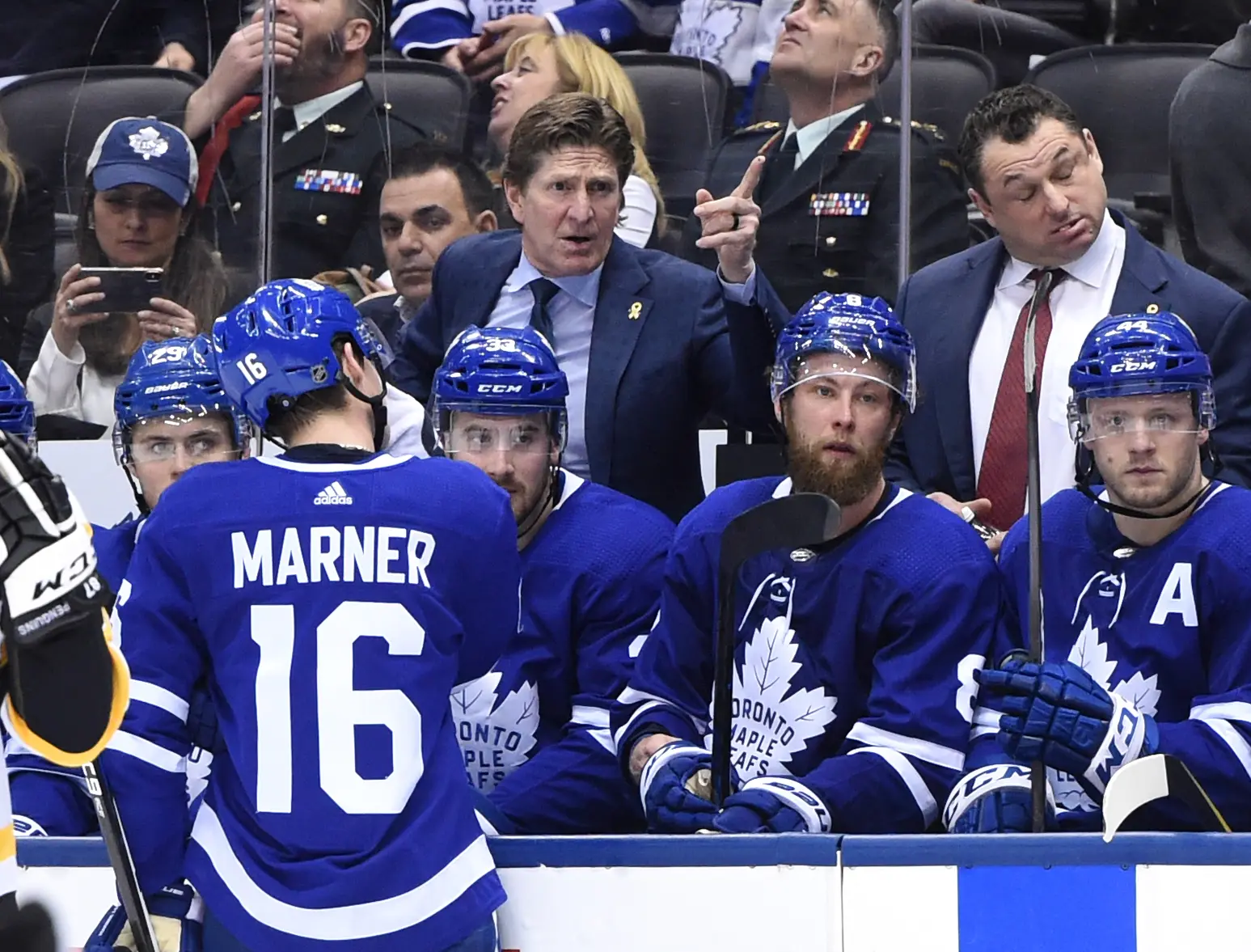
Photo credit: © Dan Hamilton-Imagn Images

Successful teams don’t just influence how opponents build their rosters. They influence how organizations think about leadership.
This year’s Stanley Cup Final features two perennial contenders that have built their success in different ways. The Carolina Hurricanes have become one of hockey’s most forward-thinking and analytical organizations, while the Vegas Golden Knights remain the league’s most ruthless operation, willing to make almost any move in pursuit of a championship.
The coaching matchup reflects that same emphasis on accountability. Rod Brind’Amour has built Carolina around structure and attention to detail, while John Tortorella’s demanding style helped push Vegas back to the Stanley Cup Final after he was hired shortly before the playoffs.
The Edmonton Oilers appear ready to follow a similar path.
Kris Knoblauch was fired two weeks after a disappointing first-round loss to the Anaheim Ducks, and the organization’s first choice to replace him was reportedly Bruce Cassidy. But the Golden Knights blocked Edmonton’s request to speak with their former coach, who remains under contract through next season.
Now, with free agency approaching and no coach in place, the Oilers have turned their attention to a name few expected to re-enter the NHL conversation.
Mike Babcock.
According to Bob Stauffer on Oilers NOW, Babcock is “100% the guy” for the Oilers and the team is only waiting for approval to hire him. Stauffer added that Babcock has met with owner Daryl Katz, his son Harrison, CEO Jeff Jackson, and general manager Stan Bowman, and that the team’s leadership group, including Connor McDavid, are on board.
“I’m not going to bullshit you. I’m gonna tell you exactly the way it is, okay? 100% Mike Babcock is the Edmonton Oilers’ guy, okay? From ownership to management to the players.“The organization feels they need a hard-ass to get over the hump, and the leadership group went to bat for him.”
Hiring Babcock would represent a sharp turn from the types of coaches the Oilers have had in recent years. Knoblauch’s signature asset is his calm demeanour. Jay Woodcroft was animated, but his background as a video coach made him an effective communicator and teacher. Even the old-school Dave Tippett was known as a player’s coach throughout his career.
Ken Hitchcock’s brief stint in 2018-19 is probably the closest thing the Oilers have had to a hard-ass head coach during the McDavid era. By the time he returned to Edmonton, however, Hitch was well beyond his yelling-and-screaming days.
Edmonton making this sort of pivot shouldn’t come as much of a surprise, given how last season went. Expectations were always going to be difficult to match after back-to-back trips to the Stanley Cup Final, but the Oilers spent much of last season looking like a team that expected success to arrive automatically.
The signs that the Oilers were becoming frustrated with Knoblauch were there during the season. Following a loss to the Calgary Flames in February, Leon Draisaitl said that everyone needed to come back better after the Olympic break, including the coaches.
“We’re not consistent enough, and this league’s too hard to just lollygag through games… You need everybody. It starts with the coaches. Everybody. You’re never going to win if you have four or five guys going, and it starts at the top. When we come back, we’ve got to get going.”
Draisaitl rarely calls out the organization publicly, which made the comments difficult to ignore.
Now, the only thing standing between the Oilers and their preferred candidate appears to be approval from the NHL Players’ Association.
Babcock’s most recent NHL job ended before he ever coached a game.
Hired by the Blue Jackets in July of 2023, Babcock resigned a few months later following a joint NHL-NHLPA investigation into allegations of inappropriate conduct.
On the Spittin’ Chiclets podcast, former NHL player Paul Bissonnette reported that Babcock had asked players to share personal photos from their cell phones and then displayed those images on his office television.
While veteran players such as Boone Jenner and Johnny Gaudreau viewed this as a standard meet-and-greet procedure, interviews conducted by the NHL and NHLPA found that several younger players felt deeply uncomfortable and that they were heavily pressured into an invasion of their personal privacy.
After Babcock’s resignation, Blue Jackets president John Davidson said in a statement that the hiring was a mistake.
“I am very disappointed. We went through a process earlier this summer prior to hiring Mike Babcock as our head coach. But we got it wrong, and that’s on us.“I can promise you we will learn from this moving forward. I also understand the criticism we are getting. It is deserved. All we can do now is learn from it and do everything we can to help our players and coaches get ready for the season.”
It’s been quite some time since Babcock was last behind the bench. After being fired by the Toronto Maple Leafs in November of 2019, the native of Manitouwadge, Ontario, had a consulting gig with the University of Vermont, then coached the University of Saskatchewan Huskies for a brief period.
Being hired by the Blue Jackets was meant to be a return to the NHL for a man who once signed the most lucrative coaching contract in league history. Instead, his few months in Columbus seemed to be the final straw in a polarizing figure landing on the blacklist.
The Oilers aren’t concerned about the optics of hiring Babcock. They’ve shown a willingness to look past uncomfortable optics if they believe the hockey upside justifies it.
What the Oilers care about is Babcock’s history of success. He’s won at multiple different levels, most notably the Stanley Cup with the Detroit Red Wings and gold with Team Canada at the Olympics.
Though those accomplishments came more than a decade ago, the Oilers appear to be betting that Babcock can still provide the demanding leadership they believe has been missing during the McDavid era. This is a team that, for better or worse, is ready for a hard-ass.
It’s not the Stanley Cup or Olympic medal that gives Babcock his authority. It’s something he refined while treating lower-level leagues like they were the highest professional ranks.
Babcock’s playing career offered little indication of what was to come. His only professional season came with the Whitley Warriors of the British Hockey League after stops in the SJHL, WHL, and four seasons at McGill University.
Without much of a profile from his playing days, Babcock started his coaching journey with Red Deer College, winning the Alberta Colleges Athletic Conference in 1989 and being named ACAC coach of the year. He then joined the Moose Jaw Warriors of the Western Hockey League in 1991 but was fired following two unsuccessful campaigns.
After being passed over by other Canadian major junior teams with coaching vacancies, Babcock took a job with the University of Lethbridge in 1993-94.
The university’s hockey program was on life support. Over their first nine seasons playing in the Canada West Universities Athletic Association, the Pronghorns had posted a paltry 57-179-9 record. A handful of veterans even quit the team to enjoy campus life rather than go through another regime change.
The hockey team was known more for partying during those years than they were for anything on the ice. That changed with Babcock at the helm. The new coach skated the remaining players to the verge of vomiting at training camp, saying he only worked them so hard because he saw promise among the misfits.
“Why don’t you guys believe in yourselves?” he would tell the team in the locker room. “Can someone answer that for me?”
The Pronghorns flew out of the gate when the regular season began, with students and professors alike filling the stands at games. Despite the early success, word came out that the university’s board of governors were considering the idea of cutting the hockey team, which had an annual budget of $125,000.
Babcock pushed his players to be more involved with the community to show the team’s value to Lethbridge. While their coach attended community forums and met with academics, the Pronghorns washed cars, hosted youth hockey clinics, and delivered presents during the holiday season.
None of those efforts appeared to make a difference, as the general faculties council met in January to discuss cutting all athletic programs by the fall of 1995. With that in mind, there was only one way Babcock knew how to save the Pronghorns.
“By winning, they couldn’t cut the program,” he told Sports Illustrated for a retrospective in 2017.
The Pronghorns reached the number-one spot in the national rankings by December, a first for any team from the University of Lethbridge. By January, they had already surpassed their single-season wins record.
Among the driving forces behind Lethbridge’s turnaround was power forward Jarret Zukiwsky, who had played under Babcock in Moose Jaw. In his first season with the Pronghorns, the former Warrior led the team with 32 goals and 63 points in 28 games.
Babcock knew exactly how to motivate a guy like Zukiwsky. It was negative reinforcement that fired him up. Babcock would snap things like “Zuk, you suck at that drill!” and “Are you going to put an effort in today?”
Wanting to shut his coach up, Zukiwsky would give all he had.
It wasn’t just yelling and insults that worked for Babcock. When the coach realized his star forward wasn’t right, he would pull Zukiwsky back on the bench for a few shifts before asking, “Are you ready to go now? Are you back?”
“He’s the best motivator I’ve ever seen in my life,” Zukiwsky said when looking back on his time with the Pronghorns. “A lot of coaches will be personal with players, but it’s about creating a relationship where you want to perform for him.”
The Pronghorns performed for Babcock. They went 19-7-2 during the regular season, which still stands as the program’s best record, and marched all the way to their first and only Canadian Interuniversity Athletic Union national championship.
When Lethbridge beat the University of Guelph in the final, goaltender Trevor Kruger praised Babcock for being “the spark plug to our engine.”
“Right now, I feel more pride in this because nobody ever thought it was possible,” Kruger said following the 1994 CIAU championship. “I mean, the lowly Pronghorns go all the way? You’ve got to be kidding.”
After delivering the most successful season in program history, Babcock had little trouble finding another opportunity in major junior hockey.
Babcock joined the Spokane Chiefs ahead of the 1994-95 season and put himself on the map as an up-and-coming head coaching prospect with a 224-172-29 record across six seasons. He was named WHL Coach of the Year twice (1996 and 2000) while guiding Spokane to two division titles and a berth in the 1996 Memorial Cup tournament.
The breakthrough that Babcock needed came in 1997 when he was called upon to coach Canada’s U20 squad. A gold-medal-winning performance at the World Juniors later led to a head coaching gig with the Cincinnati Mighty Ducks, an American Hockey League affiliate shared by the Mighty Ducks of Anaheim and Detroit Red Wings.
Despite balancing a roster full of players drafted by two different teams, Babcock guided the AHL Mighty Ducks to a franchise-high 41 wins and 95 points in his debut year in 2000-01.
With the NHL Mighty Ducks struggling, head coach and general manager Bryan Murray announced he was stepping back from coaching duties to focus on his front-office work.
According to The Athletic, Murray originally had a list of 19 suitors to replace him as coach, then narrowed it to three finalists. After interviewing the 39-year-old Babcock, Murray cancelled his meetings with the other two candidates.
“When I started looking for a coach, I was looking for someone with great enthusiasm, great ambition and who was hardworking,” Murray said following Babcock’s promotion to the NHL in 2002. “After talking to a variety of people who know hockey, and to Mike Babcock, the selection was obvious.”
Paul Kariya, the captain of the Mighty Ducks, was happy with the decision based on his interactions with Babcock at training camp.
“He’s a terrific person,” Kariya said. “A very energetic coach who coaches with passion, someone who can put us on the right track.”
The Mighty Ducks had only made the playoffs in two of their first nine seasons as an NHL franchise. Their only playoff series win at the time was back in 1997 when they edged out the Phoenix Coyotes in seven games before getting swept by the Red Wings.
In Babcock’s first season as head coach, Anaheim went 40-27-9-6, good for seventh in the Western Conference. The Ducks swept the heavily favoured Red Wings in the first round of the playoffs, got past the Dallas Stars in the second round, and then swept the Wild in the Conference Finals, allowing just one goal in their four games against Minnesota.
Though Anaheim’s Cinderella run ended with a loss in Game 7 of the Stanley Cup Final to the New Jersey Devils, the team’s surprising success put Babcock on the radar of other teams around the league.
After one more season with the Ducks, Babcock was hired by the Red Wings, who had suffered back-to-back playoff upsets to Anaheim in 2003 and then the Calgary Flames in 2004.
Detroit’s front office was already familiar with Babcock because of the shared AHL situation in Cincinnati. Red Wings assistant GM Jim Nill also worked with Babcock at the World Juniors and praised his intensity and preparation.
“He’s won at the Canadian college level, won in junior, won a world junior championship, he was successful in Cincinnati, and then went to a Stanley Cup final with Anaheim,” Nill told the Canadian Press. “That’s a pretty impressive resume for a guy his age.“There are no shortcuts with him. He’s a career hockey guy, he’s very well prepared, and he’s very intense. He demands a lot and has high standards.”
Babcock led the Wings to a 58-16-8 record in his first year with the club, which stands as their second-best regular-season result. Detroit was again shocked in the first round of the playoffs, falling in six games to the eighth-seeded Oilers.
The Wings reached the Conference Finals in 2007, falling to Babcock’s former team, the Ducks, in six games. In 2008, Detroit took down the Pittsburgh Penguins in six games to capture the first Stanley Cup of Babcock’s career. The two teams met again in the 2009 Cup Final, with Pittsburgh coming out on top in the rematch.
After back-to-back trips to the Stanley Cup, Babcock was named Canada’s head coach for the 2010 Olympics in Vancouver. The team was coming off a disastrous seventh-place finish at the Turin Olympics in 2006, and Babcock was called upon to replace Pat Quinn behind the bench.
Despite a shaky group-stage showing, Canada captured its first gold medal in men’s hockey on home soil with an overtime victory against the United States. After losing to the U.S. in the preliminary round, Babcock switched goaltender Martin Brodeur for Roberto Luongo, which wound up being a turning point for Canada.
The U.S. tied the gold-medal game late in the third period to force overtime, but Sidney Crosby responded early in the extra frame to win the tournament for the home side.
“There’s so much talent on the ice, this thing will be over quickly,” Babcock recalls telling the team before overtime. “In the next seven or eight minutes, one of you will be a hero for the rest of your life. It’s time to put your foot on the gas and go after them.”
In the course of just a couple of years, Babcock became a Stanley Cup champion and Olympic gold medalist. With gold medals from the World Juniors and World Cup of Hockey already in his cabinet, Babcock was suddenly one of the most decorated coaches in hockey history.
By the time 2015 rolled around, Babcock was the most exciting free agent set to hit the open market.
After the Wings were eliminated from the playoffs, general manager Ken Holland granted Babcock permission to speak with other clubs about his next job. After meeting with multiple teams and turning down a five-year extension offer from Detroit, Babcock signed a record-setting eight-year, $50 million contract with the Toronto Maple Leafs.
At $6.25 million per season, the contract more than doubled the salary of the next highest-paid coach in the league at the time. The money also gave Babcock a different power dynamic than most other coaches had, with a higher annual salary than many of the players who played under him.
“One of things I said to Mike was anytime you’re an unrestricted free agent in the prime of your career there’s going to be opportunities that will stagger you,” Holland said after Babcock signed with the Leafs. “I use the word stagger because I’m aware of what the industry pays, but in order to get people, you have to go above and beyond the industry standards.“I’m happy for Mike. I loved working with Mike. I believe it was a difficult decision for him, not only to go to Toronto but also to leave Detroit.”
But with the massive contract also came the pressure and microscope of working in the market most desperate for a Stanley Cup. The Maple Leafs haven’t won anything since 1967, and newly-hired president Brendan Shanahan believed his former Red Wings coach was the one to guide the team out of the dark.
The rebuilding Leafs tanked their way to a 29-42-11 record in Babcock’s first season, landing the first overall pick and the right to select Auston Matthews. With an injection of young talent in 2016-17, Toronto took a significant step forward, finishing 40-27-15 and losing in the first round to the favoured Washington Capitals.
What fans in Toronto thought was the opening of a Stanley Cup window was actually the beginning of a dramatic and tense few years between the team’s head coach and its core of star young players.
Though little spats about work ethic or commitments to defence often made headlines in Toronto, it wasn’t until Babcock was let go by the Leafs that the hockey world learned about how strained his relationship was with some of the players.
The Leafs put up strong regular-season results under Babcock, but continually fell flat in the playoffs, losing to the Boston Bruins in the first round in back-to-back years in 2018 and 2019. A few months into the 2019-20 season, newly-named GM Kyle Dubas fired Babcock in favour of Sheldon Keefe, who was coaching Toronto’s AHL affiliate.
Not long after the firing, word came out that Babcock had put Mitch Marner through a controversial “rookie test” during his debut season in 2016-17.
While the team was on a road trip, Babcock asked Marner to rank his teammates in terms of work ethic. Babcock then showed the list, which featured veterans Nazem Kadri and Tyler Bozak at the bottom, to other players on the team.
Though Bozak and Kadri stood up for Marner and Babcock eventually apologized, it was clear Marner was relieved when the Leafs finally made a coaching change in November of 2019.
“That was my first year, I didn’t really know what to think of it,” Marner said after Babcock was fired. “But it’s all over with now, there’s really nothing I can say. I’m looking forward to the future and the new change and seeing how I can help this team win with Sheldon [Keefe].”“When I heard about [Babcock telling other players about the rankings], I didn’t really know what to think,” Marner added. “But I was lucky enough to have that first-year group with me and our team was very tight and very well-knit together. That was a lucky situation. But it’s over with now. It’s out of my head.”
The playoff struggles have continued for Toronto after Babcock’s departure. The Leafs advanced beyond the first round just once in five seasons with Keefe behind the bench.
After a second-round loss to the Florida Panthers in 2025 with Craig Berube as head coach, Marner left his hometown club just before the start of free agency, inking a sign-and-trade deal with the Golden Knights.
Vegas had an unspectacular 2025-26 regular season, fired their coach a week before the playoffs, and are now in the Stanley Cup Final. Marner is among the Conn Smythe candidates for his relentless two-way play and ability to come through in the clutch.
“There’s been some dark times in hockey for myself,” Marner said after the Golden Knights advanced to the Stanley Cup Final. “I’m honestly thankful for my family, my brother, my mom and dad, my wife… You’ve got to have people around you that are amazing and love you… It’s been a great road and hopefully this road keeps going.”
Babcock’s firing in Toronto opened the floodgates to stories about issues with players well beyond Marner.
Shortly after the news broke, former NHL defenceman Mike Commodore, who played for Babcock in Anaheim, posted a slew of insults on Twitter, saying that “the hockey world is ecstatic” about his demise.
Commodore’s anger towards Babcock stems from early in his career when he was trying to break through with the Ducks.
”I don’t know who Mike Babcock is. I’ve never heard of him, I’ve never had a run in with him, nothing,” Commodore said in a May 2019 radio interview. “There’s no previous history whatsoever. I show up to camp, fight everybody in camp, I’m supposed to play [when the season starts]. I’m penciled in, but he has someone else he wants to play. Sends me down to the minors, carves me in the papers, says I showed up out of shape.“I swear to god, I never showed up out of shape because I wasn’t talented enough to do it. I would have been in the East Coast League and done in, like, two years. … I was never able to get rid of that reputation, like, ‘The guy doesn’t work out,’ because he went to the f***ing paper and said that. I read it. I’m like, are you f***ing kidding me?”
Another former player who spoke out against Babcock is Hall of Fame defenceman Chris Chelios. In the aftermath of Babcock’s departure from the Blue Jackets, the former Red Wing said that Columbus was better off without him.
“It’s just so unnecessary the things that he did to players and how awkward and uncomfortable it could be,” Chelios said. “There are too many good people in hockey who have to put up with someone like him.”
The memory that stands out for Chelios is Babcock’s treatment of Swedish forward Johan Franzen, who was dealing with post-concussion symptoms.
“What [Babcock] put that poor kid through when he was suffering through the concussion thing,” Chelios recalled. “Literally, he was calling him into his office once a week to call him a fat pig and say that your teammates hate you and why don’t you just quit?”
The tactics that Babcock used to motivate players like Jarret Zukiwsky when he was coaching at the University of Lethbridge were the same tactics that he used throughout his development as a coach in the WHL, AHL, and eventually NHL.
While that approach worked for Babcock throughout the 1990s and 2000s, it hasn’t translated into meaningful NHL playoff success since Detroit’s back-to-back trips to the Stanley Cup Final in 2008 and 2009.
Times have changed, and it’s difficult to say whether Babcock has learned how to relate to a younger generation of players. That wasn’t the case a few years ago when he had his disaster in Columbus. Whether that matters to the Oilers is another question entirely.
“He thought he could still do a lot of the things that made it successful in the past. And you can’t do that in today’s age,” one former Red Wing told The Athletic. “You just can’t. You won’t get away with it.”“He got away with a lot of stuff in an era where nobody really brought light to any of the stuff that he did,” said another former Red Wing who played for Babcock.
The Oilers aren’t the Blue Jackets. They’re a team with a generational talent who’s soon to be 30 years old without a Stanley Cup ring. They’re a team that has cycled through multiple coaching styles during the McDavid era without finding a formula capable of delivering a Stanley Cup.
For better or worse, the Oilers have decided that the thing they want to emulate from this year’s Stanley Cup Final is the need for an old-school, hard-ass coach.
Whether Vegas reached the Stanley Cup Final because of Tortorella or simply because of its talent is impossible to know. What’s clear is that Edmonton believes a tougher voice behind the bench can make a meaningful difference.
There’s no denying Babcock’s successes, but there’s also no way to ignore his faults. He’s been praised as a task-master, somebody who demands an impossibly high standard from everybody. He also hasn’t had success in the NHL in well over a decade, and his last two tenures blew up in flames.
The Oilers need to come into this knowing exactly what to expect from Babcock. He’s going to give them the motivation and structure they’re looking for, but it’s up to them to commit to it and not tune it out when it becomes difficult and uncomfortable.
Babcock isn’t coming to Edmonton to wave a magic wand and make the Oilers winners. He’s coming because the Oilers are the one team out there that thinks they can benefit from his approach.
Maybe they’re right. They better not be wrong, because there aren’t many cards left for them to play.
PRESENTED BY CAPITAL GMC BUICK

Hockey fans recognize elite performance instantly, and that’s exactly how Capital GMC Buick operates. With one of the city’s deepest selections of top-quality GMC and Buick vehicles and a customer experience built to win year after year, this dealership consistently leads the pack. Five current NHL players proudly drive vehicles from Capital GMC Buick, and for good reason. The store has been rated the #1 GM dealership in Canada by DealerRater for three consecutive years, is the only GM dealer in Edmonton endorsed by J.D. Power as a Dealer of Excellence, and has raised over $30,000 for the Stollery Children’s Hospital.


Breaking News
- Sunday Scramble: The enshittification of being a hockey fan in 2026
- McDavid scores five points in late-season game against Sharks: Best Oilers moments of 2025-26
- 3 Oilers Questions During the Summer Dead Zone
- Trent Frederic vs Mathieu Olivier: Top Edmonton Oilers fights of 2025-26
- Kapanen scores another clutch goal to seal Game 1: Best Oilers goals of 2025-26

Edmonton OilersTeam Cap Summary

Cap Summary
2026-27
2027-28
Projected Cap Hit
$99,274,166
$87,350,000
Projected Cap Space
$4,725,834
$26,150,000
Current Cap Space
$4,725,834
$26,150,000
Active Players
23/23
15/23
Draft Picks
Round
'26
'27
1
0
0
2
1
1
3
1
0