
OilersNation has no direct affiliation to the Edmonton Oilers, Oilers Entertainment Group, NHL, or NHLPA
Brutal cap realities mean Oilers cannot run it back
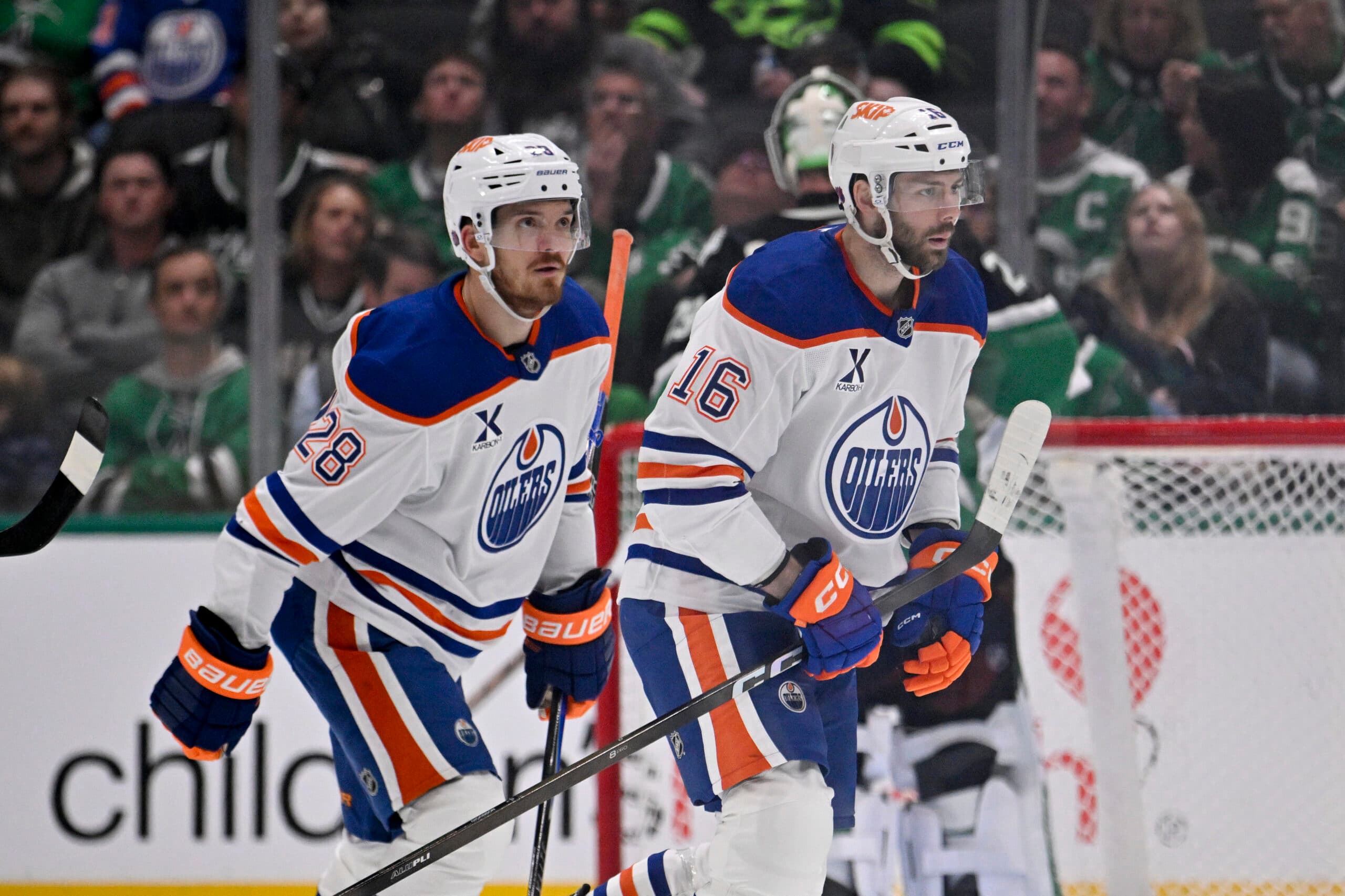
Photo credit: © Jerome Miron-Imagn Images

With two years remaining on Connor McDavid’s contract, this will be the most important off‑season in the McDavid and Draisaitl era for the Edmonton Oilers.
There is no doubt the team needs to make meaningful changes, and their recent decision to fire Kris Knoblauch shows the organization is willing to do so. But whether that ultimately ends up applying to their roster or not will depend heavily on how they manage their cap space.
The NHL has set next season’s salary cap at $104 million, giving Edmonton over $15 million in space to work with. They have a combined 10 (noteworthy) pending UFAs and RFAs heading into the summer.
Without further ado, let’s dig deeper into Edmonton’s overall cap picture and how it will shape their offseason plans.
*All cap info via PuckPedia, all player and team statistics via Natural Stat Trick and EvolvingHockey
Where they currently stand
Here is Edmonton’s rough roster template as it currently stands:
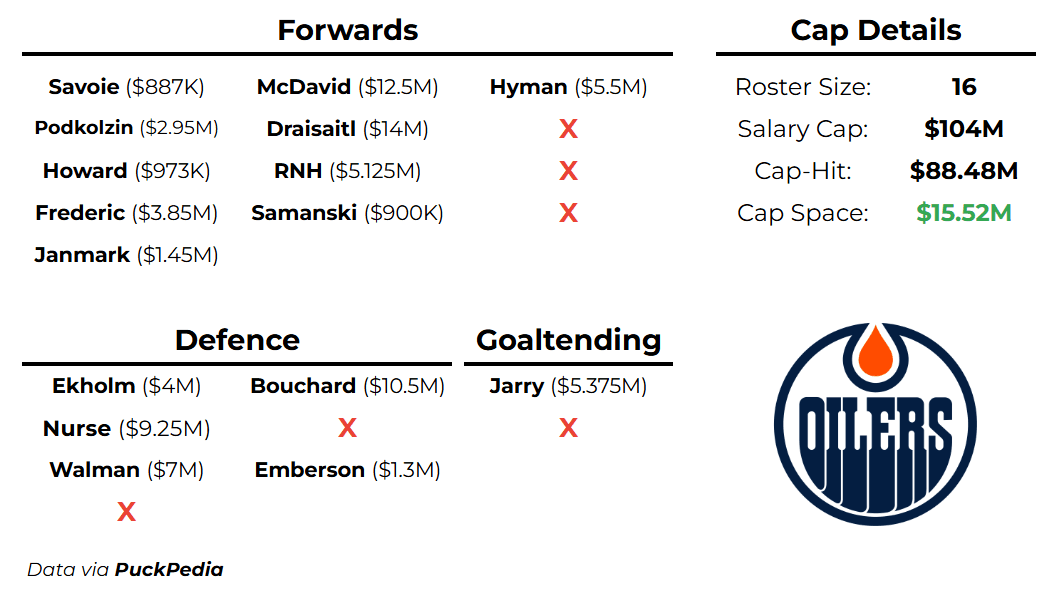
The line combinations can obviously be adjusted, but the goal here is simply to show the general structure. Note that I would assume Isaac Howard will be a full-time NHL player for the Oilers this upcoming season, or at the very least, I expect him to be given a long, extended look, likely to begin the season.
So, with this setup, the Oilers will have approximately ~$15.52 million worth of cap space for three forwards, two defencemen, and one goalie, assuming the other 16 players on this roster remain.
Specifically, they will likely need one top-six winger (or at least, one more player that can effectively play in the top-six), two bottom-six forwards, a second pair right-defenceman, a depth defenceman, and a goalie, likely a starting goalie in the scenario that Tristan Jarry does not bounce back (which, unfortunately, may seem most probable).
Can they run it back?
Can Edmonton bring back the exact roster that finished the 2025-26 season? The realistic answer is no. But they could bring back most of them.
Let’s take a look at Edmonton’s notable pending UFAs and RFAs from 2025-26 and what their next contracts might look like. I will use projection models from both EvolvingHockey and AFP Analytics, which have historically and generally been fairly reliable, though they can miss on certain players; you’ll see below where some of the numbers feel off. Nevertheless, I believe the models are still useful to at least consider. Here’s the list of those UFAs and RFAs along with their projected contracts:
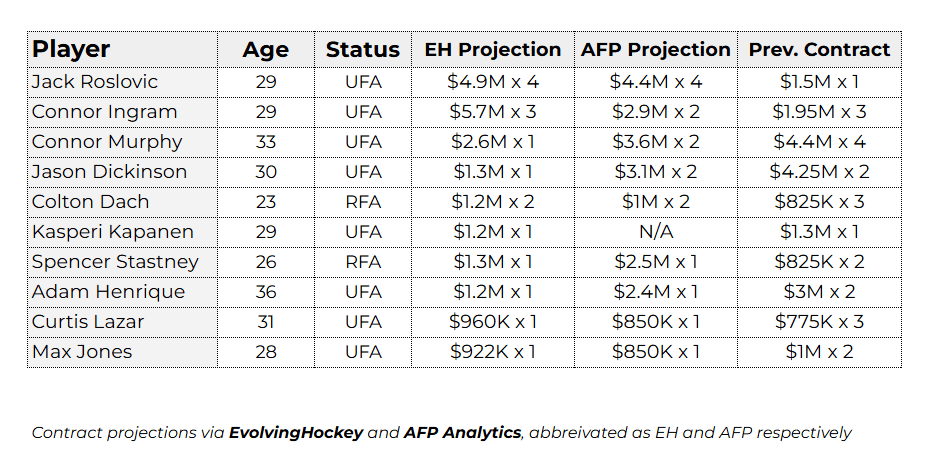
We begin with Jack Roslovic, who was signed on opening night to a one‑year, $1.5 million deal and produced 21 goals and 36 points in 69 games, though he managed just one point in six playoff games. Both models project him above $4 million on a multi‑year deal, which may be a tad high, as I could see him accepting a contract with a number that starts at 3. Still, with a relatively weak UFA class, there likely is at least one team out there willing to give a 20+ goal-scorer like Roslovic a lot more than Edmonton can.
Connor Ingram is interesting, as there seems to be significant disagreement between EvolvingHockey and AFP Analytics on his contract. AFP projects him at around $3 million, while EH nearly has him at $6 million! The latter projection certainly seems unrealistic. Based on his resume and counting stats, something in the $2-$3 million range feels far more likely if Edmonton chooses to keep him.
Then, there are the three players acquired from Chicago at the trade deadline. We’ll start with Connor Murphy. I think EvolvingHockey definitely underestimates his contract, and it should be closer to AFP’s projection of $3.6 million. Now, given the scarcity of right-handed defencemen, perhaps he could get considerably more than that. After all, Cody Ceci was signed for $4.5M last year by the Kings in free agency. Could a team in desperate need of a defensive RHD offer Murphy up to even $5 million? It’s not totally implausible.
Still, Murphy is a player that has spent the vast majority of his career on non-playoff teams in Arizona and Chicago. I could absolutely see him taking a bit less to remain on a contender like Edmonton to finally have an opportunity to win. Note crucially that OilersNow’ Bob Stauffer guesses that Murphy’s AAV will land around $3.5M to $4.0M.
Then, there is Jason Dickinson, a defensive middle-six centre. EvolvingHockey likely has another huge miss here, as Dickinson’s next deal will not start with a 1. AFP’s projection of $3.1M seems reasonable for a player that doesn’t produce a ton of points, though it’s worth noting that Stauffer estimates up to $3.75-$4.25 million over four years.
Colton Dach is a young, unproven RFA who will almost certainly land a short‑term deal at a cheap AAV. Spencer Stastney projects similarly; AFP’s number seems high, and something in the $1-$1.5 million range is more realistic as EvolvingHockey projects.
Kasperi Kapanen showed chemistry with Leon Draisaitl and was one of Edmonton’s few bright spots in their playoff loss to Anaheim. He’s inconsistent and injury‑prone, but a one‑year deal around 2.0-2.5 million makes sense if the Oilers want to see what he can do over a larger sample.
Adam Henrique still brings some defensive value and can help on the PK, but at 36 and slowing down, he’s not an ideal fit for a team that needs to get younger and faster. He could return if cheap, but it feels unlikely.
Curtis Lazar and Max Jones both posted solid underlying numbers and could return on sub‑$1 million depth deals. However, with Janmark on the roster, and a couple of younger players that could make an NHL impact next season, like Quinn Hutson, they may not wind up signing either player.
As a side note, considering the modified no-trade clause on Janmark’s contract and the fact that Janmark is reportedly good friends with McDavid and Draisaitl, I would assume it is much more likely than not that Janmark will remain on Edmonton’s opening-night roster in 2026-27.
So, with everything in mind, here’s a glance at a hypothetical roster where the Oilers re-sign most of their pending UFAs/RFAs:
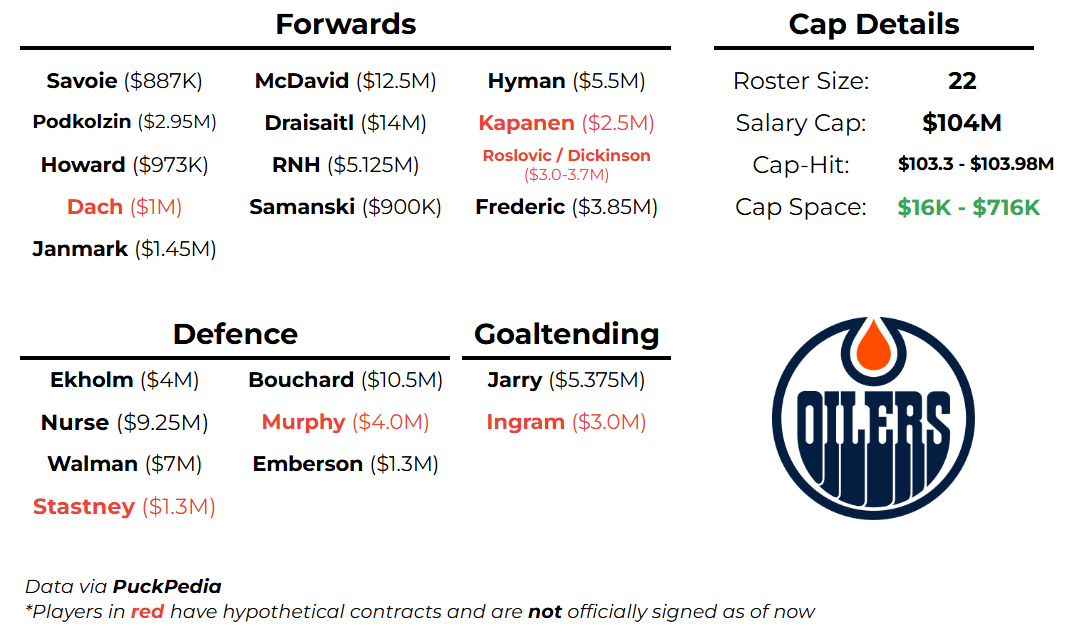
Assuming Murphy comes in at $4 million, Kapanen at $2.5 million, Dach at $1 million, Ingram at $3 million, and one of Dickinson or Roslovic at $3-$3.7 million, it is possible for the Oilers to fit underneath the cap ceiling, even using the higher end of projections for most of the re-signed players here. Note that is more realistic that Dickinson falls within the $3-$3.7 million range than Roslovic does, and it is also more likely the Oilers value Dickinson more due to his defensive prowess and ability to play centre, but the point here is, it is quite plausible to see them bring back most of their players in need of contracts.
Ok… but where does the improvement come from?
Of course, it’s one thing to try to keep the team the same, but coming off a first-round exit where Connor McDavid explicitly calls the team “average,” Edmonton quite obviously needs to improve.
Perhaps they can expect progression from younger players like Matthew Savoie and Isaac Howard, and maybe a rested, healthy Connor McDavid and Leon Draisaitl can make a huge difference. But at the same time, core players like Mattias Ekholm, Zach Hyman, and Ryan Nugent-Hopkins are all getting much older.
Simply put, the roster on paper needs to improve if Edmonton wants to keep pace with the league’s top teams. In the scenario where they re‑sign most of their pending UFAs and RFAs, they don’t have the cap space to do that. So if they want to get better, they really only have two paths:
A) Let go of multiple pending UFAs/RFAs and attempt to upgrade them.
B) Find a way to clear more cap space.
Let’s start with Option A. Of the six players re‑signed in the earlier scenario, Murphy is the one I’d prioritize as I wrote last week. I also see little reason not to give Dach another chance; he didn’t play a ton in Edmonton, but he certainly showed flashes, and as a 23-year-old with size, physicality and speed, there could be upside here.
Say Murphy and Dach combine for around $5 million. Add roughly another million for a seventh defenceman, whether that’s Stastney or someone else. From there, the Oilers would need at least two of Isaac Howard, Quinn Hutson, or Trent Frederic to become reliable third‑line players. If that happens, you could end up with a bottom six like Howard – RNH – Frederic and Dach – Samanski – Hutson, with Frederic bouncing back under a new coach.
Putting that all together, that would leave you with over $8 million to find both a goalie upgrade on Ingram and a middle-six forward with more upside than Roslovic, Dickinson, and Kapanen, and maybe about $9 million if the Oilers ice a 21-man roster. If the Oilers play their cards right, it is possible to ice a very strong team here.
But, Option A relies on a lot of “ifs.” With two years left on McDavid’s contract, it’s fair to question whether the Oilers want to bet on that many uncertainties. It will be heavily contingent on internal development.
This brings us to Option B, the path they likely need if they want to make more meaningful improvements. At the end of the day, the obvious and brutal reality here is that if the Oilers want to significantly improve upon their roster from the end of the 2025-26 season, they need need to move out at least one, if not all of the three notably bad contracts taking up cap space: Darnell Nurse at $9.25 million, Tristan Jarry at $5.375 million, and Trent Frederic at $3.85 million.
There have been reports that Edmonton has at least explored a Nurse trade. With some salary retained, I could see a team talking themselves into him at $6-$7 million, especially with the cap rising. He still has a reputation as a big, mobile defenceman who plays heavy minutes, and while the comparison isn’t perfect, the fact that contracts like Seth Jones’s and Pierre‑Luc Dubois’s have been moved shows that big deals aren’t totally immovable. Of course, even in the scenario the Oilers find a team willing to take him, the bigger question is whether Nurse would waive his NMC. That is obviously a huge obstacle.
Still, there’s a lot more smoke around a potential Nurse move than in previous years. Difficult? Yes. Impossible? No.
Jarry and Frederic are also tough to move, especially with Jarry’s cap hit and Frederic’s NMC. My guess is the Oilers keep both and hope for a rebound. Jarry has been inconsistent throughout his career, but historically better than what he showed in 2025-26 with Edmonton, and Frederic could benefit from a coaching change and better health.
One may consider Jake Walman’s contract in this conversation of bad contracts as well, though his 2025-26 was riddled with injuries and time spent on his offside, and considering his track record, I would say his chances of a bounce-back in 2026-27, potentially at LD alongside Murphy, are much more realistic.
All things considered, it is certainly possible to upgrade this roster, but it will obviously be a challenge. Will management ultimately be able to ice a legitimate cup-contending roster that can compete with the likes of Colorado, Carolina, a healthy Florida, and more and finally go all the way? Time will tell.
Find me on Twitter (@NHL_Sid)
ARTICLE PRESENTED BY bet365


Breaking News
- ‘I lost who I was’: Trent Frederic opens up about tough Oilers season
- Oilersnation Radio: Let’s talk about Daily Faceoff Edmonton
- 31 Oilers Questions: Is winning a Stanley Cup the only way McDavid will re-sign?
- Oilers building goaltending pipeline with Emil Vinni signing
- Former Oilers forward Jeff Skinner signs in Switzerland with EHC Biel-Bienne

Edmonton OilersTeam Cap Summary

Cap Summary
2026-27
2027-28
Projected Cap Hit
$99,274,166
$87,350,000
Projected Cap Space
$4,725,834
$26,150,000
Current Cap Space
$4,725,834
$26,150,000
Active Players
23/23
15/23
Draft Picks
Round
'26
'27
1
0
0
2
1
1
3
1
0