
OilersNation has no direct affiliation to the Edmonton Oilers, Oilers Entertainment Group, NHL, or NHLPA
Oilers special teams concerns mimic those from 2025 series against Kings
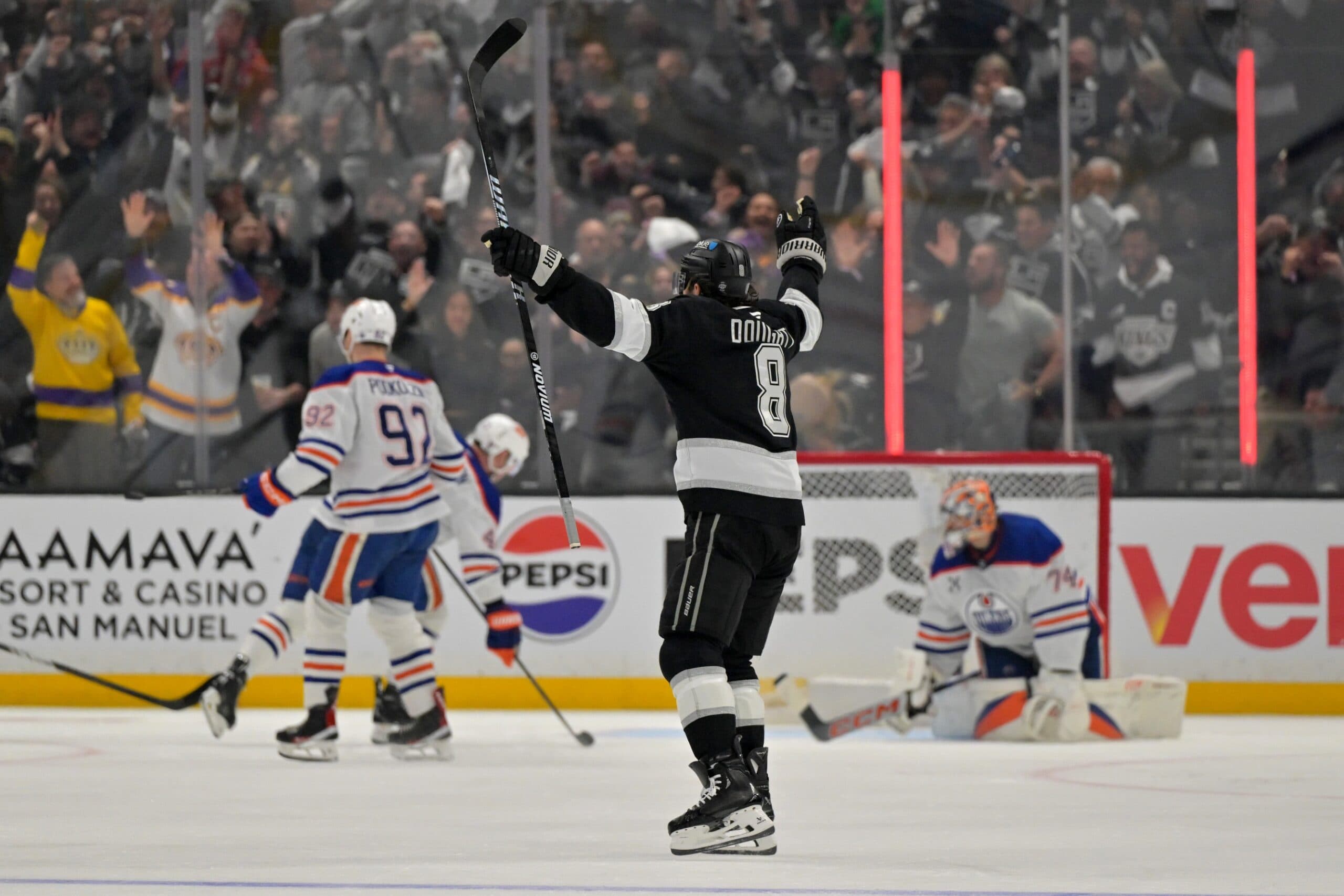
Photo credit: Jayne Kamin-Oncea-Imagn Images

Apr 24, 2026, 19:00 EDTUpdated: Apr 25, 2026, 18:50 EDT
The Edmonton Oilers have split the first two games with the Anaheim Ducks to begin the 2026 playoffs.
It’s safe to say that they haven’t been at their best. Connor McDavid has played the worst games we’ve seen in a long time, while both Jason Dickinson and Adam Henrique missed Game 2. The Oilers’ five-on-five play has been encouraging, owning 66.67 per cent of the goal share and 52.02 per cent of the expected goal share, but their special teams have been rough.
In Game 1, the Oilers were 0-for-2 on their power play and struggled to even get into the zone. McDavid was stuffed at the line numerous times, and Evan Bouchard struggled to break it out. They also allowed a goal on the penalty kill, as Troy Terry beat a screened Connor Ingram.
Game 2’s special teams were even worse for the Oilers in a 6-4 loss. Two of the Ducks’ five goals came on the penalty kill, one on a shot with a screen in front of Ingram, and the other a strong drive to the net with no Oiler around Alex Killorn. To make matters worse, the Oilers were 0-for-4 on the power play, even giving up a short-handed goal.
There are power plays that gain momentum, but none of the six power plays the Oilers have had have done that. They also can’t keep the puck out of the net on the penalty kill. Still, there are some parallels to last season.
Special team parallels to the start of the 2025 postseason
Leon Draisaitl missed the final 14 games of the regular season after a hit from Nashville Predators’ forward Ozzy Wiesblatt. Zach Hyman played in the season finale, but missed five of the last six games of the season as well. That’s two key members of the Oilers’ top-ranked power play who were out.
As you could expect, the Oilers struggled without Draisaitl. In the final 14 games of the season, they were 8-for-34 , good enough for a 24.5 power play percentage. That’d still be good enough for seventh in the league, but a far cry from their 30.6 power play percentage of the season.
Not just that, but five of those goals came in just two games, including a 3-for-3 game against the San Jose Sharks. In their next eight games following Draisaitl’s injury, the Oilers were 1-for-16 until Matthew Savoie scored a power play goal against the Chicago Blackhawks at the start of April.
It looked better toward the end of the season, but it’s clear that the power play is rusty with Draisaitl and Hyman back in the lineup, hence the 0-for-6 in Games 1 and 2.
Going back to last postseason, Game 1 was in Los Angeles, where the Oilers fell 6-5 despite overcoming a 4-0 lead to tie it late. Less than a minute following McDavid’s game-tying goal, Phillip Danault beat Stuart Skinner for the win.
Game 2 was pretty much the same. The Oilers went down in the first period and dug themselves a hole (this time 3-0). They scored twice to bring it to within one early in the third, but the Kings scored three unanswered in the third.
A big reason for the Kings’ success? Special teams. The Kings scored two power play goals on five attempts in Game 1, while killing off the two Oiler power plays. In Game 2, the Kings were 3-for-5 on their power plays, with the Oilers failing to score on their three power play attempts. Down 2-0 in the series, the Oilers’ power play was 0-for-5, while their penalty kill, one of the biggest reasons why they made the Stanley Cup Finals in 2024, was a dismal 50 per cent.
The Oilers had a lot of turnover coming into that series. McDavid played the final four games of the season, but missed eight games toward the end of the season. Draisaitl missed the final seven games of the season as well. That doesn’t even mention Evander Kane, who missed all of the 2024-25 regular season, and Mattias Ekholm, who was injured late in the year and didn’t return until the Western Conference Finals.
Simply put, the Oilers were rusty coming into that series, and they fell into a 2-0 hole thanks to poor special teams. So what happened next?
Game 3 returned to Alberta, with the Oilers taking a lead thanks to an early goal, then a 2-0 lead thanks to a Bouchard power play goal. The Kings fought back with three goals of their own, two of which came on the power play. Toward the end of the third, the teams exchanged goals, then Kane tied it with under seven to go. The goal was reviewed, it wasn’t overturned, and the Oilers scored seconds later on the ensuing power play.
Both teams were 2-for-2 on the power play. Game 4 saw the Oilers kill off all three penalties they took while scoring two power play goals. One of which came in overtime to knot the series at two each. The Kings’ lone goal in Game 5 was a power play goal, but the Oilers dominated despite going 0-for-2 and had a chance to win the series at home. In that game, a 6-4 victory, the Oilers scored on their lone power play and killed off both penalties.
Including those four games, the Oilers kick-started a 13-2 stretch, losing Game 3 in the semifinals and Game 1 of the Western Conference Finals. Figuring out their power play was a big reason for it, finishing with a 25.4 percent conversion rate. It wasn’t the same case with the penalty kill, finishing with a 67.1 penalty kill percentage.
Still, one of the big talking points after the first two games of the 2025 postseason was their special teams, just like it is right now. They’re in better shape than last season, and expect at least the power play to improve over the next few games.
Ryley Delaney is a Nation Network writer for Oilersnation, FlamesNation, and Blue Jays Nation. Follow her on Twitter @Ryley__Delaney.
PRESENTED BY VIVID SEATS

Take $20 off your first Vivid Seats order of $200+ using promo code OILERSNATION (new


Breaking News
- 4 Oilers primed for bounce back seasons
- Oilers prospect Rudolfs Berzkalns named captain of USHL’s Muskegon Lumberjacks
- Grading every trade of the Stan Bowman era with the Edmonton Oilers
- Why the Oilers can survive Frederik Andersen’s absence
- Oilersnation Radio: Bounce back Oilers, injury worries, and the Connor Hellebuyck situation

Edmonton OilersTeam Cap Summary

Cap Summary
2026-27
2027-28
Projected Cap Hit
$102,071,666
$88,322,500
Projected Cap Space
$1,928,334
$25,177,500
Current Cap Space
$1,928,334
$25,177,500
Active Players
22/23
16/23
Draft Picks
Round
'26
'27
1
0
0
2
1
1
3
1
0