
OilersNation has no direct affiliation to the Edmonton Oilers, Oilers Entertainment Group, NHL, or NHLPA
Four stats to keep an eye on as the Oilers enter the second half of 2025-26
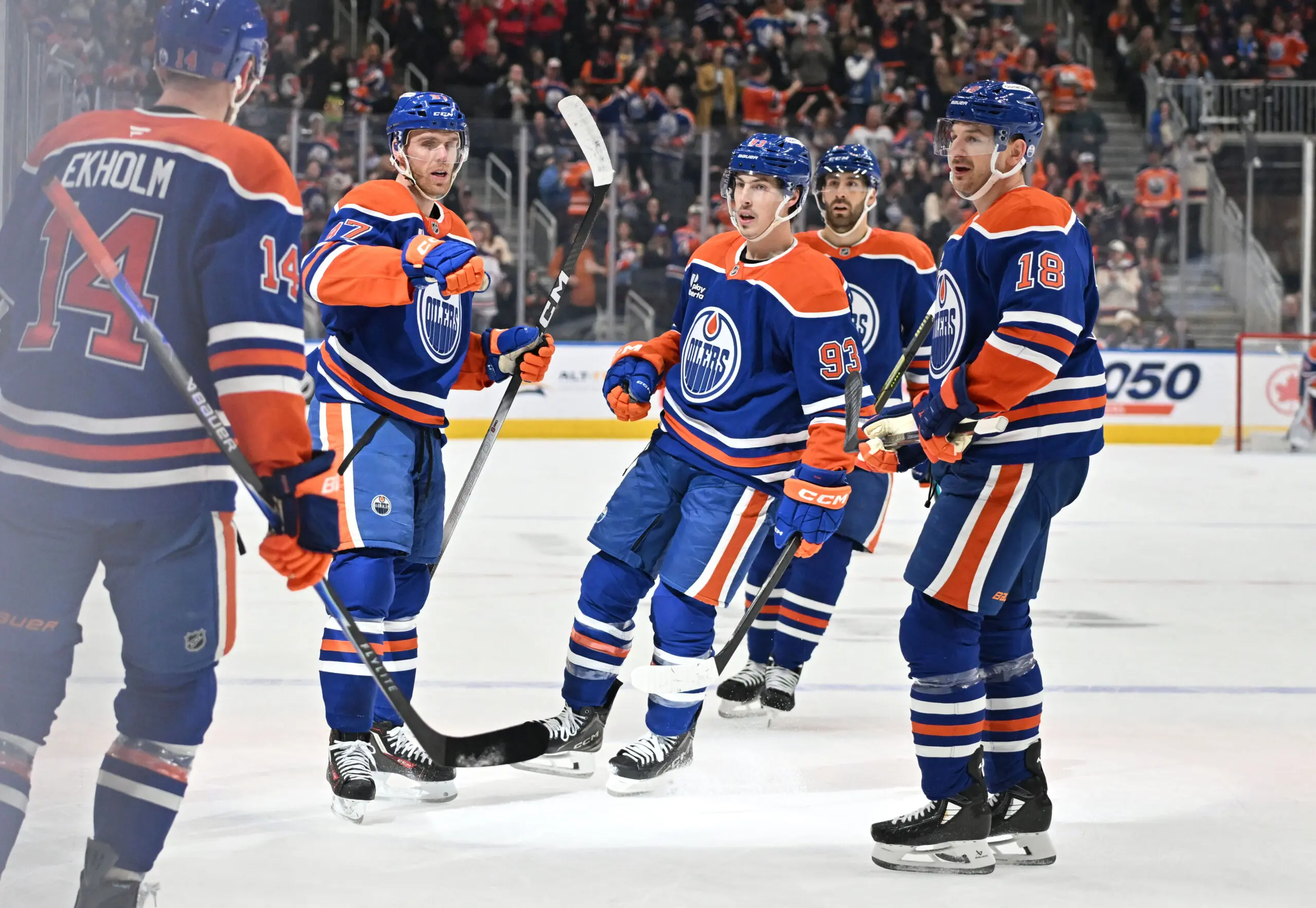
Photo credit: © Walter Tychnowicz-Imagn Images


After 42 games, the Edmonton Oilers possess a record of 20-16-6. While there have been some bright spots this season, it’s fair to say the Oilers’ performance in the 2025-26 NHL season thus far has been below expectations.
As the Oilers enter the second half of the campaign, here are four key stats that I would keep a sharp eye on.
*All stats via Natural Stat Trick unless stated otherwise
1. Power play percentage
If there’s one thing that has gone extraordinarily well for the Oilers this season, it’s their power play.
For years, the Oilers’ power play has been absolutely dominant. However, for their lofty standards, it somewhat slowed down in the prior two seasons. After averaging a record-high 13 PP goals per hour in 2022-23, they declined to 10.6 in 2023-24, and then 8.9 in 2024-25. Of course, these are not bad rates by any means at all, but I would certainly argue it was below expectations for a unit with Connor McDavid and Leon Draisaitl.
However, this season, they are now averaging 13.9 goals per hour on the man advantage. That is the highest scoring rate by any team in a single season in the analytics era, beating the record that the 2022-23 Oilers team set. Overall, their PP% through 42 games is an astounding 33.6 percent.
In the summer, assistant coach Glen Gulutzan – formerly in charge of running Edmonton’s power play – left the organization this summer as the Dallas Stars hired him as their head coach. Prior to Gulutzan’s arrival in Edmonton, the Oilers’ PP% ranked dead last in 2017-18, but it immediately improved when Gulutzan came in during 2018-19, improving to 9th in the NHL, and then improved to first place in 2019-20. As a result, there was some doubt regarding how well the power play would perform with his departure.
In Gulutzan’s place, the Oilers hired Paul McFarland. But fortunately, not only has the power play avoided any drop‑off under McFarland, it has reached new heights. The power play has been one of, if not the biggest reasons the Oilers currently sit atop the Pacific Division, and it’s something I’ll certainly be watching closely as the season moves forward.
2. Save percentage
While Edmonton’s power play percentage may be the best it has ever been, the team’s save percentage is the worst it has ever been in the McDavid and Draisaitl era. Overall, the Oilers possess a team save percentage of .877, ranking dead last in the league.
In an effort to finally address their goaltending, Edmonton made their big goalie move back in December when they dealt Stuart Skinner, alongside defenceman Brett Kulak and a 2029 second-round pick, to the Pittsburgh Penguins for goaltender Tristan Jarry.
However, in just his third game with the Oilers, Jarry left with an injury, and has been out ever since. Kris Knoblauch stated that he expects Jarry to return around mid-January. Following Jarry’s injury, the Oilers have run a goaltending tandem of Calvin Pickard and Connor Ingram, the latter being recalled from Bakersfield.
Ingram generally played decently well in his first three games in Edmonton, though one awful game against the Boston Bruins – in which he allowed 6 goals – has tanked his results so far. As for Pickard, he has continued to struggle overall, possessing a brutal 0.873 save percentage and a -2.3 GSAx through 15 games this season per MoneyPuck’s model.
When Jarry returns, can he be a reliable and consistent goaltender for the Oilers? And, will Jarry’s backup be Pickard or Ingram? These are crucial questions whose answers could very well be the difference between an early playoff exit and a Stanley Cup for Edmonton.
3. TOI/GP for Matt Savoie, Isaac Howard, and Quinn Hutson
Just two seasons ago, the Oilers ranked as the oldest team in the NHL. They have very often been critiqued for their inadequate development and handling of their younger prospects, and rightfully so.
This season, the Oilers have several young, skilled forwards in Matt Savoie, Isaac Howard, and Quinn Hutson, but Kris Knoblauch’s deployment of them thus far doesn’t exactly suggest that the team has learned from past mistakes.
Matt Savoie started the season in the bottom-six, but gained some time from mid-November to mid-December in the top-six, largely next to Leon Draisaitl and Vasily Podkolzin. In that span, he certainly showed talent, ranking first on the team in five-on-five xGF/60 and some decent production totals. However, more line shuffling from Knoblauch has resulted in Savoie going back to the bottom-six.
Furthermore, in the games they have played in the NHL, Howard and Hutson – recently recalled from the Condors – have averaged just about 9 and 7 minutes per game respectively at five-on-five, behind players like Trent Frederic and Mattias Janmark.
How Knoblauch handles Edmonton’s younger players will be important and something to keep an eye on.
4. 5-on-5 goals per 60 minutes
This season, the Oilers have averaged 2.4 goals per 60 minutes at five-on-five. To put this into perspective, that is a lower rate than both the 2017-18 and 2019-20 Oilers teams.
Overall, the Oilers’ underlying 5-on-5 numbers all season long have simply been well below expectations. They possess a negative actual and expected goal differential at 5-on-5, and their lacklustre offence has been a huge role.
If the Oilers want any chance of another deep playoff run, their 5-on-5 offence is an area that must take a massive step forward.
Find me on Twitter (@NHL_Sid)
ARTICLE PRESENTED BY bet365


Breaking News
- ‘I work my balls off’: Babcock and Oilers’ newcomers ready to make camp impact
- Real Life Podcast: The RIPNation Party, Oilers training camp, and peak Kool-Aid szn
- WWYDW(TE): Let’s talk Oilers line combos
- Five takeaways from day one of Oilers training camp
- Bouchard, Hyman named to Oilers leadership group

Edmonton OilersTeam Cap Summary

Cap Summary
2027-28
2028-29
Projected Cap Hit
$88,322,500
$61,025,000
Projected Cap Space
$25,177,500
$61,975,000
Current Cap Space
$25,177,500
$61,975,000
Active Players
16/23
10/23
Draft Picks
Round
'27
'28
1
0
1
2
1
0
3
0
1