
OilersNation has no direct affiliation to the Edmonton Oilers, Oilers Entertainment Group, NHL, or NHLPA
Which NHL teams are primed to regress to the mean?
Photo credit: © Perry Nelson-Imagn Images

We are about 30 percent into the 2025-26 NHL regular season. Thus far, this season has offered numerous surprises, with various teams performing above and below expectations.
However, it is crucial to note that hockey is a sport that can often be significantly impacted by luck and variance, particularly in smaller sample sizes. There are often several teams each year that open with impressive runs until they eventually cool off, while many others rebound from slow starts and finish strong.
The Edmonton Oilers are a prime example of the latter; many should recall their horrendous start to the 2023-24 season where they had an abysmal record of 2-9-1 in their first twelve games. However, they would go on to rally back to finish second in the division in the regular season and come just a single win short of winning the Stanley Cup.
Without the benefit of hindsight, how can one evaluate if a team’s start to the season – good or bad – is truly sustainable? One widely used metric with proven predictive value that we can use is 5‑on‑5 PDO.
This is a statistic that represents the sum of a team’s shooting and save percentage, and is commonly used as a proxy for puck luck. To explain how this stat works in a nutshell, the league average PDO is about ~1.00. Teams with a PDO well above 1.00 are often overachieving, whereas teams with a PDO well below 1.00 are often underachieving. Of course, there are outliers to this rule, as teams with genuinely elite finishing talent and goaltending can consistently score a high PDO (and vice versa), but as a general rule of thumb, the majority of teams will not sustain a PDO significantly higher or lower than 1.00 over a large enough sample.
For instance, the Oilers had a shockingly low PDO of 0.972 in the first 20 games of 2023-24. Predictably, it did not last, as they wound up finishing the season with a PDO of almost exactly 1.00! On the other hand of things, that same season, the Detroit Red Wings started strong with a record of 11-6-3 in their first 20 games, firmly in a playoff spot. But their PDO was a sky-high 1.032, clearly unsustainable. And just like the Oilers, they regressed to the mean, but in the opposite direction, as they missed the playoffs and finished the season with a ~1.008 PDO. I could go on and on with countless more examples, but I think you get the point; PDO can be greatly indicative of a team’s puck luck on both ends.
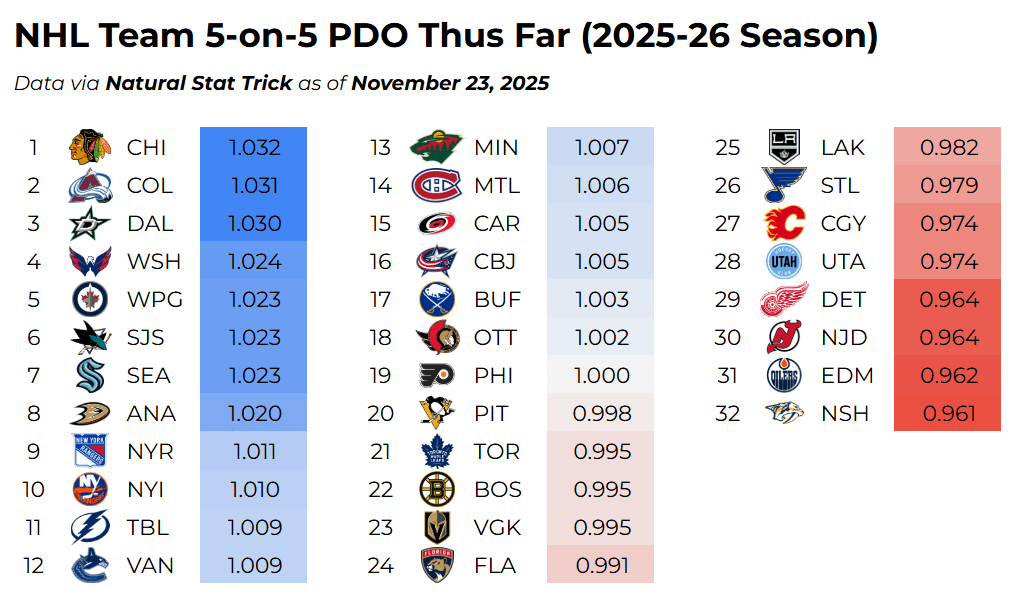
So, how do the teams fare in 2025-26 thus far in terms of PDO? Let’s take a closer look.
Let’s start with the teams that may be overachieving.
At the top of the PDO leaderboard are the Chicago Blackhawks. On paper, it seems that Connor Bedard is developing into the superstar that he was projected to be and is driving his team to be compete for a playoff spot. However, the Blackhawks are at a sky-high shooting percentage of 11.5 percent. For context, there is no team in the 21st century that has posted a shooting percentage above 11 percent for an entire 82-game season. Considering that Chicago has a -51 high-danger chance differential, this is clearly not sustainable whatsoever. Their recent 9-3 loss to the Buffalo Sabres could very well be the start of a major regression.
Now, the Colorado Avalanche are a fascinating case. Unlike the Blackhawks, this is a team with a genuinely talented roster on paper, and they hold a terrific 60 percent high-danger chance differential. It would be unfair to say that their outstanding start to the season is simply due to puck luck. Still, that being said, their PDO of 1.031 will be difficult to sustain. It’s reasonable to say that two things can be true at once; the Avalanche won’t sustain a 0.833 points percentage for the rest of the year, but they are certainly the favourites for the President’s Trophy.
The Washington Capitals are one example of a team that could sustain a high PDO over a large sample. Excluding this season thus far, their shooting percentage of 10.6 percent in 2024-25 was the highest among any team in a single season in the 21st century, and they continue to rock a 10.2 SH% and 1.02 PDO thus far this season. They seem to be one of the outliers to the general rule for PDO as mentioned above. Led by Alex Ovechkin, Washington is a team with outstanding finishing talent. Perhaps one could say the same for the Dallas Stars to somewhat of an extent, as their PDO too was above-average last season (1.019) and they possess various strong shooters like Mikko Rantanen and Wyatt Johnston, though there may still be some slight regression.
However, some teams that you can expect to regress are the Seattle Kraken and Anaheim Ducks. The Kraken currently rank 2nd in the Pacific Division, but they have a team SV% of 0.934, which is highly unlikely to last. The Ducks have certainly obtained a boost from their coaching change this off-season, but they remain heavily out-shot and out-chanced at 5-on-5. While they could absolutely qualify for a wild card spot, it is highly unlikely they finish the season first in the Pacific.
Now, let’s discuss the other end of this leaderboard. It is interesting to see the Red Wings and the Devils quite low on this list. Detroit ranks first in their division, New Jersey ranks second, and yet both teams’ shooting percentage is exceedingly low, just around 7.1 percent. Though the Devils will have to deal with an injury to Jack Hughes, these are highly encouraging signs for them moving forward overall.
The Nashville Predators seem to be the inverse of the Capitals in the sense that their PDO is consistently below expected. It was 0.970 in 2024-25, and it continues to be at a very low 0.962. Even if they do see some regression to the mean, it is likely not enough to help them qualify for a playoff spot.
And of course, there is the Edmonton Oilers, who have been near or at the very bottom of the PDO leaderboard in the first 20 games of each of the past three seasons. For some reason, this team simply seems destined to have a slow start to every season.
Now, there is a caveat here as the Oilers’ underlying numbers, specifically their xG% and high-danger chance are share, are considerably lower than it has been in the past two seasons, even during their poor starts. Their underwhelming start to the season can’t all be attributed to bad luck, as there are areas of their game that need genuine fixes. Nevertheless, there will regression to the mean moving forward, and with the Oilers’ recent win against the Florida Panthers at the end of a long road trip, things seem to be looking up for them.
All-in-all, these are fascinating results. It will be interesting to look back at this at the end of the season.
Find me on Twitter (@NHL_Sid)
ARTICLE PRESENTED BY bet365


Breaking News
- Oilers superfan ‘Mama Stanley’ says she won’t support team after Formenton signing
- Better Lait Than Never: The Oilers sign Alex Formenton and the reaction was exactly as expected
- Oilers bold prediction: An Edmonton goalie scores a goal this season
- Trying to make sense of why the Oilers signed Alex Formenton
- Evan Bouchard’s contract is aging well amid the NHL’s salary cap boom

Edmonton OilersTeam Cap Summary

Cap Summary
2026-27
2027-28
Projected Cap Hit
$102,921,666
$88,322,500
Projected Cap Space
$1,078,334
$25,177,500
Current Cap Space
$1,078,334
$25,177,500
Active Players
23/23
16/23
Draft Picks
Round
'26
'27
1
0
0
2
1
1
3
1
0