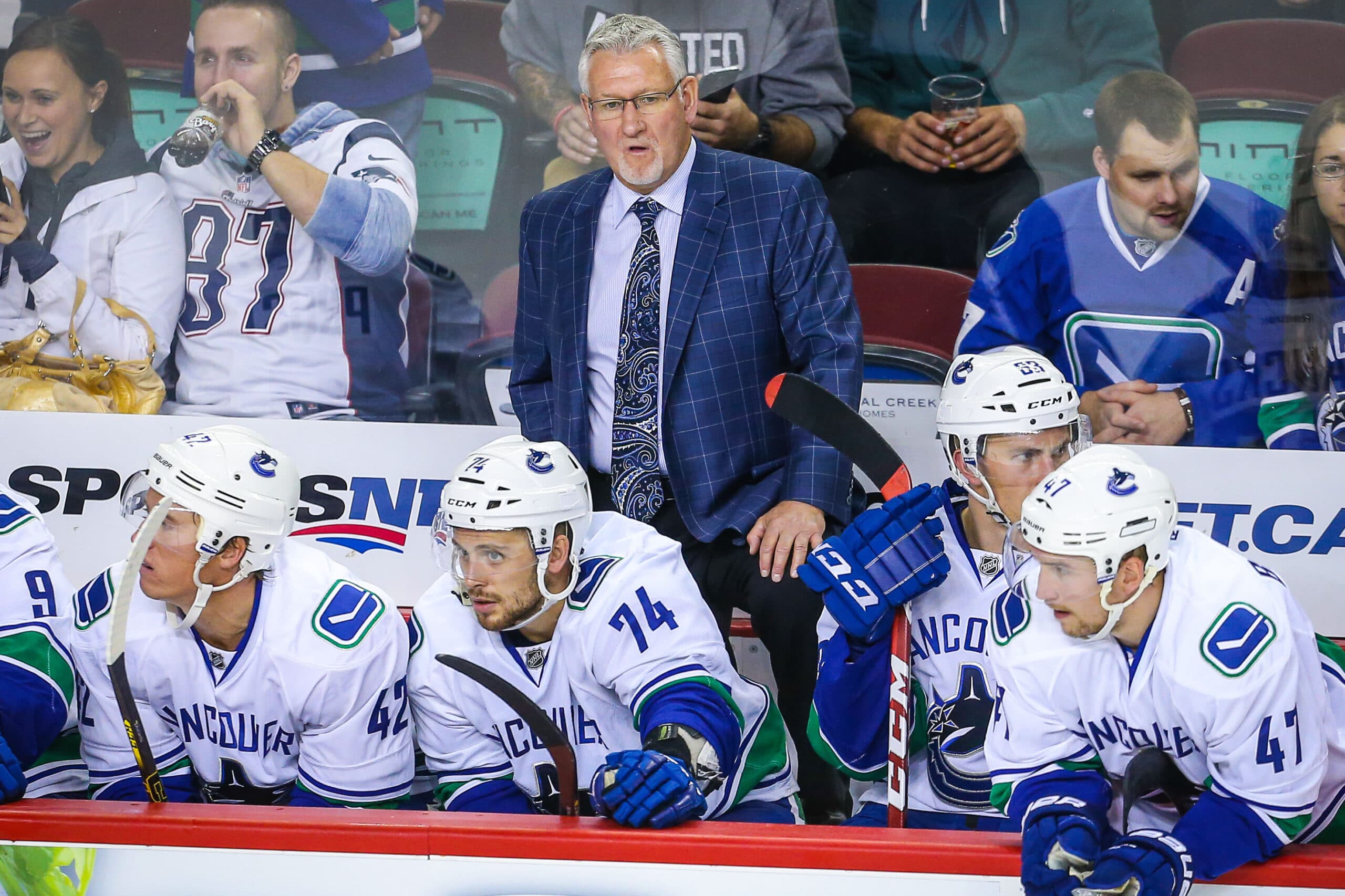
From coaching success at NAIT to the NHL and on the international stage, Perry Pearn has built one of the most impressive coaching résumés in hockey.
The Stettler, AB native coached the NAIT Ooks to five CCAA Championships and, over 14 seasons, compiled a 457-177-24 record, won six ACAC championships, and was named Coach of the Year seven times. He also helped guide Team Canada to four gold medals on the international stage, spent more than 20 seasons as an NHL assistant coach, and has been inducted into four Halls of Fame, including the CCAA Hall of Fame in 2019, among many other honours.
It was during his time coaching at NAIT that Pearn first crossed paths with a young Mike Babcock, who was leading the rival Red Deer College program. Through their battles in the ACAC, the two coaches developed a strong respect for one another that continued throughout their careers.
Oilersnation sat down with Pearn to discuss his early impressions of Babcock, the coaching philosophies that shaped their careers, what Babcock will bring to the Oilers next season, and the story behind Pearn’s renowned 3-on-3 camp, which has been running in Edmonton for nearly three decades.
Q: When you reflect on your coaching career, what do you think have been some of the biggest factors behind your success?
“I think one of the biggest things for me was I had the opportunity to begin my coaching career in Edmonton, having been around the U of A Golden Bears’ program and having gotten to know Clare Drake.
I think Clare was a tremendous influence on me and a number of other coaches who kind of came along at the same time I did, like Ken Hitchcock. I also think he had an effect on Mike Babcock, too. And another coach who was very influential for me was George Kingston.
But I started at NAIT, and it’s the first time I did a job where I felt like a coach. Right away, you look at other successful coaches, and I’ve always felt that no matter where you’re at, you figure out what teams are the best teams, you figure out what they’re doing, and you try to adapt some of that to what you do as a coach.
Back then, I’d made a lot of trips across the river to the U of A to sit down with Clare and ask him questions, and over time, my assistant coach Paul St. Cyr and I started to incorporate some of those teachings, and we started to have success with it.
So when you establish a way of how to play and players buy into it, it’s much easier going forward.
And I think that’s kind of what happened at NAIT. We developed an environment that was conducive to winning and conducive to being successful in school. And one of the things I’m proud of is that a lot of those guys that I coached at NAIT went on and did very, very well for themselves in the business world.”
Q: You mentioned Clare Drake, who was one of the most influential coaches in Canadian hockey history. What is one philosophy, strategy, or lesson you took from him that has influenced your own coaching?
“Well, Clare’s teams always forechecked really hard and competed very hard. But the other thing that Clare did really well was run the special teams.
The penalty kill in particular was something I learned a lot from Clare and tried to adapt a lot of what he did. As time went by and I got into other levels of coaching, my ability with special teams was something that really helped me be successful.”
Q: Mike Babcock, the new head coach of the Oilers, has mentioned you several times in interviews as a coach he looked up to. Can you take us back to when you first met Babcock?
“Mike came to Red Deer College as the head coach, and he was so young. He did a very good job, and we coached against each other. Red Deer had always been one of the powerhouse teams in the ACAC, but he took it right away, did a good job of recruiting, and had a really good group of core players there.
The ACAC was a very competitive league, and there was a rivalry between Red Deer and ourselves. I got to know him by coaching against him, and we’d touch base before games and a lot after games.
One year, they beat us in the ACAC final. But both teams were going to go to the nationals, and there we wound up beating Red Deer in the gold medal game.
From then on, there was a mutual respect. I had respect for the job that he had done at Red Deer, and I think he had respect for what we had accomplished, not just that particular year, but the number of years we had been successful at NAIT.
We just kept in touch over the years. We kept in touch when he went to coach at Moose Jaw in the WHL, and then I was at the University of Lethbridge, and he was at Spokane, and then at the NHL level. Mike and I would hang out at the NHL Drafts.
So, over the years, we got to know each other quite well, and I’ve always felt comfortable reaching out to him. Also, when I coached the Canadian women’s team, I reached out to Mike to see if he’d speak to the team. We had a training camp in Toronto before we went to the World Championships, and that’s when Mike came to speak to them.
He was always very accommodating in terms of helping to grow the game, and in my opinion, he’s always been a very, very good coach.”
Q: When you first started coaching against Babcock, was there something about his approach, whether it was a strategy, tactic, or philosophy, that stood out to you early on?
“There are coaches who can have certain tactics and strategies that aren’t necessarily the best methods and still be a winning coach.
But what becomes most important is earning the buy-in from your players and how hard they compete.
And for me, what stuck out about Mike right away was how hard Red Deer College competed and how hard they worked.
And that clearly was a reflection of the leadership from the coach. He instilled in them that drive to compete every night, and that made them a really, really good team.
I didn’t really think they killed penalties any better than us or that their power play was any better than ours. When it was better, it’s because they out-competed us. Same thing with their forecheck, with their defensive zone coverage — the difference always was the compete level.
Mike did a terrific job right from the start at Red Deer in terms of, you know, instilling a high compete level in that team, and I think that’s the sign of a really good coach.”
Q: Do you recall ever providing Babcock with any advice, tips, or strategies?
“Well, he’s a smart guy, and he’s well-educated. And one of the things he’s really, really good at is seeking out information from other coaches. And so, I know he asked me a lot of questions about things that we did.
And, as I recall, I didn’t mind sharing with him. That continued on from those ACAC days right through his junior days and into the NHL. And I think that was part of his strategy when he hired assistant coaches, too.
He hired guys that I think he felt he might be able to learn something more from.”
Q: You’ve talked a lot about compete level, and I think that’s something the Oilers are trying to establish throughout their lineup consistently. In your opinion, how do you get an entire team to buy into and maintain that level of compete every night?
“Probably the most important thing is, buy-in comes when everybody feels they have an important contribution to make to the team.
I think with the Oilers, sometimes that’s slipped away. So much ice time goes to McDavid and Draisaitl, and some of the third- and fourth-line guys see their ice time drop, and it’s really easy for them to think that they’re not important.
When you look at Carolina in their Cup win, they used their whole bench, and you could tell they had buy-in from all 20 skaters on the ice every night. And I think the way you get to that is your culture. You have to develop a culture where everybody believes they’re important.
I was fortunate when I coached in Ottawa that we played all four lines. We were blessed with some really good players. We had guys like Shaun Van Allen, who was a terrific competitor. He was our fourth-line centreman, but he was one of our best faceoff guys and a good penalty killer. Even if he played 10 minutes a game, he didn’t mind it because he knew he was important. Then, in other games where there were a lot of penalties, he’d play 16 minutes a night.
So, we had buy-in from the first-line centre to the fourth-line centre.
We had some pretty good players, and we had some players that eventually joined the Hockey Hall of Fame, like Marian Hossa, Daniel Alfredsson and Zdeno Chara. But there wasn’t one guy that we had to play 25 minutes a night. Of course, credit goes to the amount of talent we had throughout the lineup.”
Q: You’ve previously coached some of the game’s best players. You mentioned Hossa and Chara, but you’ve also coached players like Paul Kariya and Chris Pronger. When you’re coaching players of that calibre, what is the right approach? Is it about giving them the freedom to play to their strengths and be themselves, or is it about holding them to the same standards and expectations as everyone else?
“I think you have to have a standard that everybody gets held to. Something I tell a lot of times when I’m presenting in a coaching clinic, I explain that when you’re a coach, you’re really a salesman.
You have two things to sell. First of all, you have to sell yourself. And if you sell yourself and people buy into that, then you have the opportunity to sell your ideas.
And with those top guys, they have to believe in you.
And then they’ll buy into the ideas that you’re trying to show them. Guys like Alfredsson and Hossa, they bought in really well. I was really lucky with them. I started coaching them when they were young, and we grew up with each other and developed a good relationship. I felt they respected when I pushed them a little bit.
The guy who was a real challenge was Jaromir Jagr, when I coached him with the Rangers.
Quite honestly, he and I had a really good relationship. Sometimes he would go at me, be mad at me, and I had to stand my ground with him. I remember having an argument with him.
And I can’t remember the exact numbers, but he said to me, ‘How can you tell me how to score on the power play? You’ve never scored a single power-play goal in the NHL.’ Again, I don’t know the exact number, but he said something like, ‘I scored like 260 power-play goals in the NHL!’
And I’d say, ‘The reason I can talk to you about it, Jags, is because I’ve watched 5,000 hours of power-play footage of the best players in the NHL, and I’m giving you ideas based on that.’
He was a pretty smart guy, too. He’d never come across as if he agreed with you in the moment, but he’d go away, come back, and the next time you went through something, you could tell he kind of agreed with some of the things you’d said.”
Q: You’ve coached some of the game’s greatest players throughout your career. With Babcock now coaching elite players like McDavid and Draisaitl, what advice would you give him on getting the most out of players of that calibre?
“Well, I think there has to already be a little bit of buy-in on their part, because I don’t think the team would have hired Mike without having McDavid and Draisaitl on board.
Now, do they 100 percent know what they signed up for? I probably think they don’t 100 percent know. But they both want to win. And certainly Mike does. And I think that’ll be the uniting thing around that whole relationship being able to work.
I think Mike will bring them in as equal partners on how they approach certain things. And there will be a lot of things that are negotiable.
And then there’ll be some things that Mike brings to the table, and he will make it clear to both of them, but also to the rest of the group, that these things aren’t negotiable. These are things that have to happen.
I think he’s a good enough coach that, if he gets that buy-in from the group, they’ll have a chance to be way more successful than they were last season.”
Q: From what you know of Babcock and his coaching style, what qualities do you think make him a good fit for the Edmonton Oilers?
“Well, for lack of a better term, I do think that, in a lot of ways, he’s a bit of a hard-ass.
He’s been successful, he’s won, and he does know what it takes to win. He’s built a philosophy around that.
Anything that’s developed as a negative about Mike hasn’t had anything to do with how his teams were prepared or how they competed. It had to do with other factors.
His biggest challenge moving forward is to keep his interpersonal relationships with everybody around the team going in the right direction.
That’s the challenge in the National Hockey League, because it’s not easy.
I think it may be the biggest problem the Oilers have had — they’ve gone through so many coaches that they’ve never really established a set culture. Ultimately, I think that culture of compete and making everyone feel important is what he could bring to the table.”
Q: I want to shift gears and talk about your 3-on-3 camp. You’ve hosted the camp for several years now, and it has attracted an impressive list of NHLers. Can you tell us a little bit about the camp, how it started, and what inspired you to create it?
“We haven’t started yet this summer, but we run two groups for 3-on-3. We call one our junior group, which is basically U18. And then we have a pro prep group, which is basically major junior, college, and junior A players.
And then, after those two groups are finished, in the middle of August we work with a pro group for two more weeks, finishing on August 28 this year. But going back to the start, it’s kind of interesting. I was at NAIT, and I have a partner, Zane Jacobek. We’ve been together right from the start.
So, we were always looking to do extra things with the program at NAIT, like extra travel, and you had to find ways to raise extra money.
We used to run things like hall parties to raise money, and I can remember a hall party where it’s the end of the night, and you’re trying to get people out of the hall, and you’re cleaning up beers off the table. Somebody picked up a beer that a guy thought was still his beer, and the next thing you know, he’s trying to fight.
And here I am, the head coach of the team, wrestling with guys, throwing them out of halls at 2 a.m. And through the course of the year, I thought, there has to be a better way to raise money.
We always had a great hockey school at NAIT. We ran eight weeks of 3-on-3 skates, three groups a day, different age groups, and we were sold out all the time. But the oldest group we had would have been around a U15 or U16 group.
And so I thought, why don’t we do something conditioning-wise for an older group? So, we started the 3-on-3. And the first time we ran it, we ran, I think, two or three times a week, two groups at NAIT Arena in the evenings in the summer. And it took off.
Some of those early groups had guys like Jarome Iginla, Jason Strudwick, Hnat Domenichelli, Tyson Nash and Sheldon Souray, and so they went through as major junior players.
And so by the time they were going through, we were running two groups, and we changed it a little bit where now we were running in August every day instead of spreading it out over the whole summer.
That first year, we raised about $7,200 for the program.
None of the coaches got paid or anything. But what happened fell on the heels of me getting an opportunity to go to Europe, and I wound up going to Switzerland. But Zane and his son still handled the registrations and took all of the calls for the 3-on-3.
I got back from Switzerland and there had been a new coach at NAIT, and I gave him a rundown of everything. When I got back from Switzerland, Zane called me. He says, ‘What are we going to do about 3-on-3?’
I replied, ‘What do you mean, what are we going to do about 3-on-3?’
He explained, ‘The coach at NAIT is not going to run it.’
And I said, ‘Well, I guess we don’t have to worry about it.’
And Zane responded, ‘Well, what should I tell the 56 people that have already called me about it?’
And from there, we decided to run it. And in that second year, we paid people, and then I think we still gave about $3,000 to NAIT.
And then from then on, we ran it as a business. So now we’re 33 or 34 years later.”
Q: How did you guys go about getting NHLers and other professional players involved in the 3-on-3 camp?
“That initial group, guys like Strudwick and those guys, as they graduated junior and went into pro, they came to me, and they said, ‘What are you going to do for us now that we’re going to be pros?’ I said, ‘Well, I hadn’t thought about that.’
So I went to Jamie McLennan, who ran a skate for the pros at the KC arenas, and asked him if the group of guys would be interested in a pro group. He thought they would, so Jamie helped us get going.
And we got all those young kids that all turned out to be really, really good players at the pro level. And now all of a sudden, we had a pro group, and the program’s been going ever since.”
Q: What do you think are some of the benefits for a hockey player when they play in that 3-on-3 format?
“It draws on one of the most important characteristics that those top-level players have — their competitiveness. It’s very competitive.
We play 3-on-3, half ice, and there are two games going on. At the end of each game, you’d be surprised how, by putting guys in that competitive environment, the juices get ramped up and how hard they work without thinking about it until it’s done.”
Q: Can you think of a time over the years when some really high-profile NHLers really went at it during one of those skates?
“Every Friday we play for the Cup, and we’ve got a Cup that looks a little bit like the Stanley Cup. And if you’re on a winning team, whether you’re in the U14 group or pro group, if you win, your name goes on the cup.
When we first started it, we kept stats and assists, and when we started the pro group, we thought the pros weren’t going to buy into that. They’re going to think this is hokey. But the pros are almost worse than the kids for following stats, or more pissed off if someone misses an assist or a goal. But ultimately, they use it to have fun coming to the rink.
But one battle I remember was with Jarome Iginla and Todd Simpson, who was the captain for the Flames, and they were teammates in Calgary.
Iginla’s team went up against Simpson’s team on a Friday morning. They went at it. It was an absolute war.
I actually was afraid one of them was going to get hurt and be out for the season.
They went at each other, they ran each other, they blocked shots, and all their teammates followed. It was an absolute war. After the game was over — they’re teammates in Calgary, and they were hugging each other because they enjoyed the competition and pushed each other.”
Q: There’s a long list of former Oilers who have attended your 3-on-3 camp, players like Ales Hemsky, Tyler Ennis, Georges Laraque, Fernando Pisani, and Taylor Hall. I also saw that Matt Savoie previously attended. What skills or qualities stood out to you most about Savoie?
“With the Oilers holding their own conditioning camps around the same time as our 3-on-3 camp, we haven’t had Oilers players participate in a couple of years. But Matt Savoie, what stood out? Well, you just said it — his skills. There’s the physical part of skills. But most guys who have high-end skills also have high-end hockey sense.
And that’s definitely what I noticed and what Matt has. He thinks the game very, very well. And he’s not a very big man, but he can compete with the giants in the game and be quite successful, showing it late last season. It’s because he’s a really smart player.
He knows when to be physical and when not to be. He knows when to go and when not to go. He reads the play very well and sees the ice really well, gifted with nice skating ability and a really nice pair of hands. And if he can apply all of his gifts and consistently plays in the top six, I think he could be a 60-point player in the NHL.”
Q: Last question: What does next season hold for you? Where will you be coaching?
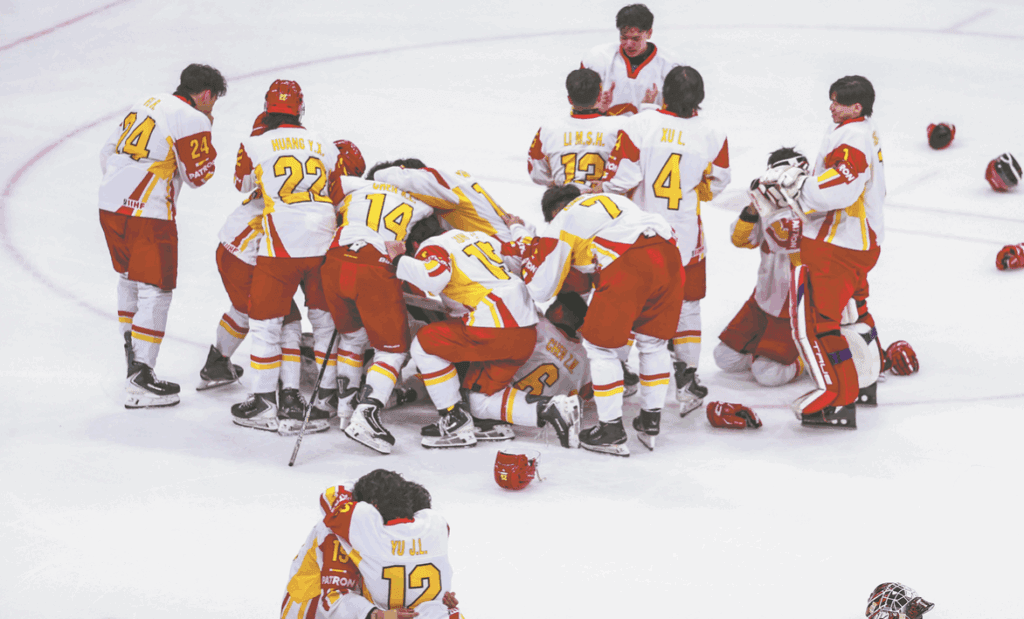
“Over the last couple of years, I’ve coached the Chinese men’s national team. And we had our most successful season last year. We won a silver medal at the World Championships.
And I’ve said this to guys that I’m close to in coaching. I said it to Glen Gulutzan — I’ve coached the women’s national team, I’ve coached in Japan, I’ve coached and been a part of six gold medals at World Championships. And so those things are all pretty neat.
I also feel like I was fairly successful in my NHL career, but seeing where we got with China, from the first day that I went on the ice with them two years ago in the fall to last October, we couldn’t pass the puck.
That first week, I was sitting in my dorm room in China saying to myself, ‘What are you doing here?’
Perry Pearn helped lead Team China’s young stars to a silver medal at the IIHF Men’s World Championship Division I Group B tournament. Photo credit: Xinhua
But I was working with some good people, and we kept going at it. I could see us getting better and better, but to see us win a silver medal the way we did… it might be one of the best coaching jobs I’ve done.
And, you know, the good thing is you’re working with good people, and to see how much joy they got out of being successful like that was pretty special.
So, having done that, they came at me to go back again. So, I made the decision that we’ll try to get it done at least one more time, and then see… maybe after, it’d be time for me to just sit at home and watch TV.”
PRESENTED BY DERRICK DODGE
There’s a new chapter beginning at Derrick Dodge, and the momentum is real. Under new ownership, the dealership is bringing fresh energy, a renewed focus on customer experience, and a bold, forward-thinking approach to vehicle buying. This change marks the start of an exciting new era, built around transparency, trust, and putting customers first. To celebrate this transition, every vehicle purchase comes with a trip for two to Las Vegas. Whether you’re shopping for your next vehicle or simply curious about what’s changed, Derrick Dodge is moving forward with confidence, purpose, and a clear vision for the future.