
OilersNation has no direct affiliation to the Edmonton Oilers, Oilers Entertainment Group, NHL, or NHLPA
Looking at where the Tristan Jarry trade ranks among the worst Oilers deals
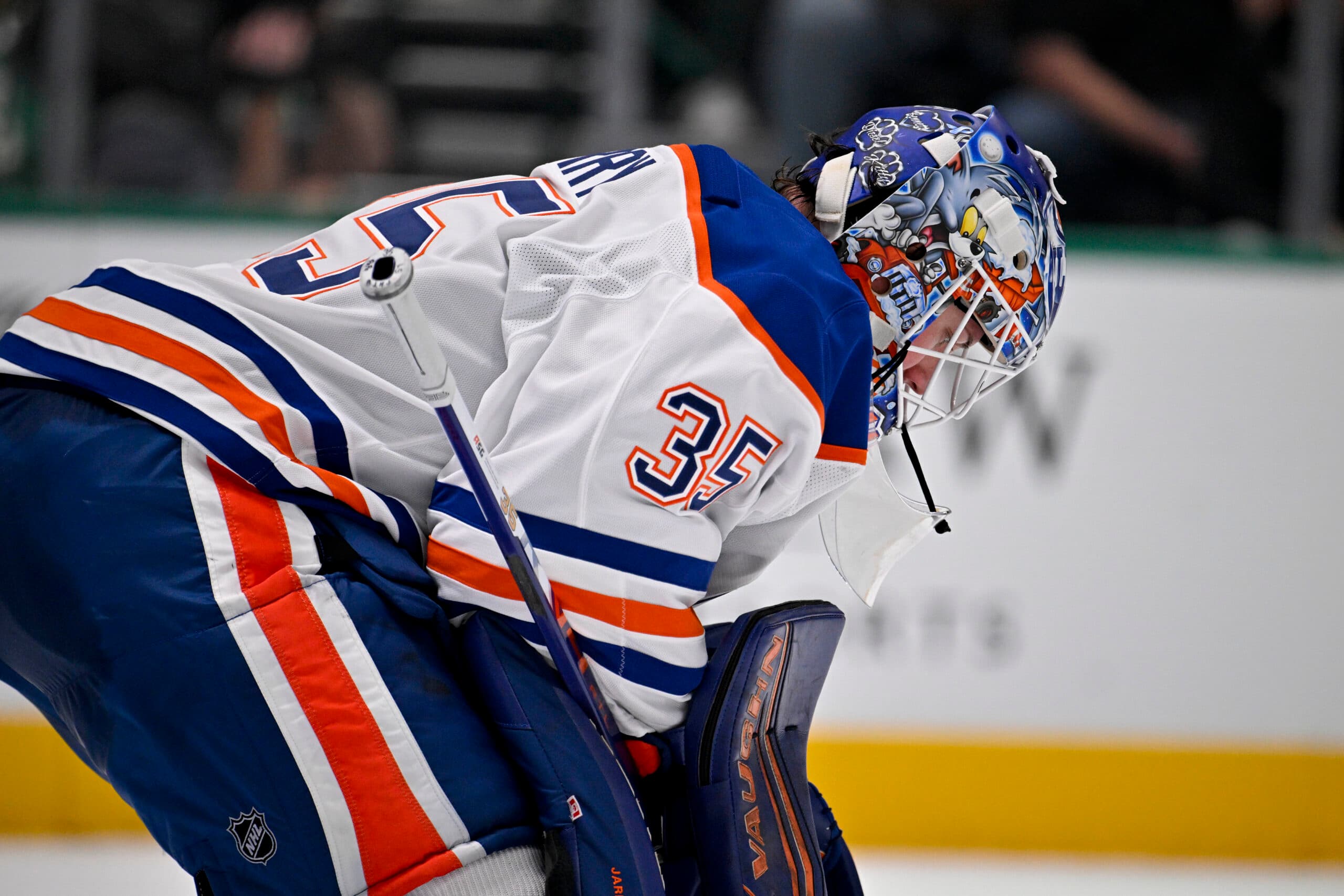
Photo credit: Jerome Miron-Imagn Images

Mar 13, 2026, 11:00 EDTUpdated: Mar 13, 2026, 12:42 EDT
It hasn’t even been three months yet, but the Tristan Jarry trade is already starting to look like it could end up being one of the worst in Edmonton Oilers history.
That may be a bit of a hot take, but Jarry hasn’t performed nearly as well as one would’ve hoped. Over the 13 games he’s appeared in, Jarry has conceded 53 goals on 365 shots, poor enough for an .855 save percentage.
Aside from leaving his third start with an injury, there have been just three instances in which Jarry has finished with a save percentage of .900 or higher, stopping all 31 shots against the Vancouver Canucks on Jan. 17 for a shutout, posting a .900 save percentage on Jan. 26 against the Anaheim Ducks, and Tuesday’s game against the Colorado Avalanche, where he posted a .917 save percentage in relief.
The Oilers have always lacked a goaltender in the Connor McDavid/Leon Draisaitl era, except for the first two or three seasons of Cam Talbot’s tenure early in McDavid’s career. Stuart Skinner showed glimpses of potentially being a successful netminder — look no further than the last two Western Conference Final against the Dallas Stars — but it became increasingly clear he was not going to be the guy.
So on Dec. 12, 2025, the Oilers sent Skinner, Brett Kulak, and a 2029 second-round pick to the Penguins for Jarry and prospect Samuel Poulin. There are a few things that make this trade so bad. For starters, Kulak was flipped by the Penguins, netting Samuel Girard and a 2028 second-round pick.
Another facet of why this trade is so bad is that the Oilers are now stuck with Jarry as their guy. It was a lateral move in goal from the start, but Skinner’s cap hit was at least coming off the books. Instead, they traded for Jarry, who has a cap hit of $5.375 million until the end of the 2027-28 season.
It’s a bad trade, and it was even at the time. But the question is, how does it compare to the other bad trades? And no, I’m not including the Adam Larsson for Taylor Hall deal because I don’t think that’s a bad trade.
Wayne Gretzky trade
Look, if you trade (or, in this case, sell) the best point-getter of all time, it has to be considered an all-time bad trade. On Aug. 9, 1988, the Oilers sent Wayne Gretzky, Mike Krushelnyski, and Marty McSorley to the Los Angeles Kings for a trio of draft picks, Jimmy Carson, Martin Gélinas, and $15 million.
Gélinas went on to have a productive career, while Carson was productive early in his career before fizzling out before he even turned 30. Martin Ručinský was selected with the 1991 first, and he went on to have a productive career, despite playing just two games with the Oilers. Nick Stajduhar, their pick in 1993, only played two NHL games.
The thing is, the Oilers ended up winning the Stanley Cup less than two years after this trade, sweeping Gretzky and the Kings in the second round. Gélinas, still a rookie, chipped in with two goals and five points in 20 games, and went on to play another three seasons after hoisting the Cup.
Gretzky never won the Cup again, with the closest he got being a showdown against the Montréal Canadiens in 1993, the final time a Canadian team won it all. That said, you have to wonder how many more Cups the Oilers would’ve won if Gretzky played his entire career as an Oiler.
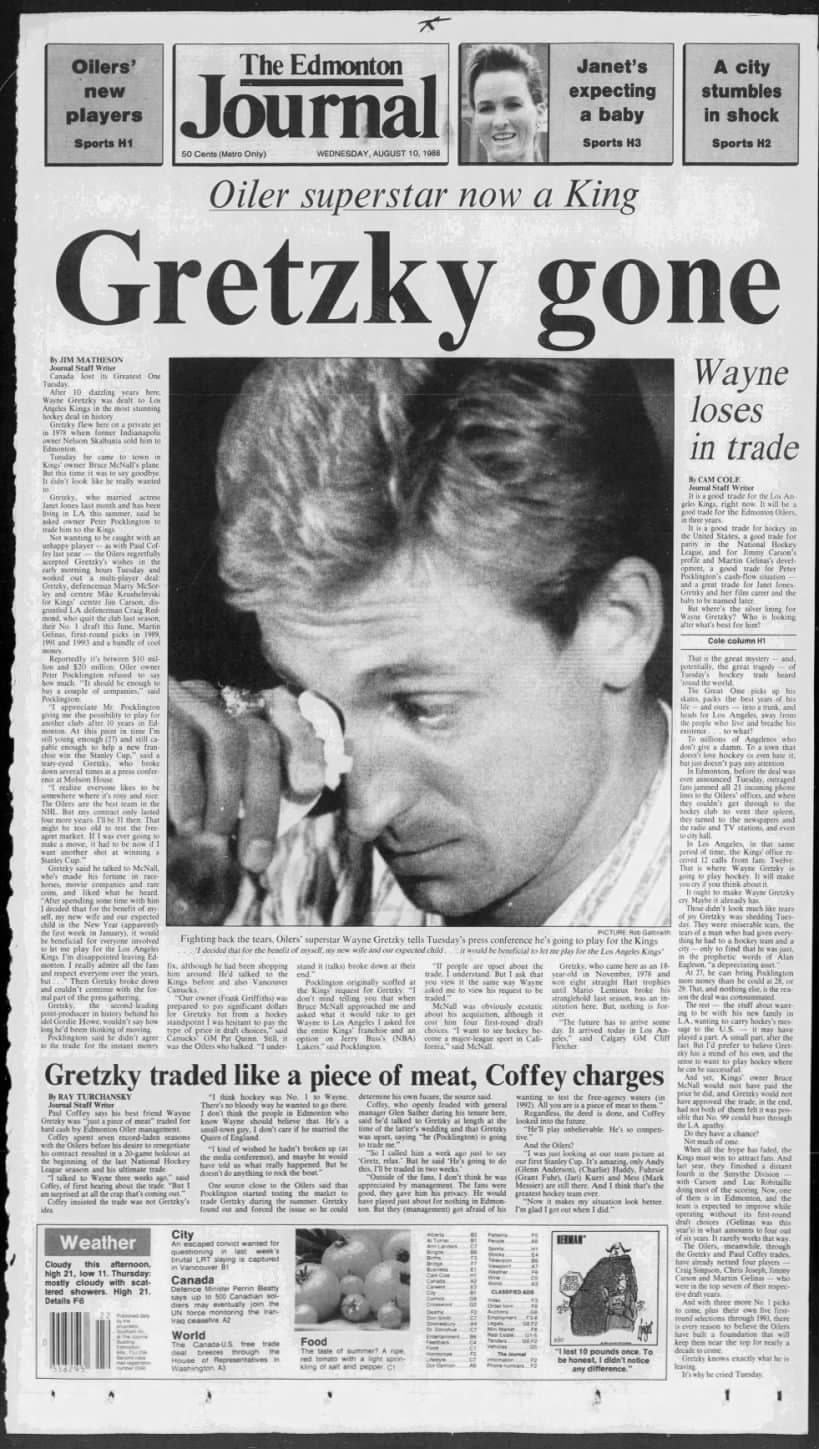
The front page of the Aug. 10, 1988 edition of the Edmonton Journal details the Edmonton Oilers’ trade of Wayne Gretzky to the Los Angeles Kings.
Miroslav Šatan trade
The Gretzky trade is bad, but there were circumstances as to why it happened. The Miroslav Šatan trade is a bad one because the Oilers have continually failed to develop talent.
In the same draft that the Oilers took Stajduhar in the first round, they grabbed the Slovak winger in the fifth round. Playing for four different teams across three leagues in 1994-95, his longest tenure was with the Cape Breton Oilers, where he scored 24 goals and 40 points in 25 games.
The following season, Šatan became a regular for the Oilers, scoring 18 goals and 35 points in 62 games. He followed that up with 17 goals and 28 points in 64 games, but was traded to the Buffalo Sabres on March 18, 1997, for Barrie Moore and Craig Millar. Combined, the pair scored 153 goals, with Šatan doubling that number after the trade. He had a 40-goal season in 1998-99 and four 30-goal seasons.
It’s one of many times the Oilers have given up on a young player.
Death, taxes, Oilers giving up on young players
During the Oilers’ struggles early in the 2023-24 season, Ryan McLeod was held goalless over his first 20 games. His name was coming up in trade rumours as he was seen as a potential trade candidate to clear cap space. At the time, I wrote an article about how the Oilers give up on young players way too easily.
McLeod ended the season with 12 goals and 30 points in 81 games, but that didn’t stop the Oilers from trading him early in the 2024 off-season. Since the trade, he has blossomed with the Buffalo Sabres, scoring 20 goals and 53 points in 79 games, and it looks like he’ll surpass his career-high point total before the end of the season.
This wasn’t a bad trade because the Oilers acquired Matthew Savoie, who has blossomed in his own right in his first NHL season. In 64 games this season, the 22-year-old has 10 goals and 25 points, which is more than McLeod’s nine goals and 21 points in 71 games during his age-22 season.
Sure, McLeod’s current production right now would be great, but he had plenty of opportunity alongside Leon Draisaitl in his Oilers tenure, and the Oilers needed cap space, getting a solid prospect in return. Let’s not talk about what they did with that extra cap space.
That said, the trades in that article are bad. Andrew Cogliano was traded for a 2013 second, which was used to select Marco Roy. Kyle Brodziak was a productive third-line centre, scoring 14 and 11 goals in his final two seasons with the Oilers in his first stint, but was traded for two middle-round picks, with the players selected having seen the NHL. Jason Chimera was also traded by the Oilers, finding success elsewhere, while the players the Oilers selected with the picks didn’t amount to much.
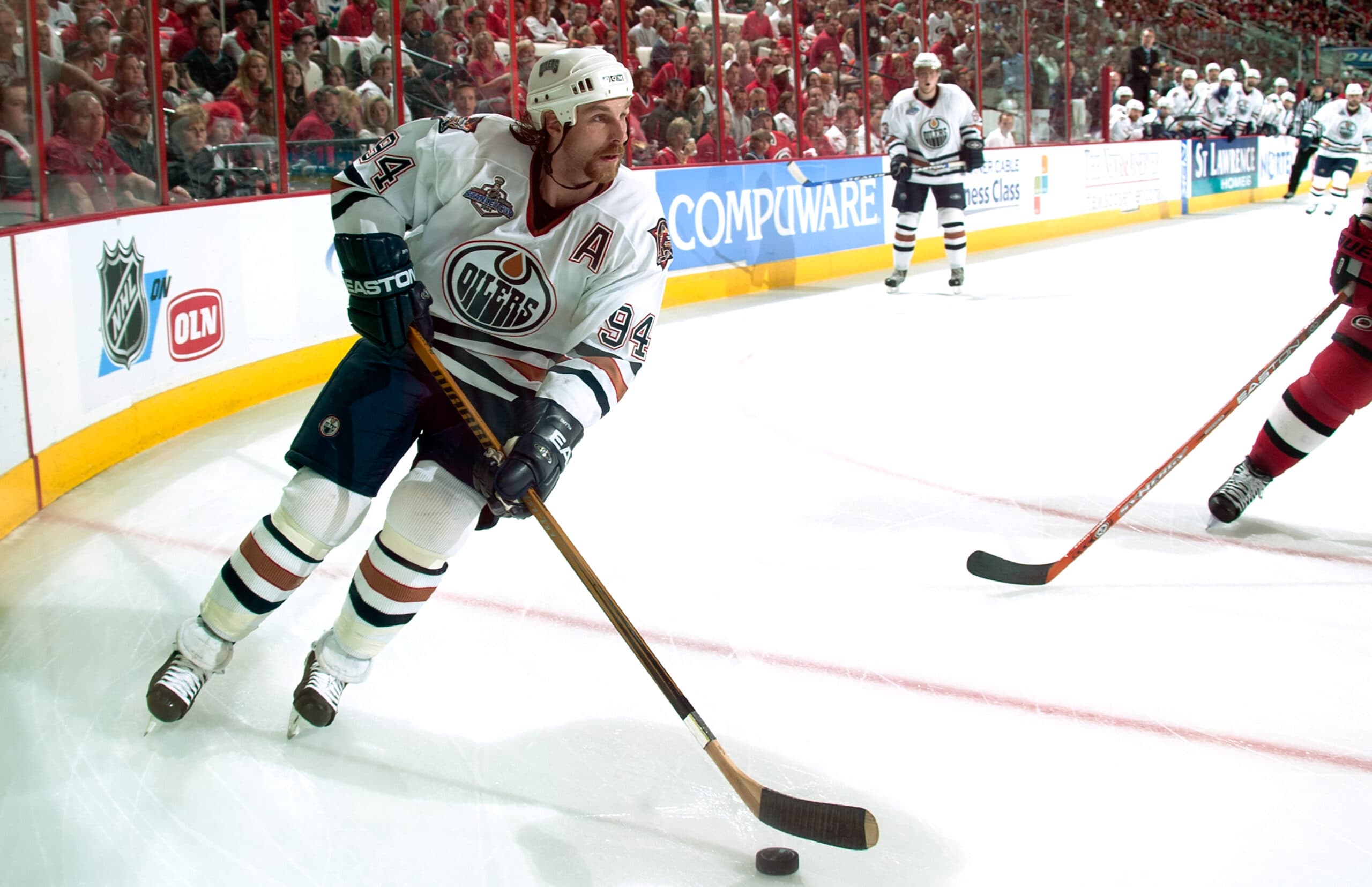 Lou Capozzola-USA TODAY NETWORK
Jun 7, 2006; Raleigh, NC, USA; Edmonton Oilers left wing Ryan Smyth (94) handles the puck against the Carolina Hurricanes during game two of the Stanley Cup Finals at RBC Center. Credit: Lou Capozzola-USA TODAY NETWORK
Ryan Smyth trade
A couple of weeks ago, I wrote about the Ryan Smyth trade for a Flashback Friday, as it was the 19-year anniversary. This trade wasn’t just bad because of what the Oilers got in return, but also because it was a massive gut punch for an Albertan native who should’ve spent his career with the team.
Quick summary of why the trade was a gut punch: Smyth was drafted sixth overall by the Oilers in 1994, and quickly became the heart and soul of the team for longer than a decade. That included a near Stanley Cup victory in 2006. The following season, the Oilers and Smyth couldn’t agree to a contract, being less than a million dollars apat, with the Oilers shipping him off to the New York Islanders. Thankfully, Smyth finished his career with the Oilers in the middle of the Decade of Darkness, but this trade kick-started their long playoff drought.
As for what the Oilers got, they received Robert Nilsson, Ryan O’Marra, and a 2007 first from the Islanders. Nilsson had a few productive seasons with the Oilers, reaching the double-digit goal mark twice and the 40-point mark in 2007-08, but played most of his career in Switzerland. O’Marra played 41 games with the Oilers, scoring a goal and seven points.
As for the pick, the Oilers used it to select right-shot defenceman Alex Plante, who played just 10 NHL games over three seasons. After a season with the Oklahoma City Barons in 2012-13, Plante played in Austria, Norway, and Korea until his retirement following the 2019-20 season.
The Jordan Eberle debacle
The Smyth and Šatan trades had something in common: they were with the New York Islanders. For the third consecutive decade, the Oilers made another dumb trade with the Eastern Conference team, shipping Jordan Eberle to Long Island for Ryan Strome.
As much as I don’t like this for fandom reasons, as Eberle was my favourite player growing up, this trade made some sense. The Oilers were going to be up against the cap, so they moved money out for a young and promising right-shot centre. Eberle had a rough playoff debut, picking up just two assists in 13 games during the 2017 playoffs, but found success with the Islanders and later the Seattle Kraken.
Throughout the Regina product’s career, he’s been a consistent 20-goal scorer and capable of 40-plus points. That’s fine top-six player production and he probably should not have been traded. That said, Strome wasn’t the worst player.
In 2014-15, the Islanders’ fifth overall pick in 2011 scored 17 goals and 50 points in 81 games, but his production waned in his following two seasons. Just like McLeod, he had fine third-line centre production in 2017-18, scoring 13 goals and 34 points in 82 games.
But after a goal and two points in 18 games in 2018-19, the Oilers sent him to the New York Islanders for Ryan Spooner. Strome immediately figured it out, finishing the season with 18 goals and 33 points in 63 games, then scoring a career-high 59 points in 2019-20. He’s since become a consistent double-digit goal scorer, and had 41 points in his last three seasons before 2025-26.
Spooner? Well, he had a 49-point season in 2015-16 with the Boston Bruins, but was held to a goal and two points in 16 games with the Rangers before the trade. Following the trade, he scored twice and picked up an assist in 25 games. After 11 games with the Vancouver Canucks in 2018-19, Spooner departed for Russia, and is currently playing in Switzerland.
Peter Chiarelli’s tenure at the helm of the Oilers did damage that is still felt to this day, and thankfully, he was fired in 2019. He should’ve been fired within months of his hiring, but more on that in the next section.
Anyway, Keith Gretzky took over after the firing, trading a struggling Cam Talbot to the Philadelphia Flyers for Anthony Stolarz. He also moved Spooner to the Canucks for Sam Gagner, a trade that worked out quite well as he scored five goals and 10 points in 25 games after the trade.
Gagner, another one of my favourite players growing up, played 36 games with the Oilers in 2019-20, scoring five goals and 12 points. Before the 2020 trade deadline, also known as the dying days of a normal world before the pandemic, the Oilers sent him, a 2020 second, and a 2021 second to the Detroit Red Wings for Andreas Athanasiou.
While the second in 2020 was used to select Brock Faber, that was after the Red Wings traded the pick to the Kings. That said, Athanasiou played just nine games with the Oilers, scoring a goal and two points before the aforementioned pandemic. He was held pointless in four games against his former team in the bubble playoffs.
The Oilers didn’t extend a qualifying offer, making him an unrestricted free agent and ending a funky trade tree.
 Sergei Belski-USA TODAY Sports
Mar 12, 2016; Edmonton, Alberta, CAN; Edmonton Oilers defenseman Griffin Reinhart (8) skates against the Arizona Coyotes during the third period at Rexall Place. Arizona Coyotes won 4-0. Mandatory Credit: Sergei Belski-Imagn Images
The worst trade of them all
There are a few things Oilers-related that make me irrationally angry: Game 5 of the 2017 second round, how Oscar Klefbom’s career ended, and the 2015 draft.
Sure, the Oilers landed Connor McDavid with the first overall pick, and Chiarelli also did a solid job in the late rounds, drafting Caleb Jones, Ethan Bear, and John Marino in rounds four, five, and six.
But just imagine if they didn’t trade the 16th overall pick and the 33rd overall pick for Griffin Reinhart. Here’s a list of players who were available with the 16th overall pick: Mathew Barzal, Kyle Connor, Thomas Chabot, Joel Eriksson Ek, Brock Boeser, Travis Konecny, and Jack Roslovic.
The Islanders flipped the 33rd overall and another pick to land the 28th overall pick, selecting Anthony Beauvillier, another productive NHLer. In one of the deepest drafts in NHL history, the Oilers decided to trade two high picks for a defenceman who was already considered a bust. Add in the fact that Sebastian Aho was picked 35th overall, and you don’t just have the worst trade in Oilers history, but one of the worst trades in NHL history.
Simply put, one of the biggest reasons Connor McDavid doesn’t have his name on the Stanley Cup can be traced back to this ridiculously stupid trade. Get him a real decision-maker this off-season.
Ryley Delaney is a Nation Network writer for Oilersnation, FlamesNation, and Blue Jays Nation. Follow her on Twitter @Ryley__Delaney.
PRESENTED BY SOUTHVIEW ACURA

At Southview Acura, luxury isn’t just what you drive, it’s how you’re treated. Family owned and operated, we’re proud to offer an exceptional selection of new and certified pre-owned Acuras, backed by a service experience built on trust and precision. Whether it’s your first visit or your next, our team is committed to excellence every step of the way. Visit Southview Acura today or online at www.SouthviewAcura.com, where luxury meets reality.


Breaking News
- Oilers bold prediction: An Edmonton goalie scores a goal this season
- Trying to make sense of why the Oilers signed Alex Formenton
- Evan Bouchard’s contract is aging well amid the NHL’s salary cap boom
- Bowman: Hockey Canada reinstating Formenton played ‘big role’ in Oilers signing
- Oilers bold prediction: Colton Dach becomes an everyday player

Edmonton OilersTeam Cap Summary

Cap Summary
2026-27
2027-28
Projected Cap Hit
$102,071,666
$88,322,500
Projected Cap Space
$1,928,334
$25,177,500
Current Cap Space
$1,928,334
$25,177,500
Active Players
22/23
16/23
Draft Picks
Round
'26
'27
1
0
0
2
1
1
3
1
0