
OilersNation has no direct affiliation to the Edmonton Oilers, Oilers Entertainment Group, NHL, or NHLPA
The Oilers depth players are making meaningful progress
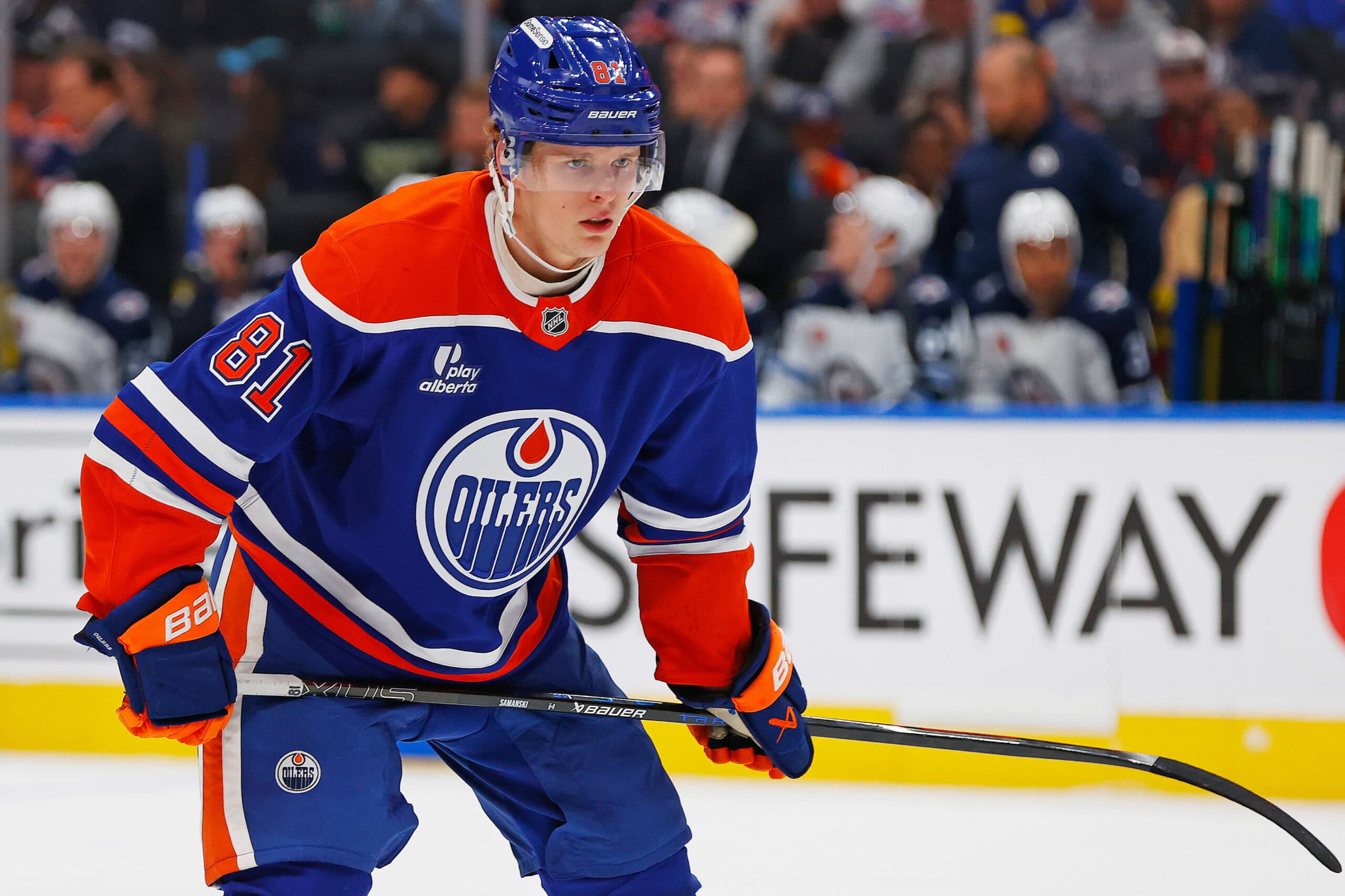
Photo credit: Perry Nelson-Imagn Images

By Lane Golden
Apr 6, 2026, 13:00 EDTUpdated: Apr 6, 2026, 13:30 EDT
The Edmonton Oilers can rely on Connor McDavid to dominate for 22 minutes per night, but that alone isn’t enough to win a Stanley Cup.
It’s whether they can limit the damage in the non-McDavid minutes that ultimately determines their ceiling. For months, depth issues defined their 2025-26 season, but lately, they’ve shown significant progress.
At the Olympic break, the Oilers were a brutal minus-19 without McDavid on the ice. The bottom six cannibalized the gains made by the top of the lineup night in and night out. Since the break, however, they’re nearly breaking even at minus-two despite missing Leon Draisaitl for half of those games.
Their recent improvement isn’t driven by hot goaltending or shooting percentages either. The supporting cast is genuinely controlling play. At five-on-five, their expected goal share without McDavid has climbed from 46 percent before the break to 51 percent. What’s driving this progress? And what’s going to happen when the team gets healthy again, and the lineup gets crowded? Let’s dive in.
System changes
Perhaps the most significant difference between the Oilers now and the group we saw opening night is their tactical adjustments. One switch they made was tempering their aggression on the forecheck. For months, they struggled to defend in transition, so their F3 is now staying above the puck more consistently, which has reduced the odd-man rushes against.
The biggest change they’ve made at 5-on-5, however, is to their breakouts. Earlier in the season, the Oilers’ forwards routinely tried to blow the zone and push the opposing defence back. Their approach proved far too aggressive. It often left defencemen without a short outlet, forcing them to make low-percentage stretch passes under pressure.
The problem was particularly worrying for depth lines, since they weren’t sharing the ice with Edmonton’s best puck-moving defencemen very often. Here’s a perfect example from back in November in a game against the Buffalo Sabres:
At one point in this clip, there isn’t a single Oilers forward in frame. Maybe Bouchard can find a way to snap a puck up ice through all those bodies, but asking your third pairing defencemen to make those plays is a losing proposition.
To fix this, Edmonton’s forwards are staying much lower on breakouts to support the puck. I would like to see them use the middle of the ice more, because a hard forecheck can kill breakouts when the wingers are low along the boards. Still, the new system is reducing catastrophic turnovers, especially for the bottom six.
Trade acquisitions
The Oilers attempted to address their defensive flaws in the lower half of their lineup by acquiring Jason Dickinson and Connor Murphy from the Chicago Blackhawks before the trade deadline. So far, they’ve made a positive impact.
While Dickinson has had the ice tilted against him most nights, that is partly a function of his role. He has the highest time-on-ice percentage against elite competition and the lowest offensive zone start percentage of any Oiler forward this season. The coaching staff is leaning heavily on Dickinson to be a matchup forward. We haven’t seen his best yet, but the veteran centre is at least limiting the damage by keeping the game low-event and freeing up easier deployment for other lines.
Murphy has arguably been the best fit from Edmonton’s trade acquisitions so far this season. He plays a physical, positionally responsible game and brings calm and simplicity to the second pair alongside Darnell Nurse.
He’s a minus-three at 5-on-5 so far with the Oilers, but the underlying numbers suggest there could be better days ahead. He plays over 85 percent of his minutes without McDavid, and in those minutes, the Oilers have an encouraging 51 percent share of expected goals.
Dickinson and Murphy are slightly losing their minutes, but the Oilers will take that over what they got from the bottom six previously. Before their arrival, forwards like Henrique, Janmark, and Frederic were only mustering around a 30 percent goal share, and Alec Regula didn’t even reach a 25 percent goal share on the Nurse pair. Those results are more reminiscent of a 90s expansion team than a Cup contender. The reality is, the new guys aren’t providing much offensive juice, but they are doing the defensive heavy lifting without leaking goals against. For this group, that’s a meaningful improvement.
Recent callups and player performance
The new guys have certainly played a role, but some of the depth players who were already in the organization are winning their minutes lately. Midseason callups, Josh Samanski and Max Jones, have been a pleasant surprise. Jones’ tenacious forechecking and net-front presence is leading to more possession time and goal scoring. Over the last two months, he ranks sixth among Oilers’ forwards in 5-on-5 points per hour and first in expected goal share.
With Samanski, the Oilers have an interesting prospect. There’s not much flash to his game, but his two-way play is impressive for his age. He consistently wins board battles and rarely gets caught out of position, making him a compelling candidate to be an everyday bottom-six centre.
Underperforming veterans like Frederic and Henrique have also slowly turned their games around. They’re still somewhat snake-bitten when it comes to finishing, but their underlying numbers have improved leaps and bounds since the first half of the season. If they can start to turn some of their chances into goals, the Oilers might do more than just break even in the non-McDavid minutes. Hopefully, Henrique’s recent breakaway goal against the Blackhawks is the start of a breakthrough.
Another factor that shouldn’t be overlooked is Jake Walman’s improved play next to Ty Emberson on the third pair. Walman was the leakiest defensive player on the team throughout most of this season, and even his puck-moving wasn’t up to his usual standard. Injuries were clearly impacting his play, but he looks healthy again, and his game is building closer to what we saw last season, when he dominated lower-lineup competition.
What will happen when Draisaitl returns?
Draisaitl is likely to miss the rest of the regular season, but when he returns, it will force the Oilers to make some tough decisions. Podkolzin and Dickinson are locks for the top nine, and Kapanen likely is too, given his chemistry with Podkolzin.
Come playoff time, the fourth line will be some combination of Henrique, Frederic, Samanski, Jones, and Lazar. All of them are playing reasonably well right now, but given Henrique’s impact on the penalty kill, he has the biggest edge to stay in the lineup. With the investment the Oilers made in Frederic, I would be surprised if he gets a scratch as well.
Regardless of who the coaches end up scratching, too many useful options in the bottom six is a good problem to have. It’s a luxury the Oilers haven’t had for most of this season.
PRESENTED BY SOUTHVIEW ACURA

At Southview Acura, luxury isn’t just what you drive, it’s how you’re treated. Family owned and operated, we’re proud to offer an exceptional selection of new and certified pre-owned Acuras, backed by a service experience built on trust and precision. Whether it’s your first visit or your next, our team is committed to excellence every step of the way. Visit Southview Acura today or online at www.SouthviewAcura.com, where luxury meets reality.


Breaking News
- Better Lait Than Never: Give me some Oilers news please
- Oilers from the past: One-quarter of HOPE, Magnus Pääjärvi, joins old friend in Sweden
- Former Oilers prospect Matvei Petrov signs two-year KHL deal
- Draisaitl 4th-best in EA Sports rankings, Bouchard sixth among defencemen
- Ryan Nugent-Hopkins set to break Oilers franchise record this season

Edmonton OilersTeam Cap Summary

Cap Summary
2026-27
2027-28
Projected Cap Hit
$99,274,166
$87,350,000
Projected Cap Space
$4,725,834
$26,150,000
Current Cap Space
$4,725,834
$26,150,000
Active Players
23/23
15/23
Draft Picks
Round
'26
'27
1
0
0
2
1
1
3
1
0