
OilersNation has no direct affiliation to the Edmonton Oilers, Oilers Entertainment Group, NHL, or NHLPA
What should the Oilers’ forward lines look like with a healthy roster?
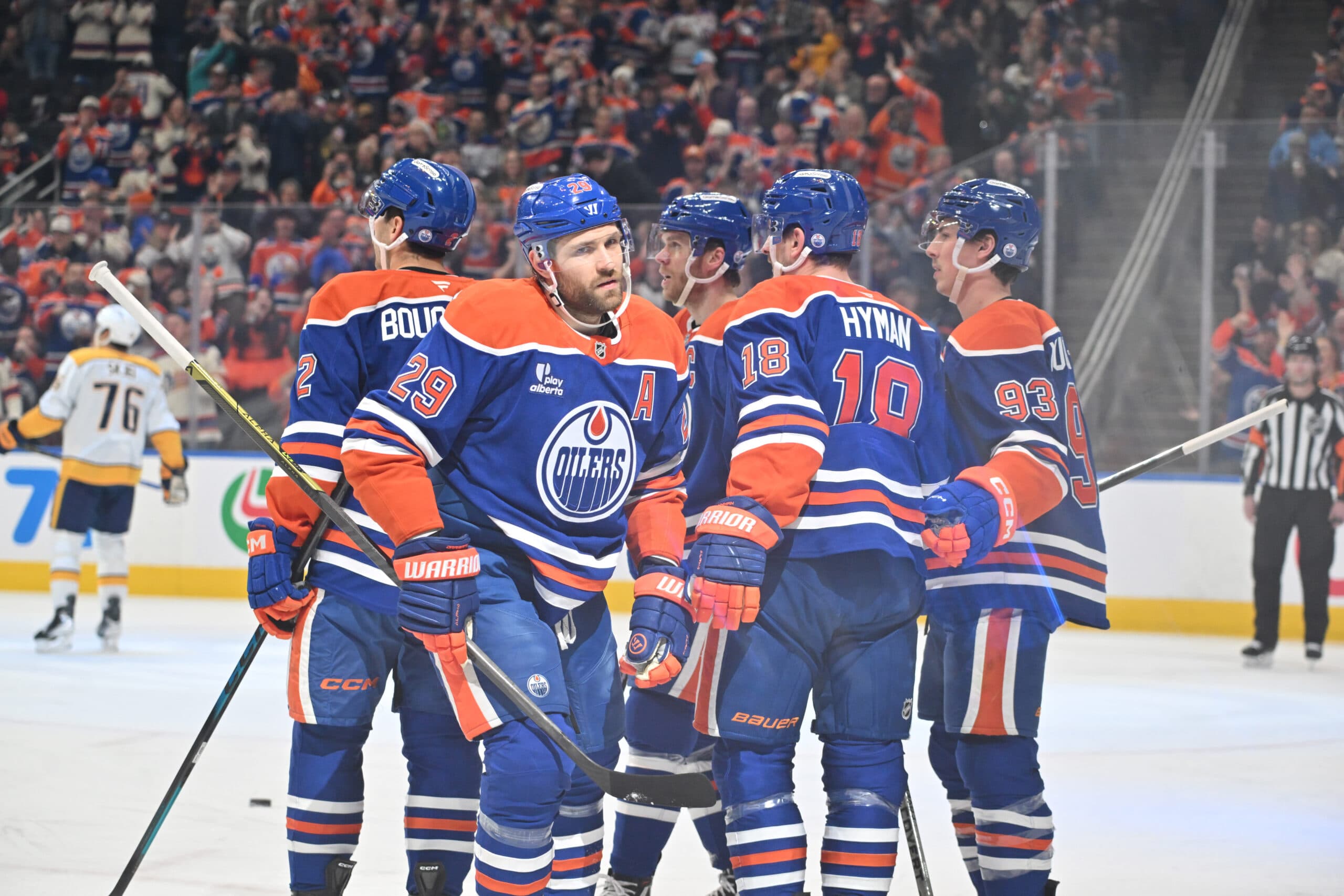
Photo credit: © Walter Tychnowicz-Imagn Images

With five wins in their past six games, the Edmonton Oilers are beginning to look much more like the team that reached the Stanley Cup Final in back‑to‑back seasons, and they have accomplished much of it in Leon Draisaitl’s absence.
Still, with the playoffs only a few weeks away, several questions remain. Chief among them is how Edmonton’s coaching staff should structure the forward group once the roster is fully healthy.
Draisaitl’s return will obviously reshape the top-six, and the recent surge from the team’s depth forwards has created genuine competition for playing time. As a result, the coaching staff suddenly has some difficult decisions to make about who should play and who shouldn’t.
Let’s take a closer look at the data and determine which line combinations would be most optimal.
*All stats via Natural Stat Trick
The first line
Though there are many possible lineup combinations one could reasonably argue for with this roster, there is one pairing that I believe should remain untouched: the duo of Connor McDavid and Matt Savoie.
Since the beginning of the new year, McDavid and Savoie have been operating at a fantastic 64 percent goal share and 59 percent expected goal share. Overall, Savoie has been outstanding since the Olympic break, producing 14 points in 18 games over that span. With his speed, skill, and intelligence, he has been an excellent fit alongside Edmonton’s captain, and I believe it would be a terrible mistake to split those two up and disrupt the chemistry they have built.
The real question, then, is who should flank McDavid’s other wing.
With Edmonton’s recent success since Draisaitl’s injury, some have suggested that it may be a more viable option to load up the first line with McDavid and Draisaitl now. I certainly understand the appeal, as with the way that Savoie is currently playing, a top line of Draisaitl – McDavid – Savoie would be a force to reckon with in the offensive zone.
However, loading up McDavid and Draisaitl is incredibly contingent on the success of the second line without Draisaitl, and I am extremely wary about those chances in the playoffs.
At first glance, it may seem that the Hyman – RNH – Roslovic line appears to be thriving. In the minutes they have played, they boast an 80 percent goal share (4-1). However, that success is heavily inflated by an unsustainably high 13 percent on-ice shooting percentage and 0.962 on-ice save percentage that simply will not hold over a larger sample. Overall, they possess a brutal 40 percent expected goal differential, with high-danger chances at 14 to 8 in favour of the opposition when this line is on-ice.
The broader issue is that, over the past five seasons, there is very little evidence to suggest that it is optimal to deploy Nugent‑Hopkins as a second‑line centre. His results have consistently been stronger either on the wing or in the minutes that he has played at 3C. And so, although loading up the top-line with Draisaitl, McDavid and Savoie is tempting, it would simply make the team far too top-heavy, as has always been the case for this team when playing their two superstars together at five-on-five.
All things considered, the (non-Draisaitl) forward with the best results and the most minutes played next to McDavid in recent history is Zach Hyman.
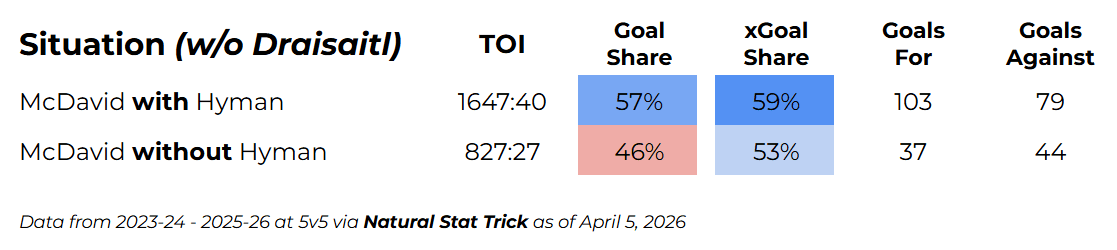
The two have played over 2000 minutes in the past four seasons, and have consistently dominated both goals and scoring chances. They have been even better together in the playoffs. Without Hyman on his wing, McDavid has seen a sharp decline in expected and particularly actual goal share.
Taking all of this into account, the data strongly suggests that the ideal top-line is Hyman – McDavid – Savoie.
The middle-six
I often like lineups centred around “duos” with proven success. Just as the Oilers have strong “duos” on the top-line with McDavid-Hyman and now McDavid-Savoie, they also possess a strong pairing on the second-line: Leon Draisaitl and Vasily Podkolzin.
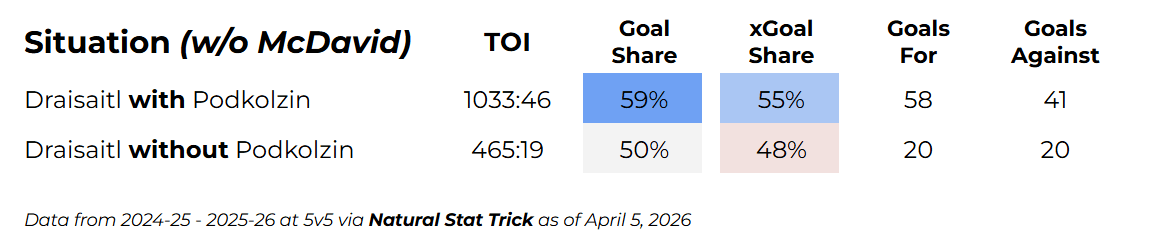
In over 1000 minutes together in the past two seasons, Draisaitl and Podkolzin have controlled nearly 60 percent of the goals at five‑on‑five. Remove Podkolzin, and that second line drops to merely a dead-even goal share. Though one may point out that the trio of Podkolzin – McDavid – Savoie had some solid results in Draisaitl’s absence, I am very hesitant to split up the Draisaitl – Podkolzin duo, given their results. Again, for me, the real question is who the other winger should be.
A variety of right-wingers have had success to varying degrees with Draisaitl and Podkolzin, including Savoie, though for the reasons mentioned earlier, I would prefer to keep Savoie next to McDavid.
On paper, Jack Roslovic should be a good fit with Draisaitl and Podkolzin. On this line, Draisaitl is the main offensive play-maker, Podkolzin can be the forechecker/puck retriever, while Roslovic can shoot the puck; in fact, he is the team leader in five-on-five goals per hour this season, ahead of each of McDavid, Draisaitl and Hyman. However, in the 193 minutes that the trio of Podkolzin – Draisaitl – Roslovic have played together, they have been out-scored (48 percent goal share) and thoroughly out-chanced (39 percent high-danger chance share). The sample isn’t huge, and perhaps giving them another look wouldn’t be unreasonable, but the current data is not in favour of that option.
The option that intrigues me more is having Kasperi Kapanen as 2RW while Roslovic shifts to the third line. There are two compelling reasons for this.
First, the line of Podkolzin – Draisaitl – Kapanen have out-scored opponents 12 to 3 (80 percent goal share) in 141 minutes. Of course, the sample is not great, and the on-ice shooting percentage is unsustainably high, but their expected goal share remains a solid 52 percent, and their numbers in limited minutes in 2024-25 were similarly strong (59 xG%). Considering Draisaitl’s ability to elevate his linemates and the fact that he has consistently performed best when playing next to tenacious, speedy players (Kailer Yamamoto in 2019-20, Warren Foegele in 2022-24, Podkolzin, etc.), perhaps the chemistry here with Kapanen is legitimate. Kapanen also had some key moments in the 2025 playoffs, including his series-winning goal against the Vegas Golden Knights in round two.
Second, this option creates a more balanced lineup when the guy who leads your team in five-on-five goals per hour is on the third line. Roslovic won’t be expected to drive the third line alone either; with Podkolzin and Kapanen on Draisaitl’s wings, Ryan Nugent-Hopkins also naturally shifts down to the third line. And, perhaps the two could be centred by Jason Dickinson, the shutdown defensive centre who has led Chicago and leads Edmonton (so far) in TOI% against elite competition.
I cannot think of many third lines in the NHL superior to and more well-rounded than a potential trio of RNH – Dickinson – Roslovic. Of course, the success of this top-nine is heavily dependent on Draisaitl’s ability to elevate Kapanen on the second line, but if he can, and several indicators suggest he can, this shapes up as an ideal middle‑six.
The fourth line
There are (at least) six more players with a case to play on Edmonton’s fourth line. Here are their metrics this season with Edmonton thus far:
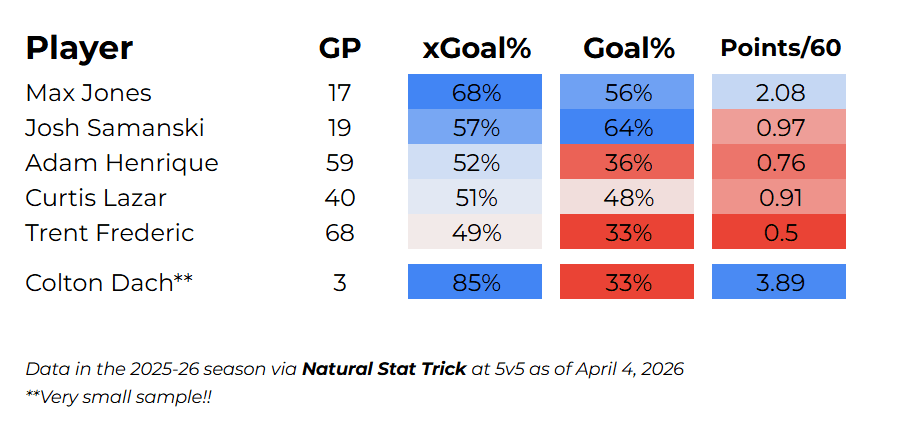
Among this group, the player that I am most fond of is young Josh Samanski. So far, he has proven to be a terrific defensive player in a bottom-six NHL role, with both his goal and expected goal share ranking extremely well. This is an incredibly smart player in his own zone, one who could be incredibly useful in the playoffs.
Furthermore, Max Jones has been a pleasant surprise. Through 17 games thus far, his underlying numbers are excellent, and he’s even chipped in a couple of goals. On merit and recent play alone, both Samanski and Jones should absolutely be in the lineup.
Curtis Lazar has also been a very solid defensive fourth-liner. Earlier in the season, he was the only bottom‑six forward above 50 percent in expected‑goal share. Given that Roslovic and RNH increase the offensive capacity of the third line, a defensively-oriented fourth line of Jones – Samanski – Lazar would be a strong idea in my mind.
Adam Henrique, meanwhile, has greatly struggled this season, holding an abysmal 36 percent goal share. At age 36, his lack of speed has been greatly evident. That being said, his play has been better since the new year, and his goals-against suppression rates in each of the past two postseasons are strong. There is still a case for him to play in the lineup, albeit rather weak in my mind.
As for Trent Frederic, his results have simply not been good enough. Perhaps he’s been (relatively) better since the Olympic break, but by every important offensive and defensive metric, he does not rank as a top-12 forward on this roster. Now, playoff hockey can produce unlikely heroes, and given Frederic’s history of stronger play in Boston, perhaps there is potential for this. But, as of now, unless there is a drop in Jones’ or Lazar’s play, I see minimal reason to play Frederic in the lineup.
Colton Dach is a bit of a wildcard. His results in Chicago were poor, but he was a young player on a struggling team, and in his brief three‑game stint with Edmonton, he showed some encouraging flashes before getting hurt. This is a player who could also bring more physicality and forechecking. I think he absolutely deserves a greater chance to demonstrate what he can do.
Of course, the forward lines won’t remain static, as players will rotate in and out based on performance and matchups. Henrique, Frederic, and Dach all have cases to draw in, particularly Dach if the team wants to see more of what he can offer. But, based on merit right now, the trio that should be in the lineup is Samanski, Jones, and Lazar.
Final Thoughts
Taking everything into account, my ideal forward lines with a fully healthy roster would look like this:
Hyman – McDavid – Savoie
Podkolzin – Draisaitl – Kapanen
Nugent-Hopkins – Dickinson – Roslovic
Jones – Samanski – Lazar
Of course, the keyword here is “ideal,” as I am not sure if Kris Knoblauch and the coaches agree. Realistically, I would assume that given his veteran status and experience, the coaching staff is much more fond of Henrique than I am, and perhaps Frederic too.
There is also a decent chance that Knoblauch either winds up loading the top-line with McDavid and Draisaitl, or shifts Savoie down the lineup in favour of reuniting RNH – McDavid – Hyman, the most frequently played line during his tenure in Edmonton.
Ultimately, we’ll soon see what the coaching staff decides.
Find me on Twitter (@NHL_Sid)


Breaking News
- Wall Street filing proposes first Edmonton Oilers-tied ETF in league-wide index
- ‘This is utter nonsense’: Gamers react to McDavid’s 99 overall rating on EA’s NHL
- 31 Oilers Questions: Which offseason acquisition will have the greatest impact on the Oilers?
- McDavid becomes first player in EA Sports NHL’s ’99 Club’
- Oilers from the past: Nail Yakupov becomes a champion

Edmonton OilersTeam Cap Summary
Cap Summary
2026-27
2027-28
Projected Cap Hit
$99,274,166
$87,350,000
Projected Cap Space
$4,725,834
$26,150,000
Current Cap Space
$4,725,834
$26,150,000
Active Players
23/23
15/23
Draft Picks
Round
'26
'27
1
0
0
2
1
1
3
1
0