
OilersNation has no direct affiliation to the Edmonton Oilers, Oilers Entertainment Group, NHL, or NHLPA
Why NHL fans should ignore giveaway and takeaway stats
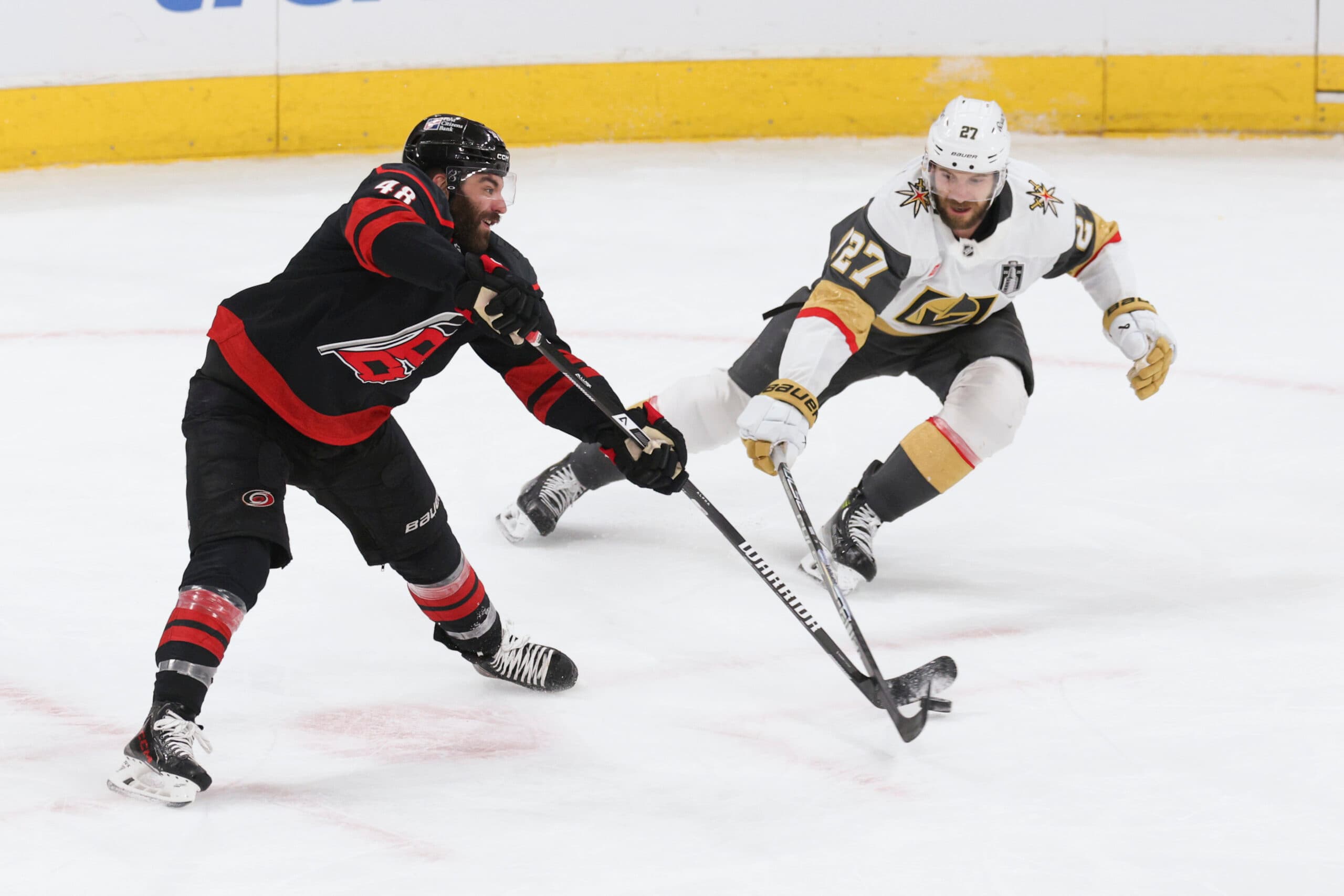
Photo credit: © Nathan Ray Seebeck-Imagn Images

NHL teams and private analytics companies track an enormous range of detailed, event‑level data, such as zone entries, zone exits, puck retrievals, blocked passes, and far more. These sorts of metrics are what we can call “microstats,” which help us understand how and why a player or team achieves their given macro-level results.
Inside NHL front offices, microstats are now common tools used to assist in decision‑making, especially as the league as a whole embraces analytics more and more. Unfortunately for us, however, the NHL does not provide us with a large variety of microstats. Most of the microstats that teams rely on simply aren’t available to fans and media.
Two of the few public metrics that do qualify as microstats are giveaways and takeaways, which have been available since the 1997-98 season.
On paper, these metrics seem incredibly useful. The NHL defines a giveaway as “a form of turnover where the player makes an unforced error,” and a takeaway as “a form of turnover in which the player takes the puck from the opposition.” In theory, giveaways should help us measure a player’s puck management and their ability to complete successful passes, while takeaways could be used to measure a player’s forechecking, entry defending, and cycle-busting ability depending on the zone in which it occurred.
If you’ve followed the league long enough, you’ve probably seen these numbers used at least occasionally in public analysis, and perhaps even frequently in discussions regarding a player’s defensive ability due to the lack of alternative defensive microstats available.
However, I believe these stats are deeply flawed. There are multiple issues involving how the NHL currently tracks giveaways and takeaways, issues so significant that I would make the claim that these metrics should hold little-to-no value at all when it comes to analysis. These flaws are simply too large and fundamental to dismiss.
Without further ado, here is a deep dive into the NHL’s giveaway and takeaway stats, and why you should not use them.
Reason 1: Many, if not most, turnovers are often not tracked
For this article, I decided to rewatch the first period of Game 2 of the 2026 Stanley Cup final and manually track turnovers myself. Specifically, I tracked which player lost possession, the opposing player who gained it, and the overall context of the play. Note that zone clears and dump-ins were not tracked as turnovers.
The aim of this exercise was to get a clearer sense of how the NHL actually tracks giveaways and takeaways, and to see whether they’re missing plays, something my own intuition has suggested for years given how unusually low these totals often appear. I wanted to test that suspicion directly, and what better sample to use than a Stanley Cup final game?
Here are the results:
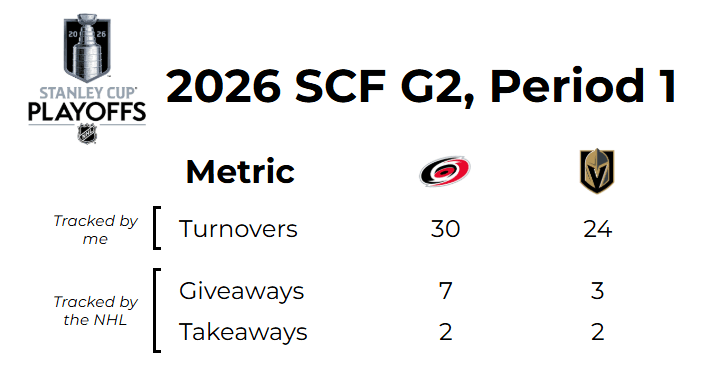
Now, human error exists, and this can particularly be the case in such a high-paced game like hockey. I was certainly not expecting my results to be precisely the same as the NHL’s. There may be plays where I may have missed or made an error on, and the scorekeeper for the game would probably want to say the same.
Still, this is a massive difference. I counted 30 turnovers for Carolina and 24 for Vegas, while the NHL scorekeepers counted just 9 for Carolina and 5 for Vegas. Even allowing for some human error on both sides, that gap is just far too large to dismiss as simple noise.
So, to properly assess what’s truly going on here, let’s take a look at the actual video and walk through plays where I assessed a turnover but the NHL did not.
The first play here starts with a dump-in by Vegas. Sebastian Aho (CAR #20) retrieves the dump-in and passes it to Shayne Gostisbehere (CAR #4), who tries to flip the puck out of the zone, but Cole Smith (VGK #22) knocks down the attempt and Vegas consequently spends about 20 seconds in the offensive-zone. This was a clear turnover in my eyes, as I assessed Gostisbehere a giveaway and Smith a takeaway.
However, the NHL assessed nothing on the play at all.
The next play also begins with a Vegas dump-in. Jalen Chatfield (CAR #5) retrieves the loose puck, but his exit attempt is knocked down by Jeremy Lauzon (VGK #5) who gets a shot attempt on the play. Again, I tracked a turnover, and again, the NHL did not.
On this sequence above, I track two turnovers, one by Chatfield at 7:12 and one very clear one by Noah Hanifin (VGK #15) at 6:54, but yet again, the NHL decides to record nothing here.
Take a minute to watch this next sequence on Vegas’ power-play and track how many turnovers occurred yourself. I personally counted three separate turnovers on this play: one by Mark Stone (VGK #61) at 1:51, one by Pavel Dorofeyev (VGK #16) at 1:39, and one by Mitch Marner (VGK #93) at 1:08.
Want to know how many giveaways or takeaways the NHL assessed on this clip? You guessed it: zero!
Perhaps the NHL scorekeepers are only attempting to track the most “glaring” turnovers. However, not only is this highly subjective – I would personally say most of the missed turnovers above are quite evident – and unspecified anywhere publicly, there are numerous plays which are highly similar, but tracked entirely differently. For example, take a look below.
The first play here is a failed zone entry by Nikolaj Ehlers (CAR #27). The NHL officially credited Shea Theodore (VGK #27) for a takeaway on this play. The second play is a similar failed zone entry by Dorofeyev, but nothing was assessed at all. These plays are functionally and nearly identical, but by some completely arbitrary decision by the scorekeeper, only one was tracked as a turnover.
Take a look at one more sequence below.
On this sequence, I counted a total of four turnovers: an offensive-zone turnover by Marner at 10:56, a failed exit by Taylor Hall (CAR #71) at 10:52, a failed zone entry by Jackson Blake (CAR #53) at 10:40, and a failed entry by Lauzon at 10:34.
So officially, how many giveaways or takeaways were officially tracked on this play? Yet again, the answer is exactly zero.
I could go on and on here for quite some time, because there are multiple other missed turnovers I noted as well, but I think you get the point. And take note that all of this is just from the first period alone. How many missed turnovers are there over an entire game? What about an entire playoff series? An entire season?
This is far from a new phenomenon, or something that is only unique for this game. It seems that the NHL’s giveaway and takeaway stat has been erroneously tracked for quite some time, perhaps even since its inception.
For example, here’s a video clip by JFreshHockey showing more examples of missed giveaways all the way back from 2020. Though this is my first time writing a detailed article on the subject, I myself have noted this for quite some time watching Edmonton Oilers games, here is a brief Twitter thread I made back in 2023 noting even more examples of missed turnovers during the Oilers’ second-round series against the Golden Knights.
Hockey is a fast game, and I wouldn’t blame scorekeepers for missing some turnovers here and there. It is bound to happen. But the amount of turnovers that go unrecorded is simply far too much, and as a result, it makes the provided dataset fundamentally unreliable and incomplete.
Reason 2: The subjectivity in determining if a play is a “giveaway” or a “takeaway”
Even when the NHL does record a turnover, the way they classify it is a problem in itself.
On any given recorded turnover, the league will assign either a giveaway or a takeaway (almost never both). But deciding which label to use is inherently subjective. How do you objectively and fairly decide if a given turnover should be a “giveaway” or a “takeaway?”
In theory, perhaps an “unforced” turnover, such as an errant pass with no opposition forecheck pressure, can be labelled as a “giveaway,” while an opposition forechecker directly stealing a puck is a “takeaway.” But in practice, there are two fundamental issues.
Firstly, most plays are not so black-and-white. For example, take a look at the video clip below.
Brayden McNabb (VGK #3) has the puck in the defensive-zone corner and attempts to pass it out, but under forecheck pressure from Andrei Svechnikov (CAR #37), he turns it over and Chatfield intercepts it along the walls. I would not definitively say this is an “unforced” turnover, as there is both a forechecker applying pressure and a defenceman pinching to keep it in. Still, the NHL officially tracked the play as a “giveaway” by McNabb.
Watch this next video, which is a combination of two separate clips. The first clip is recorded as a giveaway by Logan Stankoven (CAR #22) after Colton Sissons (VGK #10) intercepts his pass. The second clip is recorded as a takeaway by Marner after Hall turns it over. In my eyes, both plays are extremely similar, but officially, they are tracked completely differently. You can make the case that either play deserves to be a “giveaway” or “takeaway.”
Secondly, even if you could, somehow, accurately label each turnover as a giveaway or a takeaway, it is still important information to know which player was in position to intercept a technically unforced pass, and which player could not handle the forecheck pressure and gave up the puck.
Take this next example. This play is officially recorded as a takeaway by Marner, which makes sense, as he directly applies pressure on Svechnikov and swiftly steals the puck. Still, even with the pressure by Marner, this is a careless breakout attempt by Svechnikov, and knowing that he turned the puck over is analytically valuable. Yet Svechnikov was credited with zero giveaways in the period, which simply doesn’t reflect his actual puck‑management performance.
What’s incredibly frustrating here is that the solution to this issue is actually quite straightforward: simply record both a giveaway and a takeaway for every turnover. Track the player that gave up the puck and the player that consequently took possession. This results in more information and is much more objective, as no arbitrary decision is required.
Instead, the NHL has stuck to a subjective, binary system that forces scorekeepers to make interpretive decisions on plays that often don’t fit either category cleanly. Two people could track the same game, and end up with wildly different totals. This subjectivity alone makes giveaways and takeaways unusable for any serious analysis.
Reason 3: Arena bias
Tying into the previous reason regarding subjectivity, there is the issue of arena bias. Different home arenas can often track more or fewer giveaways and takeaways compared to others.
Over the past two seasons, the team with the fewest takeaways in the NHL is the Tampa Bay Lightning. This certainly does not pass the smell test, as the Lightning have consistently been one of the league’s most aggressive teams throughout all three zones, particularly in terms of offensive-zone forechecking. I don’t know if they should be the best team in that regard, but I am quite confident they should not be dead-last. It’s worth noting that the Lightning are also near the bottom of the league in giveaways, implying a clear pattern that much fewer giveaways and takeaways seem to be tracked at the Amalie Arena.
Conversely, the Chicago Blackhawks, who have ranked second-last in the NHL over each of the past two seasons, are third in the league over that span in takeaways. Now, I’m obviously not expecting a one-to-one correlation between takeaways and team success, but the point is, it’s difficult to believe that one of the NHL’s weakest teams is somehow elite at creating turnovers. If somehow true, it certainly does not seem to show up in their results whatsoever.
As an example of an individual player, take Chicago’s Ryan Donato, who has played over 1000 minutes at both home and on the road over the past two seasons. His takeaways per 60 rank 46th in the league at home. But on the road, it goes all the way down to 459th. Now either Chicago’s home crowd is magically turning Donato into one of the league’s best forecheckers, or there is clearly something fishy with the data.
With all of that in mind, there are theoretical ways to work around this. For one, you could look only at a player’s road numbers, which avoids home‑rink bias. However, that would mean throwing out half a season of data, which is certainly unideal. Alternatively, you could build an advanced “arena‑adjusted” statistical model to correct for rink effects, similar to what exists for shot‑based metrics. Nevertheless, this remains a critical flaw in the raw totals that are currently used.
Reason 4: The fundamental problem with raw giveaways
Let’s say that giveaways and takeaways were perfectly and accurately tracked, whatever you think that looks like. In this scenario, I would be someone that would find significant value in takeaways. Still, I would not be an avid fan of raw giveaways.
To illustrate why, consider this hypothetical scenario. Say that in a given period, Player A has 8 successful passes and 2 giveaways, while Player B has 1 successful pass and 1 giveaway.
If you looked only at giveaways, you would see that Player A has 2, while Player B has 1. Based on this information alone, one could come to the conclusion that Player B is a superior puck-mover. But the reality is that this is not the case at all, as we are missing crucial information that Player A had a much higher success rate with their passes.
This is an exaggerated example, but the point is, players who play the puck more will naturally commit more turnovers. Raw totals punish puck‑dominant players and reward players who simply don’t handle the puck as much. As a result, simple giveaways are an unfair metric. It would be much more fair to use a metric such as giveaway-to-successful-pass ratio or percent of total puck touches that result in a giveaway; the latter stat is actually often used by private stat companies.
This is a good time to mention Evan Bouchard. On the one hand, Bouchard’s volume of turnovers is not exactly flattering. However, a big reason it may seem like he turns the puck over often is simply that he has the puck on his stick a lot. In fact, per Mike Kelly, the director of analytics at the private company SportLogIQ who occasionally shares snippets of proprietary data, Bouchard’s turnover rate relative to puck possession ranks 14th-best in the league!
So, that’s one more thing to keep in mind with these stats. For giveaways to be a fair stat, it would need some sort of adjustment for puck possession, which is something that we are unable to do with public data.
Final thoughts
This is a topic that I have been meaning to analyze for quite some time, and with the Oilers’ early playoff exit, I found some extra time to dive into it. As a brief TLDR, the NHL’s giveaway and takeaway stats suffer from fundamental, structural flaws in how they’re defined, recorded, and interpreted. As they currently exist, they should not be used for any serious form of player evaluation or analysis.
Still, that does not mean all hope is lost for us public nerds in this regard.
One resource that I highly recommend checking out is Corey Sznajder’s AllThreeZones project. For over a decade, Corey has been manually tracking microstats for thousands of NHL games, such as zone entries, zone exits, and much more. Here is an example of Connor McDavid’s player card using his tracked data:
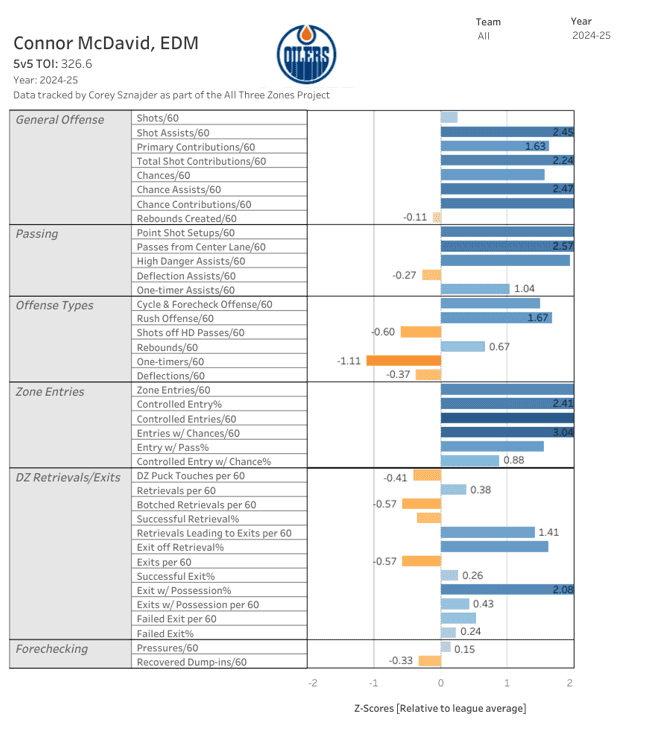
Corey does not track every single turnover. However, he does track whether zone entries, zone exits, and defensive‑zone retrievals are successful or failed, which gives an excellent picture of a player’s puck‑management and movement ability, the very things raw giveaway totals attempt to capture. He also tracks forecheck pressures and entry denials, which overlap significantly with takeaways. His data requires a subscription, but in my opinion, it’s well worth it.
I also recommend following people that have access to private data and occasionally tweet snippets of it, like Mike Kelly and Stephen Valliquette. They obviously will not post full datasets, but the glimpses they provide into proprietary metrics remain incredibly insightful.
Hopefully, the NHL will eventually overhaul its public data, not only by fixing how giveaways and takeaways are tracked, but also providing the kinds of granular microstats that many teams use today.
Find me on Twitter (@NHL_Sid)
ARTICLE PRESENTED BY bet365


Breaking News
- NHL Notebook: Canucks sign Buium to eight-year, $9.38 million AAV extension
- The Oilers have found success in giving people a second chance
- Oilers 2026 Prospect Countdown No. 9: William Nicholl
- Bowman: Babcock pushed for the Oilers to hire Misha Donskov as coaching consultant
- Champions learn how to win: Have the Edmonton Oilers?

Edmonton OilersTeam Cap Summary

Cap Summary
2026-27
2027-28
Projected Cap Hit
$102,071,666
$88,322,500
Projected Cap Space
$1,928,334
$25,177,500
Current Cap Space
$1,928,334
$25,177,500
Active Players
22/23
16/23
Draft Picks
Round
'26
'27
1
0
0
2
1
1
3
1
0